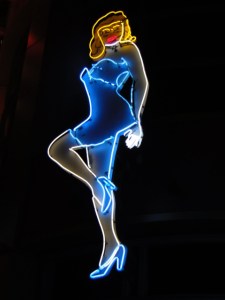
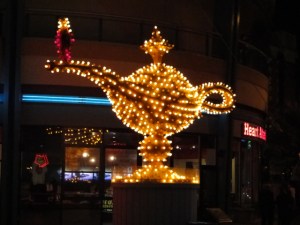
People have been staring at neon sign’s ever since French inventor George Claude sold Packard Motor Cars the first two in the early 1920’s. Yet it’s in America’s Las Vegas of the 1940’s–1950’s that the neon sign came of age as an artistic medium.
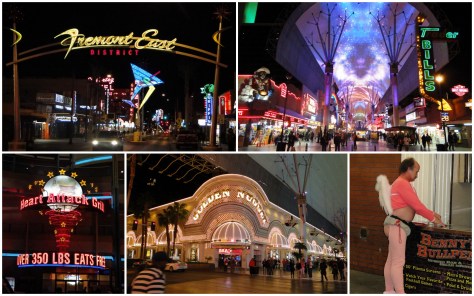
Although most of the millions of annual visitors roam the Strip with its larger-than-life tropical islands, fountains and canals, it’s in the original Vegas downtown that nostalgia reigns – still titillating but on a human scale.
The centerpiece of this revival of interest and effort in neon preservation has been the commercial success of the Fremont Street Experience. The corner of Fremont & Main is the 1905 birthplace of Las Vegas so it’s appropriate that Fremont Street should anchor the revival of “downtown.” For several blocks it’s covered like a European market yet a pulsing high-tech Las Vegas one of restored icons, such as the legendary El Cortez and Golden Nugget hotels, penny casinos, live bands, buskers, fried Twinkies and neon lights.
The mission of the Las Vegas Neon Museum, founded in 1996, is to preserve early signs from now defunct businesses as works of public/commercial art.
In a city both American and international Las Vegas is fittingly ablaze each evening with the inventive genius of a Frenchman.
From post-revolutionary obscurity, the once ancient kingdom of Champasak is at the center of southern Laos’ eco-tourism incentive.
On Don Khone, the Siphandon, Champasak Province, Laos
Cheap airfares, especially from Australia, and even cheaper cost of living attracted budget seekers of alternative vacations in the early 1990’s to the sleepy isolated islands of the Siphandon.
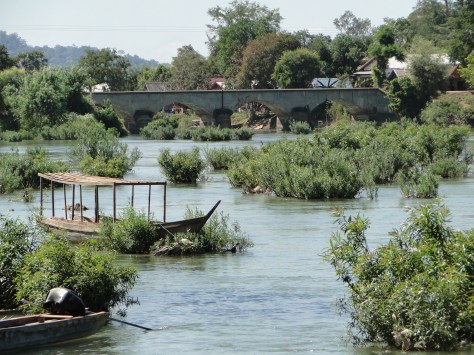
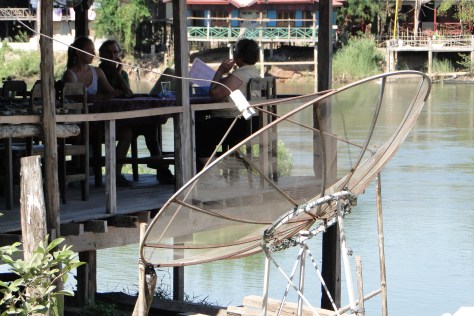
The Siphandon (4,000 Islands), from Don Khong, Champasak Province, Laos
Just 25 miles from the Cambodian border, Laos’ Mekong spreads up to 8 miles wide creating a delta-like region, the Siphandon, sheltering human and wildlife.
Hotel Senesothxeune and the Siphandon
Don Deth and Don Khone epitomize the Western vision of a tropical existence, sleeping in a hammock with mosquito netting, playing the guitar at night, picking fruit and spending as little money as possible.
Purple sticky rice: this nutty deep purple variety of Laos’ ubiquitous grain is usually reserved for desserts. Although a festive addition to dinner and delicious even when not sweetened, I was reminded of my favorite recipe for Purple Sticky Rice in Coconut Sauce.
varieties of sticky rice
You can read about all these topics in my latest articles on Suite101:
Four cities, three countries, four restaurants serving superior food, providing community training and accepting reservations – you’ll need one.
Place setting at Koto, Hanoi, VietnamCarrot cake at Koto, Hanoi, Vietnam
Koto, Hanoi, Vietnam (Know One, Teach One), founded in 1996 by Australian Vietnamese Jimmy Pham, has set the standard for grassroots not-for-profit restaurant ventures.
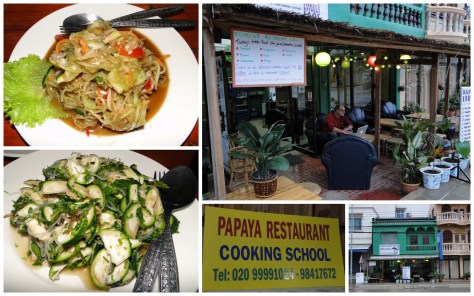
Forest Refuge & Papaya Cafe, Luang Namtha, Laos
Trekking first brought Karen and Andrej Brummer from New Zealand to Luang Namtha, just like nearly all visitors. Yet they soon felt a desire to remain and do something: Forest Refuge Bamboo Lounge.
Cabbages & Condoms Restaurant, Bangkok, Thailand, is famous, amusing and serious. Where else in Southeast Asia will there be a condom decorated Christmas Tree.
I tried to dine at Makphet three times during two trips to the Laotian capital of Vientiane. Given the hype about this must-go-to restaurant, I was pleased that the experience was worth the wait.
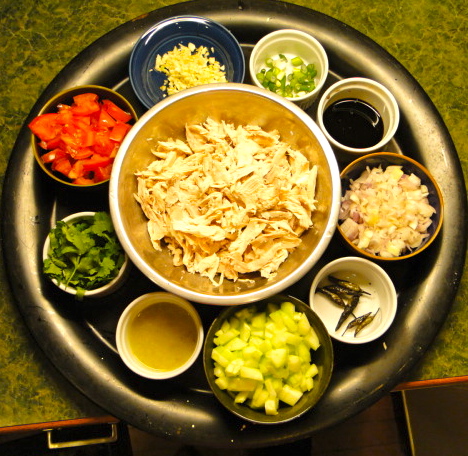
Ingredients for Yum Khi Tom
A classic recipe, Yum Kai Tom incorporates all the basics that elevate Laos cuisine to a food experience.
Interior of Dibuk Restaurant, Phuket Town, Thailand
For the best bistro (far) east of Paris, try Dibuk Restaurant, old Phuket Town, Phuket Island, Thailand – no joke.












 Travel with Pen and Palate
You must be logged in to post a comment.