The Three Reincarnations of Vientiane

Modern Laos - old and new

The baritone sounds of the giant drums resonate calling monks to prayer. Soft chanting can be heard in the stillness of pre-dawn. In the near pitch blackness dozens of men and women jog, walk and exercise on modern machines one sees in any American gym except these are free and in the park. In front of the Vientiane Times, men are stacking rolls of the daily newspaper on their motor bikes for delivery. French bakeries are opening for business. There is barely a car in sight on the streets at 6:00 AM. The air is still cool and moist before the sun raises the winter temperature to 90 degrees (F) by midday. Welcome to the reincarnated city of Vientiane, capital of the Lao People’s Democratic Republic
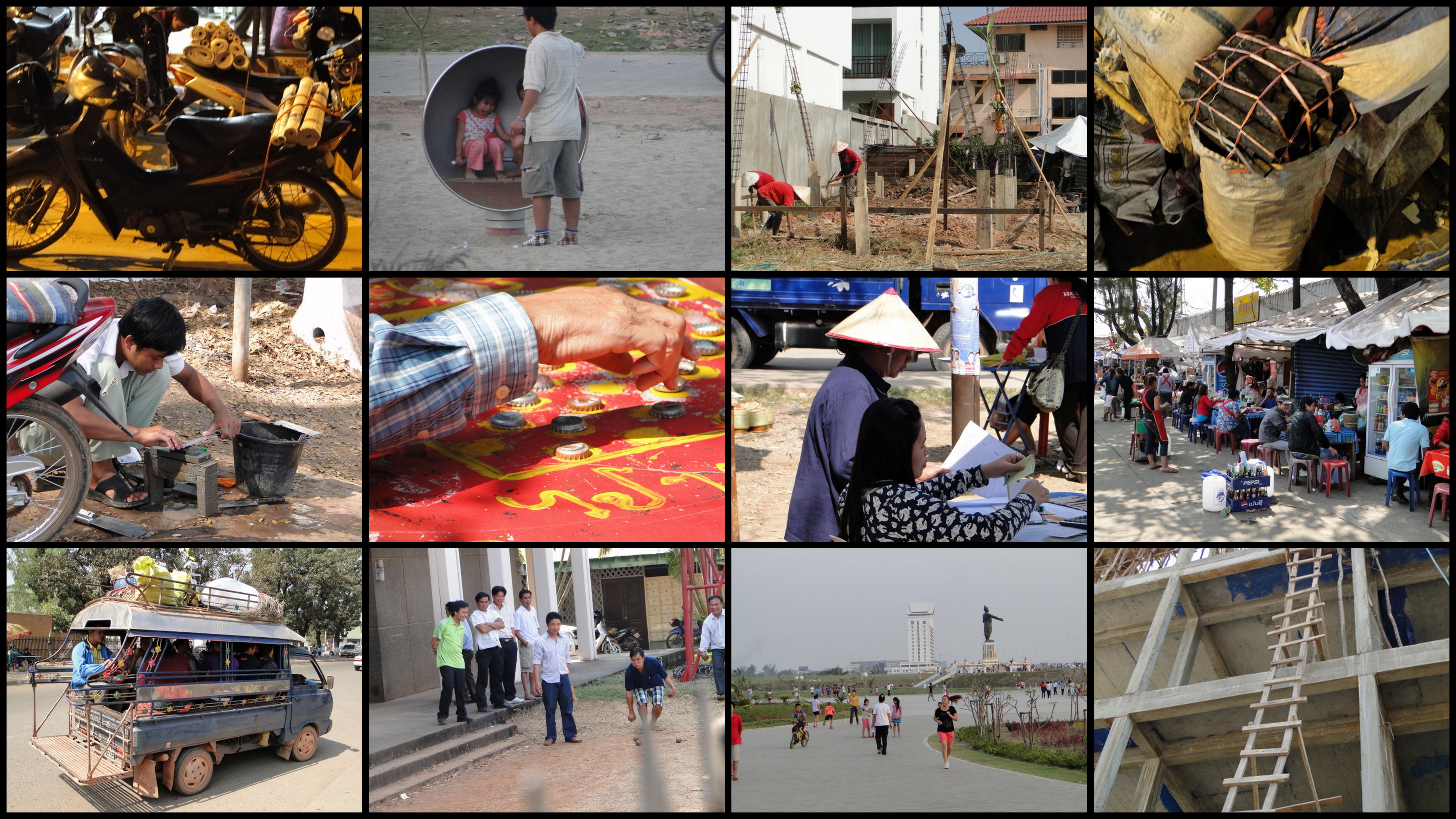


everyday life: fresh charcoal, knife sharpeners, bottle cap checkers, tuk-tuk cab, bocci ball and bamboo construction ladders


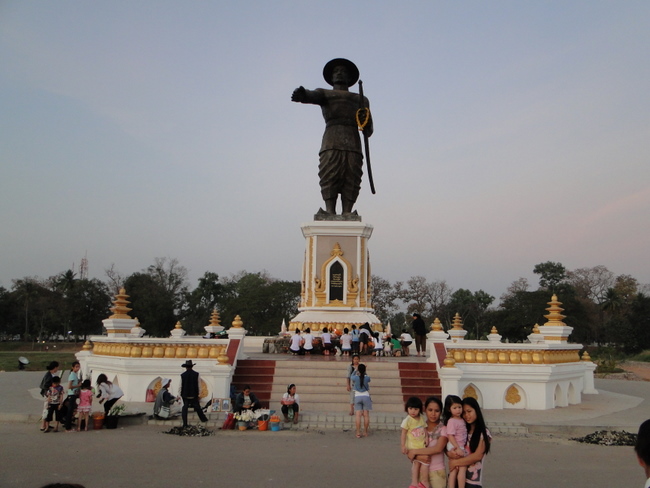
martyred Prince Anouvong (King Chaiya Sethathirath V: 1767 – 1829) last ruler of the Kingdoms of Vientiane and Lan Xang.

On the South Korean financed and constructed 2.5 mile long Mekong River Promenade/flood control wall (completion by 2013) stands the largest political monument in Laos – a Pathet Lao leader? A vitriolic monument to Western imperialism? No…it’s a memorial to an early 19th century national hero, the martyred Prince Anouvong (King Chaiya Sethathirath V: 1767 – 1829) last ruler of the Kingdoms of Vientiane and Lan Xang.  He led a failed war against their enemy, Siam (the Kingdom of Thailand) who had occupied Vientiane, and he died in captivity.

a small sample of Buddhist Wats in Vientaine (bottom center) prayer at That Dam - the revered centuries old Black Stupa - (bottom right) sticky rice offering on a protective naga (snake)

After 400 years as the on-again/off-again capital of the Kingdom of Lan Xang (Land of a Million Elephants), the city of Vientiane was utterly destroyed in 1827 by Thailand and remained a wasteland until the arrival of the French in the 1890’s. They rebuilt Vientiane as the administrative capital under their colonial “protectorate” and many structures retain early 20th century French colonial designs. Where are the memorials to the 1975 Communist revolution? They exist in only two places – the former Royal Palace (National Museum) and at the former American compound of the USAID/CIA outside of the city that became the home of Kaysone Phomvihane (1920–1992) co- leader of the Pathet Lao along with the “Red Prince” Souphanouvong (brother of the last King of Laos).  Thus is the complex history of this beautiful country with its stunningly friendly people, as well as an indication that modern Lao is still the traditional, conservative Buddhist culture that has been its history for over a thousand years.

Vientiane, like so many Southeast Asian cities, is undergoing an economic and building revival unheard of since the end of Western domination (the Vietnam War) in 1975. It still retains vestiges of a relaxed colonial town that has to deal with tropical weather which rarely gets cooler than 85 (F) on any day – and always humid. I was told that the number of cars has doubled in the last three years and building cranes can be seen in numerous locations. Chinese, Vietnamese, South Korean and European investment money is pouring into this Buddhist nation.
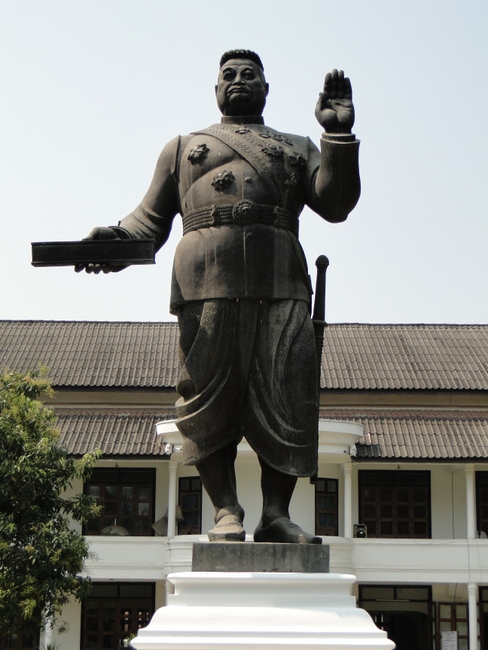
His Majesty Sisavang Vong, King of Luang Phrabāng 1904-46 and King of Laos 1946-1959)

Capitalism in a Communist nation? Let’s get real. Before the creation of the unified Kingdom of Laos, after the French withdrawal, under His Majesty Sisavang Vong, ( King of Luang Phrabāng 1904-46 and King of Laos 1946-1959) – another celebrated national hero –   the nation we know today as Laos – drop the “s” and say “Lao” – was a feudal society of several kingdoms who pledged loose allegiance to the Kings of Lan Xang and, later, to the Kings of Luang Phrabang. The monumental statue on the grounds of Luang Phrabang’s National Museum (former Royal Palace) depicts the King’s right hand in a classic Buddha position for peace and the left hand holding the 1946 constitution.
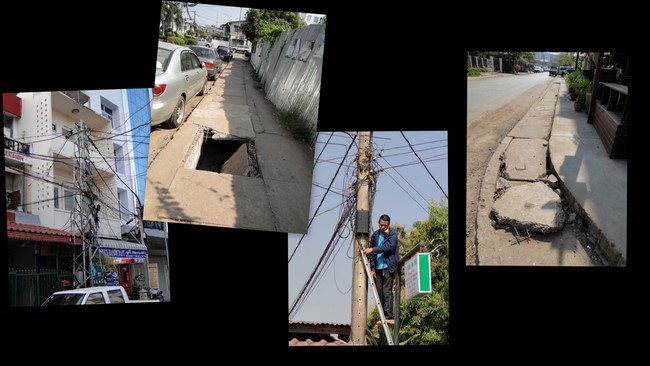
infrastrusture? Repair?
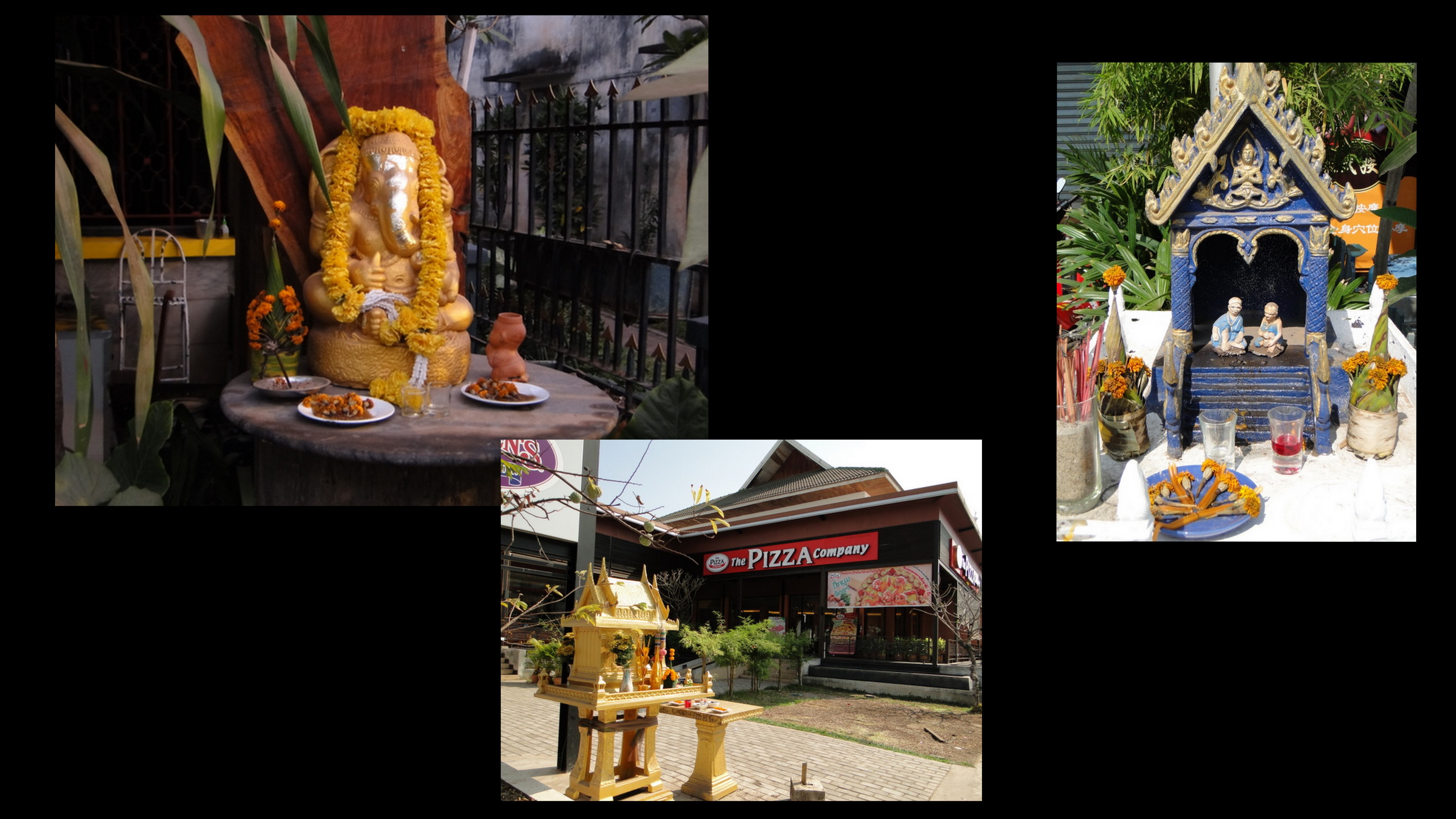
a few of the many Spirit Houses in front of shops, homes and a pizza restaurant

The current Lao People’s Democratic Republic is not much different, with many of the same families in power, except allegiance is to the Central Committee that resides in Vientiane. Over 90% of all Laotians are self-employed small business entrepreneurs and farmers and always have been. Buddhism and its teachings still remain the greatest cultural and political influence within the nation. There are more Buddhist temples and monasteries than I can count – independent of  government influence –  and travel within Southeast Asia for Laotians is unencumbered. The excessivly bureaucratic government is considered incompetent and government workers have decent middle class jobs – just like the former Royal Courts. There is a visible lack of infrastructure planning in this developing country.

Pets - which are not eaten

All of this makes Laos, Vientiane and the ancient northern capital of Luang Phrabang (a UNESCO World Heritage Site – and another blog) a fascinating country. Laos cuisine is wonderful. Less sweet than Vietnamese and with fewer hot peppers than Thai, the dozens of flavors from herbs, meats and spices shine. This will upset vegans who believe Asians are basically vegetarians and are eating more meat due to the influence of McDonalds, but Laotians have always been large meat/fish eaters. I was told by numerous chefs that currently more vegetable dishes are becoming part of the cuisine because of Western vegetarian trends! Laotians eat EVERYTHING – beef, pork, duck, frogs, rats, some dog, river fish, shell fish, all the innards and the blood – both liquid and congealed. (OK, please don’t stop reading – I won’t add recipes.) But they lavish love on their pet dogs and cats – they don’t eat their pets – unlike other Southeast Asian cultures (although this is rarely a part of the modern urban diet).

(Top) fresh roasted peanuts, smoked ducks, grilled fish in rock salt, frogs (Center) fish for stew, cockles, prawns and a variety of deserts (Bottom) produce, French bread, strips of Water Buffalo and an ivy-like vine leaves used for salads and soups

Life is on the street and in the markets – typical of Southeast Asia. The “morning markets” are primarily food (4:00 AM – to mid day.) “night markets” tend to be crafts, clothing and prepared foods and “weekend markets” are a great mixture. At any market you will find fresh frogs and the latest Apple I-Pod – it’s “one stop shopping” – the American dream…
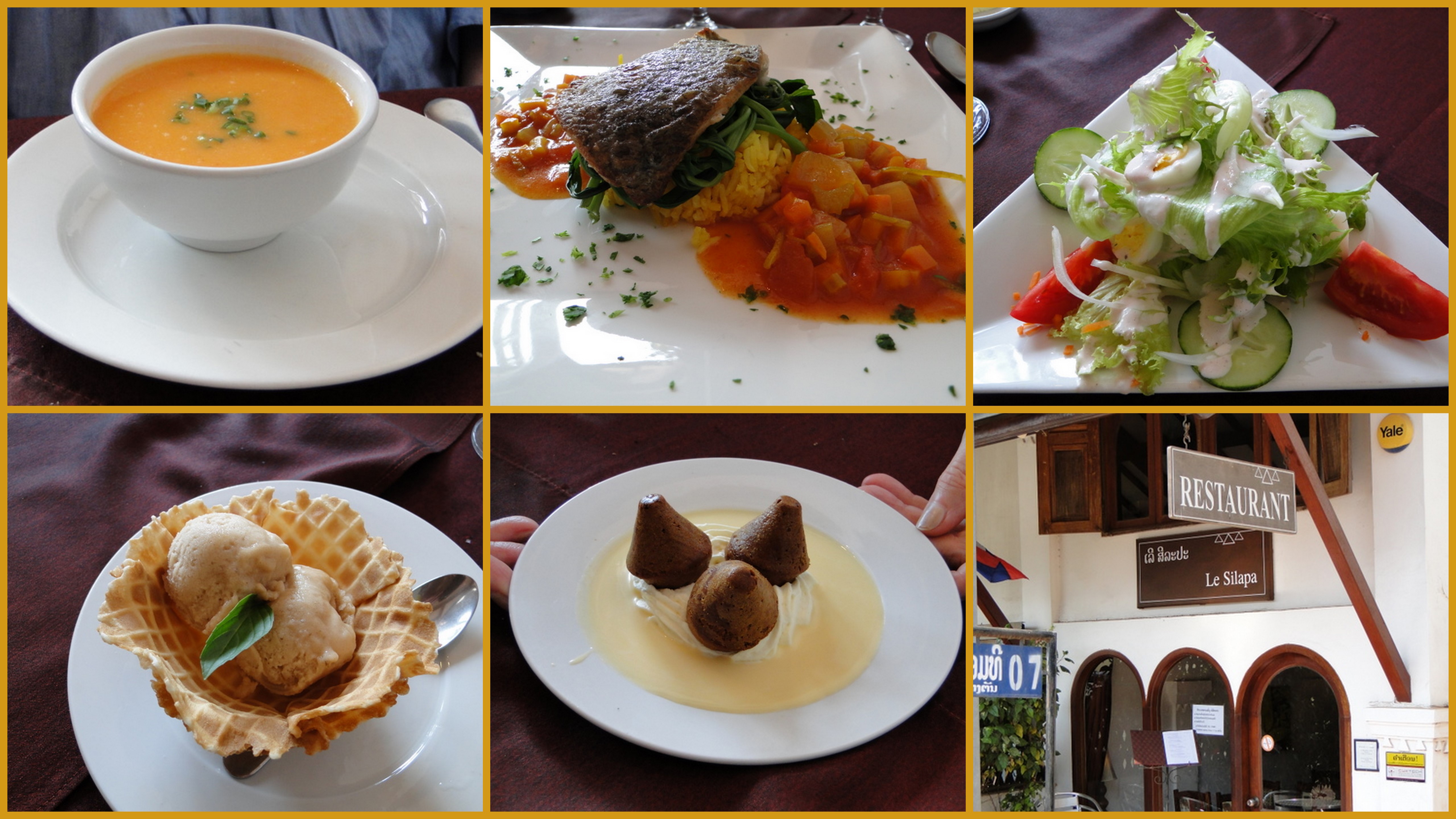
La Silapa: Cream of Pumpkin Soup, White fish with Laos vegetables, salad with a lime dressing, tamerind sorbet, ginger cakes in creme anglaise

Inexpensive restaurants abound and spill onto the streets. Lunch or dinner for 2 will rarely cost more than US$15 – unless you stuff yourself. A large 3/4 litre bottle of Beer Lao – a pleasant lager – costs $1.25. A few outstanding restaurants exist. The best being La Silapa, owned and operated by a French Canadian with a menu that is an excellent fusion of French and Lao flavors. Lunch for two is less than $30. (Note: wines are expensive anywhere in Southeast Asia. Costs are frequently more than the entire meal.) Nos serves excellent sushi at prices that make a Westerner believe they were in a Sushi nirvana – about $.25/each with salad and miso soup. There are a number of pizza restaurants using wood fired brick ovens and make terrific paper thin crusts. For genuine Lao cuisine eat on the street. Look for the most popular, crowded street restaurants. The rapid turnover means the food is fresh and has not lingered in the heat – what, no ice to keep the food fresh? Get real – I’ve yet to get even the slighest stomach problem.
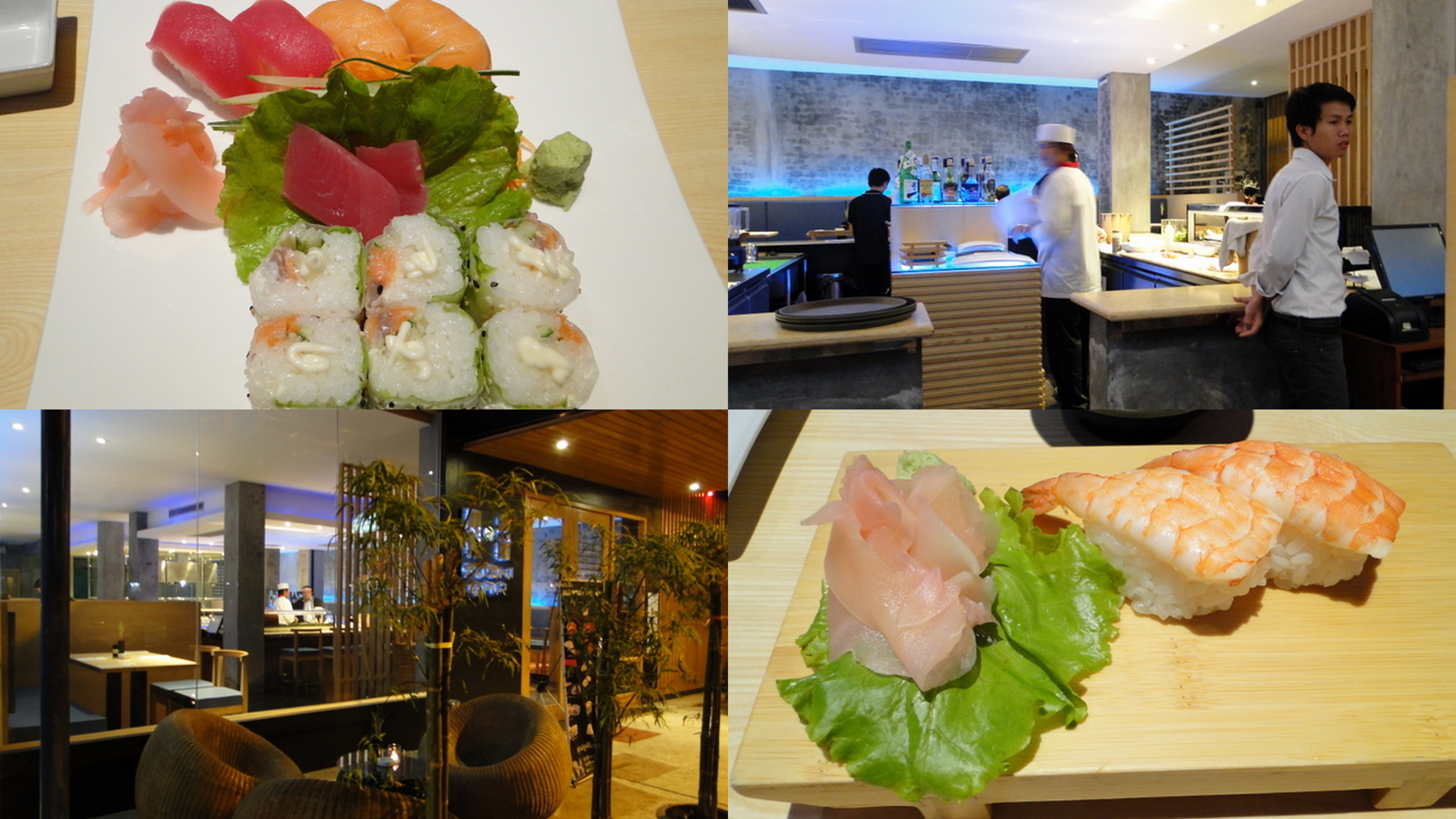
Nos

Poverty, as judged by Western standards, is the norm for most people – especially in the rural countryside – in all of Southeast Asia, but not starvation. For a visitor from the “First World,” luxury is quite affordable – beautiful hotels for less than US$70/night, restaurant meals for 2 with drinks for less than $25 (and this is the average high end.) A person/couple can travel for less than a third of that amount or waste money on  ultra luxury accommodations that will run in excess of $650/night. Yet if peace and stability remain in this fabled land they just might achieve the Lord Buddha’s dream of the Middle Path – neither lose one’s self in sensual pleasure nor deny one’s self the gifts of living.

Mahout for a Day

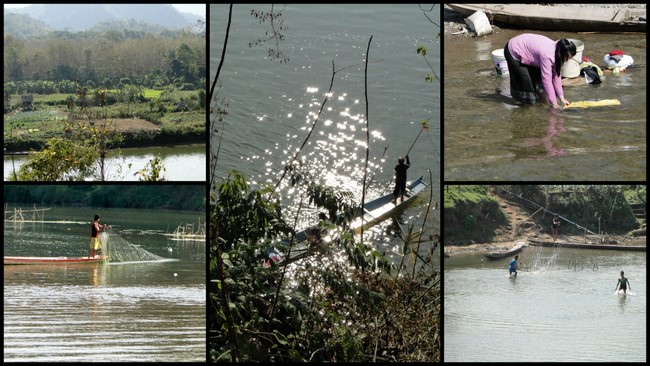
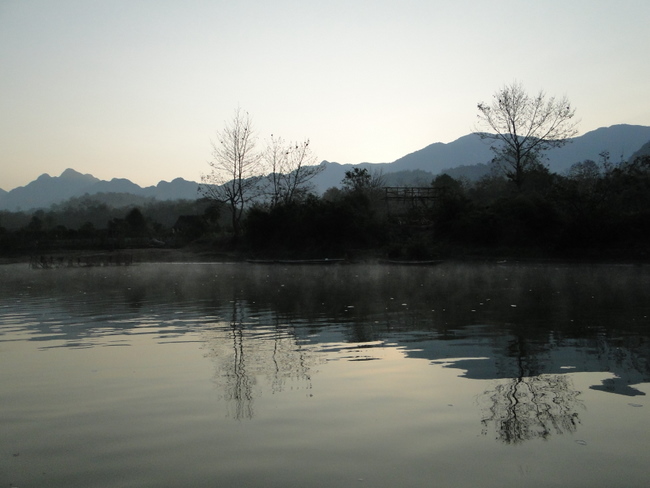
The long-tail boat, as narrow as a canoe, skims close to the water of the Nam Khan River. The verdant green teak wood jungle climbs picturesque limestone mountains. Lining the river bank, farm plots of cucumber, tobacco, corn, banana, papaya and a dozen other fruits and vegetables resemble French formal gardens. In the river women are washing laundry, men are beating the water with bamboo poles to stun fish before throwing out their nets, and boys with scuba masks are bent over peering into the river to see if this is a good fishing spot.

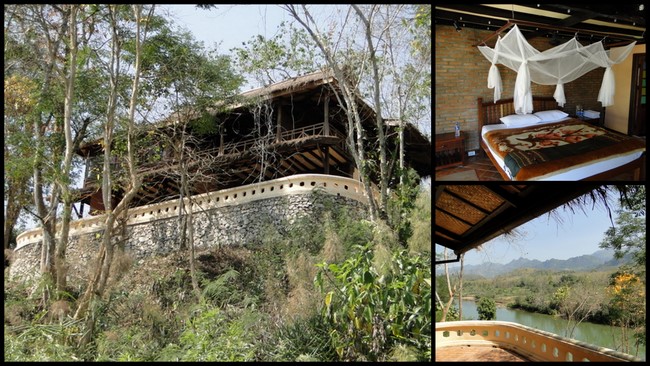
We tie up to a bamboo platform “dock” and climb the concrete staircase at least 100 feet above the river to the six room Elephant Lodge. From the wide tiled terrace in front of our glass walled room we have a sweeping view of all I’ve just described, and more – utter peace broken only by the sound of jungle birds, people working on the river below and, occasionally, the trumpet sound of elephants. Are we in paradise? Yes, at the Elephant Village 10 miles north of Luang Prabang in the north central highlands of Laos.

The Elephant Lodge at the Elephant Village

They consume 600 pounds of food and drink over 10 gallons of water a day.  Dogs, snakes and motorized vehicles scare them. Swimming and taking a bath is a thrill. They’re strictly vegan ­ (raw food types) preferring palm leaves, pineapple plants, vines and even the tough woody stems of these plants. For dessert, bananas – skins and all – are a favorite, and their average life expectancy – if not worked to death – is 80.  This is a common pachyderm – the elephant. I know this because I was a mahout for a day – well, kind of…

The Elephant Village is not a typical tourist “resort.” Founded in 2003 by Markus Peschke, who was bored with his German civil service job, it has a mission – saving the remaining 1,600 native Laotian elephants from extinction. The ancient name for Laos, Lane Xang , literally translates “land of a million elephants.” That was not hyperbole, until the 20th century it was reality. Human thirst for ivory tusks, hides, meat and work animals for the timber industry decimated the herds to today’s endangered numbers, yet still one-third of the 1600 are “employed” in the life-shortening lumber business.  To make them work harder many lumber companies feed the elephants amphetamines.

The Elephant Village owns 12 females, purchased (rescued) from debilitating work and provides everything including 24 hour veterinary care. For 6 hours a day, they give tourists an experience, and then they eat and play in the river and eat – did I mention eat? Sleep averages about 3 hours – then they eat some more. Each elephant has a mahout – their “driver/caretaker” – and they are particular. The elephant must like you, and it will take some weeks before the mahout knows if the elephant will “hire” him – it’s a life-long position.

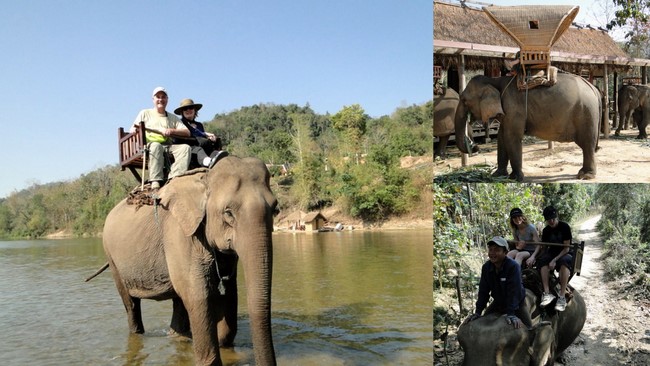
The Village offers tourists a day excursion and an all-inclusive overnight at the Lodge. Each person/couple has their own guide as well as an elephant and mahout. Our training started with getting familiar with our elephant – stroking her trunk – and then taking a one-hour ride. We sat in a chair behind the mahout, slowly plodding through jungle trails, into the Nam Khan River and then through a  poor rural village – one with the fabulous “French garden” farm plots. After the ride the elephant was rewarded with a stalk of bananas which we fed to her – their trunk is an incredibly dexterous limb!

Khmu village

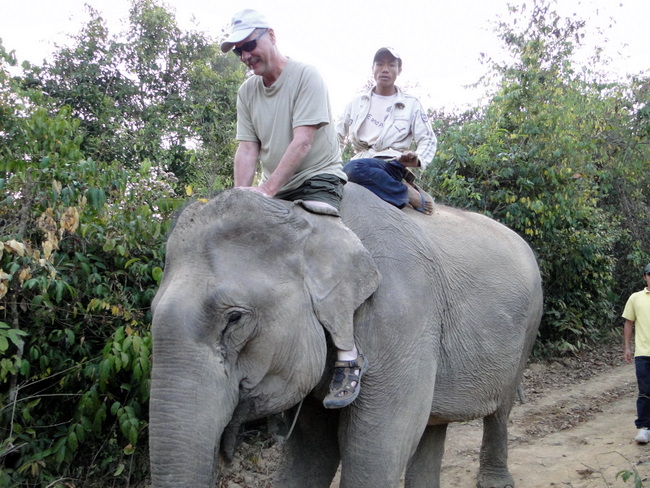
This was followed by a humbling and comic scene of learning how to mount the elephant on the back of its neck like a mahout. With great patience, this enormous animal lifts its right leg like a step to allow you to place your right foot on its leg and swing your left leg over its body and neck. At least that’s what’s supposed to happen. If you’re under 30 or a trained athlete – or a real mahout – it’s easy to swing that left leg up and over her wide body. For the rest of us it’s a humorous crawl up this huge animal. I’m sure elephants laugh, but they have the good grace to do it silently. To dismount, a command is given and she lowers all four legs as if they were hydraulic lifts, but only for a minute – their patience has a limit.

yes, that's me doing my "best"

Sitting atop the neck of this mountain of muscle, bareback, while it slowly lumbers is like standing in a rocking boat, yet you do get used to it. They are responsive to the voice commands and pressure from the knees of their mahout sitting right behind me. Within a short time, I relax and understand why these animals were the major form of transportation for eons. We traverse a trail through the teak wood jungle and into the river – presently shallow in the middle of the dry season. As we climb the river bank it’s then I discover their fear of dogs as the mahout had to sternly – with voice commands – prevent this multi-ton animal from bolting at the sight of a 15 pound pet canine. Singing helped calm her down – they love their mahout to sing to them. Elephants really do have an incredible memory for language, their surroundings and, especially, for the behaviors of humans – whether you’re respectful or not.

In the evening, we gathered for dinner under a blanket of stars – four couples from Germany, Holland/Brazil, Japan and ourselves, the USA. Southeast Asia is a mecca for Europeans, and, just like my experiences in South America, very few Westerners venture out of their comfort zone.

After a night sleeping at the lodge surrounded by utter peace and quiet with the full moon shimmering on the Nam Kahn River, we take the elephants for their morning bath. Once more riding on the neck with the real mahout in back, brush in hand, the elephant kneels down immersing itself, and my legs,  into the river. I’m still on its neck when the elephant, on command, raises its long trunk and repeatedly slams it down splashing water over itself and me. I scrub its head while the mahout takes care of the back. She definitely is enjoying this, especially splashing her trunk in the water. It’s amazing how long the elephant can immerse its trunk, literally holding its breath while we scrub. It’s fun and the river in the early morning is surprisingly warm. After 10 to 15 minutes, we lumber back to shore and she’s ready for her six hour day of work, giving people like me an eco-tourism experience I’ll always want to remember.

bath time

We arranged this excursion through whl.travel who provide outstanding customer service responding to emails with lightning speed. Cost was US$346/couple including transportation to/from Luang Prabang, all meals and the overnight at the Elephant Lodge. A portion of the cost goes directly to help fund the mission of the Village. The tour itself is conducted by Tiger Trails with informative guides.

The Elephant Village, as a non-profit organization, is always seeking donations. The cost of simply purchasing (literally rescuing) an elephant runs US$15,000 – $20,000. For an animal that has populated this Earth for over 60 million years, it would be a monumental tragedy to experience their extinction in such a short period of time. To spend a day and a half with these wonderful creatures is priceless.

The Floating Villages of Tonle Sap

A floating village on a lake, awakening each morning to the chirping birds and the dawn reflecting on serene water surrounding one’s dwelling. Casting your net to gather fish for breakfast and buying fruit from a passing market boat laden with produce – the dream of an unfettered life. Yet  the  Floating Villages on Tonle Sap  are less romantic as they are a last resort.
The great lake of Tonle Sap is the largest body of fresh water within Southeast Asia. Since 1994 it has been a UNESCO World Biosphere Site and a major world bird sanctuary. In Khmer, Tonle Sap means “large fresh water river” since it’s both a commercially important river system and an immense lake connecting Siem Reap in the north with Cambodia’s capital Phnom Penh to the south.

It is the color of mud. On a typical hot, muggy day when the humidity shimmers in the air, both lake and sky meld on the horizon. I had the sensation of floating in a beige bubble.

The villagers are mainly Vietnamese – refugees from wars – and other displaced social outcasts from the Cambodian hills. They live in six floating villages scattered around the lake eking out a living fishing and selling trinkets to tourists like me. Comments from visitors in many travel guides and internet sites are either horrified at the “waste of their travel time” or, like me, stunned that life actually survives in such conditions.

Tonle Sap is teeming with life – alligators, dozens of fish, poisonous snakes and enough parasites to populate billions of human bodies. The water is fetid with raw sewage and we’re told to keep our mouths closed so that we don’t ingest spray from the boat’s wake while it’s in motion. We do as we’re told.

Yet this is home to thousands of people. Mini-market boats laden with everything from cans of Coke to fresh produce float past. A floating pen holds several fat pigs. The Catholic Church is a modest floating blue painted building. There’s a school and a huge floating gym complete with basketball court.
Babies are washed in the stinking lake water. Several floating gardens are anchored to the lake bottom and some houses have Martha Stewart touches with bright tropical plants in contrast to the gray/brown of the floating huts.

For tourists there is even a floating cafe, museum and gift store. Even before we dock, we’re surrounded by boats that look like they could barely float no less contain the mothers clutching babies begging for money and children wrapped in snakes for photo ops. It’s well rehearsed but genuinely wretched and dirty and smelly.

Exotic items are for sale – crocodile skins, bottles of  Vietnamese rice liquor with small pythons and scorpions floating inside  and crocodile jerky.

Rice liquor with python and scorpion – strictly a male elixir…

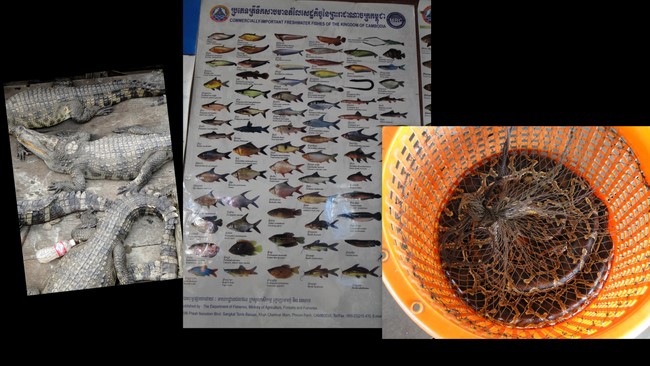
You can buy beer and ice cream as well. The museum contains displays of live crocodiles, large river fish, a mainstay of the Cambodian diet and quite delicious properly prepared, and ingenious fish and eel traps created over the centuries.

fish and eel traps
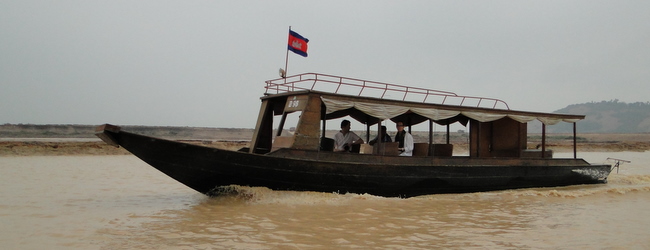
tourist boat

So why visit? Because you have to, not out of sympathy or prurient interest but human experience. Just seeing Angkor Wat or dodging the hordes of tourists and tuk-tuks in Siem Reap are not the totality of this ancient kingdom. Yet in contrast to the mud of Tonle Sap the lush green of adjoining rice paddies is soothing eye candy.

When you go:

It is best to arrange for  private certified guides for exploring Tonle Sap and Ankor Wat. Your accommodations will help with arrangements. Guides are well educated in the lore of the region.

Angkor Wat: A Millenium Symbol of Cambodian Resilience


Angkor Wat, constructed in the 12th century

Before French imperialism in the 19th and 20th centuries, before the uninvited American intervention during the Vietnam War, before “sainted” President Reagan’s support for the murderous Pol Pot, his reign of horror and the civil war he pursued for a decade after his overthrow in 1979 by Vietnamese forces, there was the glory of the Khmer Empire (9th – 15th century) and it’s capital the Royal City of Angkor Thom.

Hindu God Siva at Angkor Wat, artillery damage from recent wars

The greatest of the 292 temples that comprise Angkor Thom is the 12th century Angkor Wat constructed during the reign of King Suryavarman II (1112-1150) when the Khmer Empire was at its height dominating most of present day Southeast Asia. The temple complex covers over 200 acres making it the largest religious complex on Earth. It was built to impress. Its outer walls and outer temple are at the end of a 1,000 foot stone causeway over an equally wide 30 feet deep hand dug moat. The inner temple complex is reached by walking on another 1,000 foot raised stone causeway through the vast interior courtyard.

the three towers of the outer temple are on the national flag of Cambodia
}}
flag of the Kingdom of Cambodia

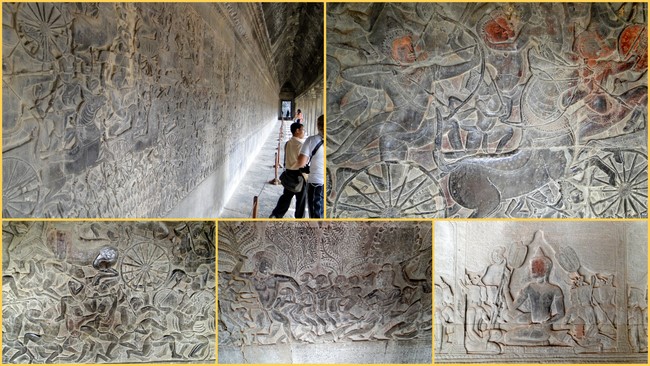
To attempt a detailed explanation of Angkor Wat, its architectural significance and the meanings of its intricate bas reliefs requires a text-book. Viewing any of the temples with out arranging for a private guide (US$45-55 for 8-hours, guide and driver) would be a waste of time. The bas reliefs of Angkor Wat are the largest in the world covering dozens of walls hundreds of feet in length and 12 – 15 feet in height. They are in stunning condition. Both carved into solid sandstone and covered from the elements over the centuries they tell the stories of Khmer glory and the religious texts of Hinduism in excruciating detail. Many are horizontal tryptics: royal life/battles top third, everyday life middle third and the ocean or hell on the bottom third.

(bottom center) punishment in hell, (bottom right) life in heaven

King Suryavarman II is depicted (picture below) riding in triumph on an elephant covered with the 15 umbrellas that signify his rank as god-king.

the God-King Suryavarman II

The Khmer Empire at its beginning was Hindu, but openly adopted Mahayana Buddhism in the 12th century. The Buddha, a Hindu prince himself, was not a religious monolith and therefore Mahayana Buddhism blends all of Hindu beliefs within Buddhist teachings – the divine trinity, heaven/hell (good and evil), the commandments. The result is a masterful melange of art and philosophy.
By the 14th century the Khmer Empire was under assault by its neighbors, especially the Kingdom of Thailand which succeeded in sacking Angkor Thom. The Royal Court moved south and the jungle slowly overtook 291 of the temples. Angkor Wat was, for the most part, spared that fate due to the diligence of the Buddhist monks who refused to abandon the complex even during the horrendous events of the recent Southeast Asian wars. Angkor Wat today is an active temple with two Buddhist monasteries –  it is “Mecca” for Mahayana Buddhist monks.  UNESCO World Heritage status and on-going restoration projects (currently being conducted with Japanese and German funding) once again are making the temple the focal point in Khmer culture it enjoyed in the 12th century.

Angkor Wat is a fitting symbol for both the Kingdom of Cambodia, which is enjoying its longest period of peace and stability (20 years) in centuries, and the resilience of the Khmer culture.

Buddhist monks and tourists at Angkor Wat

Royal Bangkok

The Emerald Buddha at Bangkok's Grand Palace

The 1951 musical, The King and I, is banned in the Kingdom of Thailand. The fictionalized script, based on the memoire of Anna Leonowens who served as tutor to the children of His Majesty King Mongkut, Rama IV, from 1862-1867, is highly offensive to both the Chakri dynasty and Thai society. Considering that the most onerous objection is the fictionalized portrayal torture and execution of Tuptim (who actually became one of Rama IV’s 36 wives) and His Majesty King Bhumibol Adulyadej, Rama IX, the 83-year old current monarch is a direct descendent of Rama IV, one might understand Thai sensitivity. When it comes to the monarchy, Thai sensitivity is high – it is a revered institution (with a capital “R”). Not only that, Rama IV started the modernization of both the monarchy and Thai society which is exactly the reason he hired Anna as governess to his children.

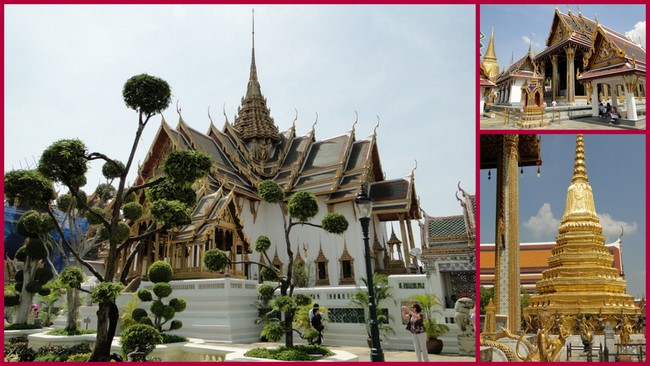
small section of the Grand Palace complex

Following the destruction of the great 14th century Thai capital of Ayutthaya in 1782 at the hands of the Burmese, the founder of the Chakri dynasty, Rama I, moved the capital 40 miles south and established Bangkok. King Rama I literally had the course of the Chao Phraya River altered along with the construction of numerous canals to surround the new capital with a watery moat. That same year, he began the construction of the half square mile Grand Palace complex on the river’s bank. At the center of the complex is Wat Phra Kaeo, the Temple of the Emerald Buddha (actually solid jade and robed in rich garments that change with the seasons. The Emerald Buddha itself was a prize of war from present day Laos centuries ago.)

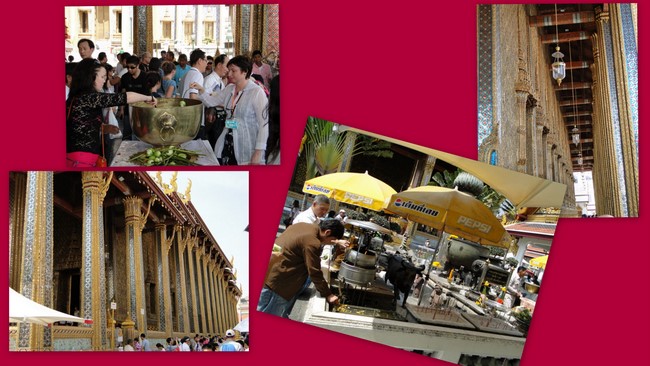
Wat Phra Kaeo: (top left) lotus buds used for blessing with sacred water, (bottom right) incense and offerings, part of the facade of the vast Temple of the Emerald Buddha

The scale of most structures is so vast that it’s difficult to capture with a camera, but the artistic craftmanship is nothing short of stunning.

Central Throne Hall, 1882

The Grand Palace complex today serves official functions only, as well as being Bangkok’s top tourist attraction. Admission to the complex is US$6.50. Photos are not permitted inside any of the few buildings open to the public, and shoes are always removed inside Temples and most Thai houses. Wandering the complex grounds is fascinating enough.

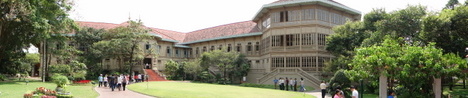
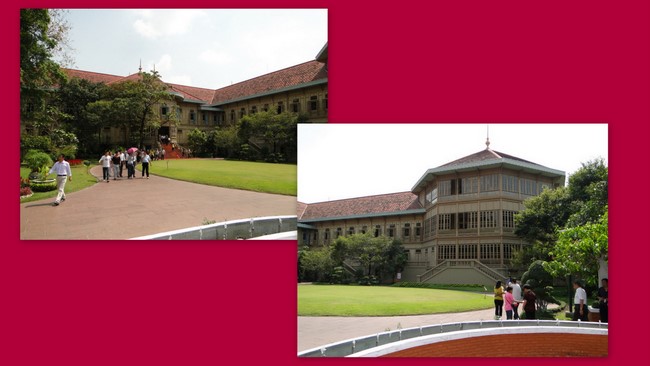
Vimanmek Palace, 1901

In the 1890’s His Majesty King Rama V found life in the Grand Palace too frenetic and moved the residence of the Royal Family to the Dusit area of Bangkok several miles inland from the river. There on a vast track of land that he personally purchased, he commissioned his European educated architect brother to design and construct the world’s largest all golden teak building, Vimanmek Palace (no interior photos, of course). The 72-room Palace would be comfortable as a mansion in any Victorian seaside town. Built in traditional Thai style there is not a single nail in the entire structure. Wooden pegs join everything including spectacular circular staircases.

Vimanmek Palace

 Unlike so many mansions, this was a home. It’s flooded with light and well ventilated with intricate wooden lace work topping all walls allowing air to freely circulate. It serves as a museum today for the royal collection of period furnishings and for both official and private functions of the Royal family.  Currently, it is now part of the extensive private compound of the Royal family including the Royal Elephant Museum and the Dusit Zoo. Admission to the Palace is included in the ticket for the Grand Palace and is valid for a visit within 7 days of the ticket’s purchase. One hour guided tours are conducted and, wearing no shoes, the silk-smooth teak floors feel wonderful on your feet.

Palace for the mother of Rama V at Vimanmek Palace

Bangkok: What defines a fabled city?


dsc04696
What defines a fabled city? Age? Diversity of cultures? Tolerance of differences? Quality of life? Art and architecture? By using any of these terms I’m not sure if “fabled” is a moniker that can be applied to Bangkok. Fascinating certainly is proper terminology.

Bangkok is young and chaotic. Founded only in 1782 (Philadelphia, USA, is a century older) after the Burmese destroyed the truly fabled capital city of Ayutthaya, the site of Bangkok was chosen for strategic purposes – protection from the Thai’s arch-enemy the Burmese. Like Venice, it was marsh land surrounded by rivers. The king immediately constructed a system of canals creating a virtual moat around the city – and like Venice the elevation of the city is sinking.

It’s a city of contrast; not only rich and poor but architectural styles as well – condo skyscrapers next to river shanties, 19th century shopping districts and modern malls, dubious electrical infrastructure, scorching heat/ humidity (even in “winter”), cooling parks, trees, flowers everywhere and exquisite topiary.

Would you believe Bangkok’s a clean city? Believe it ! Trash on the streets is virtually non-existent despite the constant and lively street life. Legions of street sweepers and building maintenance workers constantly sweep up even leaves and fallen flower petals.

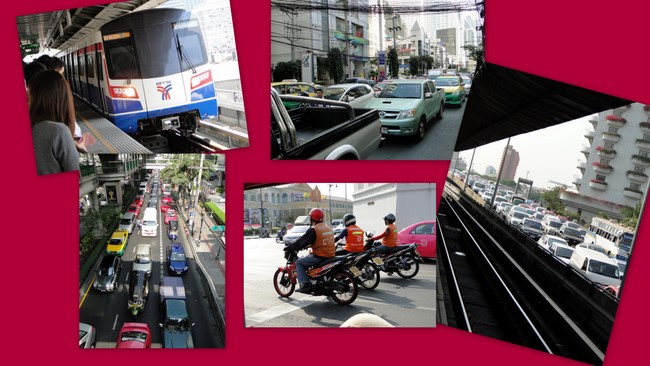
Sky Train and traffic

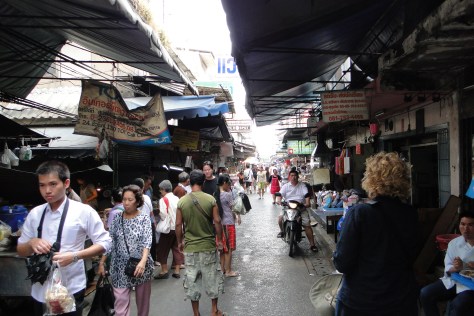
Traffic is horrendous! I spent one hour in a taxi to travel less than 4 miles – of course the fare was modest and the cabs are mostly new, comfortable air-conditioned Toyotas. Yet for less I could have taken a Tuk-Tuk – a motorcycle pulling an open air covered wagon – or, for even less, rode on the back of an orange shirted motorcycle “taxi.”

Yet, built within the past decade, the ultra modern, ultra clean and comfortable Sky Train elevated and the subway system will whisk one around the central core of the city (about one-third of Bangkok) for less than taking the average city bus in the USA. Despite the chaotic traffic I’ve yet to see a dented car.

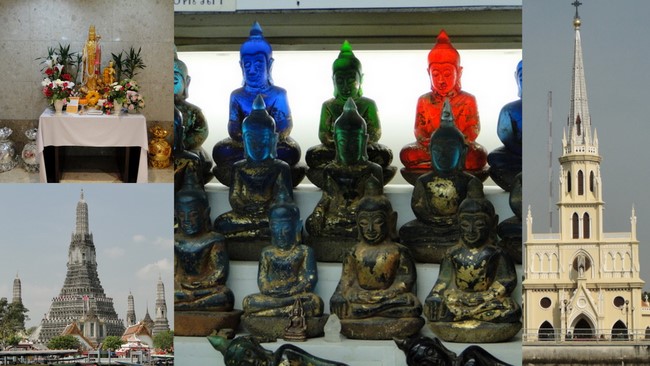
(top left) shrine in a shopping mall, (center) Buddha statues for sale, (right) Holy Rosary Catholic Church, (bottom left) Temple of the Sleeping Buddha

There are over 35,000 Buddhist temples (Wat) in Thailand, 300,000 Buddhist monks, shrines everywhere – street corners, in malls, in front of every house, in parks, restaurants and hotels with burning candles, incense, flowers and food offerings. Just about every other world religion is present as well. In the Robinson Department Store just down the street from my hotel is a Muslim prayer room.

Shoes and hats are never worn in Thai houses of worship, or, for that matter, in any Thai home. The dirt of the outside is left outside. Floors are immaculate – not a speck of dust.

street life: (top left) eggs roasting on charcoal, (bottom left) street vendor dentures maker

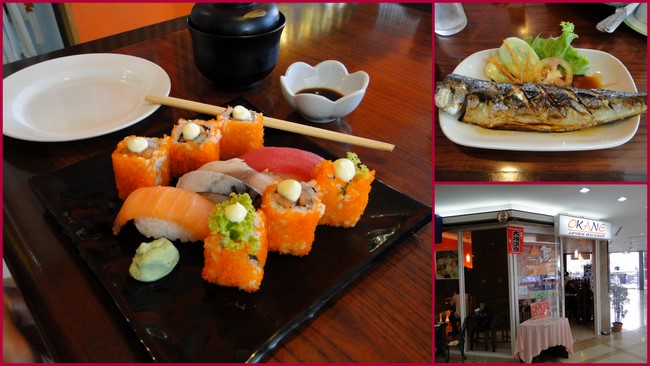
Everything is available from street vendors, especially food. The Thai’s seem to eat constantly yet I have not seen a single person you could call even slightly overweight. For a Westerner, the cost of food is embarrassingly cheap. In the pictures below, the sushi and superbly grilled trout, plus a rice salad and miso soup in a small nondescript Japanese restaurant in a shopping mall cost  less than a Big Mac in the States.

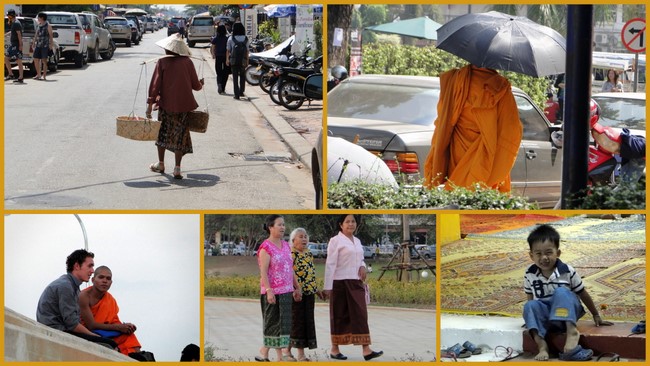
In the three days I have wandered the city I have experienced nothing less than the utmost courtesy whether in a tourist attraction, on the Sky Train or the street. I have yet to see any public display of anger or bad behavior. The police are friendly and helpful – what a contrast to so many countries.

Children seem to be revered and the photos below sums up my impression of Thai friendliness – figures of laughing children are everywhere, especially in the gardens of the Wats (temples) and street the vendor’s baby in the crib is cooled by a battery-powered fan. Bangkok may be intolerably hot and humid, chaotic and perhaps not “fabled,” but it has a more valuable treasure – it’s friendly.

Save

43 Days: The Things I’ll Carry

 “The things they carried…P-38 can openers, pocket knives, heat tabs, wristwatches, dog tags, mosquito repellent, chewing gum, candy, cigarettes, salt tablets, packets of Kool-Aid, lighters, matches, sewing kits…they carried diseases…malaria and dysentery…lice and ringworm and leeches…and the land itself…the endless march, village to village, without purpose, nothing won or lost. They carried all the emotional baggage of men who might die. Grief, terror, love, longing – these were intangibles…They carried their own lives.”

from The Things They Carried by Tim O’Brien (Haughton Mifflin, 1990)

It’s been a quarter century since peace finally came to the  lands of Southeast Asia. For centuries it was part of the fabled “spice route” between the eastern and western worlds, yet in the 20th century more than twice the tonnage of bombs were dropped on Indochina than in all of World War II. I’ll be leaving Sunday to spend 43 days in Thailand, Cambodia, Laos and Vietnam. I’ll have no worries or fears, unlike the brave but misled soldiers of that ill-fated war.

For me who narrowly escaped experiencing the horror of those past times, it feels odd that I’ll enjoy first class hotels, renowned cuisine, stunning scenery, cities and sites that have survived millennia of wars and legendary hospitality. From all my research of the past six months in preparation for this trip I expect to see, or even feel, little evidence (except in museums) of last century’s strife. As a chef, historian and travel writer I’m preparing myself for a flood of experiences that will test my ability to process this trip with all five senses – especially taste. Foods that few westerners ever have the opportunity to see, no less taste, await me, with fusion cuisine developed over centuries of east-west contact – durian cheesecake anyone?

Oddly, I’ll carry some of the same objects listed by Tim O’Brien – can opener (cork screw in my case), pocket knife, wristwatch, mosquito repellant, bottled water, sewing kit and malaria pills (one-a-day for 51 days). I’ll have to still be mindful of bed bugs – carrying bed bug repellant (fortunately I’m  already aware of what they look, and feel, like.) Lice, leeches, dysentery are all still present – this is the tropics – which means swimming in lakes and rivers is out. I’ll carry my ignorance of customs – no pointing either with fingers or, especially, with one’s foot. I’ll be ignorant of the languages. For the first time in my life as a traveller I’ll be hopelessly unaware of what anyone is saying (with the exception of tourism workers that speak English). Language will become music, much nicer than the karaoke sounds my research says is the favorite throughout all four countries.

The best thing I’ll carry? A sense of wonder.

My first blog, from Bangkok, will post Tuesday, 8 February.