Although fashion design is not my element, it is one of my wife’s great passions. Yet a recent visit to the Museum at FIT – the Fashion Institute of Technology – in New York City’s historic Chelsea neighborhood unexpectedly connected with my interest in history.
John Galliano camouflage evening gown at FIT, New York
The Fashion Institute of Technology is America’s premiere college for the business and art of fashion design. Its museum’s current exhibit, Uniformity, is an entertaining exploration that will change the way you perceive the entire notion of uniforms. The 200 year retrospective from military to sports uniforms goes beyond the obvious, detailing their influence on everyday fashion from beach to formal wear.
In John Galliano’s camouflage evening gown for Dior in 2001 (above, left) the influence is obvious. Yet I never gave it much thought that this trend is at least two centuries old. What was more surprising to me is that uniforms, clothing meant to make the wearer impersonal, for so long influenced fashion designed to be individualistic.
Fashion based on 19th century British & French naval uniformsChitose Abe, 2015
As early as the 1840s, a portrait of Queen Victoria’s four year old son, Prince Edward Albert, in a naval uniform made a fashion statement for affluent children’s clothing. By the 1890s, summer fashion for women (above left) had a decided naval bent and the trend has never lost favor (above right)
Designer Chitose Abe in her 2015 collection for her Sacai label combines British and French naval elements in her cotton and silk ensemble.
Yet by the 1940s military uniforms themselves combined functionality and fashion.
(left) Main Rousseau Bocher 1943 W.A.V.E.S. uniform & (right) & later fashion influenceWW II W.A.C. uniform designed by a committee.
The World War II uniform designed for the Navy’s new W.A.V.E.S. division was hailed as a fashion success – functional yet feminine. It was also the first military uniform designed by a major American couturier, the House of Mainbocher founded by Main Rousseau Bocher in 1929. But the Army’s new W.A.C. division uniform was the work of a committee. It was not only dubbed “olive drab,” but blamed for poor W.A.C. recruitment numbers compared to the Navy’s W.A.V.E.S. Even in war fashion made a statement!
1890s American baseball uniforms
Perhaps no genre of uniforms has had a greater fashion influence than sports. From the baseball cap to brand logos, America’s national sport has convinced well dressed people that being a walking advertisement for your favorite team and brands is desirable to one’s identity.
(left) Geoffrey Beene, 1967, Jersey evening gown
Of course football followed suit. According to FIT, Geoffrey Beene “shocked the fashion elite” in 1967 with his sequined even gown that’s simply an elongated 1930s football jersey.
FIT’s fine Uniformity exhibit doesn’t ignore the influence on fashion of maid, butler, waiter and waitress clothing. In 2015 Karl Lagerfeld designed this evening dress for the House of Chanel using the typical uniform of waiters in Parisian brasseries.
Karl Lagerfeld, 2015, French brasserie evening gown.
The museum of the Fashion Institute of Technology, part of the State University of New York, is open Tuesday through Saturday. Admission is free. What was even more surprising was the knowledge and enthusiasm of the staff, especially the guards. They were eager to engage in conversation and added to the pleasure of the exhibit.
You can read all my articles and subscribe to my Examiner columns at:
“We’ve grown smaller,” Pedro Belmar said quietly as we sampled the crisp organic kale with Parmesan tapas. That would not ordinarily be a hotel’s best business plan, but as a Small Distinctive Hotel of Costa Rica, the Hotel Belmar strives to reduce its carbon footprint while at the same time expanding its hospitality. That sentiment has greater resonance coming from a second generation heir to a hotel that has his name on everything.
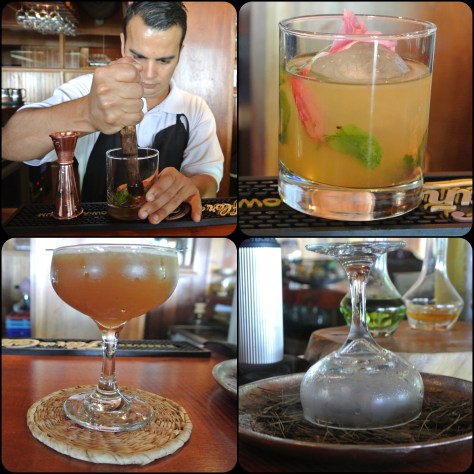
craft cocktails at Hotel Belmar, Monteverde, Costa Rica
A pleasant reminder of Pedro Belmar’s vision for the new look of success is as close as the hotel’s La Chispa cocktail. It’s firmly rooted in the forest and the 21st century cocktail revolution.
cedar pine needle smoke
premium Sloane’s Gin
black tea syrup
fresh lime
Crushed ice is swirled in a cocktail glass. Local dry cedar pine needles on a flameproof dish are lit with a torch. Discard the ice and invert the glass over the flame which should extinguish immediately and rest it on the needles capturing the smoke. The gin, syrup and lime are stirred in crushed ice. Upright the glass and strain the cocktail into the captured smoke.
Hotel Belmar (main building), Monteverde, Costa Rica
Sipping a smoky cedar scented La Chispa ensconced in the all-cedar Hotel Belmar overlooking the cloud forest tumbling down to the Gulf of Nicoya is an expression of “growing smaller.” The black tea syrup was made from ingredients in the Hotel Belmar’s organic garden as well as fresh limes. The cedar pine needles are on site. The gin may be imported, but the new craft cocktail menu anchors the Hotel Belmar’s commitment to sustainable growth and 21st century eco-luxe travel.
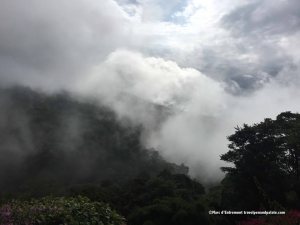
Cloud Forest, Costa Rica
When his parents, Pedro and Vera Belmar, opened their home as a bed and breakfast in 1985 in the heart of the country’s fabled Cloud Forest, Monteverde was a remote hamlet among lush subsistence farms. Located 85 miles northwest from the capital at San Jose, backpackers and naturalists exploring the cloud forests were the area’s first tourists. Isolation and climate conditions favorable for a plethora of unique indigenous flora and fauna helped Monteverde develop a mystic for natural wellness.
With nary a paved road to what is recognized today as a biological treasure, travelers to the cloud forest grew from just backpackers to seekers of tranquility with comfort. The 13 room all-cedar Hotel Belmar main building is Pedro and Vera’s homage to a love of alpine architecture. The extensive amount of cedar wood made opening a wood shop on site a logical decision. Handling all the work for hotel maintenance, it made sense for the wood shop to design and craft designated tableware for both the dining room and bar such as the sectional plate for the craft beer and tapas tasting.
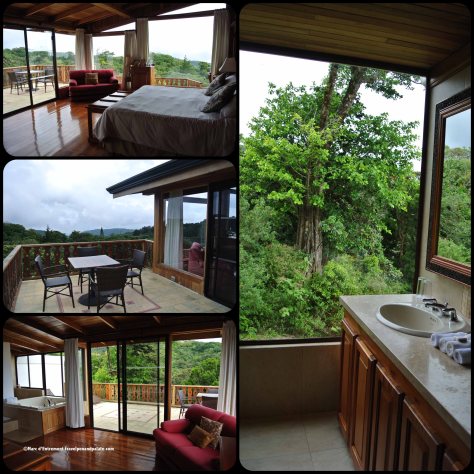
Suite the Chalet, Hotel Belmar
Under the second generation the past five years, Pedro, Jr, and his sister have renovated the hotel and transformed the original home into the sleek wood and glass nine room Chalet. The Chalet is the center of the hotel’s wellness program, spa services and organic juice and tea bar. The juices are made from fruits and vegetables grown on site.
Organic garden, Hotel Belmar
On eight cultivated acres at the nearby Belmar family farm and the compact but expanding hotel organic garden, chickens for eggs, coffee, dairy, sugar cane, bananas, avocados, curly endive, lettuces, kale, watercress as well as sunflowers, nasturtiums, fennel, amaranth seeds and dozens more items supply the hotel’s Celajes Restaurant.
Smoke house, Hotel Belmar
A smoke house made from recycled materials smokes cheese, bacon and churresso sausage with the wood shop supplying the cedar chips. Plans are to grow mushrooms using the farm’s coffee hulls and natural compost.
Methane gas is collected for kitchen use through the hotel’s biological water filtration system. The system uses no energy yet produces methane, which is stored in a tank for the kitchen. Clean water is returned to the mountain stream in exchange for energy.
Gulf of Nicoya, Hotel Belmar
“My parents had the ideas,” says soft spoken Pedro taking little credit for the Hotel Belmar’s successful transition into a 21st century Small Distinctive Hotels retreat that consistently achieves Costa Rica’s highest awards for sustainable tourism. Knowing that the caché of Monteverde and the Cloud Forest is the region’s draw, Pedro wants to position the Celajes Restaurant and bar as the hotel’s unique attraction. It starts with the view: located on the main lobby floor, the spacious Celajes Restaurant and bar commands a sweeping vista of the forest, mountains and Gulf of Nicoya far below.
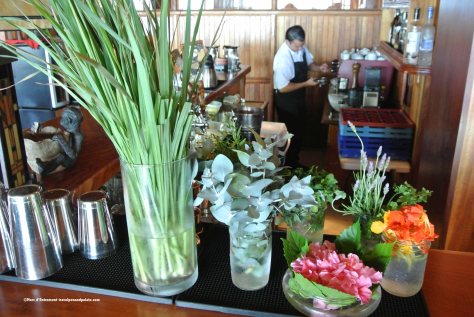
Bar ingredients from the organic garden
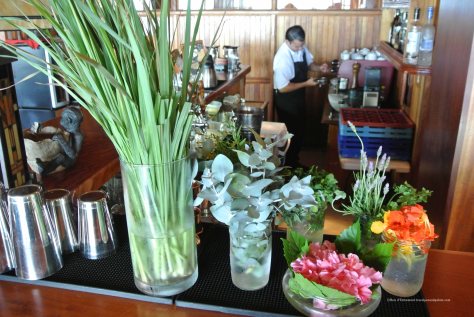
The bar reaches deep into the hotel’s organic garden for unique flavors to combine with premium sprits. Bitters and syrups are house made from reduced stout, coffee, eucuplytos and garden plants such as palo santo, a lemony scented herb that has been burned in South America to cleanse spaces of contrarian spirits – like sage. Room mini bar options include excellent house bottled Hotel Belmar cocktails.
Roberto Saenz is the Hotel Belmar’s brew master. The compact brewery just down the hill from the main hotel building was created using recycled equipment. All bottling is done on site. An inventive beer and food tasting is offered to guests at the bar or after the brewery tour.
Beer & tapas tasting on designated cedar plates
The Aura Pale Ale was light with a refreshing hint of citrus and paired well with veggie ceviche: chiote, green bananas, cilantro and lime were fresh and tangy on a small tortilla. The dark, earthy hops of Dos Maros IPA melded with the rich meat of house smoked churesso. A creamy Stout had a great vanilla nose and a lingering molasses flavor. Coffee and chocolate notes in the stout blended well with smoky and lightly candied house made bacon. The small batch brews change often so pairing combinations will vary – that’s fun.
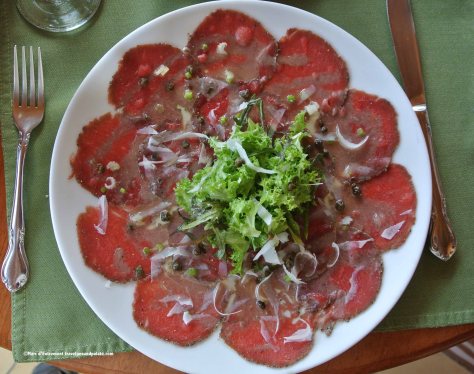
The freshness of both the ingredients and artistry of Celajes Restaurant does not disappoint. Breakfast can include a coconut milk and yogurt with chia seeds, fruit, tarragon and basil accompanied by house made granola. A lunch of beef carpaccio was a visually stunning platter of ultra thin slices of raw beef napped with a caper vinaigrette.
Beef carpaccio, Hotel Belmar
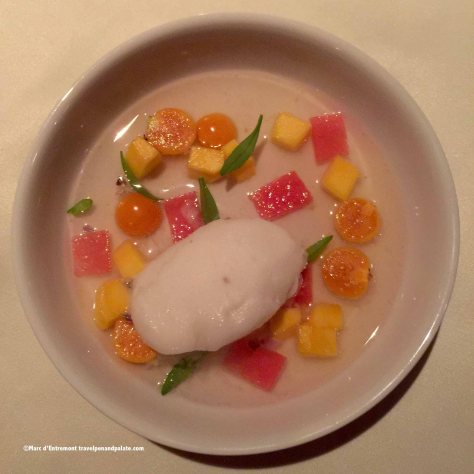
At dinner house baked bread is served with chimichuri sauce harkening back to Pedro, Sr, Chilean roots. Roasted beets, micro greens, grilled carrots, fennel flowers, basil, sunflower seeds with a yogurt dijon vinaigrette made a colorful salad. Beef tenderloin was seasoned with soy sauce, lemon juice, cilantro and fennel flowers. Wild sea bass was gently poached in butter. The perfume of a light dessert of verbana water, lavender flowers, tarragon, tropical fruit and guanabanas sorbet linked the dinner to the scents of a Cloud Forest evening.
The ethos of Hotel Belmar and of all Small Distinctive Hotels of Costa Rica is to succeed by taking less from the Earth. What is taken must be sustainable and is often delicious. Pedro Belmar and his diverse staff enhance the guest experience by living the true meaning of less is more.
Verbana water, lavender flowers, tarragon, tropical fruit and guanabanas sorbet
When you go: Juan Santamaría International Airport (SJO) is served by many airlines worldwide and is within an easy 20 minute drive of downtown San Jose and 3 hours to Monteverde. Getting around: Costa Rica has an extensive inter city bus system and many tourist van options. The easiest transportation is renting a car. Costa Rica’s road system is generally in good condition.
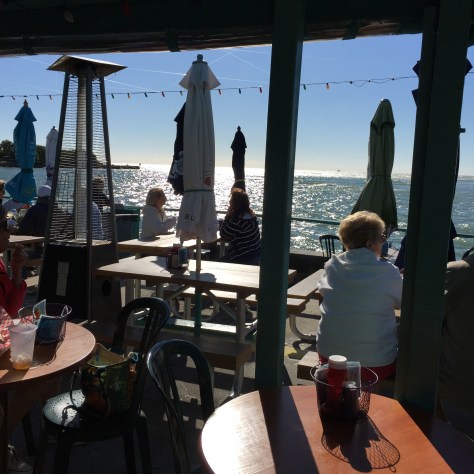
With an emphasis on independent ownership, Saint Petersburg chefs have the freedom to experiment or just create the best grilled grouper sandwich on the beach.
Lobster & Mango Salad, Sea Salt Restaurant, St. Petersburg, FL
You can read all my articles and subscribe to my Examiner columns at:
“Sleepwalker” (Tony Matalli 2014) is one of numerous art installations on the innovative New York High Line park. My love affair with the High Line goes back to its opening in 2009.
High Line, NYC
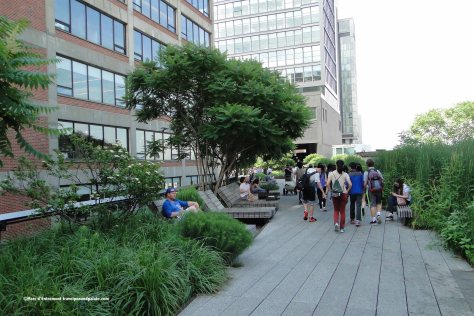
Now at its full one and a half mile length, the multi dimensional brainchild of designer Diane Von Furstenberg has set a new standard for urban reuse. Anchored by the famed Whitney Museum on the north end and the vibrant Chelsea Market to the south, the thin strip of re-purposed elevated train trestle that is the High Line teems with gardens, art and people relaxing.
High Line entrance at Gansevoort and Washington Street (Whitney Museum)
Although its success has drawn condo and commercial developers, at least many of the new buildings show hints of imagination. As a destination in its own right, the High Line deserves its success.
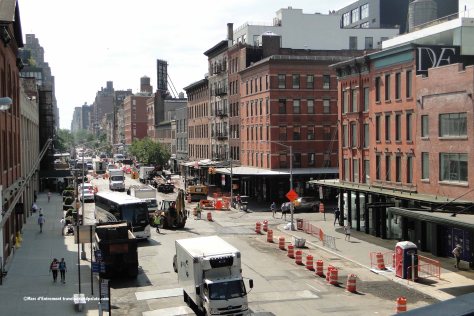
One of several High Line sitting areas to observe life in lower ManhattanHigh Line, NYCWest Village from the High Line, NYC
garden in original rail tracks of the High LineThe Swan, High Line, NYC (Matt Johnson 2016)
Now take a risk??
“Nude Sunbathers,” Kathryn Andrews 2016 (note: soft mist of cool water comes out from jets on the wall)
You can read all my articles and subscribe to my Examiner columns at:
It begins with refreshing, moist hand towels scented with lemon grass and glasses of chilled passion fruit juice upon entering the lobby. A visitor becomes a connoisseur of this refreshing amuse–bouche that teases and soothes the senses. Scented hand towels and exotic juice blends transition the visitor from the tropical humidity of Costa Rica’s lush countryside to an enclave of tranquility that is a Small Distinctive Hotel.
Nine boutique hotels, each averaging fewer than 50 rooms, are members of the Small Distinctive Hotels of Costa Rica. Each is privately owned, several in the second generation, unique in architecture and setting, luxurious with fine dinning and backstories as distinctive as the properties. The amuse–bouche – the tease – is that all this comfort helps others; each property visited touched the human side in unexpected ways.
Hotel Belmar – the burden of a name
Hotel Belmar, Monteverde, Costa Rica
Craft cocktails are not usually associated with the world famous natural wonders of the Montverde cloud forests of Costa Rica. Quakers, cows, hostels and hikers come to mind first. But when you’re Pedro Belmar, second-generation general manager of a famous family mountain retreat, continued success requires thinking out of the box. Or in this case nothing boxed.
In the Belmar’s La Chispa cocktail the refreshing, earthy aromas of the rain forests are recreated.
premium Sloane’s Gin
black tea syrup made from the hotel’s organic garden
cedar pine needle smoke
fresh lime
Crushed ice quickly wets a cocktail glass, as local dry cedar pine needles are lite with a torch. Quickly the glass is inverted over the flame – should extinguish immediately – and rest on the needles capturing the smoke. The cocktail is mixed. Upright the glass and pour into the captured smoke.
bar ingredients from Hotel Belmar organic garden
Sipping a smoky cedar scented La Chispa ensconced in the all-cedar Hotel Belmar overlooking forests tumbling down to the Gulf of Nicoya is all a tease – a visual amuse-bouche. It’s the forerunner that everything good for the guest at a Small Distinctive Hotel should be good and sustainable for 21st century Costa Rica. It should be at your fingertips. “We’re growing smaller,” Pedro Belmar said with a faint smile, expressing a vision for the new look of success.
Hotel Grano de Oro and the House of Light
A private guest room garden Hotel Grano de Oro
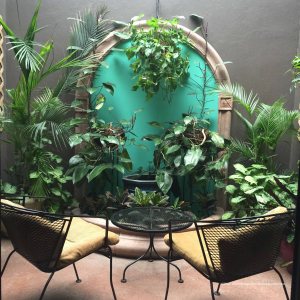
A blend of old, restoration and cutting edge, Hotel and Restaurant Grano de Oro is firmly established as San Jose’s premiere property. Yet it’s very design from the restoration of a classic Victorian colonial early 20th century mansion was to maintain the hospitality extended to houseguests in a spacious urban home. With understated elegance and graceful service, the exquisite cuisine of Executive Chef Francis Canal Bardot, has set the standard for three meals a day for a quarter century at Grano de Oro and San Jose. Hidden gardens, art and the soothing sound of water fountains follow even into the rooms. A quiet private garden patio with fountain in room six was an opportunity to discover Casa Luz.
Nearly 20 years ago Grano de Oro founders Eldon and Lori Cooke were instrumental in creating the Asociacion Reaccion en Cadena por Nuestra Ninez and opened Casa Luz (“House of Light”) in San Jose. Casa Luz provides multi-year residential programs for abused teenage mothers and their children and a safe home. The program includes all necessary monetary, emotional and psychological support victims’ need. Just ask and the front desk will be pleased to discuss this significant humanitarian project while you enjoy the elegance of Hotel Grano del Oro knowing a portion of profits help support a house of light.
Peace Lodge – inside the Cloud Forest
Of course there’s a tropical garden with stone waterfall shower in the skylight ceilinged bath of the guest suite at Peach Lodge. After all it’s nestled within La Paz Waterfall Gardens. In 18 large individually decorated suites, guests luxuriate in river stone hot tubs on plant-bedecked balconies and within private courtyards. Rooms with massive wood honed beds and river stone gas fireplaces open onto views of waterfalls and meandering free-formed trout ponds all designed to make you resign the tensions of the day – the trout may appear on the menu as a real amuse-bouche.
Peace Lodge is an integral component of the privately owned La Paz Waterfall Garden, both the visions of Florida entrepreneur Lee Banks, which protects a plethora of local fauna and animals in this area of the forests and encompasses five stunning waterfalls. Peace Lodge and La Paz Waterfall Gardens are on-going eco-tourism success stories with exciting culinary news forthcoming.
Cuna del Angel – discretely guarding your health
Gluten free bread at Hotel Cuna del Angel
It all starts with the bread. It’s gluten free. It tastes good. It’s whole grain bread with quality organic ingredients prepared by someone who understands proper techniques as in all good cooking and baking.
At Hotel Cuna del Angel, besides practicality due to a family member’s celiac disease, Tom York has every reason to prefer that his restaurant serve only organically grown and produced foods 100% gluten, GMO, and hormone free. Tom has been a devotee of healthy living spanning a decades long career. Many ingredients come from Tom’s own farm, and much of everything else is locally sourced.
Yet the tease is that a guest would never know their health is being guarded unless the menu is read in detail. Dishes from the classic continental repertoire such as flambé mango on vanilla sorbet and fresh snook with a creamy basil sauce are all components of a classic up-scale menu nutritionally balanced. The soft ambient lighting in the open walled palapa dining room overlooking the jungle and Pacific Ocean certainly are digestives in themselves. That’s just one part, as readers will discover in upcoming articles, Tom plays in helping to preserve this cradle of the Angel.
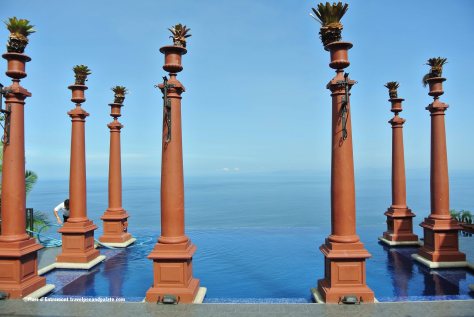
infinity pool at Villa Caletas
Villa Caletas – gazing into infinity
Denis Roy emigrated from France with a dream somewhere in his head that materialized into creating a fantasy in Costa Rica. On over 700 acres of improbable, undeveloped coastal and mountain wilderness, using building methods that hearkened back to the days of the pyramids, the multi building hotel, restaurants and spa complex of Villa Caletas and the Zephyr Palace emerged over a decade. A fusion of river stone castle and tropical Victorian, the 50 rooms range from stunning to awe inspiring.
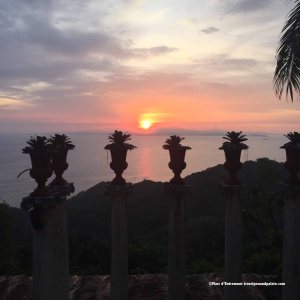
Sunset at Hotel Villa Caletas
Sunsets from the amphitheater are legendary, and views encompass forested hills and the Gulf of Nicoya from many angles. Yet those beautiful hills required total reforestation just a decade ago due to overgrazing. The lush peaks of today were barren, rocky and eroding into the clear Pacific below. Ecological restoration is ongoing and Villa Caletas spearheads major reforestation projects in the region.
That’s why the many infinity pools dotting the complex become a metaphor for the group of Small Distinctive Hotels owners, managers and chefs this journalist interviewed during an eight-day tour. They were all rooted in reality, but liked to tease. My upcoming articles will let you in on some amuse-bouche recipes – the visions they see gazing into infinity.
When you go: Juan Santamaría International Airport (SJO) is served by many airlines worldwide and within an easy 20 minute drive of downtown San Jose. Getting around: Costa Rica has an extensive inter city bus system and many toursit van options. The easiest transportation is renting a car. Costa Rica’s road system is generally in good condition.
Transportationwithin Costa Rica provided by Toyota Rent a Car of San Jose. A Rav4 made Costa Rica’s mountain roads, especially the few unpaved, safe and comfortable.
Chef Francis Canal Bardot cream of pejibaye soup, hotel and restaurant Grano de Oro, San Jose
Additional articles on Costa Rica by Marc d’Entremont:
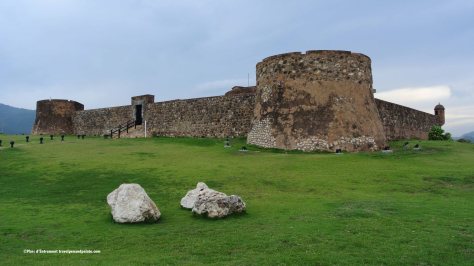
has guarded Puerto Plata, Dominican Republic for over 400 years and now anchors a pleasant ocean side park @fathomtravel #traveldeep #cruise #voluntourism #travel
sharp coral moat
Puerto Plata harbor
the park
You can read all my articles and subscribe to my Examiner columns at:
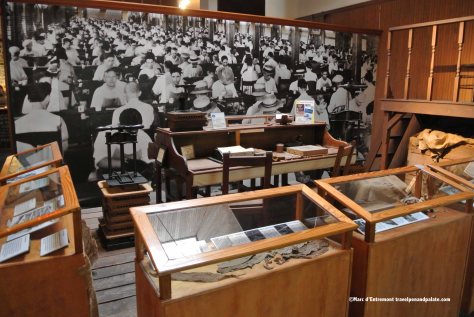
In a few square miles parcel of former Tampa marshland over two hundred cigar factories, manned by thousands of immigrant workers, were hand rolling half a billion cigars annually by the 1920s.
casitas
The fortuitous arrival in the 1880s of Spaniard Vicente Ybor turned a marshland into the cigar capital of the world and created a cultural phenomenon.
Other than the already centuries old Spanish domains in the north and the panhandle, south of St. Augustine Florida in the early 19th century was a land of bayous, forests, gators and mosquitoes. Fortunately, Florida’s still that way in some places.
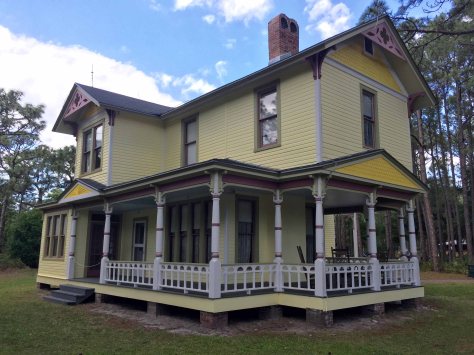
The House of Seven Gables (1907)
Yet by the 1890s the Tampa Bay/Clearwater/Pinellas County Gulf of Mexico shore had been discovered by affluent Americans traveling by the new railroads that opened Florida. Their vacation homes would reflect the styles of the day from simple cottages to Edwardian mansions and Craftsman houses.
Over two dozen historic structures – and growing – comprise the the 21-acre Pinellas County Heritage Village representing Florida life from the mid-1800s to the outbreak of the Second World War. You can continue the story at…















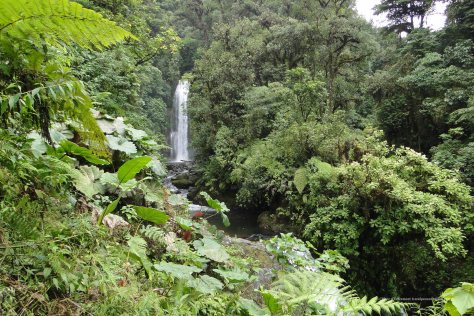
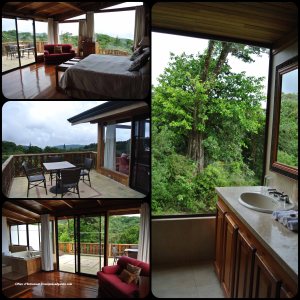
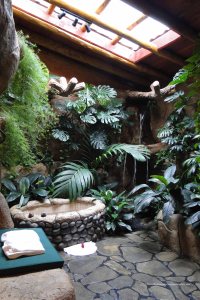 Of course there’s a tropical garden with stone waterfall shower in the skylight ceilinged bath of the guest suite at Peach Lodge. After all it’s nestled within La Paz Waterfall Gardens. In 18 large individually decorated suites, guests luxuriate in river stone hot tubs on plant-bedecked balconies and within private courtyards. Rooms with massive wood honed beds and river stone gas fireplaces open onto views of waterfalls and meandering free-formed trout ponds all designed to make you resign the tensions of the day – the trout may appear on the menu as a real amuse-bouche.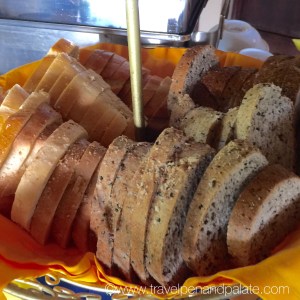










 Travel with Pen and Palate
You must be logged in to post a comment.