Epirus is a rugged, heavily forested and mountainous region largely made up of the Pindus Mountains. Considered the “spine of Greece,” the Pindus Mountains separate Epirus from Macedonia and Thessaly to the east.
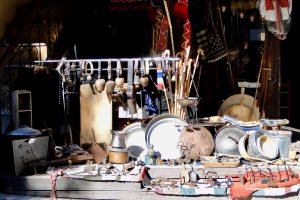
traditional crafts in Metsovo
Even though the clothing, architecture and food may have a Balkan feel, today generally older men and women gather on benches around Metsovo’s church of Agia Paraskevi to observe life on the Central Square and speak the ancient Aromanian dialect.
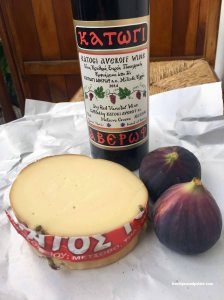
the park in Metsovo Central SquareMetsovone smoked cheese, Katogi Averoff Red, fresh figs
Livestock grazing on the green Pindus mountain slopes and crafts are still a part of life in Metsovo. To that foundation, tourism has had a significant impact over the past half century. Winter skiing, summer hiking, vineyards, unique foods, charming hotels and restaurants with a view add to the allure of this northwestern Greek enclave.
You can read more about the Pindus Mountains, Metsovo and a recipe at the Hellenic News of America ….
Naxos is the most fertile island of the Cyclades. It has a large aquifer under the island in a region where water is usually inadequate. Mount Zeus at 1,004 meters (3,294 feet) tends to trap the clouds increasing rainfall. Agriculture is an important economic sector making Naxos the most self-sufficient island in the Cyclades.
Naxos Sweet Home candy
This abundance is obvious in Naxos restaurants, artisan food shops and food markets. Besides produce Naxos is famous throughout Greece for its cheese, meats, fish and seafood. Simply walking along the wide, beautiful, long, crescent, pedestrian friendly waterfront of Chora (Naxos Town) is a gastronomic delight. Some of the best cafes and tavernas in Naxos are sandwiched between shops offering Naxos crafts and food products – it’s the center of nighttime social life in town.
No matter how murky the legends of St. Trifon Zarezan, the Orthodox Church patron saint of vine growing and wine production, Bulgarian wine is worth celebrating. Since the days of ancient Thrace and their reverence for Dionysus, Bulgaria’s neighbors have prized the wine from this region of the Balkans. At the World Travel Market London, the nation showed off its viticulture bounty to impressed attendees from around the globe.
The existence of wineries for thousands of years in what was then northern Thrace meant the industry flowed with history, sometimes with bumps. Through countless wars, Ottoman Empire restrictions on wine production to Stalinist collectivism, both the quantity and quality of the vintages varied. In the past 40 years the trajectory for quality has been steadily upward.
President Rosen Plevneliev (2012-2017) put it succinctly at a St. Trifon Zarezan Festival celebration, “If during the Socialism we were the symbol of mass production, now we enjoy quality Bulgarian wines. The Bulgarian foreign policy must focus on showcasing the success of our home winemaking; Bulgarian Ambassadors must be Ambassadors of Bulgarian wine as well.”
Constituting 42 micro climates in the five wine regions of Bulgeria classic Western European varietals such as cabernet sauvignon, merlot, riesling and chardonnay thrive along with the indigenous Bulgarian grapes gamza, mavrud, melnik, and the white misket and dimiat. Although more than 80 commercial wineries collectively produce over 100 million liters per year with 60% exported, supply does not keep up with demand. Although available in select stores and distributors, it’s difficult to find the wines in the United States.
What was particularly striking about the vintages at this tasting was their bouquet. It was difficult to put the glass to the lips because the nose was being so pleasured. The aromas of berries, especially raspberries, chocolate, hints of honey and the fragrance of oak and summer herbs was as satisfying as their taste on the palate.
Image Reserve
Bulgarians favor red wines, hence a higher percentage of vineyards are focused on those grapes. Image Reserve was a basket of ripe summer fruit, smooth with hints of chocolate, soft and full flavored from sip to finish. A blend of cabernet sauvignon, merlot and syrah, it’s rare and prized with an annual production of only 700 cases.
Rhapsody
Rhapsody 2009 Chateau Valle de Roses oak and blackberry notes would pair well with grilled meat.
Some of the vines for Ross-Idi Pinot Noir are 2,000 years old. It was light in body with oak overtones. Ross-Idi Winery Nikolaevo Vineyard merlot had a complex mix of berry notes, pleasantly dry with a slightly acidic finish.
Ross-Idi Winery Nikolaevo Vineyard merlot
Angelus Estate’s Stallion was a blend of merlot, cabernet franc, cabernet sauvignon and syrah from the Thracian Valley in southeastern Bulgaria. It continued the aromas of blackberries with a soft finish and would match well with pastas or lamb.
Butterfly’s Rock
Maryan Ivan Alexander red had only slight oak hints and sparkled with summer fruit notes such as plumbs and blueberries.
When my nose did not want to exit the glass of Butterfly’s Rock red, it was explained that they use special egg shaped oak barrels that are rotated frequently. The results are defined notes of oak, coffee, acorns and raspberries that are as pleasant to smell as to drink.
The average Bulgarian does not take white wines seriously. Even during St. Trifon Zarezan Festivals the reds are favored. Nevertheless, a smaller selection of Bulgarian whites is not to be ignored.
Izba Karabunar Ltd’s Misket & Dimgal was light in texture with slightly sweet melon tones. It would make a pleasant iced summer wine.
Midalidare sauvignon blanc added semillon to give it body. It had a surprisingly complex herbal bouquet finish.
Maryan Kera Tamara 2012 sauvignon blanc had definitive grapefruit tones with a crisp, dry, slightly acidic finish.
Angelus Estate’s White Stallion chardonnay managed to combine grapefruit with hints of honey – a terrific flavor combination of chardonnay, viognier and sauvignon blanc.
Levent 2012 is an Italian owned winery but with Bulgarian grapes vrachanski misket and traminer.
Orbelus Melnik organic wines sum up Bulgarian wine history. Today’s southern Bulgaria was northern Thrace 7,000 years ago. It is accepted that the ancient Kingdom of Thrace was the motherland of wine grapes. Soldiers of Alexander the Great brought melnik grapes to the Tharcian Valley over 2,300 years ago. The flavor notes of this full-bodied red were dark chocolate and walnuts accentuated by the smaller amounts of grenache noir and petit verdot added to the mash.
There is a good reason why wine is part of literature and science since nearly the beginning of the written word. Isn’t all of gastronomy meant to take simple ingredients and transform them into the extraordinary? Wine was an early success, and Bulgaria proudly continues the legacy.
Sommelier Lubomir Stoyanov representing Bulgarian Wine at the WTM London
Please read more by Travel with Pen and Palate at…
Marathia Restaurant on Tinos Island aptly proves the superlatives you have heard on the creativity of Greek cuisine and the uncompromising beauty of Cyclades Island beach locations.
Partokali Beach Bar at Marathia Restaurant
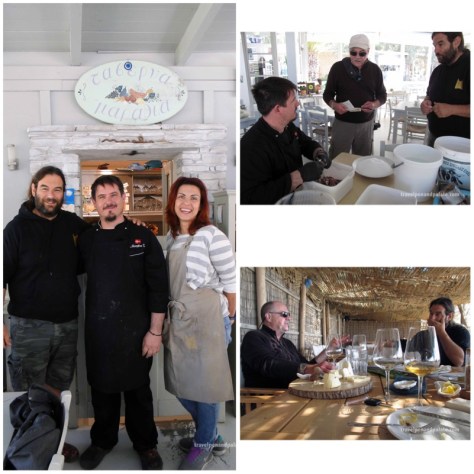
Considering how many restaurants in Greece I have reviewed, Marathia is one of the more traditional yet modern you can visit. Chef/owner Marinos Souranis opened Marathia Restaurant in 2002 in the renovated nine-room boutique hotel his parents constructed on Tinos Island 40 years before. He and his staff use ageless techniques crafting a menu firmly based on local products and traditional recipes.
antique plow as decoration at Marathia Restaurant
Yet the hook for the curious diner is in the knowledge that subtle personal touches (cinnamon added to homemade petroma cheese) and the imaginative presentations (marinated sardines served in sardine cans) set Marathia apart. That is a high compliment considering the exemplary level of Tinos gastronomy.
Both restaurant and hotel are open year round. The nine one and two bedroom apartments with kitchens are integrated within a design that’s traditional Greek village villa with 21st century amenities. The hotel includes the airy taverna style indoor dining room with many attractive antiques, tools especially, serving as sculptures against the white stucco walls.
Marathi Restaurant and Apartments
Across the street is the seasonal dining pavilion, Partokali Beach Bar, which itself languidly spreads down stunning Aghios Fokas Beach – the longest sand beach on the island. Besides the dining area, Marathia provides shaded lounge chairs for total enjoyment of this Blue Flag beach. All of this is within a ten minute drive from the center of Chora.
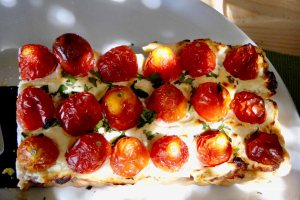
Cheese & Tomato pastry
Brunch at Marathia in general follows hotel patterns in so far as a buffet includes a variety of their cheeses, marinated fish, local sausages, yogurt, fruits and savory dishes. What from a distance could be mistaken for pastry layered with cream topped with strawberries was a baked savory pastry layered with cheese, herbs and topped with cherry tomatoes.
Chef Marinos wanted me to sample Marathia’s specialties from the a la carte menu. They are all meze, small plates that together with bread, salad and cheese frequently define a Greek meal. All were traditional centuries old preparations of local ingredients when preservation drove recipes. The dishes using riki, sardines, grazos and fish row are all uncooked salt cured.
Riki being salted for Lakerta
Lakerta appears throughout the Aegean and Adriatic coasts. It uses riki, cousin to bonito fish. The fish is soaked in two separate salt-water solutions each for 24 hours. This cleans the fish. It’s then cut into steaks, salted and weighted down for 3 to 4 days turning daily. The lakerta may then be thinly sliced and eaten or stored in olive oil.
Lakerta at Marathi Restaurant
The lakerta is tender with mild saltiness as if fresh from the sea. Serve thinly sliced drizzled with olive oil and lemon.
grazros in oil
Deboned grazros (cousin to sardines) sit in salt water for 90 minutes and in apple cider vinegar for 5 to 7 minutes. After the vinegar soak they’re placed in jars and covered with sunflower oil – important because sunflower oil imparts no flavor unlike olive and most other oils. The grazros can keep for three months.
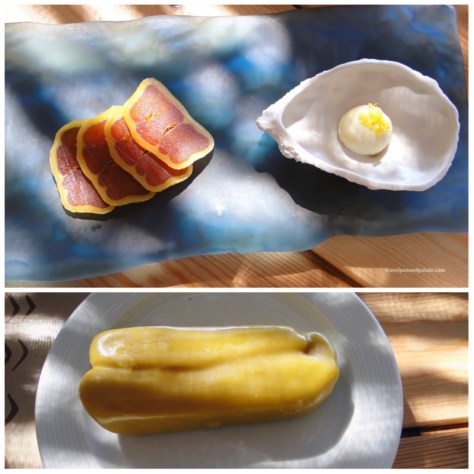
Botargo – or avgotaraho – is a delicacy of cephalus or gray mullet fish row. The whole row sack is cured in sea salt for a few weeks, sundried and then encased in beeswax for preservation as it has been for over a thousand years. Traditionally served thinly sliced with some lemon juice and/or zest and white pepper either solo or with crusty bread and butter – the beeswax is removed before eating.
Botargo at Marathia: (top) sliced with beeswax still on, (bottom) whole gray mullet fish roe encased in beeswax – botargo
The botargo has a lightly chewy texture due to the process; yet its unique flavor is intense. Although like wine, flavors can very depending on the life-style and age of the cephalus, I detected hints of mango and sea urchin tongue. Allow the botargo to linger in your mouth to maximize the subtly sweet umami experience.
In preparing smoked white grouper the fish is covered in a mixture of sea salt, white pepper and sugar for 16 days before being smoked for two days. The moist, delicate silky fish is served thinly sliced with a garnish of pickled grapes as counterpoint.
Smoked white grouper
Marinated vegetables, including artichokes, are steamed in water with some vinegar, lemon juice and a little olive oil until just tender. Then they are drained and marinated in olive oil, lemon juice and herbs. The textural contrast of the piquant vegetables pairs well with rich cheeses and delicate fish.
All cheeses, except one, are made in-house from unpasteurized milk and are so labeled on the menu due to health restrictions for certain conditions such as pregnancy. The exception is graviera, which is locally made with pasteurized milk. It’s the second most popular and versatile Greek cheese after feta and similar to gruyère. A firm but creamy cheese with generally mild on the sweeter side taste notes, it’s often sliced and added to cheese trays, grated over pasta and fried as saganaki.
I was surprised to see dozens of kariki aging. Only one person on the island makes it commercially, chef Aggeliki Vidou, but in small batches that cannot satisfy demand. Marinos makes his own kariki – the very rare (in the 21st century) “pumpkin cheese” of Tinos.
sealed kariki gourds & aged kariki cheese
The name comes from the small gourd, a karika. Traditionally it was used to collect milk. Now metal milk containers are called kariki. It starts with petia a simple base cheese, that’s packed in the karika – the actual gourd. The gourd is sealed with a flour/water paste and aged for 2 to 3 months. The interaction with the gourd imparts both color and deep flavors with hints of caramel, mild gorganzola and dried figs.
His malathouni, also from the base petia (cone), is made with goat’s milk. On average malathouni is aged for about one month. At Marathia it’s aged six months intensifying the natural tang of the goat’s milk yet maintaining a creamy texture.
Petroma’s base cheese is freshly strained petia. The round of cheese is then weighted until most of the additional whey drains. At Marathia they add a bit of sea salt and cinnamon to the petia before straining.
The wood burning oven near the entrance to the hotel is for bread baking. Olive wood only is used for its high and uniform burning temperature. Breads are made from whole-wheat flour and the yeast from a starter dough. The breads have a touch of sourdough texture and aroma that compliments rich butter and cheeses.
Tinos Island’s own T-Oinos Winery 2013 Clos Stegasta Assyrtiko accompanied the main courses. It has a classic nose of dry summer grasses and vanilla. The tongue picked up fresh citrus zest, which lingered. The throat sensed a pleasant finish of dry grapefruit zest. Assyrtiko ought to be a Greek national treasure.
With the cheese course, local Domaine de Kalathas’ Winery 10+12 late harvest 100% Tinos Island potamisi grape produces a fresh semi-dry white wine. It’s not aged and has subtle tones of honey and white currents with floral notes. Despite being semi-dry in the mouth it has a surprising dry smooth finish.
Tinos Island is a gastronomic destination of great physical beauty. Yet you could eat a convenience store hotdog on a Greek island beach and remember the beauty of the experience. At Marathia let’s just say the experience is raised far above sea level.
Marathia Restaurant and Apartments, Aghios Fokas, is just a short drive east of the center of Chora. Tinos Island is easily reached by ferries from the nearby Athens ports of Piraeus and Rafina.








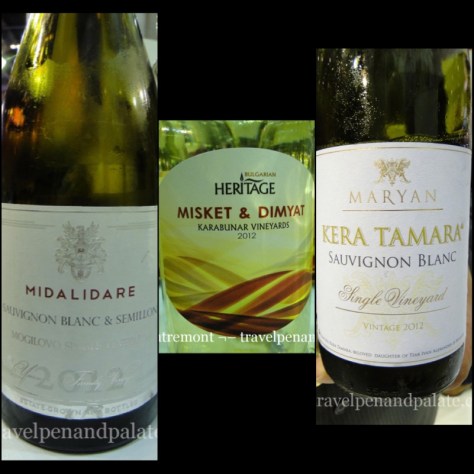
 Midalidare sauvignon blanc added semillon to give it body. It had a surprisingly complex herbal bouquet finish.
 Orbelus Melnik






 Travel with Pen and Palate
You must be logged in to post a comment.