Eastern Macedonia and Thrace is a region still home to the mix of ethnicities and religions that have settled on these lush, mountainous lands.
Xanthi
The lush mountainous terrain of Eastern Macedonia and Thrace make driving difficult. It’s not the well-maintained roads; it’s the distractions. I wanted to constantly pull the car over, get out and take yet another photo of scenes that I know the Greats of the ancient world witnessed. Every few miles another sign pointed to a sanctuary of the pantheon, sacred cave or ancient theater.
Nowhere in the southern Balkans has a region been so coveted by empires than Croatia with over 1,100 miles of photogenic Adriatic coastline. Although the ethnic Croats were themselves 7th century northern invaders, they could not stop a historical process that would come to an end only in late 20th century. The Romans, Venetians, Hungarians, Austrians, Ottomans, Mussolini’s Italy and Serbs all lusted over this beautiful and strategic land akin to the biblical neighbor’s wife.
Today Croatia is invaded not by empires but by golden hordes of tourists…
Dubrovnik July 2017
Read more on my travels to Croatia in the Hellenic News of America
With the current penchant for luxury travel flooding the blogosphere promoting budget hotels may seem incongruous. Yet during a life of travel this writer has always budgeted for both memories and things. Not to discount fine luxury properties worldwide, especially in Mexico’s Puerto Vallarta, but one does not have to compromise.
The walls of this travel journalist’s residences became filled with visual reminders of lasting memories through acquiring top quality local art and antiques. The double effect has been to patronize and promote local artists and antique shops while satisfying a desire to glimpse the soul of a destination through its creativity. Not being a wealthy individual it’s difficult to achieve both goals spending in the high hundreds of dollars for accommodations.
For the sake of full disclosure many sponsored trips including luxury accommodations are part of the business of a travel writer. Among those Puerto Vallarta’s superb Villa Premiere Boutique Hotel is close to ideal for this writer – and will not require one to take out a loan – but both professional and private travels have included modest hotels worldwide. Based on three trips to Puerto Vallarta over the past year, Travel with Pen and Palate reviews four price friendly hotels starting with its least favorite.
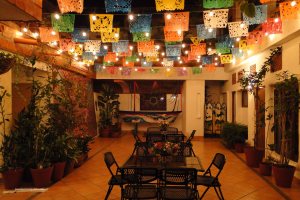
Courtyard of Posada de Roger
Hotel Posada de Roger – ★
In the heart of the rapidly gentrifying Romantic Zone of Puerto Vallarta, the Hotel Posada de Roger is top rated on Trip Advisor. (“Why” should become another article on the questionable merits of rating agencies.) From both the exterior and interior court, the hotel looks every inch a throw back to the lazy days of Margaritaville.
That doesn’t have to be an issue; it could be romantic. Unfortunately the song of that name was written in 1977, and the hotel does not seem to have been renovated anytime before or since. The beautiful jungle of the potted plant courtyard and gardens on the upper floors hide the hotel’s flaws.
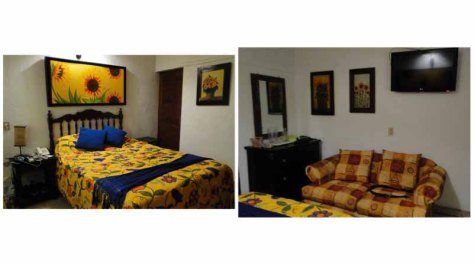
guest room Posada de Roger
The rooms are air-conditioned but gaps in the ill-fitting windows and doors, whose lock offers little security, requires leaving the air on high and using the ceiling fan as well – Puerto Vallarta is a hot, humid, albeit beautiful, Pacific Ocean city. A charity thrift store appears to have been the source of the small room’s furnishings with a hard bed, musty coverings and, considering the room’s size, an incongruous sofa jammed against an old chest of drawers – the only place to store clothing.
Access to the adequate bathroom required opening the door to the bath before one could step up an 8” rise – remember that at night or bring a night light. Wifi was hit or miss. Breakfast was not included.
Hotel Posada de Roger
The Hotel Posada de Roger has a well-known restaurant for breakfast and lunch that’s popular with tourists. Between 5:00 and 6:00 a.m. the restaurant staff begin their daily set-up and that is when you will awaken – no need to set an alarm if you’re an early riser. Given the design of the restaurant the noise level reverberating off the masonry walls and stone courtyard was unacceptable.
The hotel does have a swimming pool. The water was strangely green. That should have raised a flag for this writer, but it was hot. Regrets the following day from ingesting said water while swimming were not pleasant. That was the only personal incidence of illness in the three trips to Puerto Vallarta.
original art in Hotel Belmar lobby
Hotel Belmar Galeria – ★★
The Hotel Belmar, also in the Romantic Zone, should qualify for three stars, but after two seperate stays in two different rooms inconsistencies prevent given it more than two. The lobby and walls of the hotel are lined with top contemporary works by Puerto Vallarta artists. It’s a smart look for modest accommodations. Yet the quality of the rooms vary, and they’re location will dictate the quality of wifi reception from okay to non-existent.
guest room Hotel Belmar
Both rooms had exterior balconies which sounds romantic if one is not bothered by street noise starting early in the morning. Both beds were adequately comfortable and the second room had a desk. But to turn the air on one had to stand on the mattress and throw the circuit breaker switch.
view of Romantic Zone from balcony at Hotel Belmar
Breakfast was not provided at the Hotel Belmar but coffee and store-bought cookies were available in the lobby. Even with its shortcomings, if being in the center of the Romantic Zone on a budget is important than inspecting rooms ahead of time is advised and, for sound proofing, choosing an interior room may be a good option.
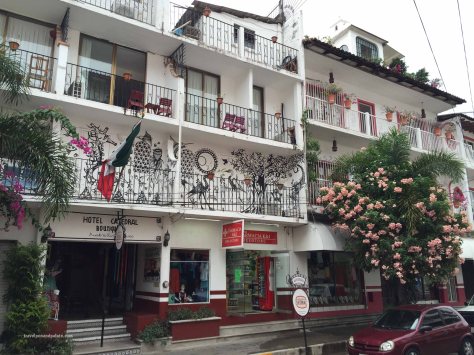
Catedral Vallarta Boutique Hotel
Catedral Vallarta Boutique Hotel – ★★★
For full disclosure the Catedral Vallarta Boutique Hotel was one of the sponsoring hotels during the second trip to Puerto Vallarta in November to cover the 22nd Festival Gourmet International. It is located in the Centro District a few minutes walk from the Romantic Zone across the Rio Cuele and the “Jungle” – the green oasis and artisan center of Isla del Rio Cuele. It’s central location puts it within blocks of the Cathedral of Our Lady of Guadeloupe and, like all four hotels, of the beach and the Malecon.
Efficiency suite Hotel Catedral
Noise level in Puerto Vallarta Centro is radically improved over the Romantic Zone – unless you’re there during Mexican Independence Day when a school marching band decided to practice at 6:00 a.m. The Catedral Hotel offers a wide variety of rooms including the spacious suite provided to this writer. Although the hotel is not 21st century modern, the furnishings were in top shape, the bed comfortable, the kitchen – had this culinary travel writer time to cook – was modern and well equipped and the expansive balcony was a pleasant spot to people watch.
Courtyard of the Hotel Cathedral at night
Both modern and traditional original works of art lined the walls of the hotel and the rooms. Like the Belmar, the hotel was constructed around a large interior courtyard, but it was quiet. Wifi was not available in the suite or in some other rooms according to guests, but was strong in the courtyard, which had several sitting areas. Breakfast was not provided but coffee, tea and cookies were available in a room off the courtyard.
Hotel Porto Allegro
Hotel Porto Allegro – ★★★★
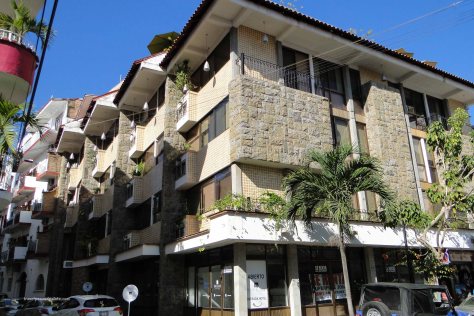
Hopefully word will not get out too quickly that the Hotel Porto Allegro is a bargain for fear management will raise the rates. Just across the street from the Catedral, this modern cut stone and glass hotel is a hidden gem. Sleek cool stone and marble tile in light grays immediately soften the bright hot sun of beautiful Porto Vallarta. Modern gym facilities are just off the lobby, and an elevator – rare among budget hotels – will carry you and your luggage upwards.
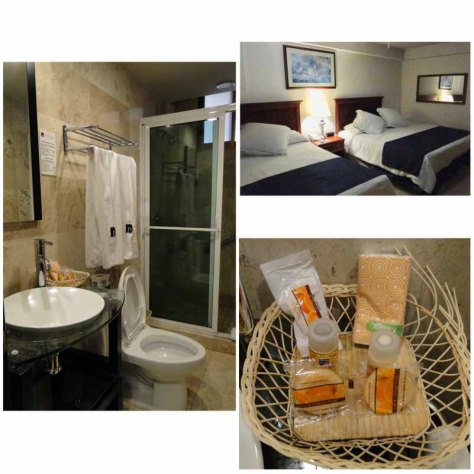
guest room Hotel Porto Allegro
The rooms are simple but well appointed with excellent beds, a desk, ceiling fan and a split air-conditioning system so efficient it needed to be kept low. A spacious closet system stored all belongings and the bathroom was ultra modern. Best of all for this travel journalist the wifi was excellent!
breakfast at Hotel Porto Allegroviews from the roof top Hotel Porto Allegro
On the rooftop of the Porto Allegro was a large hot tub and the outdoor lounge area from which to survey a vista of Puerto Vallarta, the Catedral and the Bay of Benderas. A glass walled breakfast room served a superb buffet, included in the room rate, of Mexican and American foods that tantalized this chef who desires more than anything non-traditional breakfast items. Eggs and sausages were certainly available but so were spicy sauces to liven them up as well as copious amounts of fresh fruit, waffles with dulce de leche, savory stewed dishes of poultry and/or pork to ladle over rice, fresh squeezed juices, a variety of Mexican sweet breads and excellent coffee.
It is possible to have it all: comfort, memories and fine things that will recall those experiences. The budget does not have to be sacrificed if that is a concern. When that same budget gives you Puerto Vallarta, then, like PV Tourism proudly exclaims, welcome to paradise.
Everyone welcomes you to paradise in Puerto Vallarta
Additional Puerto Vallarta articles by Chef Marc d’Entremont:
Nothing significant about the number 100 just a human penchant for symmetry. Although I continued to write for publications for which I had deadlines, since February I took time away from my own website to reorganize a significant facet of life – to be settled or wander. Necessity for the change was partly dictated by the end of a long relationship – isn’t that the truth in literature.
But as a life-long traveler – I was barely 20 years old when I went off on a solo year in Europe – the decision I made did not cause much loss of sleep. Okay, a little. Perhaps it was loosing the relationship that caused more sleepless nights, but that’s more for a romance novel than a travel web site, and besides, it ended amicably.
Old & new in the Principality of Andorra
Being a full-time culinary and cultural travel writer since 2009 after a long and varied career as a chef, educator and historian, relocating – having a permanent address – in any number of suitable American locations appeared an oxymoron. (I’m doing my best not to bring politics into this.)
on Paros Island, Greece
Except for frequent transportation connections – aka waiting – I freely admit being turned-on by the road. Why have an apartment when I don’t have to clean a hotel room? Why cook for myself when as a culinary writer it’s the cuisine of others that I seek? Why agonize over choosing among Earth’s beautiful locations when passport in hand I can be on a beach, hiking in a mountain or rambling through a vibrant urban space.
French House Party, Carcassonne – a loyal sponsor for 3 trips.
That doesn’t mean I seek the life of a wandering gypsy. I do have commitments to publications, fine public relations firms and tourism boards that work with me and my own interests that have already helped shape life for the foreseeable future.
One month ago, after considerable research and several invitations, I embarked on an ambitious seven month schedule that has already taken me to Mexico, France, the Pyrenees Mountain Principality of Andorra and, after several days in Barcelona, currently a long train ride through the beautiful Spanish countryside for a return visit to the ancient Roman/Visigoth/Moorish/Spanish city of Cordoba – a personal favorite.
Walls of the 9th century Mezquita mosque, Cordoba
By mid-June I’ll make a long-anticipated visit to Morocco. Having extensive life experiences with Spanish and Latino cultures and cuisine, Morocco – the wellspring of Moorish civilization – is essential in understanding the interplay of cultures that has so influenced the Western Mediterranean, Central and South America.
From Morocco I’ll fly east to the Balkans and a third return to beloved Greece. My smart sponsors for two months in Greece – September and October – not only admire my writing on Greek culture and cuisine, but also recognize my keen interest in history. I’ve always taken a holistic view that the life experiences of people in any region help determine its fascination as a travel destination.
Basilica Sagrada Familia, Barcelona, Spain
1917 was the turning point for the Balkans and Greece during the First World War. Thessaloniki in particular is honoring this pivotal year that saw Macedonia and Thrace reunited with southern Greece after centuries of separation during Ottoman rule. Besides continuing culinary and cultural explorations in the north and Halkidiki – including Mount Athos – the Corinthian coast in the south will be a new region that’ll only add to my Greek experience.
Mt. Athos as seen from Sithonia, Halkidiki, Greece
Prior to my Greek return in September there are the months of July and August which will be filled with culinary and 1917 experiences in the heart of the Balkans including first time visits to Croatia, Serbia, Romania, Bulgaria and the city that sparked the world changing conflagration, the Bosnia-Herzegovina capital of Sarajevo.
raw oysters, quail egg, sea urchin & golden caviar in Puerto Vallarta
By the 1st of December I’ll have made a full circle from where this adventure started returning to Mexico where I already signed a year-long lease on a beautiful apartment in Puerto Vallarta with stunning views of the Pacific Ocean – and weekly maid service (I still don’t have to clean!) It’s fortuitous that just as life was changing, invitations for two culinary press trips to Puerto Vallarta occupied a month of my life last Autumn. Not only did the city’s excellent cuisine and vibrant culture win me over but solidified my acceptance that being on the road is the life meant for me.
Puerto Vallarta, Mexico
So a year in one city is not like being on the road? Not necessarily since exploring Central and South America has been part of my writing life since 2009 and Puerto Vallarta will become a hub.
After 2018…I don’t yet need to know. That’s the freedom of being on the road. The hundred days of silence are over, and a hundred articles are sure to follow.
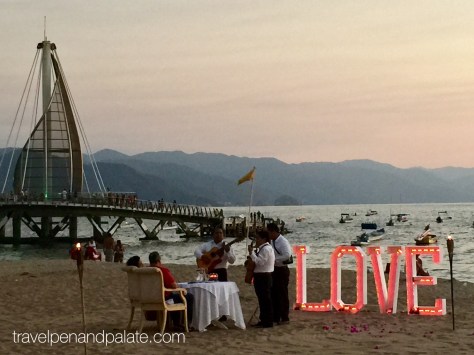
sunset over the Bay of Banderas, Puerto Vallarta, Mexico
“Thankfully, we’re starting to pull away from the idea that all Mexican food means burritos as big as your head.” Chef Rick Bayless 1
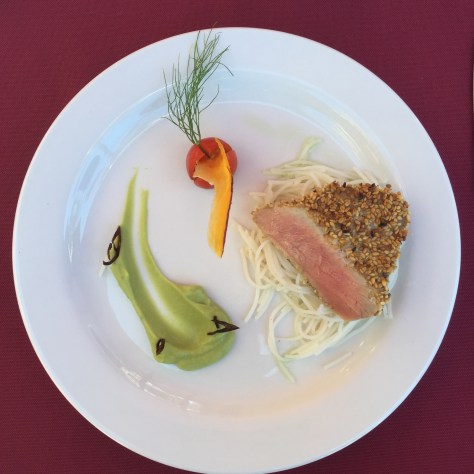
Chef Luis Noriega’s Grilled Tuna topping Mint Scented Vermicelli
American Chef Rick Bayless has built his celebrity status on both introducing Mexican regional cuisine to the United States as well as creatively reinterpreting its concepts to a 21st century palate. Naturally the word fusion comes to many people’s mind. Yet fused from where and with what – other ingredients from the Americas?
If you accept that concept – other ingredients from the Americas – than it’s not a fusion (a joining of unknowns) it’s creativity with native sources that form a cuisine of the Americas. It’s estimated that over 50% of commonly eaten foods by North American descendants of European immigrants were unknown to their ancestors prior to 1492 including vanilla, tomatoes, bell peppers, catfish and ducks.
tuna steak from Mexico’s northwest coast
So if we can get beyond the self-imposed value judgment of authentic cuisine – aka a real Italian pizza is only made with (American) tomatoes…? – than perhaps we can revel in our human culinary diversity and sit down to an enjoyable meal full of terrific flavors.
When covering the recent 22nd Festival Gourmet International in Puerto Vallarta, Mexico, more than one first time visitor to both Puerto Vallarta and the festival commented how they had “no idea” cuisine in Mexico was so varied? The names of several popular American corporate chains of Tex-Mex food were often cited. The festival’s hallmark was highlighting Mexico’s ever-evolving New World cuisine.
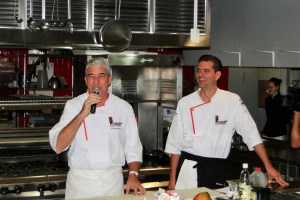
Chefs Luis Noriega & Heinz Reize owner of Coco Tropical
Chef Luis Noriega’s illustrious international career has taken him from Acapulco to European capitals and Chef/Professor at leading Mexican culinary collages. He is chef/owner of Restaurant La Gula in the south central Mexican Pacific coast city of Zihuatanejo. At the November festival Chef Noriega conducted an in-depth daytime cooking workshop and lunch at Puerto Vallarta’s Coco Tropical on the beautiful beachfront Malecon.
Restaurant Coco Tropical, Puerto Vallarta Malecon
Grilled sesame crusted tuna steak on a bed of mint scented vermicelli may not sound Mexican, but more than half the ingredients are indigenous to the Western Hemisphere and the remainder were introduced through European domination more than 500 years ago. So the recipe is as “American as apple pie” – apples are indigenous of central Asia.
Chef Luis Noriega’s Grilled Tuna topping Mint Scented Vermicelli
Ingredients for 4 servings:
500 gr. (16 oz) fresh tuna steaks
to taste fresh ground sea salt & black pepper
100 gr. (3 oz) sesame seeds
50 ml. (3½ tablespoons) olive oil
100 gr. (3 oz) rice vermicelli
50 gr. (1½ tablespoons) unsalted butter
10 each finely chopped leaves of fresh mint
2 each small ripe avocados
2 each green chili piquin – very small HOT chilis – finely minced – or substitute ½ to 1 teaspoon (hot) hot sauce
50 ml. (3½ tablespoons) sour cream
Preparation:
Cook the rice vermicelli according to package directions
Mash the avocados and blend in the chili and sour cream to make either a chunky or a creamy guacamole.
Place the sesame seeds in a bowl, season tuna with salt & pepper and coat the tuna steaks.
Heat (preferably) a cast iron pan, add the olive oil and sear the tuna steaks for a minute or 2 per side until browned but pink in the middle. Transfer to a cutting board.
Drain the rice vermicelli and toss with butter and the mint.
Divide the vermicelli among 4 plates, top with slices of tuna steak and decoratively add a generous garnish of guacamole.
Serve with a fine Rivero Gonzalez Scielo Blanco (Chardonnay) from Mexico’s Valle de Parras, Coahuila and enjoy New World cuisine.
When you go:
Puerto Vallarta is served by many international airlines.
1 “Let’s Talk to Rick Bayless About Mexican Food.” The National Culinary Review, Vol. 41, Num. 2, American Culinary Federation, February 2017, St. Augustine, FL
Additional Puerto Vallarta articles by Chef Marc d’Entremont:
Oysters au gratin & Raw oysters with sea urchin & quail eggs
For twenty-two years Puerto Vallarta – a food tourism powerhouse – has hosted the Festival Gourmet International attracting an eclectic and enthusiastic mix of international and Mexican chefs eager to turn the nation’s premium food products into culinary art works. Among many highlights of the 2016 festival were cooking demonstrations, tastings and special festival menus created by guest chefs at A-list Puerto Vallarta restaurants.
Since I have a passion for oysters, two dishes created by Mexican chef Luis Noriega and Japanese-American chef Hiroshi Kawahito were particular favorites. Mexico’s northwest Pacific coast – particularly Puerto Vallarta’s Bay of Banderas and the Gulf of California – produce both excellent oysters and sea urchins.
Chef Luis Noriega
Chef Heinz Reize has owned the beautiful oceanfront Coco Tropical on the Malecon for years and is a co-founder of Puerto Vallarta’s Festival Gourmet International. Coco Tropical’s guest chef Luis Noriega’s international career has taken him from Acapulco, Europe to owner of Restaurant La Gula in Zihuatanejo. His inspired festival menu for Coco Tropical included grilled oysters over wilted spinach with chipotle hollandaise sauce.
Oysters au gratin with Chipotle Hollandaise Sauce
Ingredients for the oysters:
12 each fresh oysters on the half shell
5 tablespoons unsalted butter
8 ounces fresh baby spinach leaves
5 tablespoons dry white wine
1 each shallot, finely chopped
1 each clove garlic, finely chopped
several drops Worchester sauce
pinch black pepper
pinch salt
Ingredients for the Hollandaise Sauce:
4 each egg yolks
10 ounces clarified butter
3 ounces white wine
1 each chipotle chili liquefied in a blender with a small amount of white wine
pinch salt
Preparation:
for the oysters
Shuck oysters but reserve bottom shell. Wash and dry the shells.
Sauté spinach, onion and garlic with 4 tablespoons of butter, salt, pepper and Worchester sauce.
Saute oysters in a seperate pan with the remaining 1 tablespoon butter for 1 minute. Add the white wine and reduce for 2 to 3 minutes.
Remove both pans from the heat but keep warm.
for the Hollandaise Sauce
In a stainless steel bowl set over another pan with hot water beat the egg yolks, white wine and salt with a wire whisk until slightly thickened and creamy.
Slowly add the clarified butter in a thin stream whisking constantly until the sauce is smooth.
Blend in the chili puree.
Assemble
Divide the spinach among the 12 reserved shells on a baking dish.
Top each with an oyster.
Cover with Hollandaise Sauce.
If you have a gas torch, gently brown the top or place the oysters under the broiler until lightly browned.
Monte Xanic Sauvignon Blanc
Serve immediately with a crisp, dry white wine such as Monte Xanic Sauvignon Blanc from Mexico’s Guadalupe Valley.
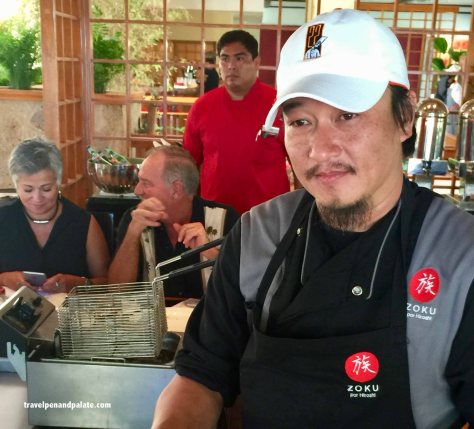
Chef Hiroshi Kawahito
Chef Hiroshi Kawahito of Restaurant Zoku in Mexico City epitomizes the international trend that’s creating Mexican New World Cuisine. Born in Japan, grew up in Los Angeles, Chef Kawahito returned to his home country after university studies in architecture. Drawn to Japanese cooking he honed his skills over a decade and a half before returning to Los Angeles.
Despite a successful Los Angeles restaurant experience, Mexico attracted Hiroshi, and Zoku offered a venue for his imaginative Japanese inspired cuisine. During the 22nd annual Festival Gourmet International held in Puerto Vallarta, Mexico, he was quest chef at Casa Magna Marriott’s Japanese/pan-Pacific Rim restaurant Mikado.
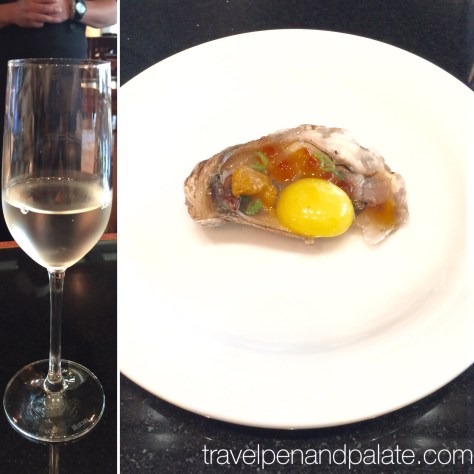
Chef Kawahito’s recipe for raw oysters with sea urchin and quail eggs is not for the faint of heart. Yet for a true lover of raw food, I enjoyed ever morsel. It’s imperative that the ingredients are as fresh as possible and purchased from shops selling the highest quality ingredients.
Fresh sea urchin is available at Japanese or other specialty seafood markets. If you can’t find fresh sea urchin but want to sample this dish simply double the quantity of salmon caviar, or substitute two tablespoons of golden caviar. Gently wash the quail eggs with warm water and dry before cracking them open.
Raw oysters with sea urchin & quail eggs
Ingredients:
12 each fresh oysters on the half shell
2 each sea urchin tongues thinly slivered
2 tablespoons salmon caviar
12 each quail eggs
Preparation:
Shuck the oysters and discard the top shell.
Top each oyster with some sea urchin and ½ teaspoon caviar.
Carefully break a quail egg over each oyster being careful not to break the yolks.
Serve immediately.
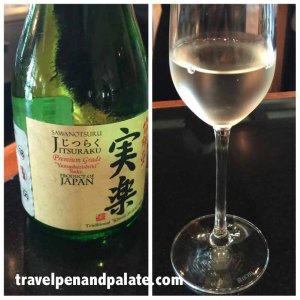
Sawanotsuru Itsuraku Premium Grade Sake
I often don’t think of sake as a dinner wine, but Chef Kawahito dispelled that myth pairing the oysters with a glass of chilled Sawanotsuru Itsuraku Premium Grade Sake. It’s mild umami notes and dry finish were perfect.
When you go:
Puerto Vallarta is served by many international airlines.
Other oyster dishes in Puerto Vallarta: (clockwise from top left) raw, grilled with zarandeado sauce, grilled on coals with butter, fresh oysters on ice, raw served on the beach
You can read more articles by Marc d’Entremont at:
Chef Hiroshi Kawahito of Restaurant Zoku in Mexico City epitomizes the international trend that’s creating Mexican New World Cuisine. Born in Japan, grew up in Los Angeles, Chef Kawahito returned to his home country after university studies in architecture. Drawn to Japanese cooking he honed his skills over a decade and a half before returning to Los Angeles.
Restaurant Mikado at Casa Magna Marriott, Puerto Vallarta
Despite a successful Los Angeles restaurant experience, Mexico attracted Hiroshi, and Zoku offered a venue for his imaginative Japanese inspired cuisine. During the incomparable 22nd annual Festival Gourmet International held in Puerto Vallarta, Mexico, he was guest chef at Casa Magna Marriott’s Japanese/pan-Pacific Rim restaurant Mikado.
The up-scale design of the restaurant with seating surrounding expansive cooking stations allowed participants at Mikado’s festival cooking demonstration an up front experience of Chef Kawahito’s imaginative preparations. Crispy panko crusted giant shrimp from Mexico’s northwest coast rested on a tartar sauce seasoned with Japanese 7 spice. A personal favorite was fresh-shucked local oysters topped with raw quail egg, caviar and sea urchin.
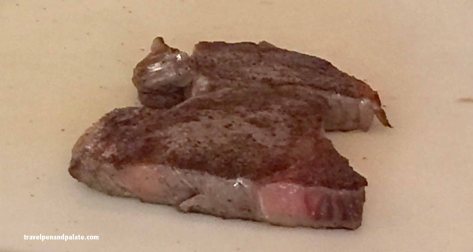
Wagyu rib eye steaks raised in Durango, MX
The key to Mexico’s New World Cuisine is pairing local ingredients with international preparations. Wagyu beef is now raised in Durango. Sea urchin is available in the Gulf of California.
Wagyu Tataki is quick to prepare. The tender barely seared beef blends well with the subtle brininess of sea urchin. It’s a beautiful dish for a special meal.
For the home cook, wagyu beef is available at good meat markets. Fresh sea urchin is available at Japanese or other specialty seafood markets. Salmon caviar can serve as a substitute.
ingredients for Wagyu Tataki
Wagyu Tataki – 2 servings or 4 as a first course
Ingredients:
2 3-ounce Wagyu rib eye steak
2 teaspoons truffle oil
2 slices fresh lime
1/3rd teaspoon Hawaiian black salt or sea salt
2 sea urchin tongues or 3 tablespoons salmon caviar
2 tablespoons Japanese ponzu sauce
1 radish thinly sliced
2 teaspoons finely diced fresh chives
seared wagyu steaks
Preparation:
Thinly slice the sea urchin tongue and set aside.
Heat a cast iron pan until very hot – a couple drops of water should dance in the pan and quickly evaporate.
Sear the two steaks for 1 to 1-1/2 minutes per side. The steak will be rare but not bleeding. Transfer to a cutting board. Thinly slice each steak and arrange on 2 to 4 plates.
Sprinkle half the black salt on each steak and then 1 tablespoon ponzu sauce and juice from 1 lime slice.
Arrange half the sliced sea urchin or caviar over each steak and drizzle each with 1 teaspoon truffle oil.
Garnish with radish slices and fresh chives.
Although this dish is easy to prepare, why not enjoy a vacation in Puerto Vallarta and feast in the full range of New World Cuisine in Mexico’s culinary powerhouse. A historic seaport, dining on the beach, the warm water of Bahia de Banderas, beautiful hotels and guest houses make Puerto Vallarta a safe and easy choice for the whole family.
Wagyu Tataki
When you go:
Puerto Vallarta International Airport (PVR) is served by many international airlines from major cities worldwide.
Swiss Chef Christian Krebs is not personally 100% vegan. But you know the old saying, “happy wife, happy home.” His vegan spouse, Vera Webber, is a second generation owner of the historic and renowned Grand Hotel Giessbach. Among its three restaurants is the vegetarian/vegan Le Tapis Rouge for which Chef Krebs serves as culinary consultant.
(left) Chef Thierry Blouet, (right) Chef Christian Krebs
Based on the enthusiasm Chef Krebs displayed during the 22nd Festival Gourmet International in Puerto Vallarta, Mexico, for vegan cuisine his wife is a successful influence. As guest chef at Café des Artistes, considered by many to be Puerto Vallarta’s premiere restaurant, Christian Krebs took the challenge of proving vegan dishes are not simply a platter of steamed vegetables. He enthralled guests at both his vegan cooking demonstration and the sold-out themed dinner attended by Puerto Vallarta’s food aficionados.
(left) Chef Thierry Blouet, (right) Chef Christian Krebs & staff at the Café des Artistes festival vegan dinner
Yet in a country known for its meat, fish and seafood, Café des Artistes owner/chef Thierry Blouet was not the only one who gave center stage to vegan cuisine during the festival. One of the original founders of Puerto Vallarta’s Festival Gourmet International, this multi lingual Puerto Rico born French expat has made Mexico and Puerto Vallarta his home for decades. The quality of his restaurants have justifiably gained Chef Blouet celebrity status leading with his flagship Café des Artistes located in the heart of historic Puerto Vallarta.
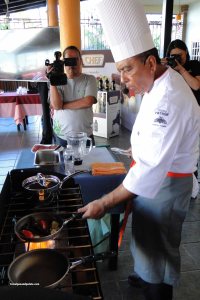
Smiling broadly at the Café des Artistes cooking class Chef Krebs conducted for the festival he stressed that all dishes are fascinating if they start with a good recipe and preparation. Like all excellent chefs, he uses multiple ingredients creating layers of flavor in recipes such as delicate rice flour crepes which held a fragrant filling of sautéed tofu and spinach seasoned with vegetable and herb reductions. Thin slices of sautéed eggplant, onions, tomato and herbs were arranged in individual timbale molds and baked melding the flavors into an eye-appealing dish.
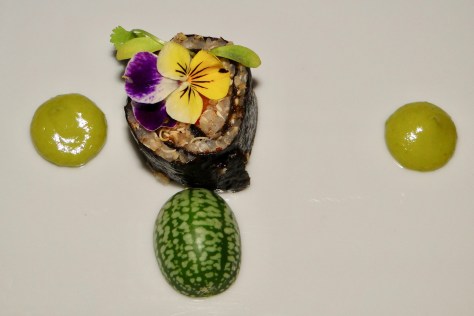
His twist on a vegan sushi roll of seasoned quinoa, papaya, mango and avocado paired with a wasabi scented soya based panna cotta is refreshing and not at all difficult to prepare.
Quinoa sushi with wasabi panna cotta – 4 rolls
Note: make the wasabi panna cotta one day ahead since it needs 24 hours to gel. Use agar not traditional gelatin which is made from animal ingredients.
Special equipment: bamboo sushi mat for rolling
Ingredients for the sushi:
16 ounces (2 cups) water
½ pound (1 cup) quinoa
5 ounces (1/3rd cup) rice wine vinegar
2 tablespoons sake
salt and pepper to taste
1 mango peeled and sliced lengthwise into sticks
1 avocado peeled and sliced lengthwise into sticks
1 small papaya peeled and sliced lengthwise into sticks
wasabi paste to taste
4 nori seaweed sheets
Ingredients for wasabi panna cotta:
4 ounces ( ½ cup) soy milk
4 ounces ( 1/2 cup) soy cream
1 teaspoon agar powder (or 1 tablespoon agar flakes or ½ bar agar)
3 tablespoons wasabi paste
drop or two of green vegetable coloring
chopped fresh herbs (to use as garnish and/or add to panna cotta)
Preparation of sushi:
Cook quinoa in 2 cups simmering water, covered, for 15-20 minutes until water is absorbed and the white “tails” are visable.
Gently stir in rice vinegar, saki, salt and pepper. Cool to room temperature.
Place one sheet of nori on the bamboo mat and gently spread with ½ cup seasoned quinoa.
Spread a line of wasabi paste lengthwise across the quinoa and arrange sticks of sliced avocado, mango and papaya.
Using the bamboo mat, roll the nori tightly. Allow the roll to rest for several minutes before slicing.
Preparation for the panna cotta:
Slowly heat the soy milk and soy cream for 2 minutes, stirring, until the agar melts. Remove from the heat. Add the wasabi paste and combine.
Add the food coloring if desired.
Line 4, 4-ounce custard cups with plastic wrap and fill with panna cotta. Refrigerate for 24 hours.
Unmold each panna cotta onto a plate. Garnish with fresh herbs and arrange the sushi slices.
When you go:
Puerto Vallarta International Airport (PVR) is served by many international airlines from major cities worldwide.
Among the five course festival menu Chef Luis Noriega created for Coco Tropical, the Angus short ribs marinated in a fragrant mixture of sautéed dried peppers, herbs and spices then wrapped in banana leaves and slow braised was something I never tasted north of the Rio Grande.
Barbecued Beef Guerrero StyleChef Luis Noriega
Chef Luis Noriega’s illustrious international career has taken him from Acapulco, European capitals to Chef/Professor at leading Mexico culinary collages. He is chef/owner of Restaurant La Guia in the south central Mexican Pacific coast city of Zihuatanejo. Recently Chef Noriega conducted an in-depth daytime cooking workshop and lunch at Puerto Vallarta’s Coco Tropical for the 22nd Festival Gourmet International.
Unlike many culinary festivals, Festival Gourmet International in Puerto Vallarta stretches over eleven days with dozens of events among one-time theme dinners and brunches, wine and tequila tastings to daytime cooking classes and lunches with guest chefs throughout the city. Additional participating restaurants offered nightly festival menus created by their sponsored guest chefs.
More than one first time visitor to both Puerto Vallarta and the festival commented how they had “no idea” cuisine in Mexico was so varied. The name of one popular American icon of Tex-Mex food was often cited. The breadth of the 22nd annual Festival Gourmet International ranged from Pakistani to Austrian fusion menus.
Yet the festival’s hallmark was highlighting Mexico’s ever evolving New World cuisine.
Chef Heinz Reize & Chef Luis Noriega
Chef Heinz Reize has owned the beautiful oceanfront Restaurant Coco Tropical on Puerto Vallarta’s Malecon for years and is a founder of Puerto Vallarta’s Festival Gourmet International. This is not the first time Chef Noriega has teamed with his old friend.
Wearing gloves, remove the veins from the chilies and as many of the seeds you wish – they contain much heat – and sauté in a hot cast iron pan with one tablespoon oil for 5+ minutes. Add the onions and saute 5 more minutes. Add the tomatoes and cook additional 2 minutes.
Remove pan from the heat and add one cup boiling water – slowly or else it’ll splatter on you. Add the leaves, if available, and soak for 20 minutes.
In a dry small hot cast iron pan quickly toast the ground spices and orange zest stirring constantly for a minutes or until fragrant. Remove from heat.
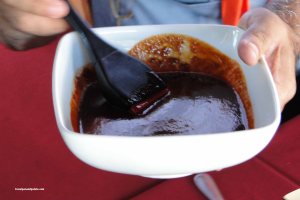
In a blender add the vinegar, chilies, soaking water, toasted spices and dry herbs. Blend until liquefied. Transfer to a small saucepan and, over medium-low heat, simmer until reduced to a sauce.
In a very hot cast iron pan brushed with just a touch of olive oil sear the Angus beef on both sides for two minutes.
Remove the pan from the heat and brush both sides liberally with the chili sauce.
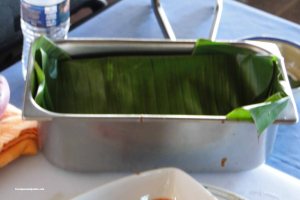
Line a baking dish large enough for the beef with the banana leaves or parchment paper and fold the leaves over encasing the short ribs.
Cover and bake in a pre-heated 240° Fahrenheit oven for 4 hours.
During the last hour gently simmer the diced sweet potatoes with the orange juice, sugar and 1 cup cold water in a sauce pan for 30 to 40 minutes until fork tender. Mash along with the sour cream. Serve with slices of beef.
The dish was superbly paired with a Spanish petit verdot imported by Va de Vinos. This new import company is quickly adding to Mexico’s reputation for embracing fine wines. The deep berries of the petit verdot melded with the rich natural sauce of the braised beef.
Keep in mind, this was a major international festival, but Puerto Vallarta’s culinary scene is smoking every day.
When you go:
Puerto Vallarta is served by many international airlines.
The Tampa Bay area’s premiere culinary event, the St. Pete Wine & Food Festival is a showcase for this vibrant city!
Set against the backdrop of sun dappled Tampa Bay, the 2nd annual St. Pete Wine and Food Festival is in full swing now from November 3 – 6. St. Petersburg, Florida has established itself as an art and restaurant destination on the Gulf of Mexico coast. From stunning restorations of historic hotels to vibrant arts districts and such new restaurants as Sea Salt offering 130 artisan salts to stimulate one’s palate, St. Petersburg is a world class city content that it will be on everyone’s travel and food list.
Grand Tasting from the 2015 festival
One does not normally think of a supermarket chain and fine food in the same sentence. Yet Publix is not only the major sponsor of the St. Pete Wine and Food Festival, it has positioned itself as a choice equal to its amiable competitors Trader Joes and Whole Foods. The surprises don’t end there because a significant percentage of the festival’s profits go to the St. Petersburg Arts Council and the Waterfront Parks Foundation.
Wine selections at the Grand Tasting from the 2015 festivalTequila tastings
Lest one think St. Petersburg is an example of the old joke that Florida is ‘God’s little waiting room,’ The SPWFF attendees are from all age ranges offering such events as Tequila tasting and Beer nights! St. Petersburg is attracting residents from a vibrant cross section of educated world citizens that thrive on the arts, sun, beach, boating and fine food. An explosion of fascinating venues more than satisfies all of these eclectic tastes.
St. Pete Beer Night from the 2015 festival
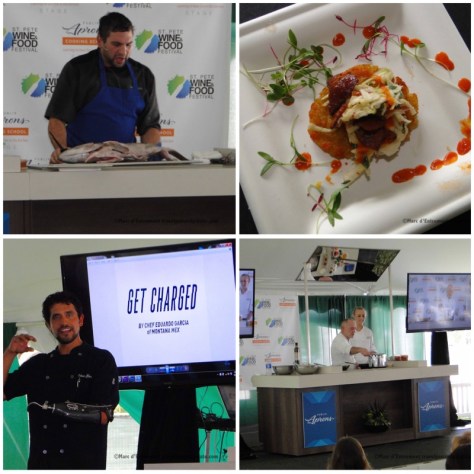
After Beer Night St. Pete tonight November 4 at the St. Pete Wine & Food Festival get ready for the signature event both Saturday and Sunday afternoons November 5 and 6 – the Grand Tasting. Sample dishes from dozens of area restaurants and wineries and watch Tampa Bay’s most talented chefs create signature dishes in the demonstration tent.















 Assemble










 In a blender add the vinegar, chilies, soaking water, toasted spices and dry herbs. Blend until liquefied. Transfer to a small saucepan and, over medium-low heat, simmer until reduced to a sauce.
 In a very hot cast iron pan brushed with just a touch of olive oil sear the Angus beef on both sides for two minutes.
 Line a baking dish large enough for the beef with the banana leaves or parchment paper and fold the leaves over encasing the short ribs.
 During the last hour gently simmer the diced sweet potatoes with the orange juice, sugar and 1 cup cold water in a sauce pan for 30 to 40 minutes until fork tender. Mash along with the sour cream. Serve with slices of beef.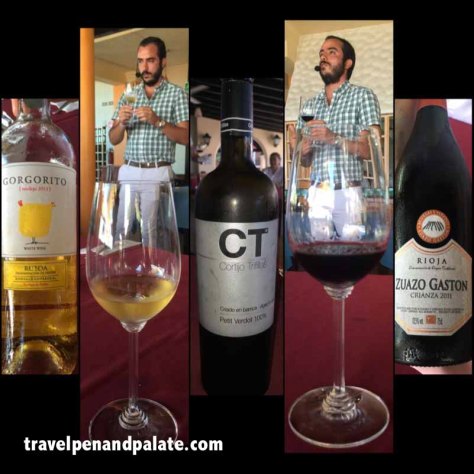



 Travel with Pen and Palate
You must be logged in to post a comment.