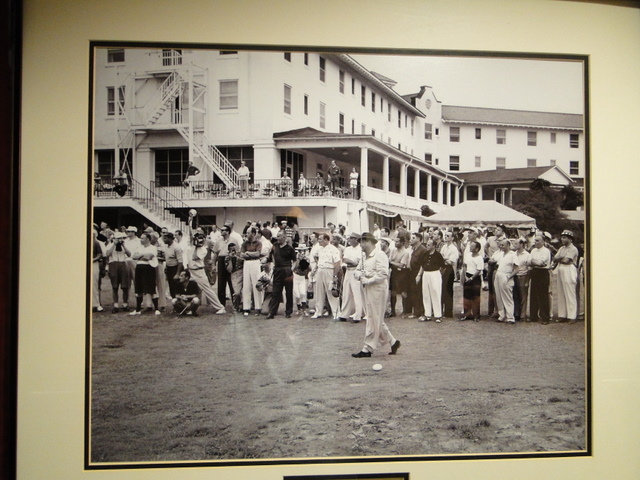
Jackie Gleason learned how to play golf at Shawnee in 1959
“Out with the old and in with the older.”
Shawnee’s Centenary motto
On Pennsylvania’s Shawnee Inn and Golf Resort’s spacious and secluded grounds guard bees congregate on the porch of the hives providing ventilation for the life of the queen. Six varieties of tomatoes, white eggplant, Chinese five-color peppers and multi-colored chard thrive in the middle of one of America’s oldest award-winning golf courses. Micro-beers are being bottled by a former electronics engineer of advanced defense weapons. Goat cheese is delivered fresh from a local farm. The mist on the Delaware River swirls through the tree-covered Pocono Mountains, and Frank Sinatra’s voice croons softly through the 100 year old lobby. This is the 21st Century?
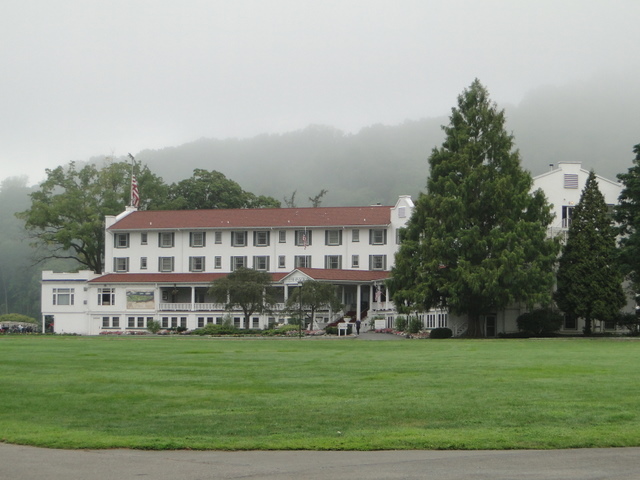
The River SanctuaryShawnee Inn (1911)guard bees in the Apiary – they’re providing cooling ventilation for the QueenChinese 5-color pepper at the Shawnee FarmThe Verandah at Shawnee InnThe Inn in the evening
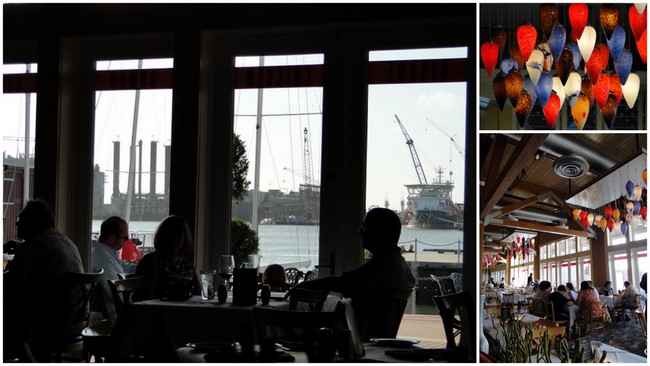
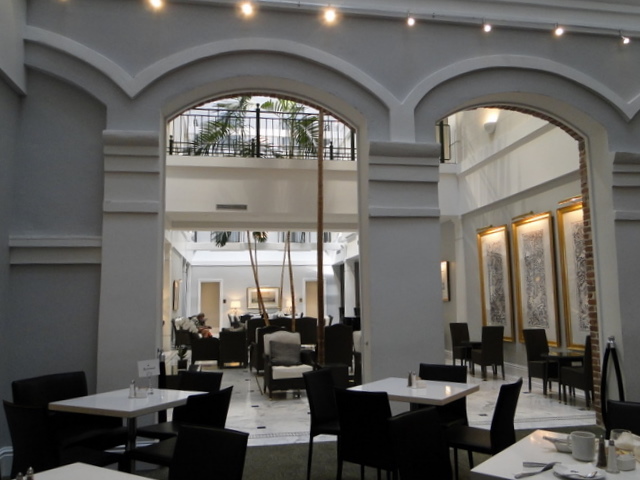
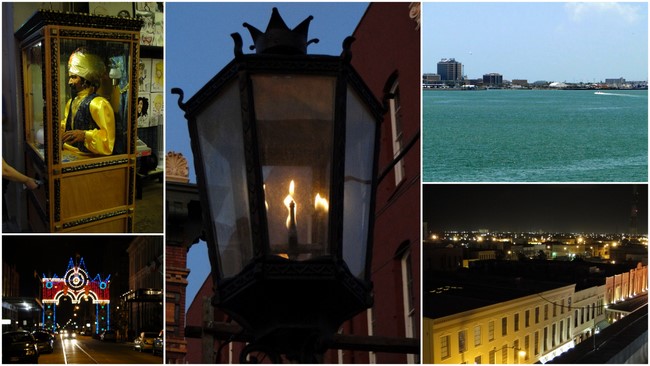
Saltwater Cafe’s decorative lamp, soft sculptures and Silver Spoon Award hanging just below the 6′ Ike water level marker
Galveston, Texas, from breakfast at the Tremont through a late night cocktail at M & M’s, this city should be on any foodie’s culinary map.
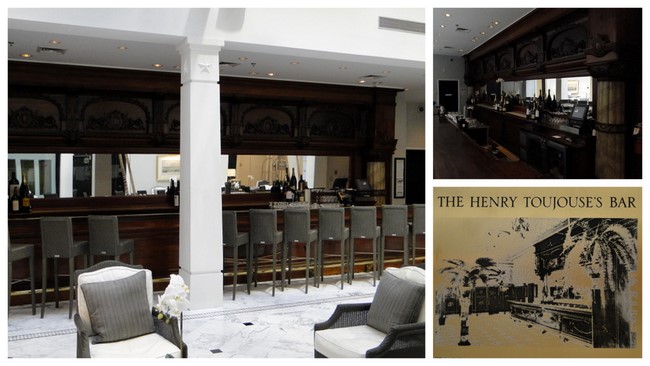
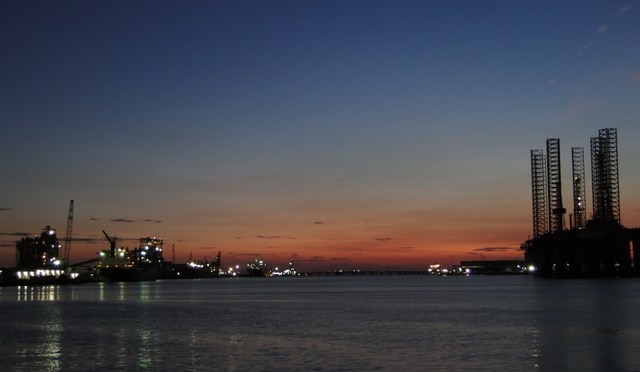
Mosquito CafeShip Channel from Willy G’sM & M Restaurant & BarTremont House Hotel’s restored 1888 Henry Toujouse rosewood bar from the former First Henry’s CafeTremont House Hotel lounge from the Cafe
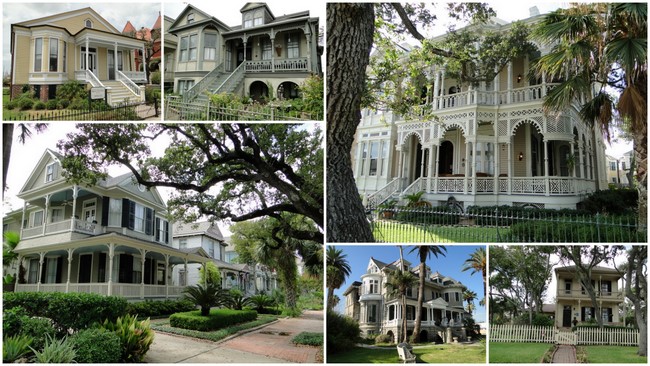
Galveston, Texas, once the New York of the Southeast, is struggling to regain its much deserved prominence among America’s ocean side retreats.
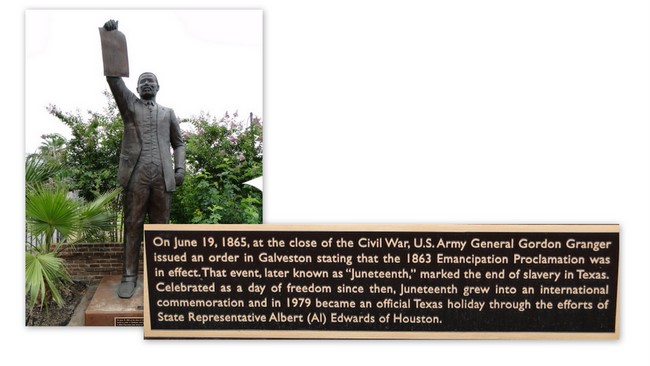
Galveston: Birthplace of “Juneteenth”Galveston Beach, (lower right) Jamaica Beach area of Galveston island
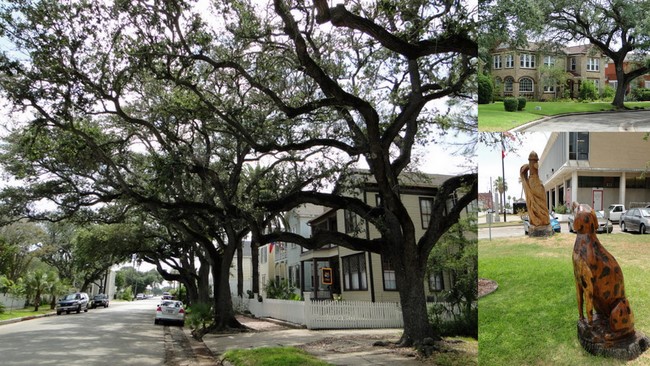
Stately Oak trees once shaded all of Galveston but Ike’s tidal surge killed most of the trees. A city art project has turned dozens of trunks into fanciful sculptures. This one (lower right) is in front of the fire station. (upper right) house in the 1930’s Cedar Lawn district
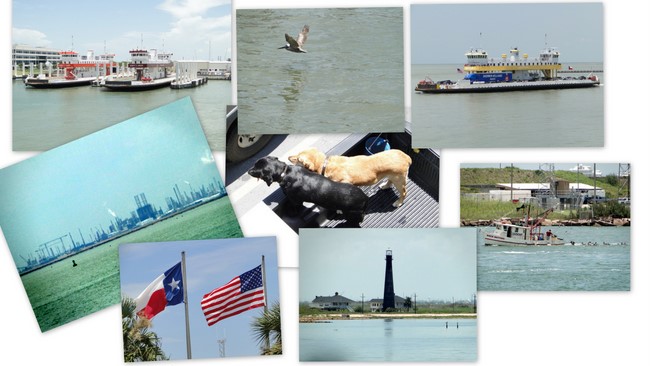
The free ferry service (both car & pedestrian) to Bolivar Peninsula across the Ship Channel and Galveston Bay
“We live and eat from the land. Pachamama is our mother and we have to respect her.” Juana, spiritual healer
Iruya, Argentina
Our guide pulled the Land Rover off the road and stopped the engine. The lights were off; we were in total blackness and silence. I asked,“¿Cuál es el problema?” believing something must be wrong with the car. Opening the door, he replied, “No hay problema. Las estrellas.” As eyes adjusted, the sky was ablaze with stars. The Milky Way was a sash of white gauze. The Southern Cross stood out clearly despite competition from a few million other constellations. Satellites passed overhead. Stars sparkled white, blue and red. The dome of the planet was a Christmas display. At 10,000 feet elevation in the middle of the Andes Mountains, there were no ambient lights to dim the awe we were experiencing.
The Pachamama
No wonder for thousands of years the indigenous peoples of the Andes have worshiped the land as a living force and looked upon the Pachamama – the Earth Mother – as their benevolent protector. The mountain environment provides for the people – pack animals, meat, cloth, water from the glaciers for drinking and irrigating the parched land.
Despite Inca and Spanish conquest, both the indigenous cultures and the Pachamama remain. Jesuit missionaries were far too intelligent to attempt a wholesale, and fruitless, change of attitude. They could understand the correlation between Catholic beliefs in the Virgin Mary with that of the Pachamama and interwove their veneration. Roadside shrines can be seen today in the most remote mountain areas with statues to the Virgin Mary with traditional offerings to the Pachamama of food, jewelry, figurines, coca leaves and hundreds of burning candles.
The Quebrada de Humahuaca
Argentina’s Andean Northwest is home to cultures that have called it home for 9,000 years. Irrigation canals constructed 3,000 years ago still water fields. 3,500 year old villages are alive with people in traditional clothing except it’s not a fashion statement. Hornos, outdoor clay ovens, are the center of the kitchen; adobe houses are constructed as a community effort without power tools.
The ancient village of Tilcara, 1,100 miles northwest of Buenos Aires, is an excellent base to explore the UNESCO World Heritage Site of the Quebrada de Humahuaca. The mountain enclave of Iruya is reached only after a surreal six hour journey. At 13,000 feet, the Salinas Grande Salt Flats seem like a different planet, and not too far north, near the Bolivian border, the legendary Ruta 40 begins its 5,000 mile journey to Tierra del Fuego.
Brown is the color of Tilcara, but don’t let that deter you from staying. Its brown adobe buildings, tan stone streets and dusty countryside provide a beige backdrop for the stunning multi-colored reds, greens and pinks of the surrounding mountains. The brown of Tilcara is also a foil for the bright colors of indigenous handicrafts – multi colored garments made from soft alpaca and llama wool along with many forms of pottery based on ancient designs. The senses are entertained by the aromas from food stalls selling humitas – a creamy corn and cheese mixture wrapped in corn husks – empanadas – an Andalucian savory pastry first made by the Moors of North Africa – fresh grilled tortillas and the incomparable Andean goat’s milk cheese Queso de Cabra.
Angels and Folk Heros
Angeles Arcabuceros
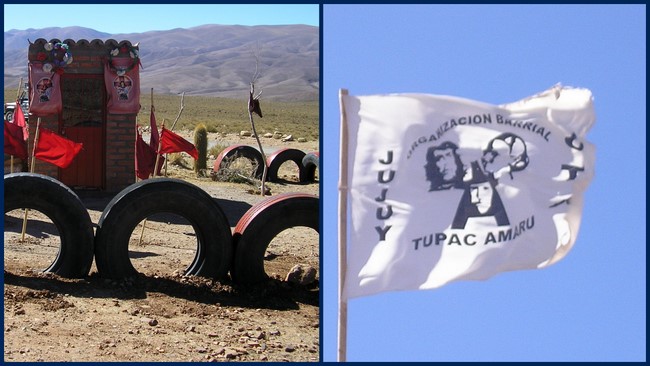
To explore the rugged countryside of the Quebrada requires a four-wheel drive vehicle. Many of the roads are unpaved, twisty and narrow. The journey to Iruya explored a surreal mountain landscape – barren and rocky, nearly unpopulated, at elevations exceeding 9,000 feet – punctuated by tiny villages and steep valleys shrouded in clouds. In Uquia’s 17th century Iglesia de San Francisco de Paula is a priceless collection of the Angeles Arcabuceros(Angels with Guns). The paintings depict winged angels fully dressed as conquistadors bearing guns and swords – not too subtle Spanish Colonial propaganda. Several miles further I spied a road side shrine to folk hero Gauchito Gill. Throughout Argentina, shines to this 19th century gaucho Robin Hood are visible on rural road sides identifiably draped with red banners. He is especially revered in the north where he led a peasant rebellion against landowners, was captured and executed. Numerous miracles have been attributed to Gauchito Gil, and he has a large cult-like following. Red banners and depictions of Gil’s heroism are frequently superimposed on the cross and may be flanked by the unlikely triumvirate of Evita Peron, Che Guevara and the last ruling Inca, Tupac Amaru.
shrine to Gauchito Gill
Our guide had prepared a picnic lunch. Before eating he poured a portion of our drinking water onto the soil. It was the offering to the Pachamama. This was not a gesture to fascinate tourists – this was for real.
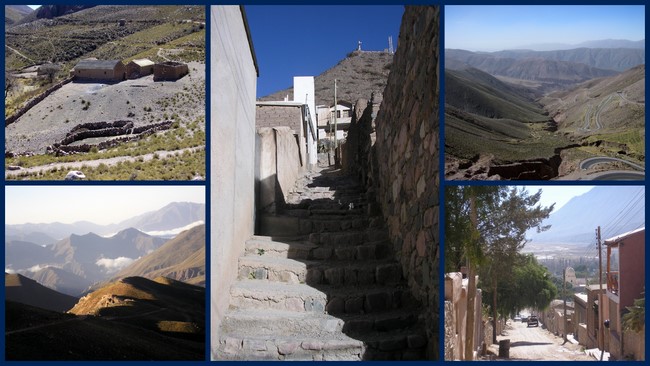
(upper left) a farm at 8,000 feet, (center) staircase street in Iruya, (lower right) Tilcara
Iruya
Iruya, with a population of 4,300 at an altitude of 9,120 feet is perched on the mountainside high above the Rio Iruya. Its white buildings, dominated by its much photographed Igelsia de Nuestra Senora del Rosario y San Roque, gleam in the sun as they rise in a jumble up the green-brown hills. Many of its streets are literally stone staircases and negotiating this labyrinth can be bewildering at first when the street dead ends at the door of a house.
Salinas Grande Salt Flats
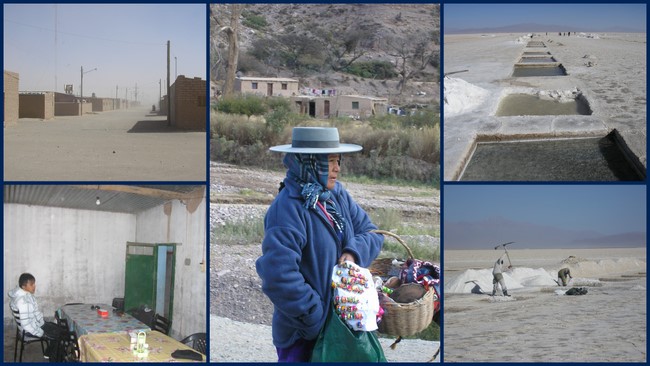
The following day our excursion to the Salinas Grande Salt Flatstraversed numerous switchbacks as we climbed through the spectacle of the Cuesta de Lipan offering panoramas of snow covered peaks and barren steppe. A road side marker indicated the highest point for this route, 13,344 feet. As we descended, the gleaming salt flats came into view. Amid the treeless, brown countryside of the altiplano, the vast Salinas Grande Salt Flats reflected the sun like an immense solar collector. These are among the world’s largest and highest naturally renewing salt flats in existence covering an area of 3,200 square miles. Salt extraction has gone on for decades using unchanged hand methods. Walking on the flats is nothing less than other-worldly. In the thin winter air at 12,000 feet the strong wind was biting yet the experience exhilarating. Sunglasses are necessary – the glare off the salt is blinding without them. The flats resemble cracked concrete except there’s a crunch under your feet.
Comunidad Aborigen Tres Pozas
meat drying in the sun
Comunidad Aborigen Tres Pozas is eight miles west of the flats, and the only human settlement for many miles in any direction. It’s the home for most of the workers and consists of a few dozen simple adobe buildings as brown as the surrounding desert. The winter winds were creating a sand storm. Sand whipped by high winds can find its way through closed car windows and doors lodging everywhere inside your clothing, your mouth, nose and ears. The café, Comedor Las Guapas Salineras, is not an establishment any guide book would recommend for dining, but I’d highly recommend if you want to actualize that overused phrase “an authentic experience.” The education is startling and humbling. For an absurdly small price, coupled with genuine kindness and effort, you dine on simple food in conditions few of us would ever accept.
(right) Comunidad Aborigen Tres Pozas (left) Salinas Grande Salt Flats

















 Travel with Pen and Palate
You must be logged in to post a comment.