Robert Venturi's Silver Tea Service and Paradiso's Tripe
Good food and good tools – a chef’s first love. To wander and discover – a travel writer’s first love. To experience it in your own back yard – nice.
Italy is indisputably a preeminent center for design be it clothing, jewelry or kitchen tools. The Philadelphia Museum of Art’s current exhibition: Alessi: Ethical and Radical, is a virtual catalogue of Alessi kitchen design over the past 75 years. It’s quite literally the catalogue if you browse both the exhibit and their website. Currently operated by the third generation, the family owned Alessi Design Factory is a major supplier of restaurant small ware, home kitchen tools, home and office decor, but it’s the designs and the company’s philosophy that the exhibit in the Perelman Building is celebrating.
(left) restaurant coffee pots (1956) (right) assorted pots - all available
From the simplest restaurant coffee pot to partnerships with some of the world’s foremost designers, artists and architects, Alessi has consistently striven to explore the boundaries of form while not compromising function or quality. Although the titanium tea and coffee set could be mistaken for a sculpture, it is a functioning service.
Titanium Tea/Coffee Service
Alessi is renowned for seeking out artists world-wide and devoting financial resources, space and time allowing them the freedom to create. Philadelphia architect Robert Venturi’s tea and coffee service for Alessi (see picture at top of post) combines spherical form, classic colonial elements and Philadelphia’s own silver tradition.
The whimsical and the practical are both well within Alessi’s vision. The simple Brazilian designed wire baskets with leather binding and the amusing coffee pot show off this side of the line.
Italian Market
Since the Industrial Revolution in the mid-1800’s, South Philly – the area bounded by South Street to the north, the Delaware river to the east, the Schuylkill River to the south and Broad Street to the west – has been Philadelphia’s ownLittle Italy. It’s a compact, densely populated area of neatly maintained row houses, small shops, churches and Union halls. Cars tend to park where ever it’s legal, which seems to be places I’d never suspect. Although much of the heavy industry that first attracted immigrants to the city has vanished, South Philly is still a center for food markets – the famous Italian Market – fabrics and Italian restaurants.
Paradiso Restaurant & Wine Bar
Paradiso Restaurant & Wine Bar at 1627 East Passyunk Avenue, near Tasker Street, is in the heart of South Philly. I was not familiar with the restaurant, but we wanted to eat in the middle of the neighborhood, and we were not disappointed. Early on a Sunday evening, having a table without a reservation seemed fine, but counting the number of regulars, I’d recommend reservations any other night. At less than ten-years old, Paradiso is not a South Philly institution allowing it the freedom to combine tradition with innovation. Chef/owner Lynn Marie Rinaldi’s Rice Pudding ($8.50) with dried sour cherries, cinnamon and vanilla beans, is an award-winning (Philadelphia Magazine 2005) perennial favorite, and if I can believe our server (her brother) the Braised Tripe with Fresh Tomato and Parmigiano Reggiano ($8.50) was their South Philly grandmother’s recipe.
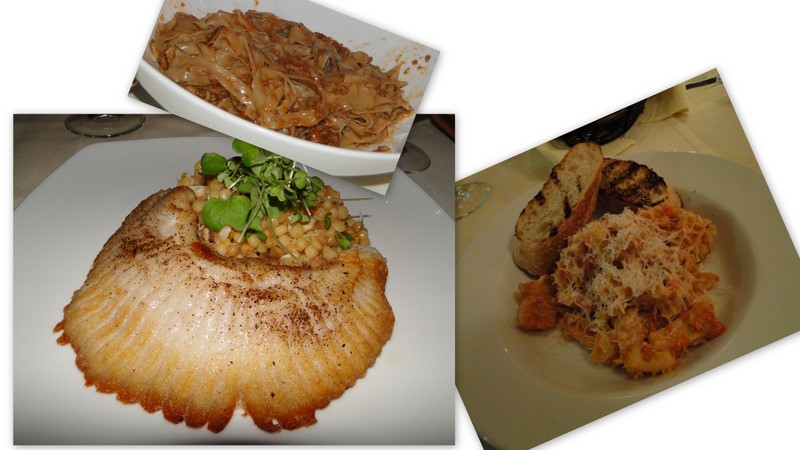
(top) Chestnut pasta with Wild Boar Ragu, (left) Seared Skate and Fregola Sarda with lump crabmeat, (right) braised tripe
The Seared Skate accompanied by Fregola Sarda with lump crabmeat ($22.00), is not a South Philly regular – or even a Philadelphia regular – menu item. Skate is the tender wing of this ray fish and enjoying its natural butter-softness with Paradiso’s well seasoned searing was a rare delight. Fregola Sarda is Italian couscous made by a time-consuming process of rubbing tiny grains of semolina together with a bit of water and toasting them, repeating until you end up with tiny toasted pasta balls that are the size of Israeli couscous – not the tiny Moroccan. Paradiso made it an opulent side dish with the addition of crabmeat. We had not seen Fettuccine with Wild Boar Ragu ($17.00) on a menu since a trip to Siena several years ago. This rich, earthy pasta dish is perfect for winter time, and Paradiso gilded the recipe by adding ground chestnuts to the pasta dough. Paradiso has an extensive wine list, yet on Sunday patrons may BYOB.
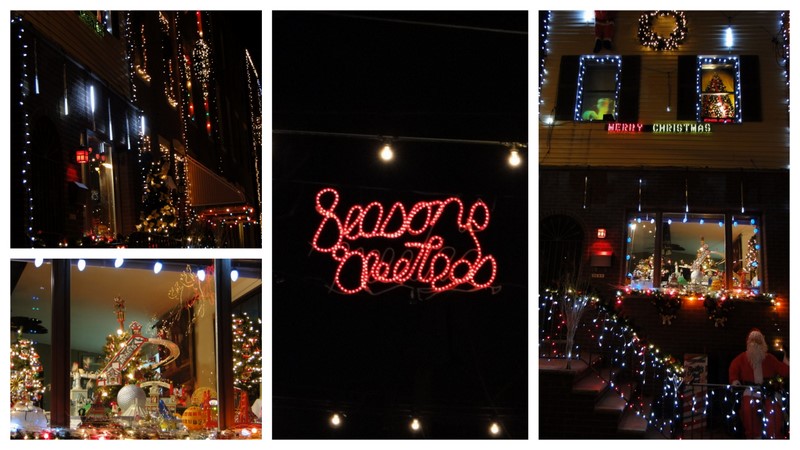
13th St. near Tasker St.
South Philly celebrates Christmas with exuberance. Entire blocks compete for decorating honors and the bakeries overflow with Italian treats. It’s not too early to order your pig, that whole pig, at Cannuli’s in the Italian Market.
And little rivulets from the rocks add beauty to my grove.
I drink the wine my hills produce; On wholesome food I dine;
My little offspring ‘round me Are like clusters on the vine…”
Thomas Livezey, circa 1750
It’s Friday evening and we’re sitting on the great marble staircase having a drink and listening to jazz at the Philadelphia Museum of Art’s Art After Five. Stepping out into the courtyard, the city at night glitters and hums like an urban engine. The following day, we leisurely stroll down Forbidden Drive in bucolic Valley Green after having lunch in an 1850 Inn. Mounted horses pass at full gallop and geese float down the Wissahickon Creek. We’re still within the city. Like all great urban centers, Philadelphia is a city of neighborhoods. Like all great cities, these neighborhoods evolve, and so it is with William Penn’s original square mile city of Philadelphia as well as leafy Chestnut Hill/Valley Green. The future doesn’t always preserve the past, and sometimes that’s good.
an original 19th century stable and one the few remaining trolley linesSwan Fountain (Alexander Calder, 1924) at Logan Circle
William Penn’s original square mile city, bounded by the four squares of Rittenhouse, Washington, Franklin and Logan, still retains an orderly grid. The absence of a glass and steel jungle blotting out the sun, and the presence of 300 year old alleyways lined with colonial houses allows Philadelphia to feel like a home for humans, rather than just an economic engine. Visionary city planners as early as the late 1700’s designed the grand boulevard, the Benjamin Franklin Parkway, that stretches from City Hall/Logan Circle to the Art Museum. It’s hard to experience a finer entrance to a city than the tree-lined, flag bedecked, fountain anchored Parkway. Its space, like a giant front lawn, is shared by commuters, strollers, special events, runners, frisby players, three generations of Calder family sculptures and many cultural institutions. Yet one square mile Philadelphia was an urban economic engine in the 18th and 19th centuries with all the accompanying issues of pollution, muddy streets, poor sanitation and summer “fever” epidemics.
Philadelphia Museum of Art
The 1920’s Greek temple that is the Philadelphia Museum of Art stands, appropriately, on a hill at the far end of the Parkway. Its galleries contain priceless collections spanning millennia. Music and social events are not new to museums, but Art After 5 (every Friday from 5:00 to 8:00) has become a fixture in Philadelphia’s “TGIF” venues. There are a limited number of tables that fill quickly but sitting on the smooth marble of the grand staircase, under the gaze of an enormous backlit “Diana,” creates an amphitheater feel. The central hall rises up one floor to a broad mezzanine where it’s possible to sit as well. Two full service bars and a professional, personable wait staff serve light fare and drinks. It’s an informal, club atmosphere and people wander through the adjoining galleries while the music filters in as doors open adding to the visual experience.
Art After 5 at the Philadelphia Museum of Art
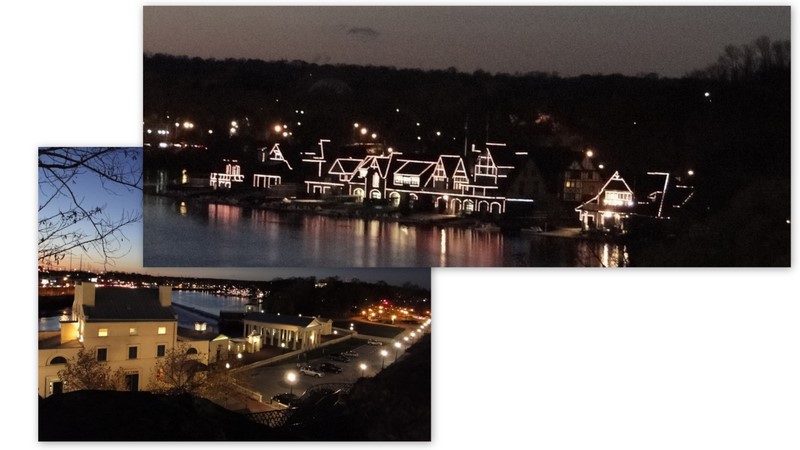
From the gazebos that sits on a rocky promontory outside the museum there’s a nice view of the Waterworks and Boathouse Row.
(top) Boathouse Row, (bottom) the Waterworks
An engineering marvel when it opened in the early 19th century, the municipal Waterworks pumped fresh Schuylkill River water directly into an ever-expanding city. Today its restored buildings house a pricey restaurant, small museum and provide public space as part of Fairmount Park. Boathouse Row stretches just beyond. This collection of late 19th century stone and wooden houses represent generations of private university associated sculling clubs. Although the sport is often thought of in the same league as polo, dressage and fox-hunting, the skill necessary to compete in sculling is achieved only after arduous physical training. In Philadelphia, it’s a serious sport.
Fairmount Park's Valley Green, (top right) Livezey House, 1740
The 1740 Livezey House has that stately look of so many of the well-preserved antique houses in Valley Green and the neighborhood of Chestnut Hill. From the Art Museum it’s possible to hike or bike the five miles on trails that meander through the thickly forested Park, along the river and creek, directly to Valley Green and Chestnut Hill. Yet except for the pre-1870 houses, little of this countryside was bucolic as late as the 1870’s. The banks of the Schuylkill River and Wissahickon Creek had been denuded of trees for nearly 200 years and over built with a series of small company towns while its polluted waters were harnessed to provide energy for the mills that were part of Philadelphia’s economic engine. Mr. Thomas Livezey made a nice fortune from his Wissahickon Creek mill but his surroundings were certainly not as attractive as today.
Rittenhouse Town
It was the threat to Philadelphia’s drinking water that spurred the building of the long-planned 9,000 acre Fairmount city park. Its serpentine shape deliberately included both the Schuylkill River and Wissahickon Creek within its boundaries. Gone were dozens of Colonial and early 19th century mills, houses and entire small company towns. The Park-owned historic Rittenhouse Town is an exception and provides a glimpse of life when it was a company town/suburb to Philadelphia’s one square mile city. Yet since the town’s business was paper making one can be sure few trees existed when it was purchased by the Park Commission in the 1870’s. Restoration of the watershed, over a century later, is still ongoing. These generally affluent neighborhoods today have the look and feel of story book versions of leafy, bucolic Colonial villages, and yet they’re within the bounds of a 21st century city.
interior of Valley Green Inn
The Valley Green Inn on Forbidden Drive (cars were banned in 1920) has been open since 1850 but with a checkered history. In the past few years it seems to have secured its future as a venue for fine interpretations of classic American and Continental fare. It’s setting directly on the Wissahickon Creek with its antique decorated dining rooms make it an ideal venue for any occasion. There’s nothing better than taking a walk along the 7-mile Forbidden Drive after lunch nearly any time of the year, and if you’re riding your horse, you can still hitch it to the posts outside the Inn.
(I am posting some photos not printed with the articles)
(Top)model of San Ignacio Mini, stone carving detail (Bottom) ruins of church facade, on-going restoration work
(Top) native Guarani, ruins of mission housing (Bottom) irrigation canal, school and countryside
(Top) Quiroga's motor bike & first house, (Bottom) interior and exterior of second house)
and
Global Writes, the 54 year old journal of the International Food, Wine and Travel Writers Association (http://global-writes.com/ ) published Sweet Fire in Ushuaia, my article on the incomparable food enterprise Dulce Fuego in Ushuaia, Argentina run by 20-something-year-old chefs.
staff of Dulce Fuego, grilled Patagonian Trout, and Ushuaia, Argentina (the southernmost city on Earth)
The unexpected fireworks were free, in celebration of the 2010 New York Marathon that would be run the following day. We had just stepped out of Pasha Restaurant on West 71st Street, when the booming commenced. It was an unexpected end to a pleasant Turkish dinner, one of the great cuisines. The interior of Pasha is comfortable with soft lighting and well modulated background music. From 5:00 to 7:00 PM the $23.95, 3-course, prix fixe menu is well thought out attracting repeat customers with five choices from the main menu (not the boredom of so many prix fixe selections.) My wife had the prix fixe with a salad, Piya (Cannellini beans tossed with sweet onions, scallions, parsley, tomatoes, and extra virgin olive oil) with warm flaky rolls to absorb the herbs. Alabalik Tava followed (Boneless brook trout dusted with cornmeal and pan seared). Dessert was a wedge of perfect baklava – (non-syrupy) – spice, nut and honey infused pyhllo pastry. For $24.95, I had the fish entrée of the day: a whole, wood-grilled Chilean Sea Bass. Its moist white meat was encased by its crispy, herbed skin. Side dishes were crisp, steamed vegetables and an herb-infused rice pilaf. It was not wise to arrive on a Saturday night without a reservation – even if it was only 5:30 PM. Yet Pasha was gracious and had a table that was not booked until 7:30 PM, but I would recommend reservations since the dinning room was full by 6:30.
At West 78th’s Drilling Company Theater, we attended a moving and jarring new play, superbly acted and produced by this award-winning 11-year old company. Eric Sanders’ Reservoir is a heart wrenching look at the psychological detritus of war – the “survivors”. At $18/ticket, the Drilling Company proves that top theater is found everywhere in New York before it moves on to $200/ticket on Broadway. Saturday evening’s dinner, theater (and fireworks) cost less than $130/couple.
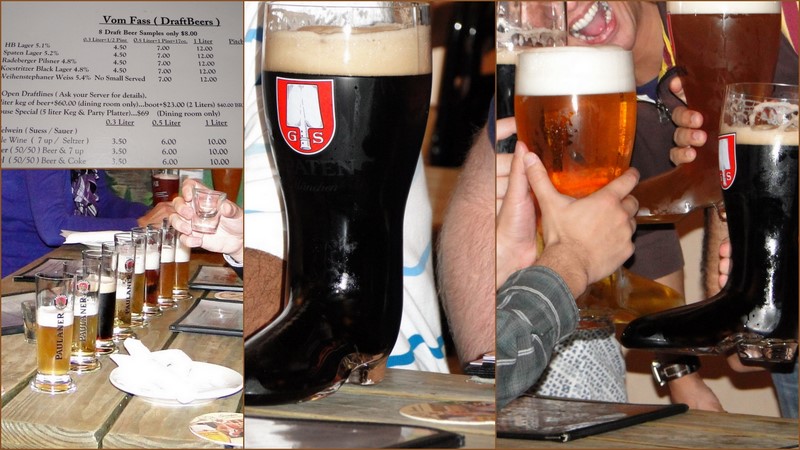
(Bottom left): beer flights w/schnapps, (center & right): "boots" of beer at Lederhosen
Actually, Lederhosen Bierhaus is not nearly as kitsch as their home web site suggests. On Grove Street, off Christopher Street in the trendy East Village, Lederhosen has the atmosphere of a neighborhood bierhaus. In my two visits, over a six month period, I’ve yet to see any staff wear either lederhosen or rhinestone decorated milk-maid dresses. Of course, I’ve yet to order the decidedly college-fraternity sized boot of beer. In smaller, more manageable quantities, their superb selections on-tap, and in bottles, set the stage for equally authentic Bavarian bierhaus food. Main courses ranged from the classic Schnitzel to sautéed herring fillets with mushroom sauce (I had that). Each generous portion comes with a variety of sides, minimum four – green and red cabbage slaw, potato salads, sautéed potatoes, bean salads, spatzzle. (average entrée $10 – 19) Soft, aromatic, in-house pretzels are served with german mustards ($3.00) along with a variety of wurst on crispy rolls with toppings ($5.00), appetizers for pickle and herring lovers ($5.00) and generous soups and sandwiches ($5.00- $10.00) round out a menu to be enjoyed in a convivial atmosphere that’s hard to top – unless you just really don’t like German food, but then…you can always try their flights of beer (8, I believe) with shots of schnapps.
On our first visit to Lederhosen we were with an Austrian friend who was impressed with the quality of this everyday German pub faire. In the picture above the three dishes are from left: Boneless Herring Fillets with a choice of sauces ($10), Currywurst grilled beef sausage ($5.00) and Wiener Schnitzel ($17) Ah yes, those are lederhosen hanging from the ceiling (top left). The restaurant has three small rooms that fill quickly for lunch and dinner. Reservations are not accepted except for special occasions, but waiting times are typically not long, and you can always have a beer while you stand in the social bar entrance area.
a rare 1930's WPA reverse painted glass mural (protected with a plexiglass cover)
Marie’s Crisis Cafe, 59 Grove Street,is oddly unique in bridging a number of Lower Manhattan social stages. The below street level bar is dark as should be expected when in an 18th century building – once home to Tom Paine, where he penned his famous revolutionary essays The Crisis Papers. It went down-hill after that going from bar/brothel to worse until Prohibition (by the 1920’s it was known as Marie’s). After Prohibition’s 1930’s end, Marie’s somehow qualified for a stunning WPA funded reverse painted glass wall mural depicting both the French and American Revolutions, launching a new era.
On Grove Street just off Christopher and 7th Ave, (and only 4 or 5 blocks from the Lederhosen) this area of the Village was always known for being largely gay, hip and culturally cutting edge. For over 35 years the latest reincarnation of Marie’s Crises Cafe has witnessed the neighborhood’s transformation from grunge to designer chic. Yet Marie’s Crises Cafe has remained a relaxing, straight-friendly, singing piano bar and neighborhood hangout. My wife, friends and I have spent several evenings enjoying the ongoing concert with professional theater pianist playing at the separate piano bar. The pianists of the evening have terrific voices and encyclopedic musical theater repertoire, but its the participation of patrons that take Marie’s to a different level. We’re not talking karaoke here. Regular patrons at Marie’s are often the seasoned professional as well as the young aspiring male or female stage singers. There is more standing room than sitting room and the bar is basic but inexpensive ($6 – $7/beer and $8 – $10/shots and drinks). Yet there’s no cover for this top-notch entertainment.
Between Lederhosen Bierhaus and Marie’s Crisis piano bar, a Friday evening in Manhattan’s Village for two, with dinner, entertainment and drinks cost us less than $100.00
Lower Manhattan from the Staten Island Ferry
We were staying with a friend on Staten Island, a pleasant, free, 20 minute ferry ride that passes Governor’s Island, the Statue of Liberty and Ellis Island, but it’s viewing Manhattan at night that’s magical. Staten Island’s an article in itself, but one restaurant stands out, amidst a sea of mediocrity.
(Top) Oysters Rockefeller, Rack of Lamb, Seafood Stew, (Bottom) Seafood bake, antique Italian glass chandelier, and Gumbo
We had Sunday dinner at Bayou Restaurant, 1072 Bay Street, in the middle of a nondescript commercial strip. Yet there’s nothing nondescript about the execution of its Louisiana inspired menu. My wife, a New Orleans native was impressed with the Cajun Seafood stew, our friend’s Seafood bake and my rack of lamb – all with Cajun spices and Louisiana’s French/Spanish inspired sauces. Dinner per person, with wine and tip, for 3 was $136.00 ($46/per person). Everything else we did that day of the Marathon was free(no, we didn’t run…now if it was a hike…).
True, we spent the weekend at a friend’s apartment, but before the invitation, I had planned to use some rewards points for two-nights at a first class Manhattan hotel that, without points, would have cost $600 for the weekend. Responsible use of travel reward credit cards can result in significant savings on future trips.
For a bit over $350/couple we had dinner and entertainment for three weekend days, two nights, plus subway fares on the city’s efficient, renovated system. Manhattan on a budget? Actually, no – Manhattan on the smarts. With a little reading/skimming – New York Times (paper or on-line), New Yorker magazine and blogs – it’s easy to create a list of favorites.
window poster on office building on Madison Ave.
There’s nothing like New York…at least to visit for a weekend.
I well remember the crumbling elevated rail (the Hi-Line) from 34th street to the warehouses, bakeries and docks 13 miles down Manhattan. To my teenage eyes in the 1960’s it was all part of the look and aromas of the exotic multi-ethnic, working class warrens of Chelsea and lower Manhattan. Forty years later the area still retains a touch of the exotic even if its present day residents vacation in the ancestral countries, eat in the upscale ethnic restaurants and live in multi-million dollar condos.
from the Hi-Line:(upper left) ultra modern meets (center) early 19th C. (lower left) commercial meets (upper right) early 19th century brownstone (lower left) the Empire State
The 1929 Hi-Line rail link ceased in 1980 and crumbled until gentrified Chelsea residents created the Friends of the Hi-Line in 1999. In just ten years, this dynamic organization cut through the bureaucracy, gained powerful supporters, financial backers and opened the first of three sections of what is a unique urban elevated park.
Hi-Line Park
The High-Line’s design is a deft melding of urban chic, live performance art, natural landscaping incorporating the essential rail road backbone, art installations, arts & crafts, cafe stalls and a tiered public plaza overlooking Tenth Ave.
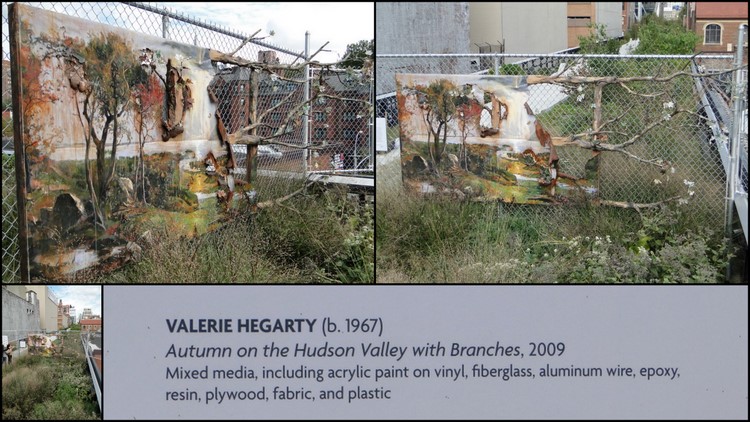
Valerie Hegarty’s art installation actually hangs on the fence that separates Section One from continuing construction on the remainder of the park. A stroll on a pleasant autumn weekend afternoon was relaxing and stimulating in only a way great urban centers create. Yet where Central Park hides the visitor from the city, the High-Line provides a panoramic view.
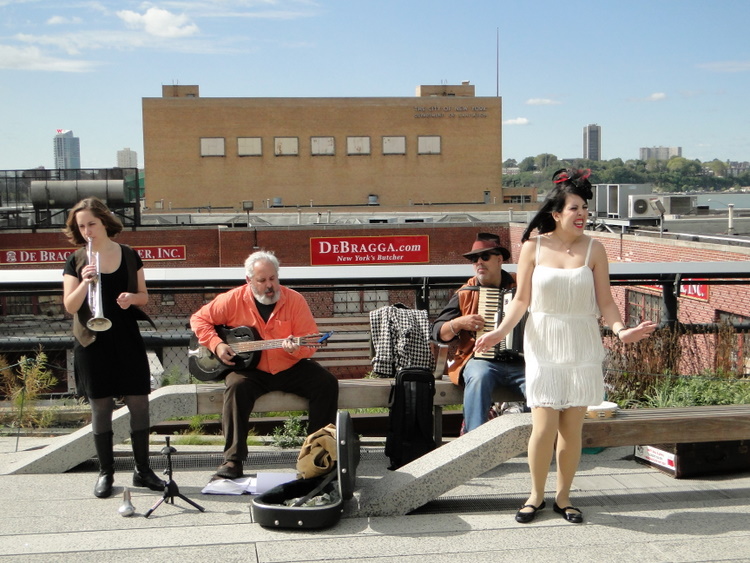
Even if you just need to walk the ten blocks from Gansevoort Street on 10th Avenue in Chelsea up to 20th Street, then why not use the Hi-Line rather than street level. You might even meet up with a …oh wait…that was the 1960’s. This doll’s a great 1930’s jazz singer, on the Hi-Line.
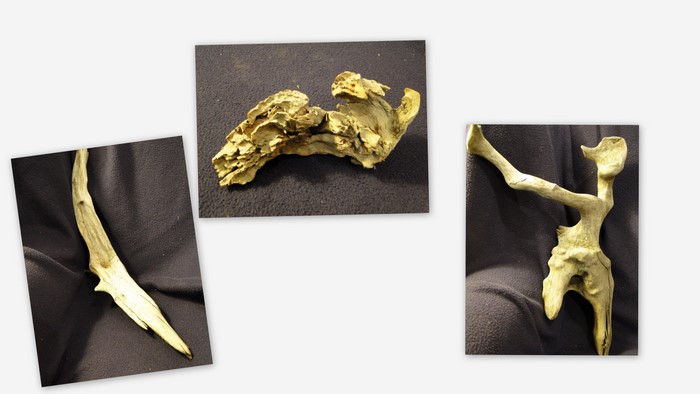
“I’m not an artist; I’m not a wood carver!” Ralph was emphatic, “I don’t know how to take a piece of wood and make anything.” With strong calloused hands, Ralph Eyre held a gnarled silver gray piece of driftwood up to the light filtering through a sawdust caked window of the century old shed that was his workshop. “I just see the bird in the wood; I don’t carve it. It’s there.” His finger touched the smooth wood and traced the outline of the neck then the beak. “See, there’s its eye,” his finger pointed to a small dark knot then flowed down a graceful back to the end of its tail feathers. His blue eyes gleamed with a child’s reality of the obvious. This was not a metaphysical moment. The bird was in the driftwood, and I could clearly see its presence. After a dozen years visiting Ralph, purchasing many of his birds, watching him work and listening to his stories, I didn’t just believe him; I saw the bird before his finger touched the wood.
Ralph and Winne Eyre in 2002
For forty years, with the assistance and fierce devotion of his wife, Winnie, Ralph Eyre found over 20,000 birds hiding in the driftwood roots of native Nova Scotia spruce, sumac, white cedar and barberry. I had the great fortune of interviewing Ralph and Winnie in 2002, their last year at the 100 acre farm outside Yarmouth, Nova Scotia. Winnie passed away in 2006 and Ralph followed in 2007 at the age of 90, but their legacy lives on.
Like living birds, no two of Ralph’s driftwood creatures are alike. “It’s nature’s way of imitating art. I just release them from the wood,” he said without pretension. Mounted on exquisite pieces of driftwood, they have found homes throughout North America, Europe, Japan, and “I know there are a few in Vietnam.” With no advertising, Ralph was living proof that it it’s good enough they will come. And they came back to the Eyre’s farm summer after summer, bringing friends, relatives and the friends of relatives. I know; I was one of them. I also know I’m not the only one who gave more as gifts than I kept.
Each bird began its life as a weathered piece of driftwood, 90% of which were tree roots. Ralph became fascinated with the intrinsic beauty of tree root driftwood in the late 1940’s while stationed in the Yukon. He observed the techniques and styles of several First Nation craftsmen. In the late 1950’s, while on a camping trip to Nova Scotia’s Lake Rossignol, Ralph was stunned by the quality and quantity of its driftwood. “It must have been stacked 20 to 30 feet tall on the shore.” While others were looking for First Nation artifacts, “I loaded my canoe. It must have looked like a crazy driftwood freighter.”
As Ralph and Winnie explained the process, I watched their eyes sparkle from both the pleasure they found in their work and the obvious love for each other – when Winnie passed away in 2006 they had just celebrated their 63rd wedding anniversary. Their tools and methods were simple. “I start with collecting tree roots that have been submerged in the lake maybe for 30 or 40 years. They’re dead but preserved. Many are riddled with worm holes. That gives them character and texture.” For at least a year hundreds of pieces lay on long wooden tables outside his workshop drying in the sun. He studied a seasoned piece of wood, discovered the bird and traced its outline using a black crayon. Depending on the size of the piece, he used a chain saw and/or hand axe to cut away the wood trapping the animal. A wood rasp and disk sander was applied to reveal its form. Winnie then joined the process by hand sanding, giving each piece a smoothness that rivals silk and highlighting the subtle shadings of color and grain unique to each piece of wood. After applying sanding sealer and roughing the surface slightly with steel wool, she used ordinary neutral Kiwi shoe polish that added a soft, rich glow. “No verithane,” Ralph said, “too glossy.”
Another piece of driftwood was carefully selected to provide the base. Nothing was altered on this piece, “I want a polished bird on a natural wood base. Maybe it’s a single bird resting, or ready to take off, or a family with the daddy bird off to the side protecting the mother as she looks at her eggs.” Eggs were beautifully painted nodules of sea kelp resting in a nest of hay in a natural hollow in the wood. “Selecting the right piece of wood for the base is important”, Ralph added, “It gives the bird a story.”
seal resting on the shore
Stories were important to Ralph and Winnie. A back room of their barn/showroom was the “museum.” They discovered more than just birds in the wood. On one table was an exquisite driftwood shoe complete with the Old Women and all her children. Within a wire cage was a driftwood tree with dozens of swinging monkeys from its branches. A collection of mermaids and sea animals sun themselves on ocean worn rocks. An entire circus train with each wooden carriage containing animals is now part of the permanent folk art collection of the Art Gallery of Nova Scotia – the premiere museum in Halifax. None of these were ever for sale, but I knew more than one child that was gifted with a dinosaur or lizard while their parents perused the hundreds of birds on display.
Mermaid and sea animals sunning on the shore
Ralph’s vision didn’t stop at animals. He discovered the perfect piece of driftwood, weighted with just enough embedded rocks to make a fascinating lamp base. Or the correct oval piece, with a slight indentation, for a free form fruit bowl.
Their playfulness and joy in living makes using the term “National Treasure” trite, and they would have been embarrassed if I had insisted on that title. Yet the prices that they placed on their creations were an embarrassment. After 40 years (late 1950s – early 2000s) and 500 works of art per year, the average prices ranged from $10 to $25. On many occasions Ralph would tell me that few people would want to pay more for his simple birds. When I ask again, “Why do you sell the birds for so little?” Winnie jumped right in without hesitation and with genuine enthusiasm, “Because of all the people who come and visit us! We love the people. We get cards at Christmas from all over, and they come back and bring their friends. It’s just wonderful! They might not come back if we charge more.”
Many a business person would question this economic wisdom, but for Ralph and Winnie Eyre, they saw a treasure hiding in the driftwood that few people will ever discover – the secret to a life fulfilled through the sheer pleasure of following their passion.
log cabin on small lake Ralph built for picnics on their Yarmouth farm
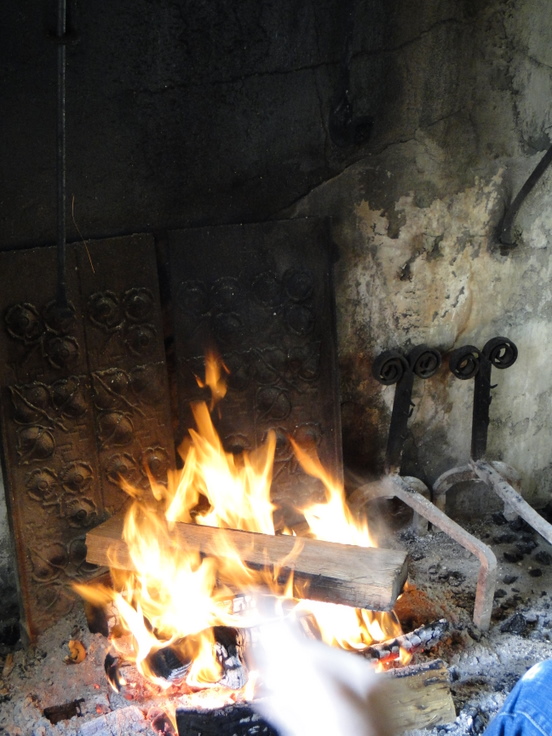
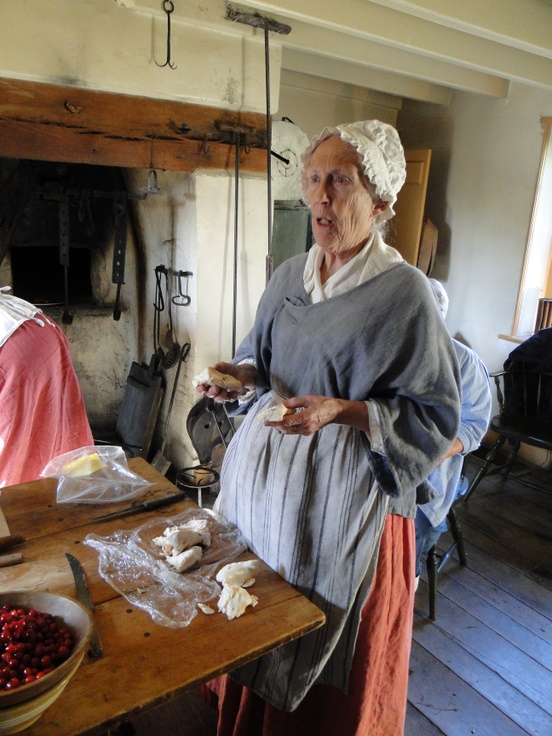
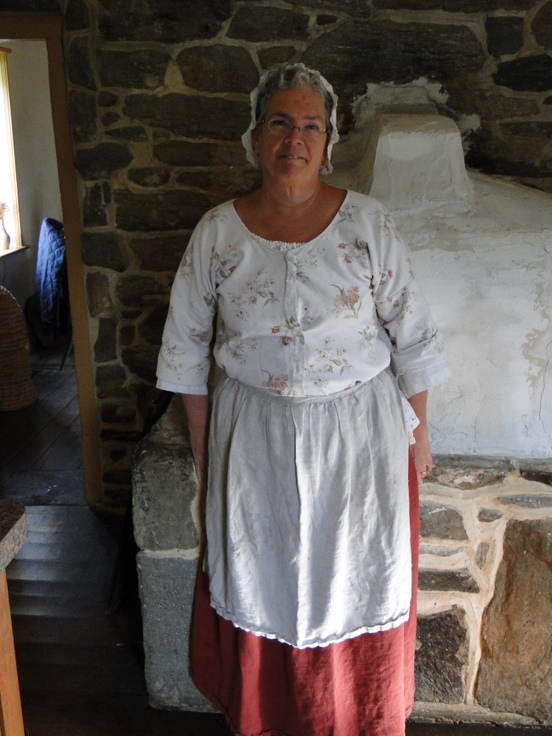
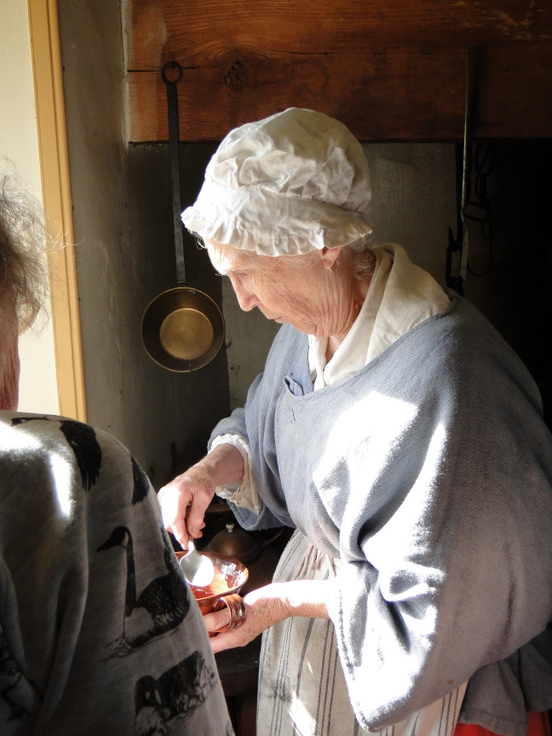
The fire’s roaring in the kitchen of the 1696 Thomas Massey House, trying to take the chill out of the beautiful autumn morning in this 17th century stone house. Eight of us are gathered around a colonial cooking icon – Clarissa Dillon, Ph.D. I’ll refrain from using the word “legend” since I heard one well known Philadelphia chef recently reject that term when applied to him saying, “I can’t be a legend; I’m not dead yet.” Neither is Dr. Dillon, an octogenarian who next year on her annual trip to the British Isles will study whiskey distilling in Scotland.
Clarissa Dillon, Ph.D.
Clarissa is one of the foremost authorities – and she’ll freely say still a “student”- of 18th century American Colonial cooking, farming, gardening and household activities. I’ll leave all the details to your exploration of her web site. Needless to say, she’s a stickler on authenticity – writing, editing and traveling extensively to get the facts and set the history books straight.
A life-long teacher, she conducts seminars, cooking and gardening classes at many 18th century historic homes that are the legacy of William Penn’s Pennsylvania colony – Pennsbury Manor, the Wyck and Morris Mansions, Pottsgrove Manor, Anselma Mills, Ephrata Cloister just to name a few.
Thomas Massey House, 1696
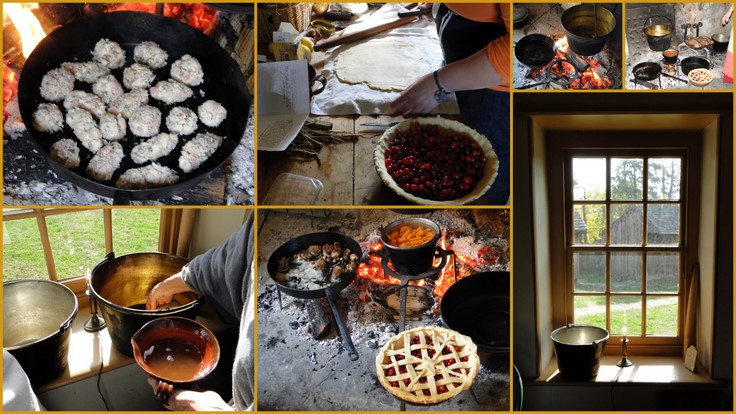
On this Saturday morning we are learning about, and preparing, an autumn dinner on an open hearth using 18th century utensils with vegetables and herbs from the Massey House garden.
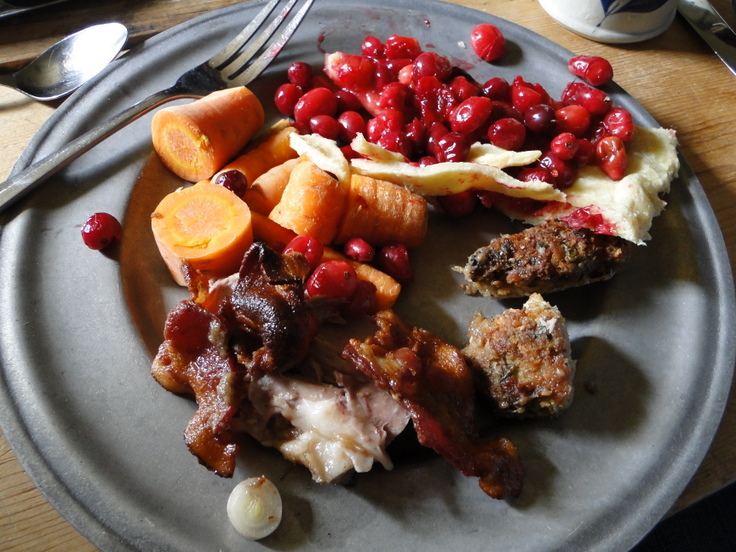
Stewed duck with bacon and veal forcemeat
Boiled Carrots
Boiled Scorzonera
Cranberry Pie
Hard cider
It’s confusing at first when I hear the word “receipt” used instead of recipe, but our modern word is, well, 20th century. For years, receipt meant cooking preparation instructions as well as accounts, and even Dr. Dillion says it’s often confusing until she sees the actual document.
Colonial American receipts were, for the most part, English, which makes perfect sense. After all, we were English colonies with very English sensibilities. Catherine Brooks, The Complete English Cook, 1762, was one of the popular sources for Colonial kitchens.
Brooks’ receipt for Stewing Ducks Whole: (all receipts are written in 18th century format)
Draw your ducks (pluck the feathers, etc.) and wash them clean, then put them into a stew-pan, with strong Broth, Anchovy, Lemon-peel, whole Pepper, and Onion, Mace and red Wine; when well stewed, put one piece of butter and some grated bread to thicken it; lay force Meatballs and crisped bacon round them and garnish with Shallots.
To translate: for 8 servings – 2 to 3 whole ducks covered with water or chicken stock. Add 5 to 6 chopped anchovy filets, peel of one lemon, 12 – 15 whole pepper corns, and one large onion chopped, 1 t. ground mace, and 1-1/2 cups red wine. Simmer until ducks register 165 degrees with a meat thermometer. Remove the ducks from the stock and keep warm. Strain the stock. Skim as much fat as possible. (If you prepare in advance, refrigerate both the ducks and the stock overnight. All the duck fat will solidify on the top and you can simply remove it.) Return to the fire, or stove, and add 1 to 2 cups of bread crumbs and ¼ pound of butter. Simmer until thickened.
Anchovy fillets, and other small salted fish, had been used since pre-Roman days as a salt substitute. Until the 19th century, salt was an expensive item commonly used for food preservation, not in a bowl on the dining table unless you were very rich!
Catharine Brooks’ Veal Force-meat Balls:
Take half a pound of suet, as much veal cut fine, and beat them in a marble Mortar or wooden bowl; have a few sweet Herbs shred fine, and a little Mace dried and beat fine, a little lemon-peel cut very fine, a small Nutmeg grated, or half a large one, a little pepper and salt, and the Yolks of two eggs; mix all these well together, then roll them into little round balls, and some in long ones; roll them in flour, and fry them brown.
To translate: for 8 servings – I’d use 3/4th pound each suet and ground veal. Buy suet from a butcher or good grocery store (DO NOT use suet for birds!!!) and chop very fine in a food processor. Add 1t. crushed dried thyme, 1 T. fresh minced parsley, 1/2 t. nutmeg, ¼ t. mace, ½ t. grated fresh lemon peel, ¼ t. each salt and pepper and the egg yolks. Roll into balls and coat with flour or bread crumbs. Fry in butter.
Bacon: Cut half a pound of sliced bacon into thirds and fry until crisp.
Presentation: Arrange the ducks on a platter, arrange the meatballs and bacon around the ducks and sprinkle with 2 sliced shallots. Serve the gravy in a separate bowl.
Stewed duck with veal force meat and bacon
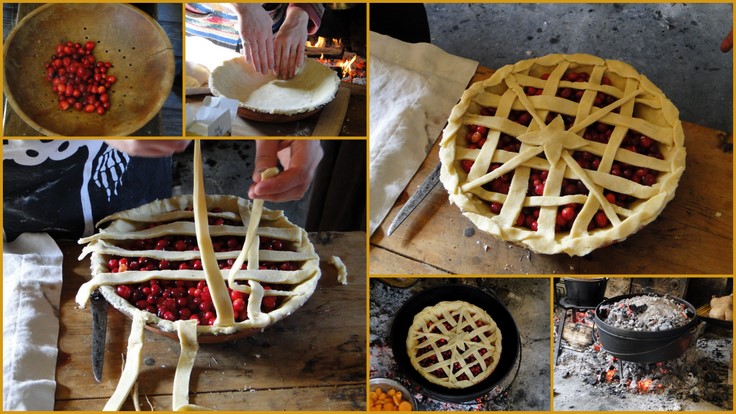
In the 18th century, pies were generally thought of as savory dishes whether made from beef and kidneys or fruit. Ann Peckham’s 18th century Cranberry Pie was meant to be served as a side dish. As a counter point to the richness of the Duck dish, the tart cranberries and flakey crust were terrific. In the 18th century, the crust was frequently so thick it was not meant to be eaten. It served as the “dish” from which the filling was spooned out.
Cranberry pie
Ann Peckham’s Cranberry Tart:
Roll a sheet of tart paste, put it into your dish, boil up some cranberries with loaf sugar; when cold put them in, and trellis them over with the puff paste, cut a border out to lie round your dish, and bake it.
To make the paste for tarts: Take a pound of flour, and half a pound of butter, rub the butter into the flour, two eggs, and a little water, and make it into a paste.
To translate: Make the filling by combining 1-½ pounds of fresh cranberries and 1 to 1-½ pounds of sugar. Place on the fire, or the stove, and bring to a boil. Simmer for 10 to 15 minutes. Drain through a colander. (Reserve the liquid, if you wish, adding ½ to 1 pound more sugar. Bring to a boil until reduced by half, and you have a cranberry syrup to use on pancakes, etc.)
For the crust: Cut the butter into the flour either with two knives, a pastry blender or in a food processor. In the bowl, using clean hands, lightly rub the flour and butter together to coat the flour with the fat, BUT don’t knead it together like bread. The heat in your hands will melt the butter and toughen the dough. Add the eggs and combine with a fork. If the mixture is not combining into a ball sprinkle in a little ice cold water just until the dough forms. Roll out 2/3’s of the dough and line a deep pie pan. After the cranberries have cooled to room temperature, pour into the crust. With the remaining 1/3 of the crust, roll out and cut into strips making a lattice design on top of the pie. Place into an oven at 375 degrees for 45 minutes until the crust is golden brown.
If baking on an open fire, place the pie pan into a cast iron Dutch oven and cover with the lid. Place on the coals of the fire, or better, on a cast iron trivet above the fire, and cover the top of the lid with coals. Rotate the Dutch oven after 20 minutes. Check the pie after 40 minutes by removing the coals from the top of the lid and checking to see the color of the crust.
Serve the pie as a side dish to the duck.
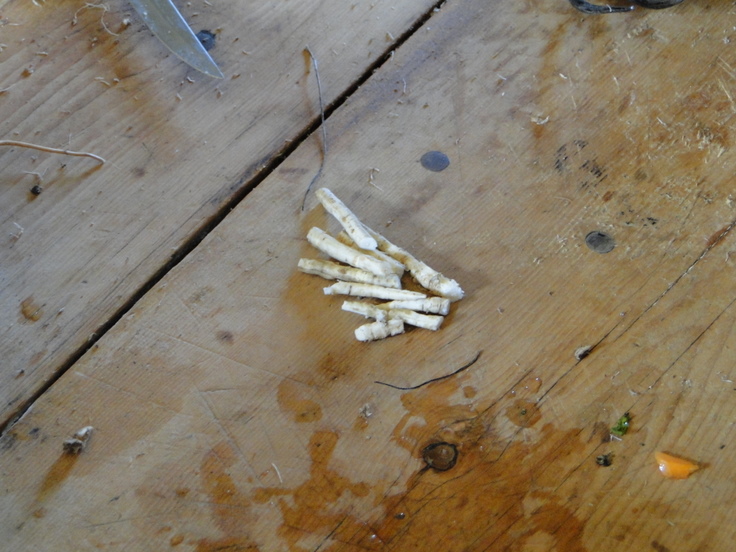
top left: whole scorzonera, top right: trimmed, bottom left: cleaned, bottom right: fresh carrotsfrom the above raw amount, this is the quantity of scorzonera ready to cook
Carrots are carrots and even in this very late October day, they were still fresh in the garden. Scorzonera though is something else and you’ll not find it in any market. You have to grow it yourself. Known in England as Viper grass, its root is the only edible part, but it’s a very thin root. After scraping the skin off, what you have are very thin pieces of a root vegetable which was fried or steamed and frequently cream and butter were added. Its flavor is akin to a mild carrot. In the 19th century it fell out of the general cooking repertoire and was replaced by parsnips. Since the amount was so small we simply added them to the carrots and simmerd both over the fire for about one hour.
Hard apple cider was the beverage of choice for the common English/Colonial person for most meals and the major reason for cultivating apple trees in the first place.
As delicious as this dinner was, more fascinating were the tidbits of knowledge I was able to absorb at this first class.
The green tops of the carrots were used as a wool dye. After boiling, the wool turns yellow.
Claret, a common wine in English receipts, is French Bordeaux.
Suet for all recipes is the thick layer of creamy white fat that cushions the kidneys.
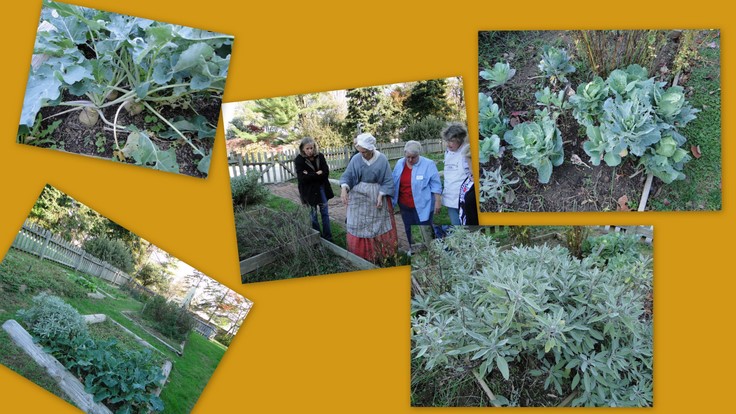
the kitchen garden
Kitchen gardens were first created by the Dutch and not adopted in England until the 16th century, even then only the affluent had extra land around their houses for a garden. Most kitchen gardens were for medicinal purposes – sage, turnips and potatoes being among the many forms of produce used for medicine. The average person gathered wild herbs, green onions in the spring, nuts etc. for cooking until the 19th century.
American colonial cooking was not in any way influenced by the Native American diet – with the exception of common vegetables such as corn. Native Americans, considered savages, were ignored and condemned. John Bartram, the famous 18th century Philadelphia medicinal gardener grudgingly served as a go-between with the Onondaga in order to increase his knowledge.
The Colonial diet was as far from organic, vegetarian and low-fat as one can imagine. Human manure was commonly used as fertilizer. Meat was devoured especially in winter and copious amounts of fat were used in all dishes.
Cheese was a summer substitute for meat since cattle was not slaughtered until winter – they needed the summer to fatten. Cheese and butter were made in late spring and summer when the grass the cows were munching on were free from spring onions and other weeds that would taint the milk sour. Most cheeses were of the soft, fresh variety. Obviously the wealthy could afford to preserve or import high quality, and harder, English cheeses such as cheddar.
Because hearth cooking made it difficult to keep food hot while waiting for the remainder of the meal to cook, dishes were frequently eaten at room temperature which often does not detract from the flavors. All dishes would be placed on the table at once – even those deemed “sweets.”
A very wealthy household with many servants frequently served three courses with an average of 20 – 25 different dishes per course – “buffet style.” Meats, fish, seafood, vegetables, pies and puddings would all be part of each course. The first course would be “hardy” – beef, etc. Second course lighter – chicken, small birds, etc. The dessert course usually consisted of fresh and dried fruits, nuts and chocolate coated nuts.
Wine was made from everything including turnips and parsnips and brewing beer was part of every houshold and farm. “Fresh water” for drinking was an anomaly. Wherever there were towns and farms, lakes and streams were polluted with human and animal waste.
This is just the proverbial “tip of the ice berg” when it comes to my knowledge of 18th century food preparation, but it was sufficient to make me desire more!
Pat Martin
The Thomas Massey House hosts authentic Colonial dinners, by candlelight, several times during the year, check their web site, and will host a Christmas house event on 11 December 2010 highlighting the food of the various ethnic groups that comprised Penn’s colony. Pat Martin is the very capable, and overly modest, chef of these dinners.
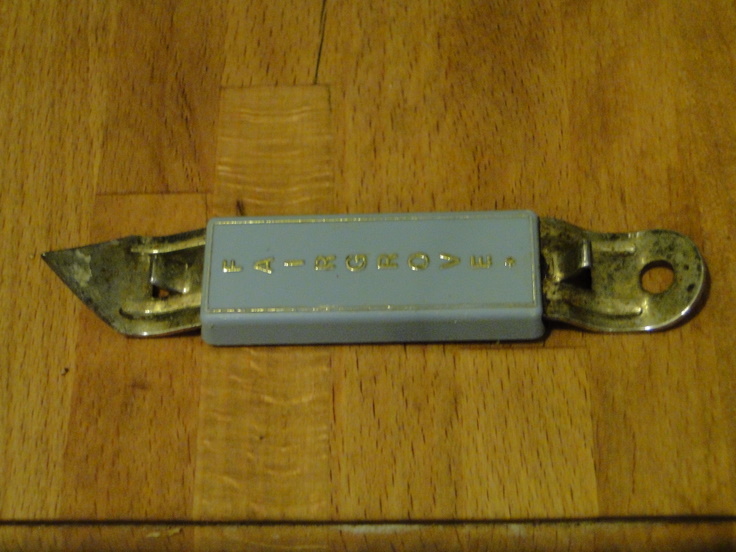
a "church key"
Oh…the church key. Clarissa said it soon will cease to be manufactured because few liquids these days are canned that necessitate the punch section of the opener. Except that in Colonial cooking, items such as canned milk are necessary. She urged that we all stock up on this simple and effective tool. Nothing, including Dr. Clarissa Dillon, ever loses its usefulness!
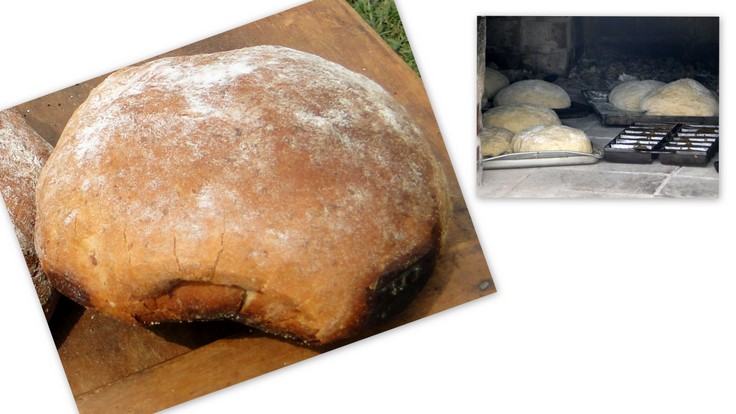
This is not what Marie Antoinette, the young ravishing French Queen had in mind when she spoke her famous “Let them eat cake” as Paris burned – or was that Nero in Rome? Doesn’t matter. “Cake” in the 18th century was the semi-charred bottom of a loaf of bread – at least the cook hoped it was only semi-charred – the result of thin sheet pans sitting directly on the hot bricks of a wood heated oven. The cook would slice off the charred bottom section and send the “upper crust” of the loaf to the dining table. The Queen was suggesting that the tens of thousands of bottom crusts – the cake – from the bread shops be distributed to the poor instead of going to the pigs…misinformation…it’s enough to make you lose your head.
the charred bottom part (the cake) would be cut off before the “upper crust” would go to the dining table
The delectable 8″ lemon and raspberry cake, in the first photo, was purchased for $23.00 at the Night Kitchen, Chestnut Hill’s (Philadelphia) premier bakery, for my wife’s birthday. Prior to 1856, making such a cake would have cost dearly in real money, and it all had to do with the one simple ingredient of the egg white. Only rich households could afford the expensive sugar, flavorings and the hired help that would laboriously hand whip the egg whites in copper pans to produce the essential white foam required to help lift the batter into the light texture we so prize in a cake – not to mention getting the oven temperature correct. It took American ingenuity to bring this über luxury into the middle class home.
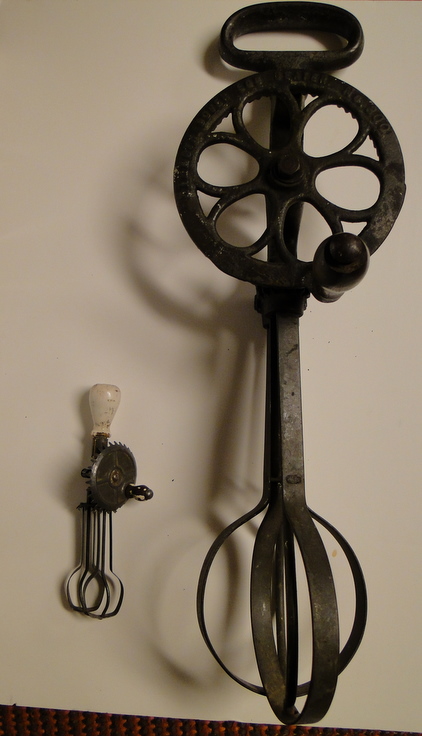
Dover Stamping Co, Boston, 1870 – my oldest egg beater
Don Thornton’s Beat This: The Eggbeater Chronicles – the Stirring History of America’s Greatest Invention is the only authoritative study, and its title is not hyperbole. I doubt anyone who’s ever used a hand eggbeater at 7:00 a.m. to prepare scrambled eggs ever gave a thought to the revolution this 1856 invention started. One of the over 1,000 patents granted in the USA alone since 1856 for hand eggbeaters explains the genius succinctly:
“An egg beater having a manually cranked drive wheel with opposed gear faces which are engaged by a pair of pinions keyed to the shafts of intermeshing beater elements whereby the turning wheel causes these elements to rotate in opposite directions.”
Why is this genius? What we take for granted as a simple device was, in reality, a seminal invention – a gear mechanism responsible for such essential tools as the hand drill for everyday home use, the oil drill exploring for “black gold” and the automobile transmission. But first it revolutionized the kitchen allowing for today’s bakeries, Dunkin Donuts and Mom’s birthday cakes for the children.
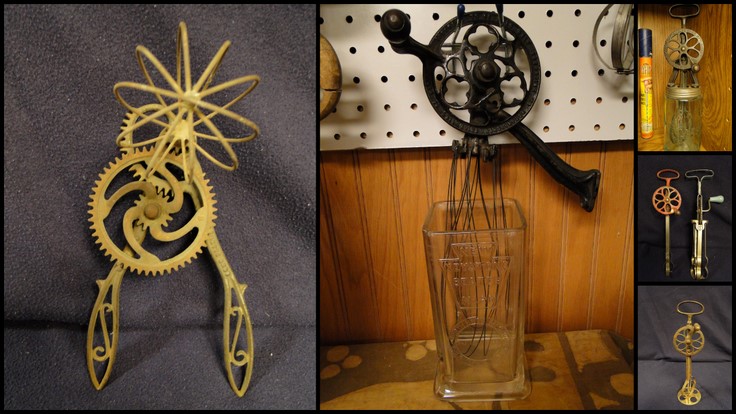
Late 19th century: Philadelphia, Brooklyn & New England manufactures
Ingenuity quickly ignited creativity with elegant cast iron designs – beautiful glass containers to prevent splatter, thin dashers allowing beaters to be inserted in jars and stands allowing them to stay up in a bowl. (Please click photos to enlarge.)
I was eleven years old when I graduated from box cake mixes and wanted to make real cakes. The dreaded egg whites where the killer. Coming from a family that enjoyed good food, at restaurants, but had no time for home cooking, it took a lot of trial and error before I mastered the technique.
To whip egg whites:
(1) always seperate cold eggs, dropping the white, one at a time, into a small bowl and putting the yolks into a seperate bowl.
(2) Check the white and make sure there is not even a speck of egg yolk in the white. Any yolk at all will cause the whites to fail. Transfer the whites, one at a time, to a clean, grease-free mixing bowl. Repeat this until you’ve seperated all the eggs.
(3) The egg whites must sit at room temperature for one hour – cold egg whites will not produce the necessary volume.
(4) Make sure the mixer’s dashers are grease free and clean. Whip at high speed until soft peaks form, hold but gently fold over as you lift the dashers. Do not over mix because the whites will become stiff and actually lose the essential air that’s been incorporated.
(5) If you are making a meringue, start adding the sugar once the whites begin to foam, but, sprinkle the sugar slowly as the whites are beating. Adding the sugar too fast will cause the whites to collapse.
(left) 1906 archimedes type, (right) Dormeyer patent 1921 electric
My 140 egg beater collection (at current count) started some years ago. I always liked old tools, but it was an uncle that piqued my interest in the egg beater over 25 years ago when he gave me my first two antiques. Curiously the one on the left, above, is not based on the 1856 gear mechanism but rather the 3rd century Archimedes screw principle. This rare 1906 beater was considered by its inventor, George Flowers of Philadelphia, to be an improvement because of its lack of gears that could get out of alignment. In 1921 a patent was granted for a portable hand-held electric mixer. Hamilton Beach made the motor and Dormeyer marketed the beater. The motor housing detaches so the dashers can be washed. It still works fine.
Years later, as a Chef/Educator, student interest in old kitchen tools led me to explore antique markets, and ebay, where I discovered a new world – the enormous variety of eggbeaters, their ingenuity and fascinating industrial designs. From beating egg whites, inventors turned to simplifying other common kitchen tasks.
Heavy cream splatters when beating to create whipped cream. Although incorporating air into cream is necessary, it doesn’t require the volume traditional dashers provide. By the late 1800’s inventors were creating flat, horizontal dashers. The 1897 Lyon has a unique set of double dashers that rotate in opposing directions. The Dunlap Sanitary Silver Blade came with a dedicated ironstone bowl with an indentation that fit a tip on the blade’s bottom to keep the beater in place. Other designs were meant to fit into dedicated glass jars.
turbine eggbeaters 1930’s from England, Canada, USA
Everyone wants to avoid splattering their clothes. Putting a beater in a glass jar had been an idea since the 1880’s. Besides the rotary gear and the Archimedes slide screw, a basic spring coil that agitates the mixture is a common mechanism in many beaters. One ingenious device marries the Archimedes with a counter weight that spins a single dasher in continuous motion just like a child’s toy top – the 1939 Jiffy Mixer.
(left) Jiffy Mixer 1939, (right) coil spring plunger 1931
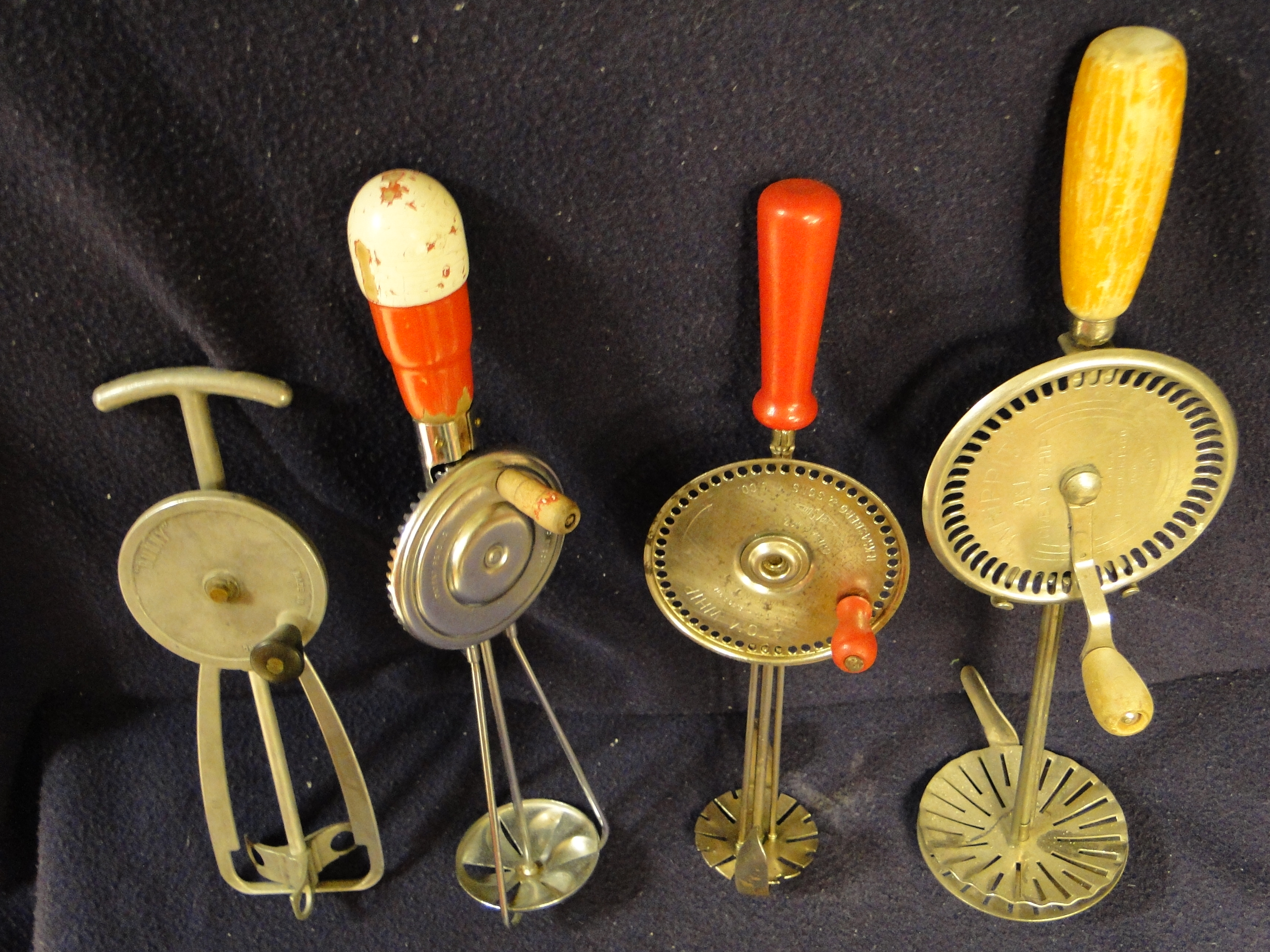
By the 1920’s, heavy cast iron egg beaters were losing their appeal. For a collector, the cast iron beaters are beautiful with elaborate and imaginative designs – the golden age. For the cook they were heavy, brittle and the gears needed constant lubrication and adjustment to stay aligned. By the early 20th century, tin and aluminum were replacing cast iron. Many tin beaters were inexpensive and flimsy – like early plastic – but the aluminum beaters were innovative, extremely light and high-end. Louis Ullman, New York City, patented his all aluminum American Beauty and created an instant success.
Louis Ullman aluminum eggbeaters 1920Elliott’s Kansas City “soap bubble” dashers (Red-E-Mixer) 1951
Clarence Elliott of Kansas City developed a high-end, sturdy beater sought after by collectors and known as “KC’s.” Inside the round dashers he placed additional round rings dubbed “soap bubbles” which aerated a mixture with great efficiency. His 1935 model with a folding side handle is a particularly nice design.
Kansas City folding handle 1935
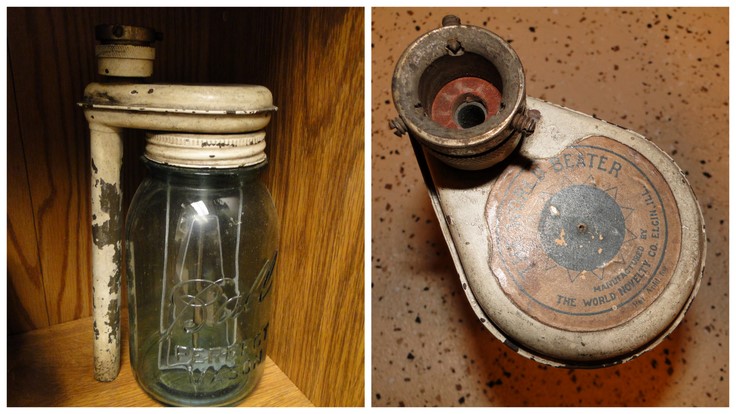
In the 1920’s less than 50% of the American population had electricity in their homes. Water powered glass jar eggbeaters were the high-end kitchen tool in these households. Operated by attaching a hose or tightening a faucet connection, water circulated through the cap turning the dashers – the water emptied down the tube. Even better for the thrifty farm cook, the mechanism attached to a standard one quart Ball canning jar.
water powered egg beater World Novelty Co. 1924
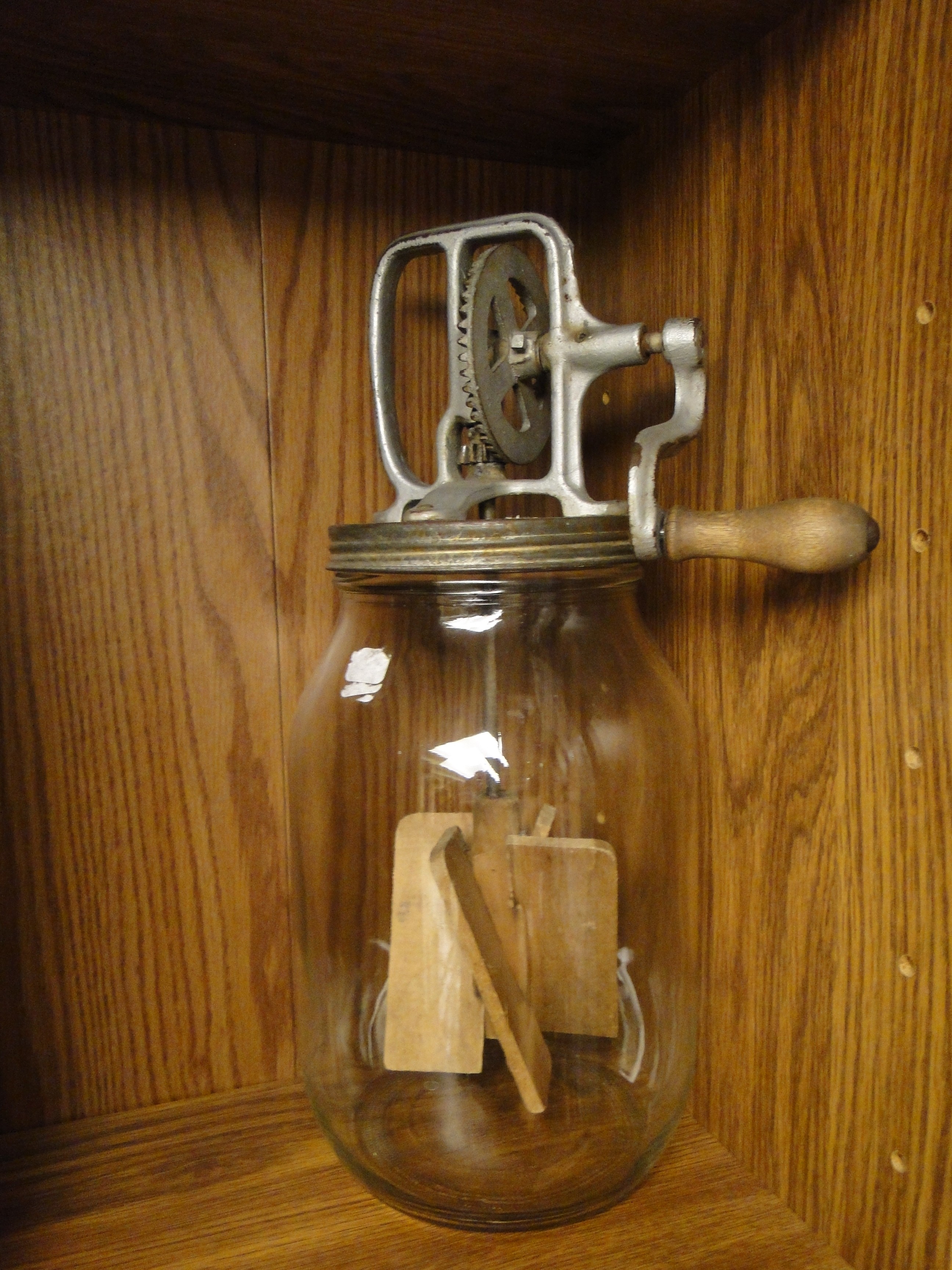
Before 1860, making butter was a laborious process of aerating the cream by plunging a wood dasher up and down. The egg beater gear mechanism revolutionized butter allowing any kitchen to make fresh butter, and its accompanying butter milk, in “two minutes.” Actually, it took about five minutes when I use the 1914 Two Minute butter churn.
“Two-Minute” Butter Churn 1914French mayonnaise maker, late 1800’s
Mayonnaise has been a beloved sauce, especially in France and Spain, since the early 1700’s. Its preparation by hand, even today, requires patience, skill and time. Prior to the egg beater, the whole eggs had to be beaten with a whisk for a considerable amount of time while the oil was added drop by drop. Adding the oil too quickly – faster than a drop at a time – will cause the eggs to stay flat and thin because the oil will fail to bond with the yolk protein during aeration. Not only did the eggbeater lessen the hand drudgery, but the ingenious addition of an attached funnel allowed the cook to control the drops of oil by adjusting a valve.
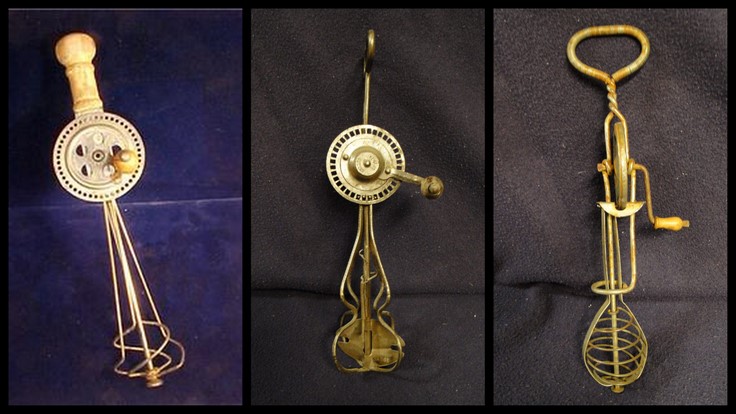
circa 1920’s French egg beaters
The French created fanciful designs for their dashers, as evidenced by the above three egg beaters.
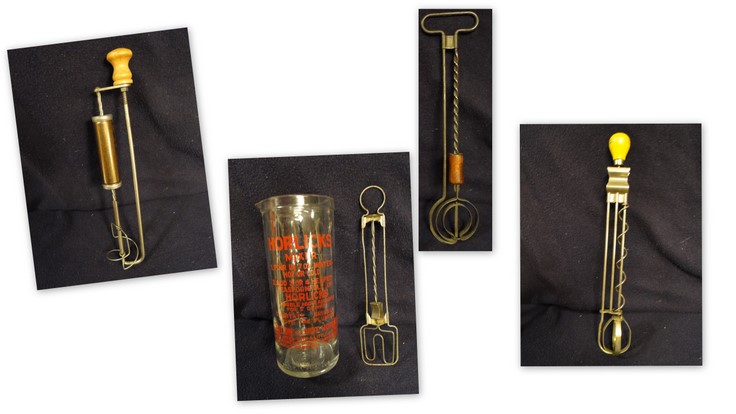
Archimedes beaters 1875 through 1930’s
These Archimedes beaters, above, attest to both interesting designs and marketing. The second from the left, with the jar, is English, Horlick’s Malted Milk powder, created by the aristocratic Horlick brothers, but manufactured in Racine, Wisconsin for the American market. Their simple beater and jar, which included the mixing procedure, was frequently included for free when a customer purchased their first supply of powder.
The Universal Cake Mixer 1905
Labor saving devices were the hallmark of the Industrial Revolution. The 1905 Universal Cake Mixer went one step further allowing the baker to combine all ingredients and gently fold the beaten egg whites into the batter.
Yoder Food Mixer 1941
The Yoder Food Mixer’s interchangeable dashers was revolutionary for a hand mixer. Its encased housing allowed easy lubrication of the gears providing, to this day, smooth operation for all mixing needs.
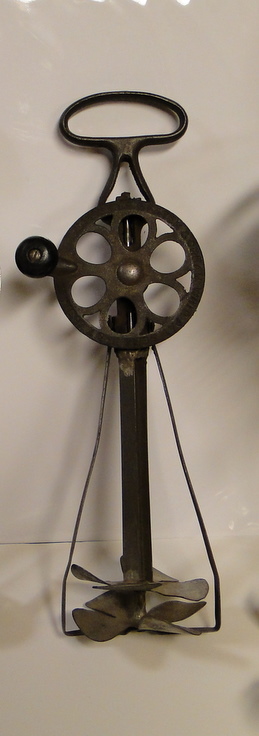
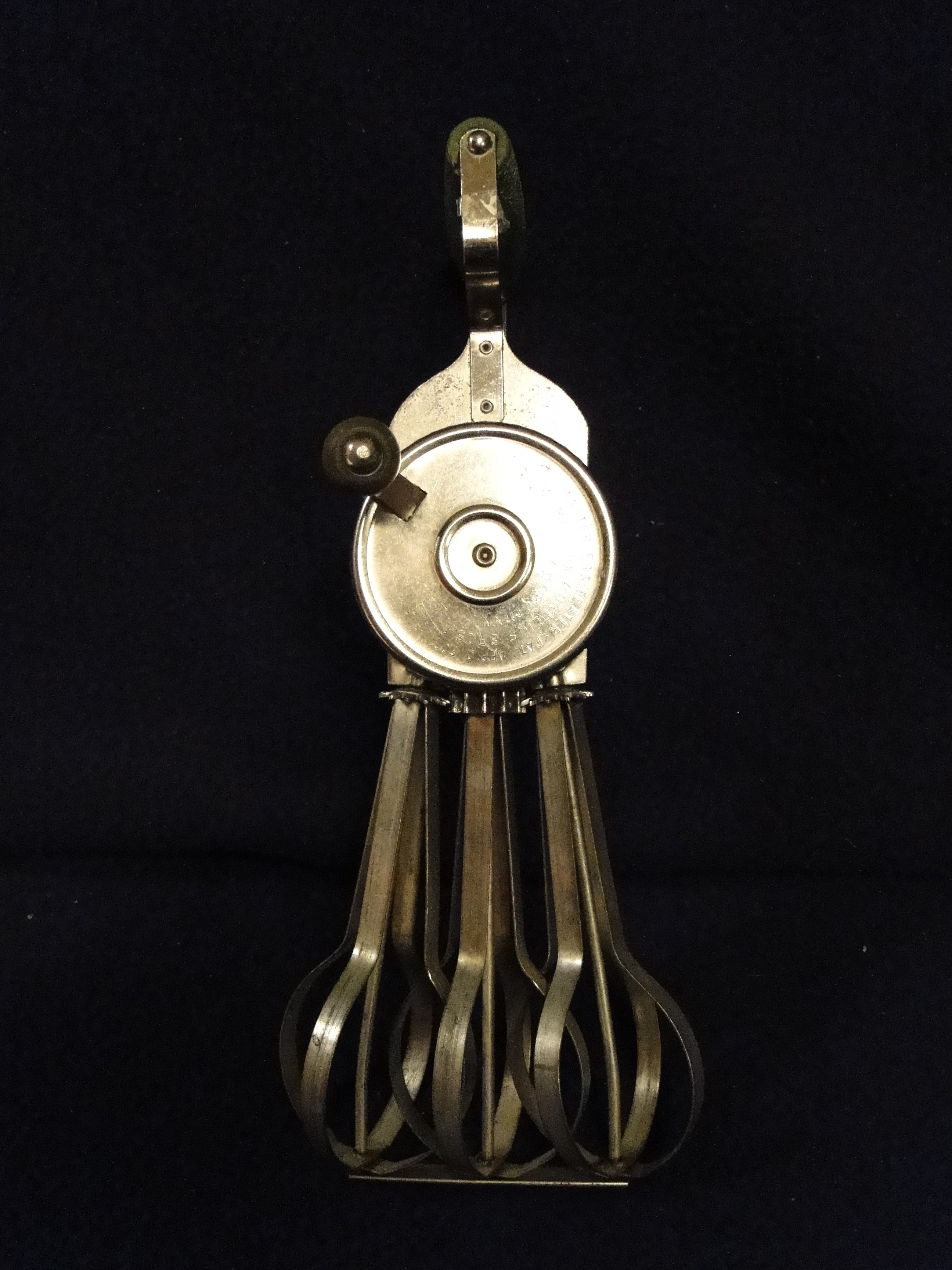
Aureluis triple dasher 1945
My two personal favorites are the Aureluis Brothers triple dasher and the Maynard Master Mixer. The triple dasher is the only one of its kind manufactured in the United States. Even though the Aureluis Brothers Co. of Braham, Minn., made many types of tools, it was Eugene Aureluis who became fascinated with the egg beater. From 1926 through 1949 he designed and manufactured 4 egg beaters that were built to last. Although the company no longer makes egg beaters, it is still in Braham and owned by the second generation of one of the company’s first employees.
Maynard Master Mixer 1950’s – MOMA’s Good Design Award
The Maynard Manufacturing Co. of Glendale, CA, made some of the finest manual eggbeaters ever. Once more, they were like tanks and used state-of-the-art materials such as stainless steel and nylon. The gears were encased in hard plastic with a hole to add lubricating oil. The 1950 Master Mixer was based on a 1923 design. The dashers minimize splashing by using hard nylon plastic. The Master Mixer was awarded New York City’s Museum of Modern Art (MOMA) award for industrial design and is part of their permanent kitchen tool collection.
Stanhome, Inc., “Get Acquainted” Hostess Party gift, 1950’s
Oddly, the beater to the left looks similar to the Master Mixer, but it’s a cheap knockoff. Perhaps Maynard sold this design to Stanhome, Inc. of Westfield, MA. It’s a flimsy plastic version that was a house gift for a Stanley Hostess Party, a 1950’s “tupperware-like” house party event for kitchen and household products, in the days before Wal-Mart.
The Soviet dominated East German manufacturing industry was infamous for making shoddy products and the Gloria, (below left) is a prime example. Despite its similarity to the Maynard, the plastic housing encloses gears that rattle and the beater would definitely not last long under constant use. The thin wire squeeze whip on the right, below, is of unknown origin and, hopefully, few were ever manufactured.
(left) the Gloria, made in East Germany 1951, (right) unknown
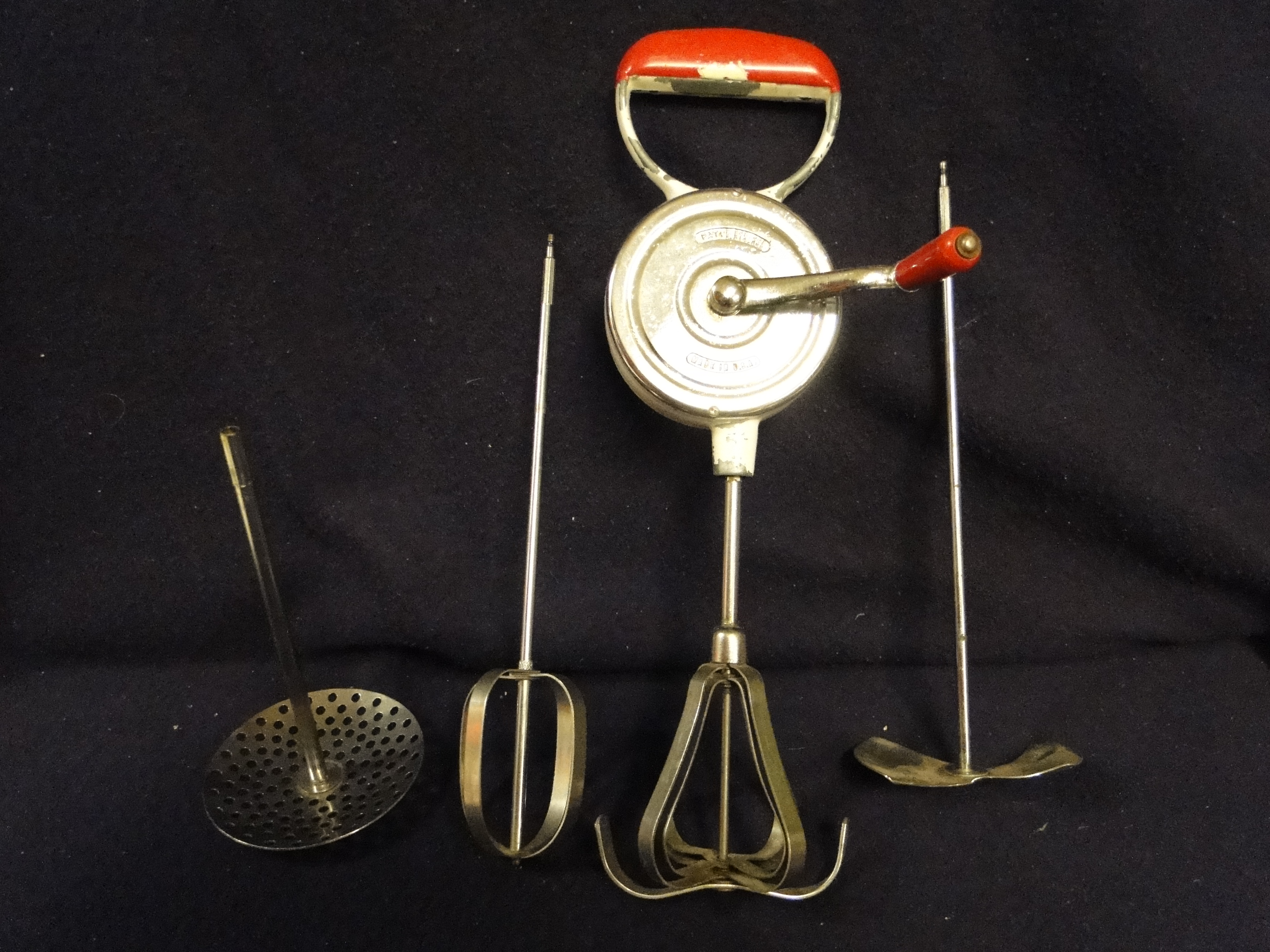
Ron Propeil, founder of Ronco Industries, was a true American marketing genius. Following a long tradition of traveling salesmen and hawkers, he created the TV infomercial that is the solace of so many people awake at 3:00 a.m. Versions of his inexpensive inventions remain on the market today – the Veg-O-Matic, the Chop-O-Matic and the Whip-O-Matic. Combining inexpensive plastic, Hobart planetary dasher design and marketing chutzpah, Propeil launched an empire, created an entire advertising niche and earned a devoted following among collectors and consumers looking for cheap products.
Propeil’s Whip-O-Matic 1975
The egg beater gear design advanced the modernization of equipment for many professions. The 1931 Whip-Mix Spatulator, was, as stated by its inventor, “For mixing compounds for the preparation of molds in dental castings.”
Whip-Mix Spaculator 1931Eskimo drink mixer
The first electric egg beater, meant for commercial baking, was granted a patent in 1885. It was a huge machine with a fan belt running from the motor to the gears that turned the dashers. Yet it was not long before the lure of electricity was pulling the affluent household away from the ingenuity and beauty of many hand beaters. An interesting 1930 example was the Bersted mixer. Mr. Bersted was infamous for purchasing profitable companies and eviscerating their tools turning them into cheap products. He would then sell the company before his scams caught on. The Eskimo Co. had a reputation for excellent electric fans. Bersted simply took the fan motor, added a handle and shaft with a blender blade and sold it as a milk shake mixer. Few of his “reinvented” companies survived after he bailed out with hefty profits.
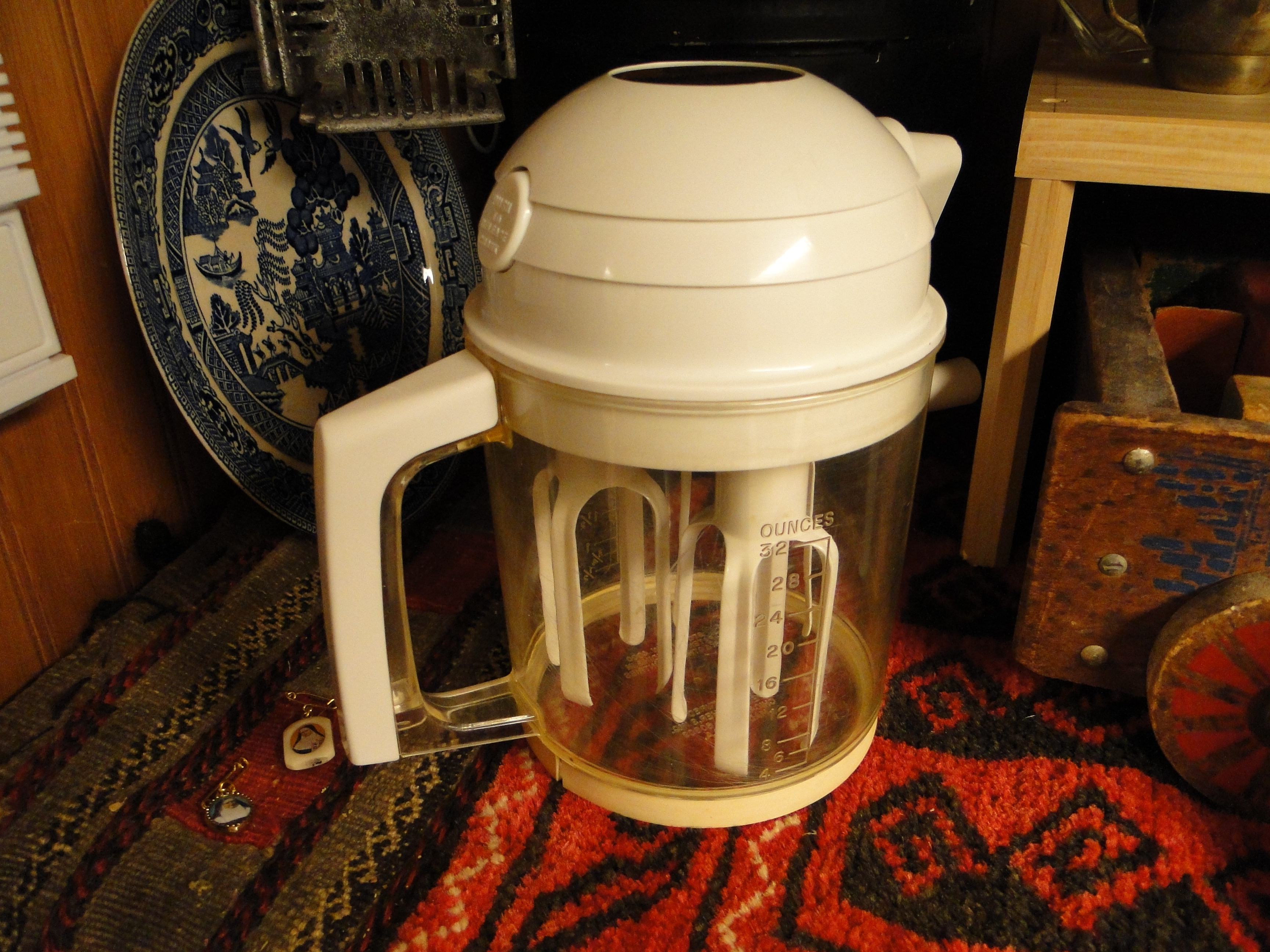
from left: small dedicated glass bowl single dasher electric mixers ca.1920 – 1940, triple dasher GE 1940’s, Japanese hand held battery mixer ca. 1960-1970
Herbert Johnson, in 1908, revolutionized the electric egg beater through his invention of “planetary action” in which an individually rotating beater travels in one direction around the inside of a mixing bowl while the dasher revolves in the opposite direction resulting in superior mixing. Johnson envisioned that his mixer could accommodate a plethora of attachments from beater, whip, bread hook, meat grinder, juicer etc. – a total kitchen appliance. When the Hobart company began marketing the KitchenAid in 1916 it sold for the very high-end price of $189.50 ($2,400 in 2010 dollars.) Today, an average KitchenAid sells for less than $300.
left: 1920’s KitchenAid Ad, right: modern KitchenAid(left) the Betty Taplin, (right) the Mammoth 300
The world of the eggbeater is vast and this article simply introduces the story. It revolutionized home and commercial baking. From the 16 1/2 inch cast iron Dover Mammoth 300, weighing 6 pounds, to the Taplin child’s toy beater, the Betty Taplin, weighing ounces, the eggbeater is a true American success story. My use of the word story is deliberate, because what is ingenuity but the personal stories of visionaries.
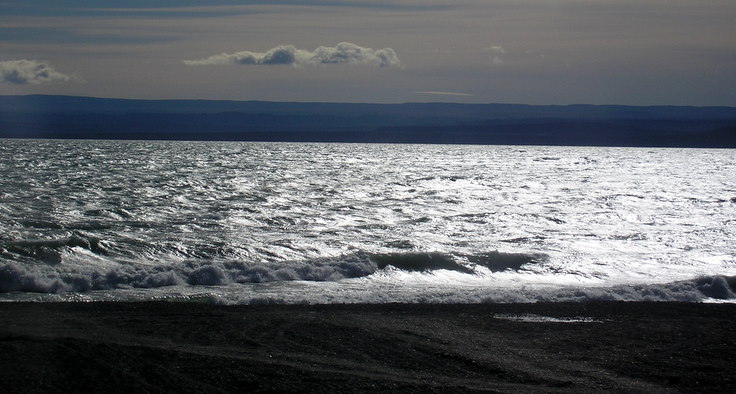
Lago Buenos Aires (largest lake entirely in Argentina)
I am on the shore of Lago Buenos Aires, in front of a crackling fire on a beautiful autumn evening (late April) in Los Antiguos. At a southern latitude equal to Quebec City (Canada) in North America, it is 70 degrees one month into Argentina’s autumn, but the fire feels nice now that a breeze off the lake chills the air. After a 13-hour bus ride from El Chalten on Argentina’s legendary (mostly unpaved) Ruta 40, through the near-desert steppe of Patagonia, entering this oasis of alumina trees (cousin to poplar), cone laden pines and the startling blue of Lago Buenos Aires is surprising. It doesn’t matter what you read, reality is always more intense.
Route 40 (over 5,000 miles long) and the Patagonian steppe
Los Antiguos is one of the lucky regions on Earth – a microclimate – those areas that possess an environment warmer than they deserve given their latitude and/or altitude. In Los Antiguos’ favor this means a rich agricultural area for fruit with dozens of profitable farms. Being on one of the nation’s most beautiful lakes, Lago Buenos Aires, certainly doesn’t hurt.
A mere 1-1/2 miles from the Chilean border, in the foothills of the Andes, at an altitude of 700 feet, Los Antiguos is the cherry growing capital of Argentina. In January they celebrate with the National Festival of the Cherry. In October, their cherry blossoms blanket this village of 2,500 people. In summer, the population swells filling the modest number of hosterias in town with visitors from Argentina and Europe but less than 1% from North America.
Hosteria Antiquo Patagonia and Patagonia's alumina trees
Having visited a number of beautiful Argentine towns, I am surprised that Los Antiguos isn’t more developed for tourism. I saw only a small number of lake-side summer homes and a half dozen nondescript hotels in town. The Hosteria Antiquo Patagonia is the only hotel on this vast lake, at the town’s entrance, but it’s a gem! There is only one road into the village from the closest larger town, Perito Merino, with bus service from Route 40 making it not as attractive to tourism. From mid-May through September (the Andean winter) nearly everything related to tourism closes. Yet its climate remains moderate with winter temperatures rarely falling below freezing and summer topping out at 80 degrees.
It’s a paradox because this is a retreat, but if it was more accessible it wouldn’t be a retreat. There are no dramatic mountains to trek and, although I’m told there are some good restaurants open in the summer season, what is available now is nothing to write about – decent but not exciting. Yet there’s a peace that I would seek if I were a busy Buenos Aires professional who desired a mid-winter escape in front of a crackling fire on a beautiful lake…but you know what’s said about having fantasies fulfilled.
From September through April, you can visit most of the farms, the “chacras,” but I had the great pleasure on this beautiful late April autumn day of having a personal tour of Chacra Don Neno.
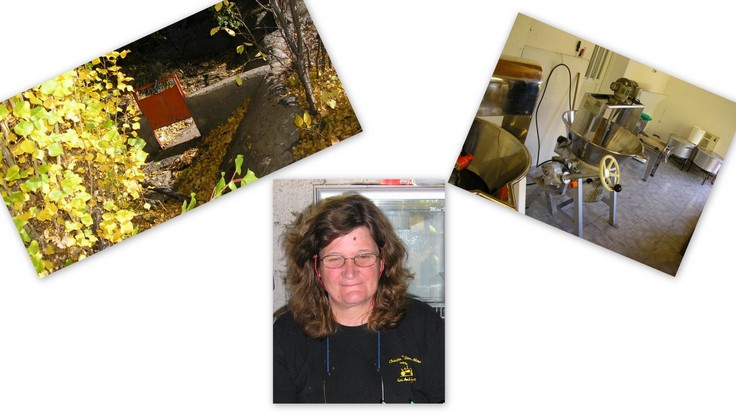
Dona Malu Cienfuegos , (upper left: sluce gate for irrigation canal, upper right: part of the kitchen)
Dona Malu Cienfuegos met me as I walked into her garden. She was not expecting me. She simply saw me from the glass wall of her kitchen where she was jarring one of her many creations from the fruits and vegetables she and her husband, Walter Treffinger, grow on their 15 acre farm. Dona Malu is the 4th generation of Cienfuegos’ to own and farm Chacra Don Neno.
I already knew that Chacra Don Neno was one of the few Los Antiguos farms that remained open all year for visitors to purchase products. Naturally, seeing that in the first month of autumn so much of Los Anteguos was closed for the season, I assumed Don Neno would be a tourist store with everything but “real” food.
Assumptions are made to be broken. Dona Malu’s store is a small structure stocked full of several dozen chutneys, jams, conserves, escabeches, honey and liquors. Many are old family recipes. Everything, down to the herbs that flavor these incredible creations, is grown on the farm.
I set aside 7 items – (1) Escabache of Mushrooms with onions, tomato, garlic, herbs, oil and vinegar, (2) olive spread, (3) preserved cherries, (4) Dona Malu’s grandfather’s cherry liquor, (5) calefate berries in gin, (6) a marmalade of tomatoes and walnuts and (7) a mixed berry jam (all for $35.00).
Dona Malu asked why is an American visiting Los Antiquos? I explained my mission and handed her my card. She immediately beckoned me out of the shop to her fields. With her English as basic as I knew Spanish we communicated on a food level just fine.
My first question was about pesticides. “NO!” was her strong response.Pesticides, fungicides and non-organic fertilizers are unnecessary in this microclimate and rarely used by any Argentine farmer. Particularly in this microclimate there simply are no pests. Water for the fields comes from the Rio Mayo that’s fed from the glacier water of Lago Buenos Aires through a system of irrigation canals.
In garden-like arrangements, Dona Malu showed me orchards of apple, cherry, apricot, figs, raspberries, strawberries, as well as Andean varieties that are cousins of these soft berries, quince, Andean melons, sweet and hot peppers, almond, hazelnut, rose hip, rosemary, basil, wormwood (the herb basic to vermouth), oregano, edible flowers, the plots for tomatoes, spinach, eggplant, onions, garlic and other vegetables, lavender, asparagus, anise, horseradish, grapes, fava beans, and thyme. All the plots are protected from any harsh winter winds by towering alumina trees, cousins to the poplar. Dona Malu cooks and jars her creations in a small, pristine kitchen with modern commercial equipment and showed me a new, larger kitchen facility under construction.
Organic is a word used for tourists; Argentines accept it as the norm.
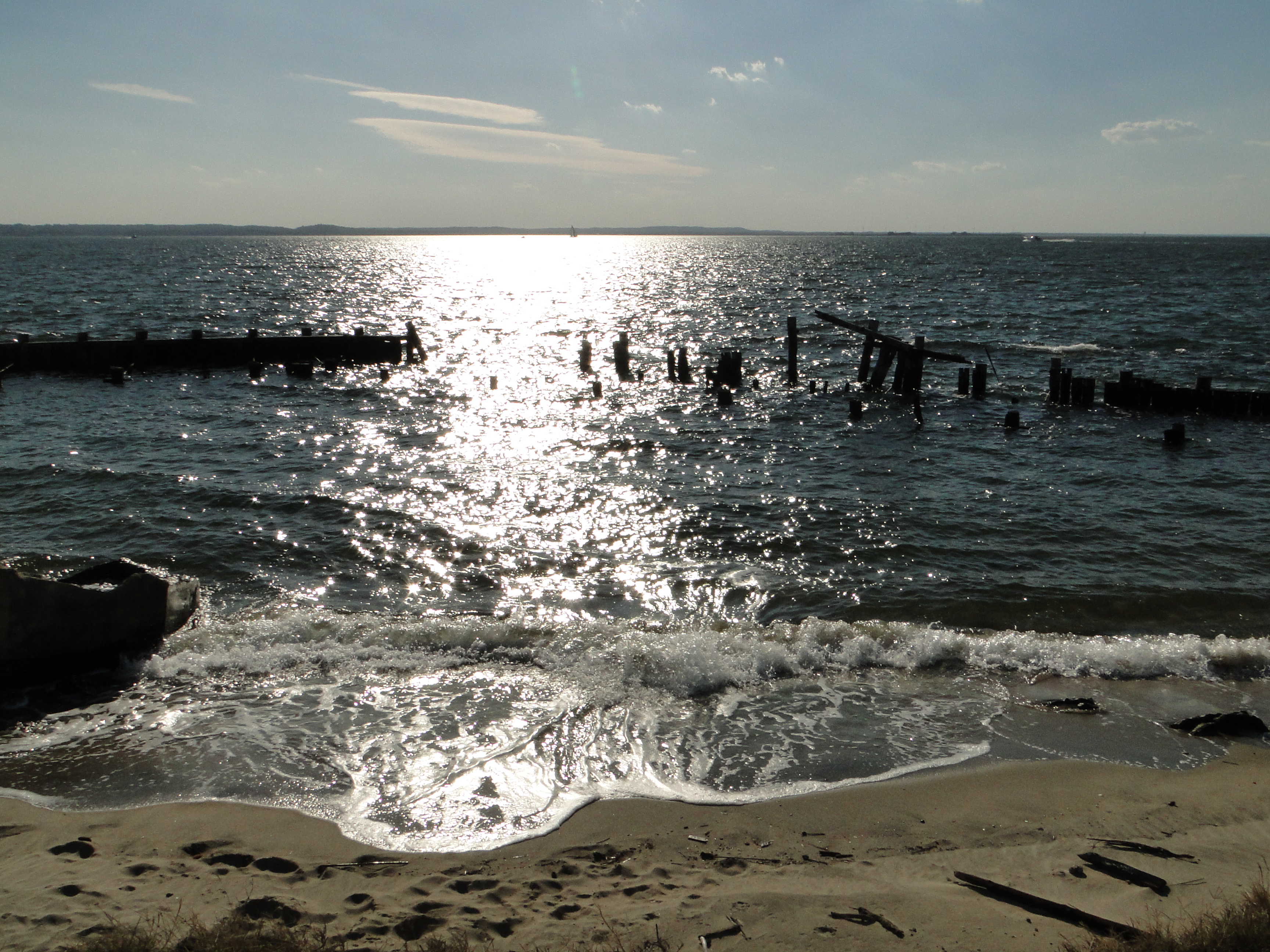
We are driving on a sliver of land – a sand bar really – with the Atlantic Ocean and Sandy Hook Bay visible to our right and left. It’s a beautiful October day, breezy, bright sunshine, kite surfers in wetsuits and even one man swimming in a low 60 degree ocean. The beach is autumn empty, no crowds. The dune grasses glint golden in the sun. The leaves of low lying shrub plants are painting the seashore hues of red/purples and yellow/greens. Off in the distance, through a light haze the skyline of lower Manhattan, Staten Island, the Verrazano Bridge, Brooklyn and Rockaway Beach are all visible. Yet there are no “Mc Mansions”, or any beach house in sight for this is the protected land of Gateway National Recreation Area on the Sandy Hook.
(Bottom Center) Visitors Center for Gateway National Recreation Area
high speed ferry from Manhattan
Less than an hour drive from New York or a 40-minute high speed ferry ride from Wall Street, Sandy Hook has long been a playground for New Yorkers and Northern Jersyites. Yet only two-hours from Philadelphia, it remains a virtual unknown area for many Pennsylvanians (isn’t New Jersey from Atlantic City to Cape May?). The North Jersey coast is thick with forests, colonial villages, craggy cliffs and wide beaches.
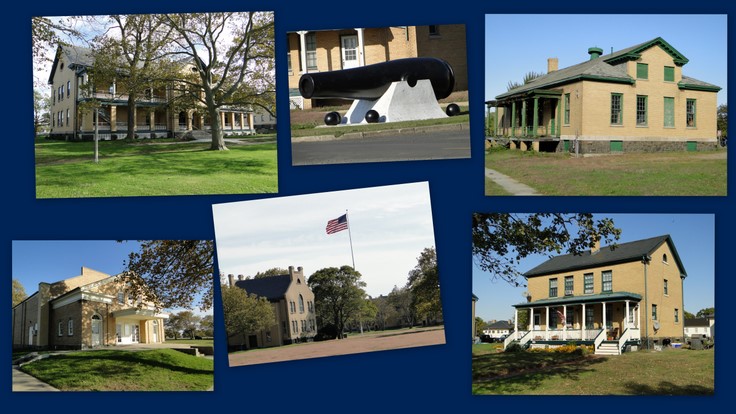
Fort Hancock: restored & unrestored (bottom left: Theater)
Towards the end of the seven miles, Fort Hancock comes into view. From 1898 through the 1970’s the Hook was not always sparsely populated. During the Second World War, this end of the sand bar held a population of 20,000. Named in honor of civil war General Winfield Scott Hancock, construction on the Fort started the same year as the Spanish-American War (1898) and America’s acquisition of an overseas empire. The fort is a sprawling complex of handsome Colonial Revival buildings constructed from distinctive, local pale yellow bricks. It was a small town from the beginning with a theater, recreation facilities, clubs, church and, of course, housing. Enlisted men lived in large barracks, but married officers enjoyed spacious houses.
Officers Row
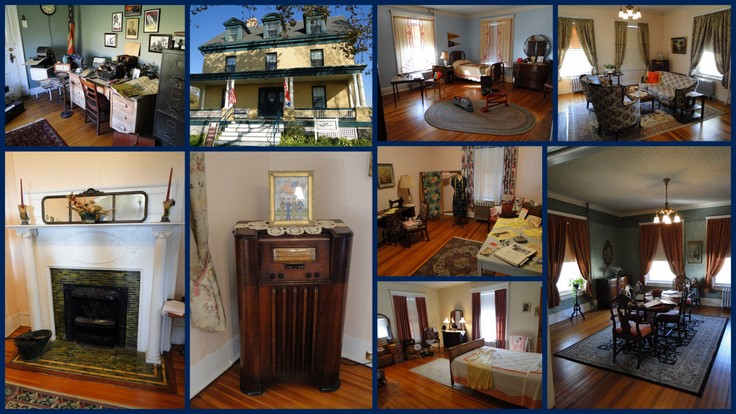
Officers Rowconsists of 18 waterfront houses ranging in size from 5,000 to 6,500 square feet. They were built at a cost of over $8,500 each in 1898 ($250,000 in 2010 dollars) with all the modern and decorative features of the day including fireplaces faced with tiles from Portugal. One – History House – is fully restored and furnished to reflect the life of an officer’s family during the Second World War years of the 1940’s. Excellent weekend tours are conducted by volunteers from 1:00 – 5:00 PM.
History House: restored 5,500 sq. ft. officer house
Naturally I found the kitchen interesting. An original Frigidaire refrigerator and Kelvinator stove are in working order allowing History House to host receptions utilizing this spacious kitchen. A walk through pantry connected the kitchen to the dining room. A unique item is the dining room’s steam radiator that was constructed with a food warmer top section! A servant’s staircase just off the hallway outside the kitchen attests to an era when the middle/upper middle class could afford hired help.
History House 1940 Kitchen (bottom left: radiator/food warmer)
Unfortunately, due to lack of funding, most of the remaining houses have fallen into disrepair and face an uncertain future. It’s ironic that these solid yet graceful structures with their stunning views of Sandy Hook Bay would be worth millions anywhere else on the Jersey shore.
Many structures within the Fort serve the National Park’s work in administering the Sandy Hook seashore, historic lighthouses, some staff housing, as well as offices for NOAA (National Oceanographic and Atmospheric Administration). Fort Hancock is also home to the Marine Academy of Science and Technology, a four year high school operated by Monmouth County Vocational School District.
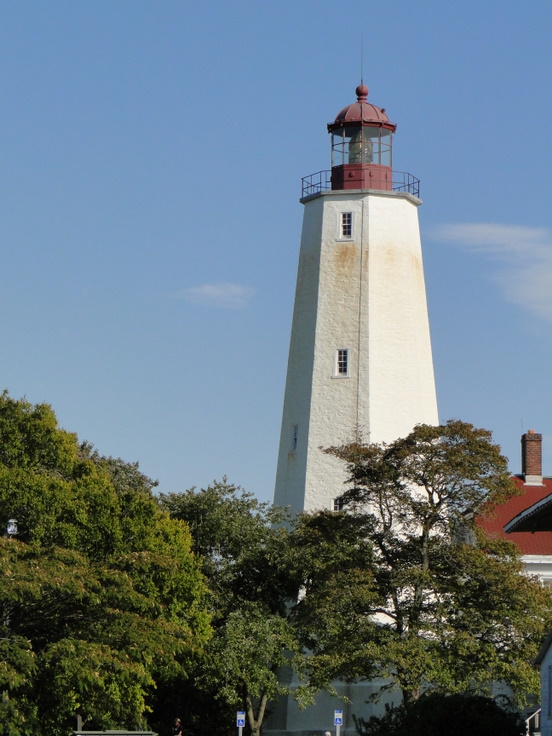
Sandy Hook Lighthouse: 1764 (oldest USA lighthouse still in use)
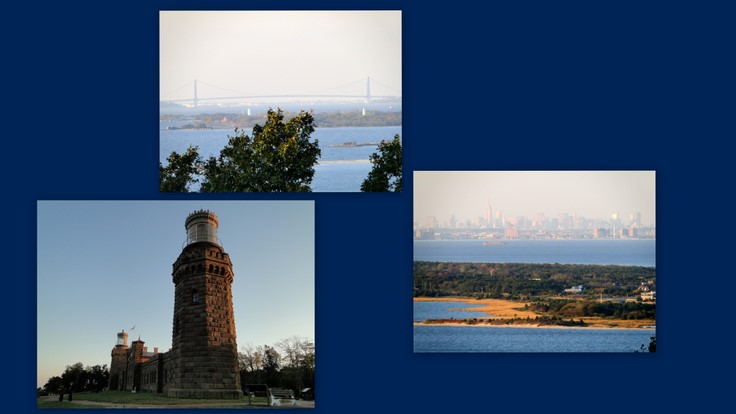
Yet walking the grounds past abandoned houses in the quiet of an autumn day is a melancholy experience. I have no idea if ghosts exist, but I can imagine they might, given the colorful history of Sandy Hook. Its lighthouses protected New York harbor from its earliest days in the 18th century both in war and peace. The Hook and protective cliffs of the Highlands harbored both busy commercial and fishing fleets as well as pirates and smugglers right through the Prohibition years of the 1920’s and 30’s. High up on the Highlands stands a unique 1862 “castle”, the Twin Lights of Navesink, a national historic site under the state park system. The lights no longer function but provide a commanding view. There is a nice museum, picnic tables and it’s possible to climb to the top of the north lighthouse. An 18th century cannon, found on the grounds, attests to the hill’s use by pirates as well as during the American Revolution – although that time it was loyalists protecting the British occupation of New York City.
Twin Lights with views of Sandy Hook, Manhattan & Varrazano Narrows Bridge
The town of Highlands is an affluent community with a bustling harbor front still devoted to fishing, although today the fleet is more pleasure craft than commercial. It’s not all gentrified either with the harbor lined by a jumble of businesses, restaurants of different types and modest houses.
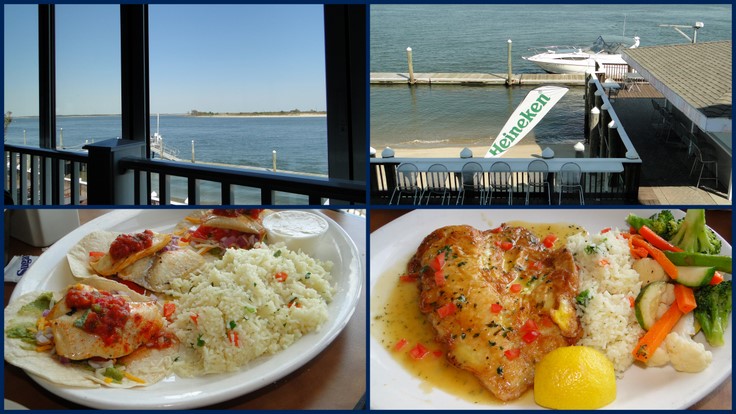
Two of the dozen or so restaurants stand out. Doris & Ed’s serves elegant seafood dishes in a relaxed atmosphere with beautiful bay views in a renovated 19th century former hotel. It is well established after over 30 years, but its preparations, presentations and quality remain high and have not gone stale by success. Prices are high, but fair, with lunch/dinner for two with wine/drinks easily in the $125 – $150 range. The Windansea is an equally good choice with great bay views and an even more relaxed environment. It has a dock right in front allowing boaters to tie up and walk right to the restaurant. In the summer there’s a lively outdoor bar/dining area. Preparations, presentations and quality are nearly as high as Doris and Ed’s but the prices are less expensive. Lunch/dinner for two with wine/drinks will run in the $50 – $85 range. For lunch we had Fish Tacos topped with a good salsa and Tilapia Francaise that was lightly battered with a flavorful lemon wine sauce. Both entrees came with a nicely seasoned rice pilaf. A salad of spring greens, walnuts, dried cranberries and crumbled blue cheese was generous and dressed with good balsamic vinaigrette. Both establishments serve only fresh fish and seafood – never frozen – and do offer meat dishes as well.
Windansea Restaurant (Top: views, Bottom: Fish Tacos & Tilapia Francaise)
Unlike the beach towns of South Jersey, North Jersey doesn’t close up during the off-season. Its proximity to New York has ensured year round life and a permanent population the southern towns don’t enjoy. So, Philadelphians, get out and discover beautiful, vibrant, peaceful destinations a mere 1- ½ to 2 hours from your driveway.












































 Travel with Pen and Palate
You must be logged in to post a comment.