Tag Archives: Pennsylvania

Philadelphia: A Tale of One City/Two Neighborhoods

“…here I dwell, where these sweet zephyrs move,

And little rivulets from the rocks add beauty to my grove.

I drink the wine my hills produce; On wholesome food I dine;

 My little offspring ‘round me Are like clusters on the vine…”

 Thomas Livezey, circa 1750

It’s Friday evening and we’re sitting on the great marble staircase having a drink and listening to jazz at the Philadelphia Museum of Art’s Art After Five. Stepping out into the courtyard, the city at night glitters and hums like an urban engine. The following day, we leisurely stroll down Forbidden Drive in bucolic Valley Green after having lunch in an 1850 Inn. Mounted horses pass at full gallop and geese float down the Wissahickon Creek. We’re still within the city. Like all great urban centers, Philadelphia is a city of neighborhoods. Like all great cities, these neighborhoods evolve, and so it is with William Penn’s original square mile city of Philadelphia as well as leafy Chestnut Hill/Valley Green. The future doesn’t always preserve the past, and sometimes that’s good.

an original 19th century stable and one the few remaining trolley lines
Swan Fountain (Alexander Calder, 1924) at Logan Circle

William Penn’s original square mile city, bounded by the four squares of Rittenhouse, Washington, Franklin and Logan, still retains an orderly grid. The absence of a glass and steel jungle blotting out the sun, and the presence of 300 year old alleyways lined with colonial houses allows Philadelphia to feel like a home for humans, rather than just an economic engine. Visionary city planners as early as the late 1700’s designed the grand boulevard, the Benjamin Franklin Parkway, that stretches from City Hall/Logan Circle to the Art Museum. It’s hard to experience a finer entrance to a city than the tree-lined, flag bedecked, fountain anchored Parkway. Its space, like a giant front lawn, is shared by commuters, strollers, special events, runners, frisby players, three generations of Calder family sculptures and many cultural institutions. Yet one square mile Philadelphia was an urban economic engine in the 18th and 19th centuries with all the accompanying issues of pollution, muddy streets, poor sanitation and summer “fever” epidemics.

Philadelphia Museum of Art

The 1920’s Greek temple that is the Philadelphia Museum of Art stands, appropriately, on a hill at the far end of the Parkway. Its galleries contain priceless collections spanning millennia. Music and social events are not new to museums, but Art After 5 (every Friday from 5:00 to 8:00) has become a fixture in Philadelphia’s “TGIF” venues. There are a limited number of tables that fill quickly but sitting on the  smooth marble of the grand staircase, under the gaze of an enormous backlit “Diana,”  creates an amphitheater feel. The central hall rises up one floor to a broad mezzanine where it’s possible to sit as well. Two full service bars and a professional, personable wait staff serve light fare and drinks. It’s an informal, club atmosphere and people wander through the adjoining galleries while the music filters in as doors open adding to the visual experience.

Art After 5 at the Philadelphia Museum of Art

From the gazebos that sits on a rocky promontory outside the museum there’s a nice view of the Waterworks and Boathouse Row.
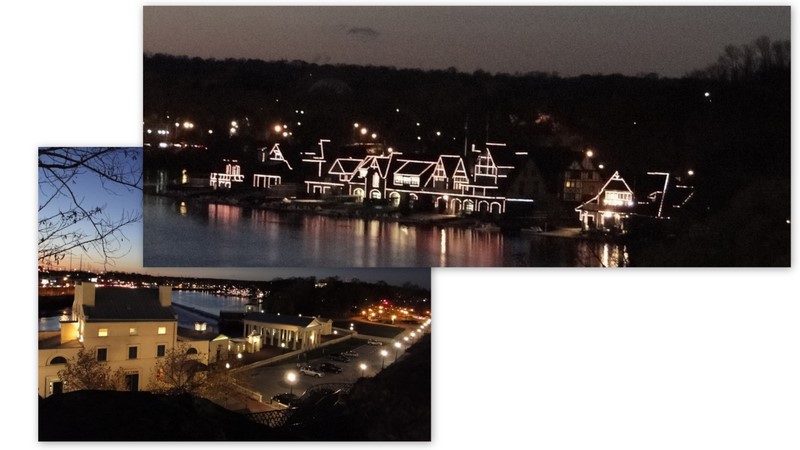
(top) Boathouse Row, (bottom) the Waterworks

An engineering marvel when it opened in the early 19th century, the municipal Waterworks pumped fresh Schuylkill River water directly into an ever-expanding city. Today its restored buildings house a pricey restaurant, small museum and provide public space as part of Fairmount Park. Boathouse Row stretches just beyond. This collection of late 19th century stone and wooden houses represent generations of private university associated sculling clubs. Although the sport is often thought of in the same league as polo, dressage and fox-hunting, the skill necessary to compete in sculling is achieved only after arduous physical training. In Philadelphia, it’s a serious sport.

Fairmount Park's Valley Green, (top right) Livezey House, 1740

The 1740 Livezey House has that stately look of so many of the well-preserved antique houses in Valley Green and the neighborhood of Chestnut Hill. From the Art Museum it’s possible to hike or bike the five miles on trails that meander through the thickly forested Park, along the river and creek, directly to Valley Green and Chestnut Hill. Yet except for the pre-1870 houses, little of this countryside was bucolic as late as the 1870’s. The banks of the Schuylkill River and Wissahickon Creek had been denuded of trees for nearly 200 years and over built with a series of small company towns while its polluted waters were harnessed to provide energy for the mills that were part of  Philadelphia’s economic engine. Mr. Thomas Livezey made a nice fortune from his Wissahickon Creek mill but his surroundings were certainly not as attractive as today. 

Rittenhouse Town

It was the threat to Philadelphia’s drinking water that spurred the building of the long-planned 9,000 acre Fairmount city park. Its serpentine shape deliberately included both the Schuylkill River and Wissahickon Creek within its boundaries. Gone were dozens of Colonial and early 19th century mills, houses and entire small company towns. The Park-owned historic Rittenhouse Town is an exception and provides a glimpse of life when it was a company town/suburb to Philadelphia’s one square mile city. Yet since the town’s business was paper making one can be sure few trees existed when it was purchased by the Park Commission in the 1870’s. Restoration of the watershed, over a century later, is still ongoing. These generally affluent neighborhoods today have the look and feel of story book versions of leafy, bucolic Colonial villages, and yet they’re within the bounds of a 21st century city.

interior of Valley Green Inn

The Valley Green Inn on Forbidden Drive (cars were banned in 1920) has been open since 1850 but with a checkered history. In the past few years it seems to have secured its future as a venue for fine interpretations of classic American and Continental fare. It’s setting directly on the Wissahickon Creek with its antique decorated dining rooms make it an ideal venue for any occasion. There’s nothing better than taking a walk along the 7-mile Forbidden Drive after lunch nearly any time of the year, and if you’re riding your horse, you can still hitch it to the posts outside the Inn.

Valley Green Inn, 1850

Valley Forge: A Reality Show

Reality #1:  The American Revolution was saved at Valley Forge

For over twenty years  I have driven through Valley Forge, site of the great winter encampment of 1777-78. Nearly every road was laid out over 300 years ago. The landscape is still lush with rolling hills. There are many more trees and deer than in 1777, but I can imagine that prior to December of that year, it was just as peaceful as now in the early morning mist – perhaps a few more farm animals would be awakening.

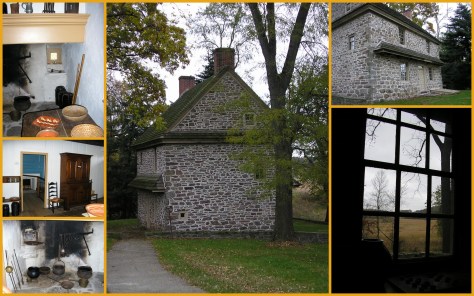
I park my car and walk down the silent lane towards the Issac Potts House. The gravel crunches under my shoes, birds chirp, Valley Creek gurgles on its way to the Schuylkill. The small stately house that Washington rented for six months, which served as the headquarters of the General Command, stands solitary.  The Potts grist mill  burned in the 1830’s, victim to sparks from one of the nation’s first rail lines – still in use in 2017.  Long-gone as well is the bustle of 1777 Valley Forge village.  Myth and reality float as mist on a land that  holds too many undiscovered stories.

1913 Reading RR train station now Washington’s HQ visitors center, Top Right: original ticket window, Bottom Right: rail line still used for freight

The 3,700 acres of Valley Forge National Historic Park are a small part of what was known in the 18th century as Pennsylvania’s Great Valley – one of the wealthiest agricultural regions in the thirteen colonies. Populated largely by Quakers, this industrious area had given rise by the 1750’s to the start of Pennsylvania’s iron industry – hence the village of Valley Forge along Valley Creek.  This small company town owned by a few intermarried families, along with farming and water powered mills on the Schuylkill River, was making the region an economic power house. Yet before the  autumn of 1777, the bucolic, hilly and peaceful countryside was hidden from the turmoil embroiling the colonies since 1775,  but Philadelphia was only 20 miles south.

 The crops were being harvested when the British advanced towards Philadelphia in the autumn of 1777.  Although there is evidence of British requisitioning of supplies, the population was equally nervous concerning any future involvement in war. The British did burn a Potts  forge warehouse because munitions were found. Being staunch Quakers, it’s unlikely the family gave the local colonial militia captain permission to use the facility.

One week before Christmas 1777, the first of what would fluctuate between 10,000 to 17,000 troops, women and children arrived. An area of 3,700 acres had been chosen months before as an alternate encampment should Philadelphia fall to the British.  On the Schuylkill River, at the highest elevation closest to the city and overlooking the  major routes from Philadelphia to the interior of northern and western Pennsylvania, the site at Valley Forge was ideal for both defense and reconnaissance

It wasn’t a demoralized, bedraggled rag of an army that marched into the encampment. The troops were rather pumped at the drubbing they’d given to some of the British Empire’s crack brigades while defending Philadelphia. True, the Battle of Brandywine was horrific in terms of casualties, but the pain was equally shared and the Continental brigades remained intact. Washington’s competition to house everyone in log cabins was a resounding success. Many diary entries speak of the relative comfort of these accommodations compared to other encampments.

Reality #2: Starvation or incompetence?

A severe lack of effective planning plagued the loose collection of brigades that constituted the Continental Army in 1777 with food supplies being the most obvious initial problem. No one was in charge. The troops had arrived at the start of winter, in the midst of the breadbasket of Pennsylvania and they had no one in charge of obtaining food. A canary in the coal mine?

Christopher Ludwick accepted the commission Baker General of the Continental Army. A prosperous German/Philadelphia baker, renowned for his gingerbread (General Washington’s favorite dessert) and a financial backer of the revolution, he was in his late 50’s – one of the oldest men in command.  (Ludwick would remain BG until the end of the war in 1782). Along with the appointment of General “Mad” Anthony Wayne as Quartermaster General, these two men created, within three weeks of the first troop arrivals, an efficient commissary system with 13 field kitchens and 22 bake ovens feeding 10,000 – 15,000 people a day soup/stews and baking nearly as many loaves of  bread. (Volunteers offer baking and cooking demos during the summer and special events. See park web site.)

  Reality #3: Snag the Golden Ring

Because the defense of Philadelphia had called for a total effort, nearly every important person involved in the Revolution (and most of the troops) were together at Valley Forge – in one encampment. Yet Valley Forge encampment history seems almost uneventful to all but diehard history buffs. No battles for one thing.

The British fail to venture out of Philadelphia by the end of January to engage Washington at Valley Forge (they were not having an easy time controlling the city). The consequences of such an encounter – before the onset of “mud season” –  would have been fatal for the Revolution.  A golden opportunity presented itself and the General Command seized the ring: six months to get organized, trained, equipped, deal with corrupt merchants and a cautious Congress, standardize training, revamp recruitment and establish a central commissary kitchen system that remained in place for the remainder of the War. In other words, create a unified Continental Army – in six months.

The French Alliance in the spring of 1778 sent the French navy and millions in gold to the Revolution. The army marched out in June and nearly crushed  British forces evacuating Philadelphia for New York at the Battle of Monmouth.  For all practical purposes (except New York City) the Revolution in the North was over – bitter fighting moved South for five more agonizing years.

Reality #4: Myths are easy; uncovering the human story is difficult.

Mrs. David Edwards Stephens inherited from her father, a prosperous Methodist farmer in this Quaker community, a comfortable stone house and 400 acres. The slave-owning Mrs Edwards, and her Quaker husband David  Stephens, rented the second floor of their house as an office and beds for the staff of 28 year-old  General James Varnum.  A wealthy, staunchly abolitionist Rhode Islander, General Varnum had successfully pressured Rhode Island to create a free-black regiment who billeted across the street.   To have been the fly on the wall…the dinner conversations…

Yet the family put up with half their small house being occupied and watched their prime farm land – the encampment’s Grand Parade – turn into a sea of mud by the boots of troops being trained under the Baron von Steuben. It would be four-years before any of the farms financially recovered.

Little is known of the family that rented rooms to the tall,  dashing 19 year-old Frenchman the Marquis de La Fayette. The Marquis rapidly gained Washington’s trust, entre into the General Command’s inner circle and, I can assume, was a favorite at dinners. The house is not open for tours and is said to be haunted.

Eight hundred fifty women and children lived at the winter encampment.  Blood relatives could share the 12-person cabins with others in the brigade. Women and children performed a number of necessary roles within the camp structure. An authoritative and insightful new book, Following the Drum, does much to end the myth of the disreputable woman camp follower.

The American born Scots aristocrat, General William Alexander, 6th Earl of Sterling, his wife, Lady Sarah Livingston Sterling, along with Martha Washington, were the center of the social calendar for officers and their wives during the encampment. The Sterlings leased a house that, unfortunately, is unstable today, but the Washingtons  leased what is presently the best preserved 1760’s house in America.

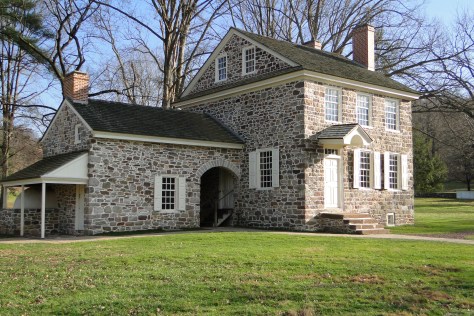
Issac Potts house – George Washington's Headquarters at Valley Forge
Issac Potts house – George Washington’s Headquarters at Valley Forge

Built in the 1760’s as one of thirteen rental properties owned by the wealthy Potts family, this fine example of 18th century craftsmanship was never meant to house 15 to 20 people. The staff of the General Command exceeded that number, but not all shared the house with the General and Mrs. Washington (it’s rumored Martha Washington  remarked, through cinched teeth, that the house was a “lovely little cottage.”)  There were strategic reasons for choosing this site even if it was cozy.

Only top aides had the comfort of beds. Most slept on the floor in bed rolls and the attic – including approximately five slaves. One slave, Hannah Till, earned enough money on the side as a seamstress (allowed in the 1700s) to purchase her freedom after the War.


 The kitchen hummed all day with a staff of five – majority slaves – cooking meals for the General Command staff as well as numerous VIP guests. The fare was not the bread and soups of the enlisted men. Officers were from a different class. They lived better, ate better, and many subsidized their own expenses. Martha surprised the General with what became the first official celebration of his birthday in February 1778 complete with cake and a band.

kitchen at George Washington’s HQ set with officers fare

Reality #5: This was the 18th century – before indoor plumbing…

That’s why 3,000 people died at Valley Forge. Sanitation, 18th century style, no matter how well thought out by the best science of the day, still left much to be desired. Mass inoculation for small pox was a resounding success – George and Martha led by example. Daily rations for all of beer and whiskey to prevent the consumption of tainted water helped. A daily dose of wine vinegar prevented scurvy. Yet by the end of March and through May 1778, as Spring arrived, fevers, dysentery, pneumonia and infections took the lives of nearly 3,000. None are buried at Valley Forge – considered bad for morale. Many lie in lost graves. Most were tended in hospitals as far away as 50 miles from the encampment by pacifist Amish/Mennonites and Quakers – Ephrata, PA, contains a rare grave yard.

P. C. Knox House (descendant of General Henry Knox) c.1900, with Mercer tiles, now VFNHP’s archives

I spent more hours than I can count roaming the fields and buildings of Valley Forge, leading tours as a volunteer and cooking in the outdoor kitchen. To a military history buff, the meaning of this site is obvious and the wealth of 18th century military information available is abundant.

For me, though, it’s the drama of the human stories of both camp and Valley residents that resonate: the failed attempt by influential locals to arrange a peace conference, dissension within the officers of the General Command,  the constant complaints concerning mud,  denuding  the landscape for over a 5-mile radius of the encampment,  the stench of thousands of barely washed bodies and animals, the smell of fresh-baked bread and dinners at the Sterling’s.

The detritus of war. It’s never myth; it’s only reality.

Maurice Stephens House, 1816


Save

Save

Save

Save

Reinventing Reading

No, the frog has not become the mascot of Reading, Pennsylvania. They are two of four outdoor sculptures from the annual June Arts of the Avenue Festival. They  grace the grounds of the four businesses on Penn Avenue in West Reading that commissioned them for the 2009 festival.

Once a coal choked industrial city in the hills of Berks County, Reading is reinventing itself as a center for arts, education, restaurants and natural food. On the subject of food, it helps that Berks County farms are part of the Pennsylvania Dutch agriculture region famous for their all-natural farming methods.

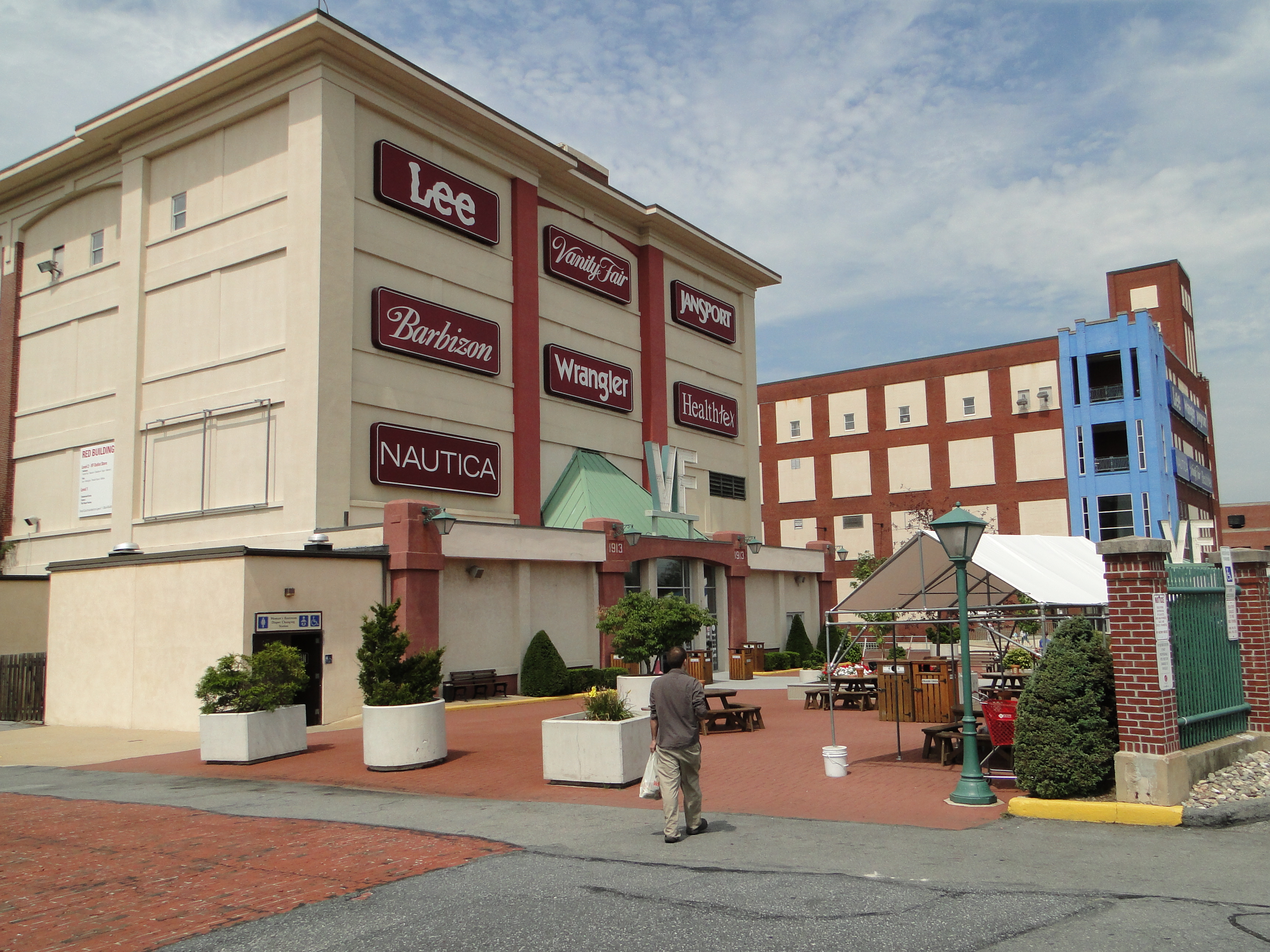
part of the VF clothing outlet complex in West Reading

Founded in the 1740’s, along the Schuylkill River, by two of William Penn’s sons, Reading quickly became an important link for access into Pennsylvania’s interior and a center for the growing iron industry during the Revolution. Reading boomed until the 1930s, when its population reached nearly 120,000. Coal from Pennsylvania’s mountains flowed through Reading like a black river fueling the city and the nation’s industrial might. The city not only was a center for heavy manufacturing but its proximity to New York and Philadelphia retail markets created a vibrant textile and clothing manufacturing sector. The Reading Glove and Mitten Manufacturing Company founded in 1899  changed its name to Vanity Fair in 1911 and is now the major clothing manufacturer VF Corp. In the early 1970s, the original factories were developed to create the VF Outlet Village, the first outlet mall in the United States. The mall is so successful that it draws hundreds of thousands of tourists to Reading every year.

Reading from Mount Penn

From the 1940s to the 1990s, however, the city saw a sharp downturn in prosperity and population (80,000 in 2008) largely owing to the decline of heavy industry and railroads on whose wealth Reading had been built. Yet even as the city struggled with urban blight and a deteriorating downtown, by the 1990’s a certain stability had been reached. The revitalizing Penn Avenue commercial center – from Mount Penn to tony Wyomissing – played heavily in the December 2007 NBC’s Today show featuring Reading as one of the top four “Up and Coming Neighborhoods” in the United States.

 A great example of adaptive reuse is the Goggle Works. Founded in 1871, the Wilson Co. manufactured industrial goggles and glasses until 2002.  The idea of the 145,000 square-foot brick complex  deteriorating just blocks from Penn Avenue stirred strong interest in local leaders. Extensive restoration to the factory resulted in the 2005 opening of the Goggle Works Center for the Arts. Included in the Center are performing arts spaces, galleries, studios and workshops encompassing a wide selection of the arts.

Just across the bridge from the Goggle Works is West Reading where walking along plant bedecked Penn Avenue is a nice shopping stroll past locally owned small shops, restaurants and cafes. I did not see a single national chain store among the lot. The profusion of plants exist, according to the post-office women I stopped to ask, due to the persistance and persuasion of one businessman – the owner of Curious Antiques and Secret Garden, 605 Penn Ave, which is well worth a visit. A branch of the Young Chef’s Academy, 703 Penn Avenue, is in an attractive space. It was filled with eager kids taking cooking classes. The shop carries a line of kid-friendly kitchen tools and uniforms for the budding chef.  Visit the West Reading Main Street site for a list of special events, festivals and shops.

Top center: Haute Chocolate Cafe (a killer Frozen Hot Chocolate), Bottom center: Brassiere Papillion,right: interior of Cafe Harmony

I’ve had numerous reasons to visit Reading over the decades but not for interesting restaurants. The good German stock of Berks County consume high quality meats, vegetables and baked goods from the local farms but there was never much variation in preparation – generous portions of simple hardy food. Yet change has come to Reading and great ingredients are being imaginatively prepared by a new generation of chefs and restaurant owners. Once more, Penn Avenue in West Reading seems to dominate the cafe scene for five blocks from the classic West Reading Diner, 411 Penn Avenue, where you can still get that hardy food, to Go Fishi Seafood Market & Sushi Bar, 622 Penn Avenue.  At Go Fishi you can dine in an attractive front room, or purchase an extensive selection of fresh fish, seafood and salads from the market in back.

Go Fishi Seafood Market & Sushi Bar

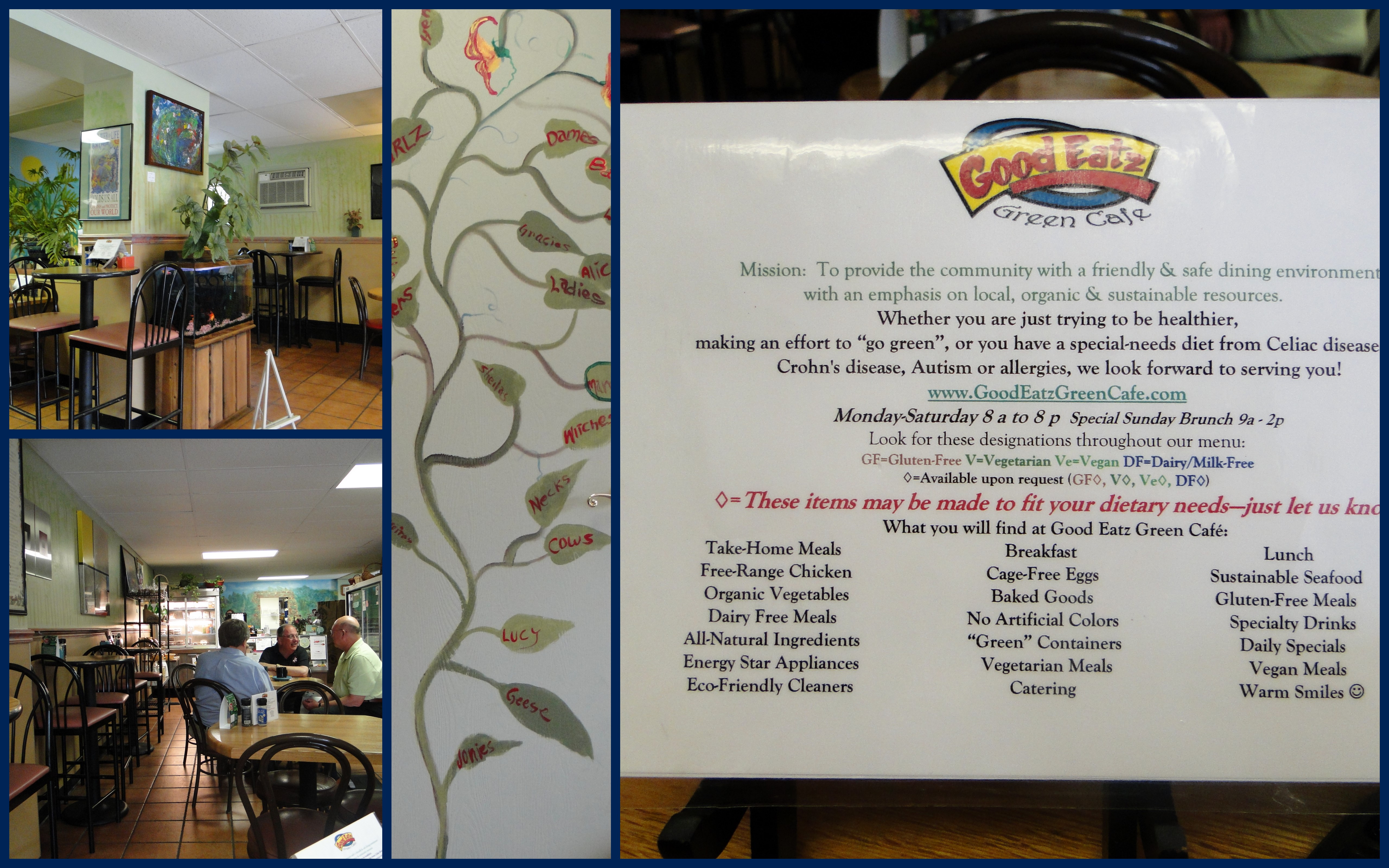
Breakfast at Good Eatz Green Cafe, 701 Penn Avenue, is not only imaginative and healthy but good for the environment.

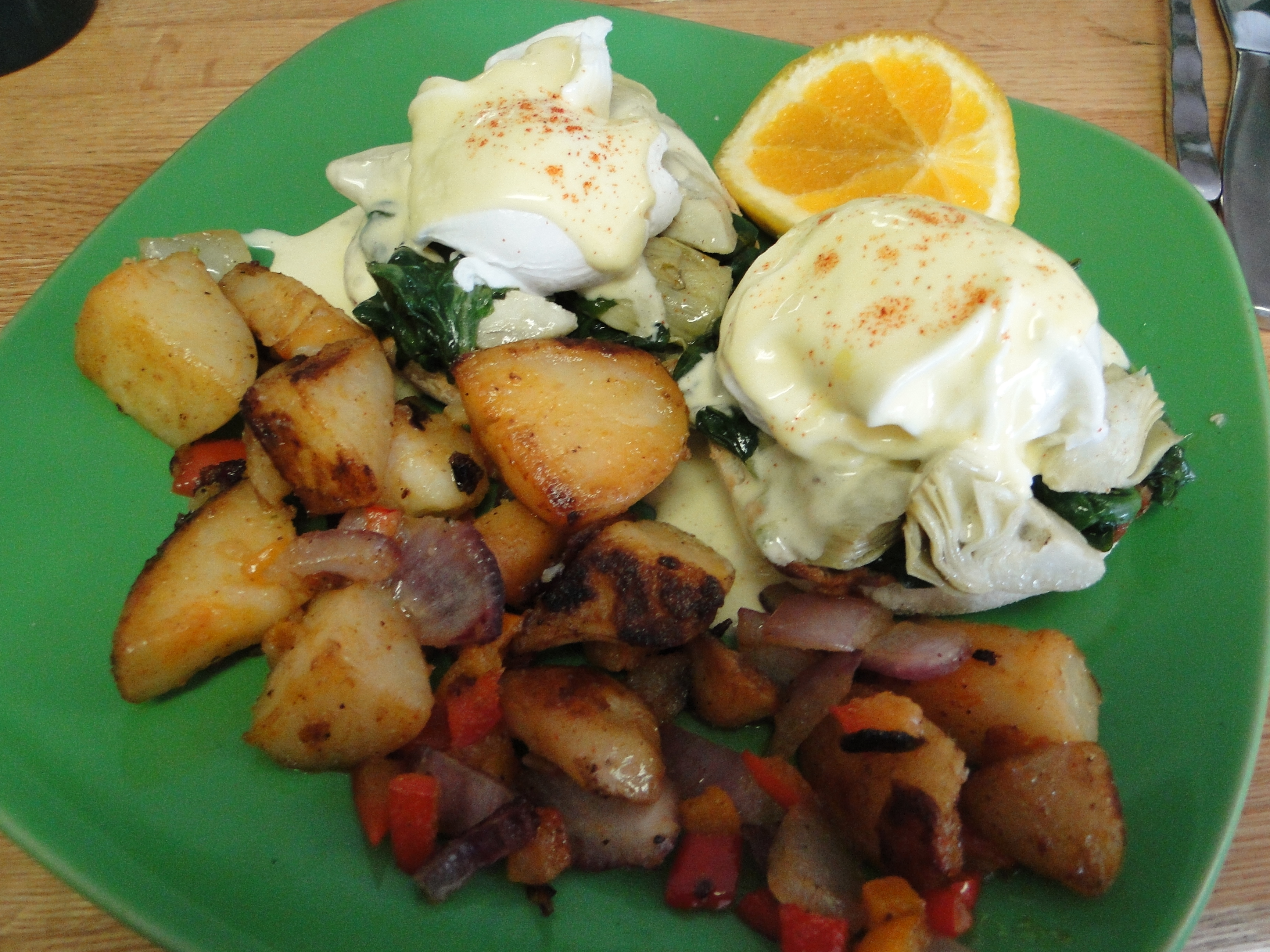
Eggs Sardou

The 30 month-old cafe (almost at the magic 3-year survival mark) serves meticulous, mostly vegetarian/vegan dishes but wisely offer items for carnivorous. Besides being green and natural, an atmosphere of “old town cafe” pervades as a couple of low-key business conversations are carried out over coffee, a few  people at single tables read the paper, backgammon games and books are in a bookshelf and customers walk-in for take-out (natural beverages, prepared sandwiches & salads).

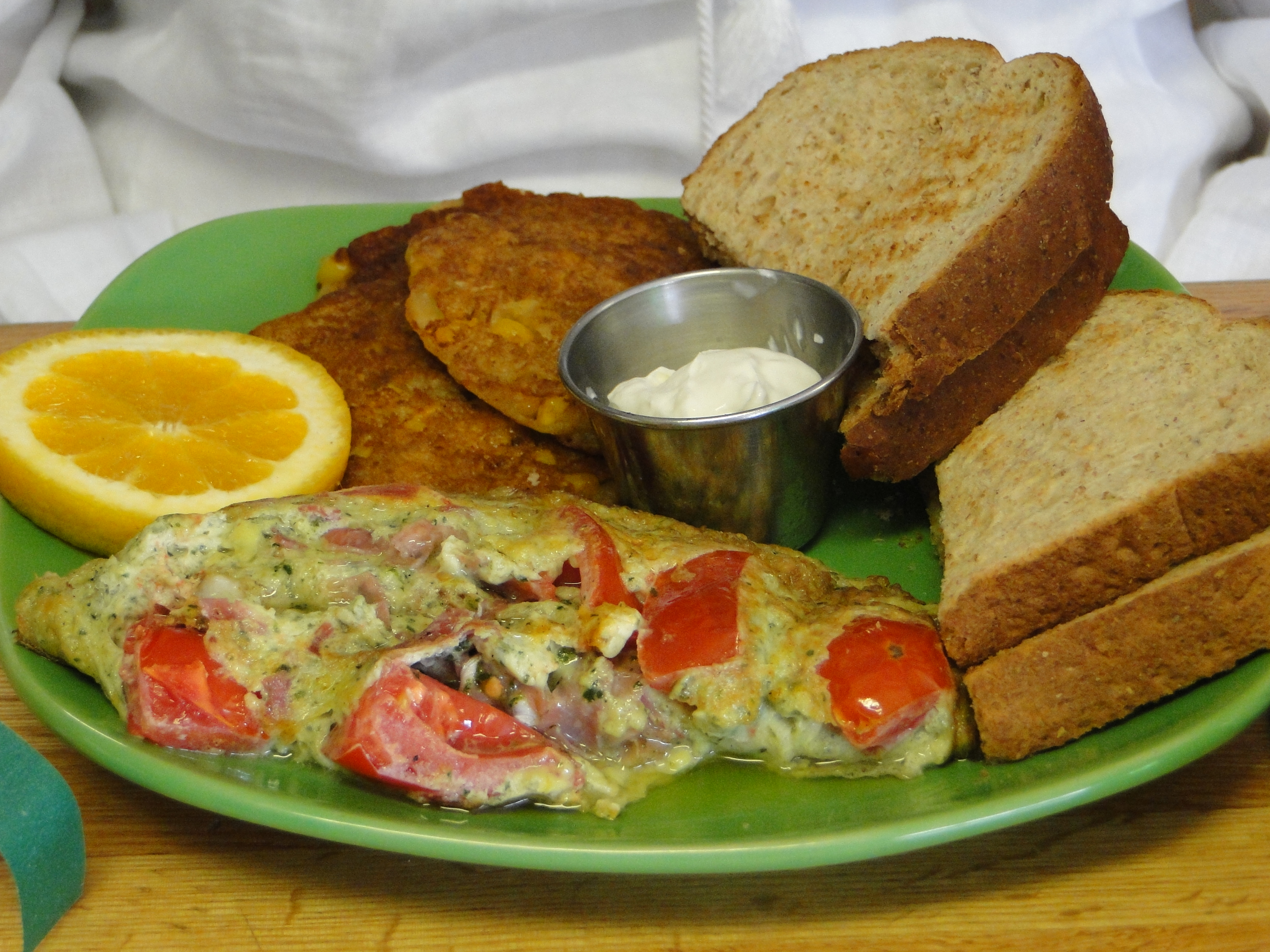
Green Eggs & Ham

My wife had Green Eggs and Ham, an omelet with prosciutto, tomato, basil pesto and provolone served with three perfect corn cakes – crisp exterior, soft fresh corn interior ($9.00). I enjoyed Eggs Sardou, a variation of Eggs Benedict with spinach and artichoke hearts (no Canadian Bacon) topped with two perfectly poached eggs and real homemade Hollandaise Sauce. They were accompanied by Yukon Gold hash browns ($8.00). The presentations were attractive and the dishes carefully prepared. The Good Eatz Green Cafe is not for customers looking for a quick sitdown breakfast but, as mentioned, talk-out is available.

Even that once venerable bastion of old-school dining, Stokesay Castle, 141 Stokesay Castle Lane, has changed ownership after many decades and entered the world of modern fine dining, sensible portions and artistic presentations. Set in a sprawling 1920’s English stone manor just outside Reading on Mount Penn, the view from the covered bar patio is bucolic and the interior dining space understated, elegant and spacious. The Tuesday and Thursday four-course prix fixe dinner menu is an excellent choice.

Top: stately High School & the Hampden Heights, Bottom: art deco Olympian Ballroom & 50's signage

Many of the once well crafted urban row-house neighborhoods are in bad need of repair, as in many cities. Yet there is evidence of slow progress in renovating these blighted areas. Very positive is the determination of residents around Penn Avenue, Albright College, Berks County Park (spotless, safe restrooms) and the still beautiful 1920/30’s hill-side neighborhood of Hampden Heights to maintain the original architecture and landscape.

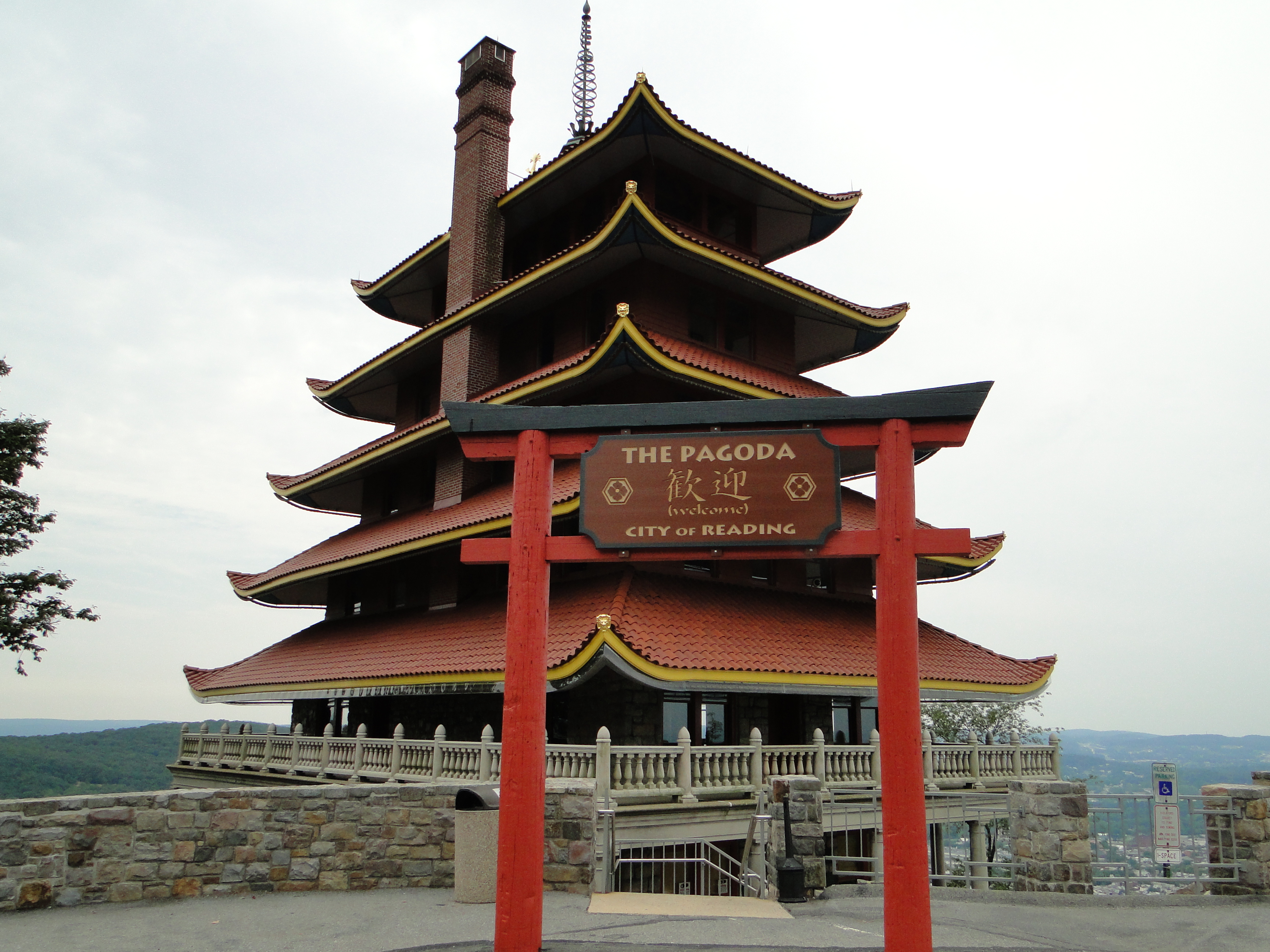
Driving into Reading, especially at night, a visitor can’t miss a large, brightly lite red Japanese Pagoda looming over the city 900 feet up Mount Penn. Built in 1908 by a Reading quarry millionaire, plans to open it as a hotel/club/restaurant quickly fell through. It was purchased in 1910 by another Reading millionaire who promptly gave it to the city. Like all “white elephants” it’s useless and beloved. Having gone through a number of restorations over the years, the Pagoda is in beautiful condition, and the city has recently constructed nature walks in that area of Mount Penn. It seems only open on the weekends, contains a small gallery and an oriental themed cafe. There is talk that perhaps the city will restore the Pagoda to its original purpose as a hotel and fine-dining restaurant. Perhaps it will reinvent itself yet again.  In which case, the Pagoda is a fitting mascot for the city it oversees.

Peas In A Pod – A love story


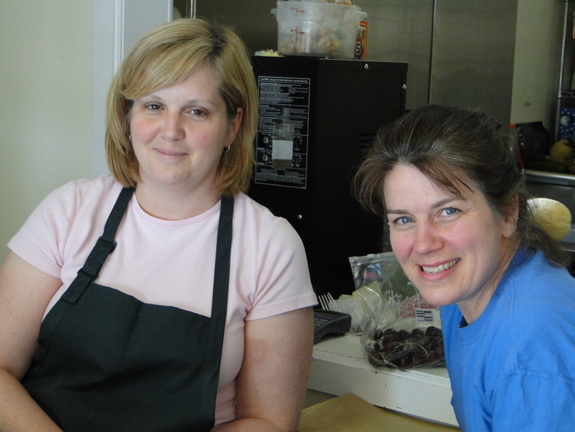
Susan and Kristen

2007 did not start well for Kristen Coyle, Susan Bailey and Karen Dooley. The three sisters faced a bitter-sweet crossroad. Their beloved parents passed away too soon to enjoy retirement and for these three daughters to share those years. Now the nest egg their parents had saved became an unexpected inheritance for the three sisters. It was the decision of the women to use the money in a way that would both benefit all three and, privately, memorialize their parents. They would open a business, a produce business. In my opinion after 30 plus years in the food industry, I’d say opening a small produce shop ranks very high on the risky scale in an industry that already is a big risk. It took brains, passion and a sense of humor to turn sorrow into Peas In A Pod.       


The sisters do not come from a food industry background. Kristen and Susan are both nurses and Karen is a teaching assistant. All were ready to try something different – but anyone can run a food business? Susan and Kristen freely admit that after three years they are still learning – a key ingredient for success. Their Dad, according to Kristen, had an adventurous spirit taking the family on roaming summer drives through the farms of south-eastern Pennsylvania – the famed Pennsylvania Dutch and Quaker farm counties: Lancaster, Chester, Berks, Montgomery and  Bucks. The object was to find, and eat,  the freshest in-season vegetables and fruits at local farms. “Eating a fresh tomato with salt…,” is a strong memory for Kristen. So is growing up in the Mount Airy section of Philadelphia surrounded by the kitchen aromas of the many Italian households in the neighborhood and  sitting down to a freshly made family dinner every night – a tradition these three busy, multi-career women still uphold.       


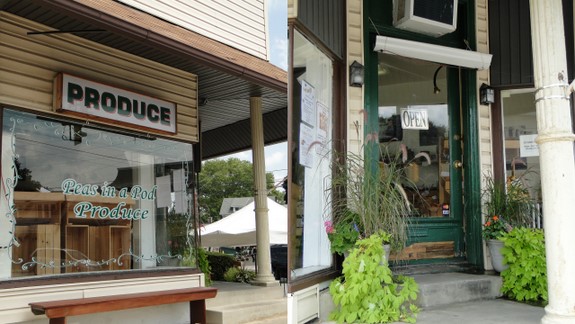
I entered the small shop at the intersection of Keswick and Glenside Avenues in Glenside, PA – a leafy, older suburb a mere 10 miles from center city Philadelphia – through a plant framed door that sticks and agitates an old-fashioned bell announcing a customer. Peas In A Pod is in a typical nondescript twin house converted into mixed commercial/apartment space. Out in front of the shop is a covered stand with produce available on the honor system. Inside, Kristen was at the counter and Susan, with helper, niece Mary Kate, were in the kitchen. (Karen had the day off). Frequent customers, of which there are many, are greeted by name; perhaps they have a quart of soup reserved. Customers, now friends by association, linger and chat.  The interior space of the shop is small, simple and functional.       


80 South Keswick Avenue was chosen the end of March 2007, and the doors to the shop opened in June – record time for a food business…until the sisters tell me the space was the very small front room – maybe 8 x 10 –  of the three rooms.  From day one the object was to sell produce from local farms that used green-earth farming techniques from southeastern Pennsylvania counties.       

 For small shops, and any small food business to succeed, it’s necessary to build personal relationships with suppliers. Susan spent days driving through  the countryside and was attracted to the corn fields ofTruck Patch Farms in Bucks County and developed the trust necessary to ensure high quality fresh vegetables, fruits and eggs. Truck Patch is their largest supplier.  Heirloom tomatoes come from Herrcastle Farms and Jesse Hale of Everhart supplies the raw honey. Patterson Farm’s  maple syrup is a personal favorite, and Four Seasons Farm in Lancaster County, as well as orchards in Loyola, PA, supply fruit, especially Pennsylvania’s wide variety of apples. What you will not find at Peas In A Pod are strawberries in January.       


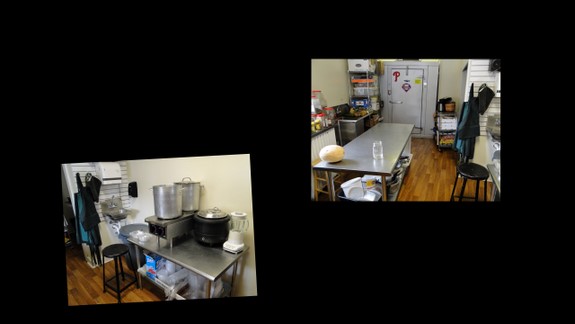
You also will not find most of their 21 soups during the months of June, July and August, but, fortunately, their incomparable Crab Bisque is available every Friday year round – otherwise there would be serious withdrawal issues. Susan’s responsible for the soup, according to Kristen. (Susan: “What were we going to sell in the winter? Soup!”) Susan wanted to bake breads, make soup and maybe expand into… (the curse of a new business – expand). Expansion is a decision often made too early. Sometimes bureaucracy is beneficial, especially considering the 2008 financial meltdown. Cheltenham Township made it clear that fire codes allowed a maximum of only two hot plates for cooking – no oven without excessive renovations –  in the compact kitchen (complete with walk in-refrigerator) that was being constructed in the second room.  A third small room became more produce and Cento brand packaged pastas and sauces. Susan had a stint, while being a nurse, at Flying Fish restaurant in Chestnut Hill and still has dreams of adding more in-house made products, but reality dictated that soups and salads were a marketable match. With the exception of crab bisque every Friday (300 quarts), the remaining 20 soups rotate with one or two  available daily – lemon chicken, bean and potato leek are all favorites. I was allowed only the briefest glance at one of their proprietary recipes, some from their Mother.  Fresh salads with in-house dressings are in a refrigerated section and range from garden to chicken to orzo. The two professional grade hot plates are doing just fine.       


Peas In A Pod celebrated a milestone anniversary this past June 2010: they’re still in business three years after opening – nearly 65% of all food businesses are bankrupt within the first three years. Not that mistakes haven’t been made – the worst was an early over reliance on expensive certified organic produce. Customers preferred the chemical-free products from many local farms that result in “same as organic” at less cost. An obvious suggestion that  future  marketing of their soups, salads and dressings may be a good idea was met with a look  in their eyes that it was already on the table.

The bell at the front door gently clanged as another customer entered the shop. Kristen said that sometimes the bell rings but no one enters. After a brief pause she adds, shyly, “We know its our parents. They would want to be here. I think they’d be proud.”                    

They certainly would.       

Peas In A Pod       

80 South Keswick Avenue
Glenside, PA 19038-4607
(215) 887-2719