Not unlike the deep respect for nature ingrained in Native American cultures, Hawaiians saw themselves as simply caretakers. ‘He ali’I no ka ‘aina, he hauva wale he kanaka’ – the land is chief; the human is but a servant.
High above what passes for tourist glitz on the Kona coast of the island of Hawai’i, the town of Hohualoa sits in early 20th century calm.
Overlooking the Kona coast
Holuakoa Gardens and Café is set within lush gardens complete with a meandering koi pond, yet their story of is more than a small café morphing into a successful restaurant; it’s an integral component in the revival of the Hawaiian ahupua’a system.
With the active encouragement of the Hawaii Regional Cuisine movement and the considerable resources of the Kamehameha School agricultural land use initiative, the future for serious small farmers has rarely been brighter in the islands. With over 300 independent farms growing Kona Coffee and several dozen growing cocoa beans, the future for these Hawaii agricultural products is robust.
cocoa pods at Original Hawaiian Chocolate, Kona, Hi
The Kona Coffee Belt, panoramic Hawaii Route 180, hugs the Kona coast. Several dozen farms, including UCC-Hawaii Kona Coffee Estate and Original Hawaiian Chocolate offer tours and tastings. It’s no surprise that coffee and chocolate pair well together, but their Hawaiian story is just as interesting.
Lush green grass, the deep blue of the ocean, dry rock wall fences and plump black cattle are as much a part of Hawaiian tradition as spear fishing and canoe racing.
Nearing the Hilo Farmers Market, the scents and sights are a kaleidoscope of sensations. Food stalls, produce vendors, flower sellers, clothing, crafts, jewelry and a even a seamstress radiate out onto the surrounding sidewalks.
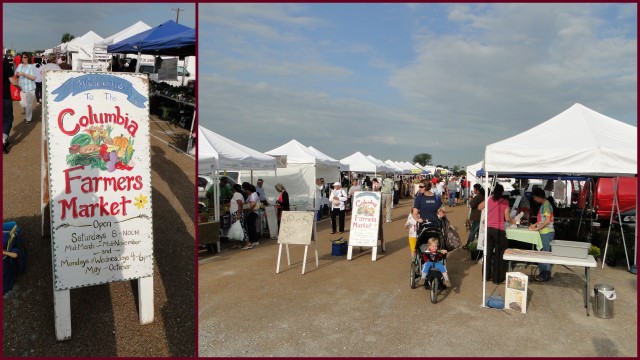
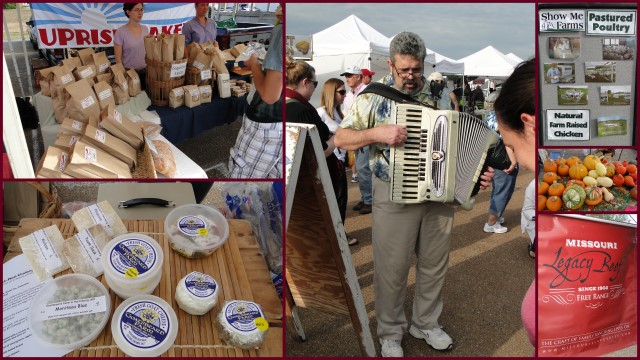
Columbia and AgriMissouri is putting money where its mouth is supporting farmers markets and sustainable agriculture.
Carolyn Todd, Market Director, “Local is not 1,500 miles away,” as she informs me that membership is open to producers living within a 55 mile radius of Columbia.
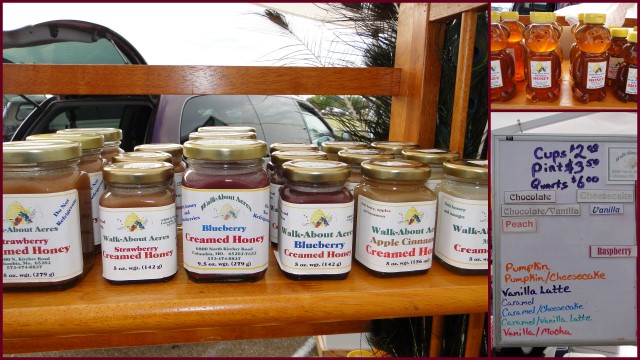
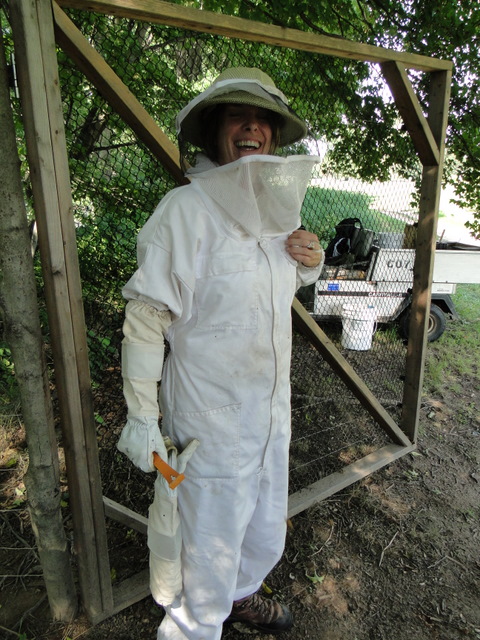
Walk About Farm's honey
5,000 Columbians a day patronize the market.
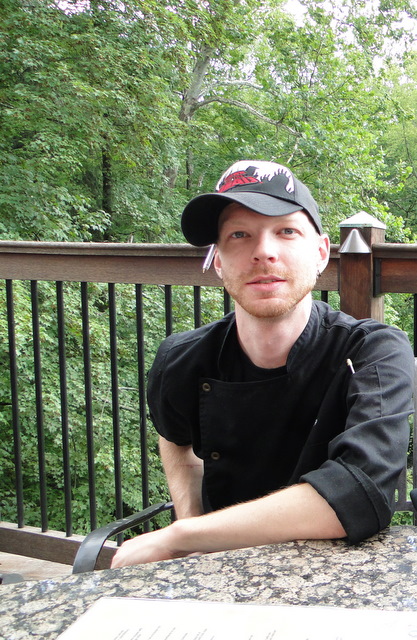
Eric and Chert Hollow Farm garlic & herbs
Despite my love of garlic, and being a chef, I was unaware that garlic originated in ancient Persia.
Chef/Manager Dan Stripp of Shawnee Inn’s The Gem and Keystone Brewpub
Gem & Keystone Brewpub’s Dan Stripp and his team of “artists, skateboarders and rock stars” are unconcerned they’re on the cutting edge of national trends.
Gem and Keystone Brewpub: (clockwise) Limestone Springs Trout with Asian sauted vegetables, cold smoked Baby Back Ribs, Soft Pretzels with Cheddar Ale Dip, Lettuce Wedge salad with Calkins Creamery Blue Cheese, Jumbo Lump Crabcakes
Sous Chef Corey Scott could have inherited his family’s 480 acre resort but why do something predictable? Sous Chef Travis Dente, a dishwasher a few years ago, created the recipe for their cold smoked wood grilled baby backed ribs with a deep flavored smoky BBQ sauce that sent me over heaven.
Sous Chefs Travis Dente and Corey Scott of Shawnee Inn’s The Gem and Keystone Brewpub
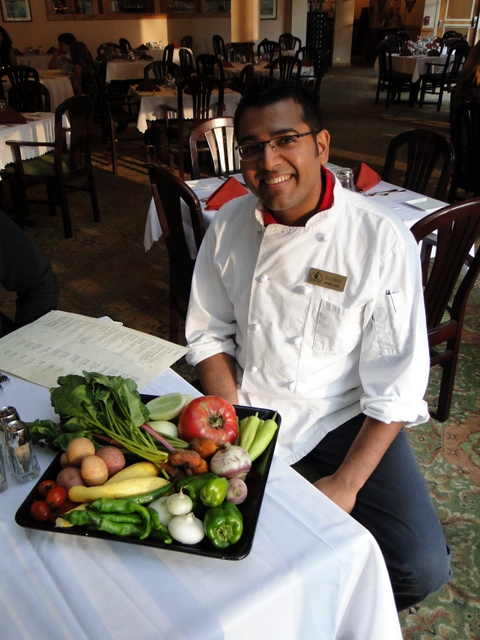
From India to rural Pennsylvania, Chef Gaurav Navin brings a world’s experience to Shawnee Inn and Golf Resort’s menu using locally sourced products.
He’s about four feet tall and looks like any one of a hundred classic poses of the Lord Buddha. He rests behind bars in an exterior open gallery with a twenty-something female guard sitting at a desk (no guns). Photos are forbidden. Because Laos’ a Communist nation? No… the statue’s a cultural icon, it’s worth a zillion dollars and the Luang Prabang National Museum would like visitors to buy a postcard. The statue is THE Golden Buddha – the Phra Bang – of Luang Prabang, and it’s 90% solid gold. For centuries it sat in an inconspicuous corner of Wat Ho Prabang on the Palace grounds in this city of over 40 Buddhist temples and monasteries until someone noticed it after the 1975 revolution.
the confluence of the Mekong and Nam Kahn RiversRoyal Palace (Luang Prabang National Museum)
For nearly a thousand years Luang Prabang, in the northern highlands at the confluence of two great rivers, the Nam Kahn and the Mekong, served as capital for the kingdoms of Lang Xang, Luang Prabang and, finally, Laos. The French, under their “protectorate,” built the 1904 Royal Palace (now the National Museum) for the revered national hero Sisavang Vong, King of Luang Phrabāng and Laos for 55 years (1904- 1959). Ironically, in 1975, it was at the same palace that Prince Souphanouvong (the “Red Prince”) arrested his half brother, KingSisavang Vatthana sending him, the Queen and Crown Prince to die in a “reeducation camp.” Prince Souphanouvong became the first President of the Lao People’s Democratic Republic. It’s a much more peaceful city today.
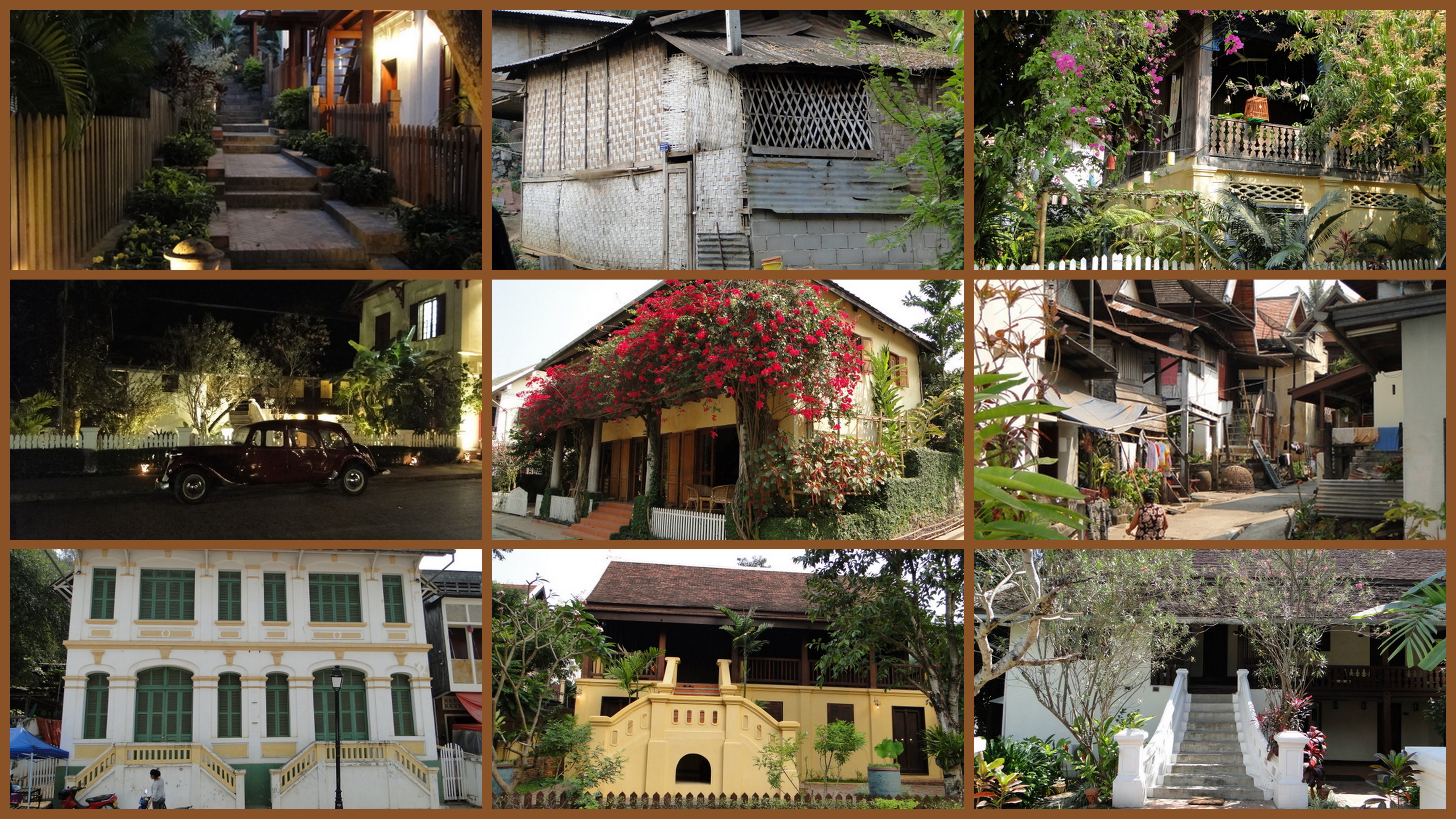
In 1995 Luang Prabang was rightfully declared a UNESCO World Heritage Site and today is the most popular tourist attraction in Laos. The city is gorgeous, at least the old historic core and the stunning surrounding countryside. Luang Prabang is a classic Southeast Asian provincial city and one of the few remaining – villas next to woven bamboo houses, residents cooking in the alleyways on charcoal and wood, aging French colonial buildings and 600 year old Buddhist stupas with monks everywhere, backpackers from Australia and Europe, people in business suits in Toyotas and motor bikes and fisherman throwing nets in the river. For me the preservation of this wonderful collage is what I hope the UNESCO designation will maintain, although there are an increasing number of upscale hotels and amenities geared to the well-heeled Western and Asian tour bus crowd which could alter this reality.
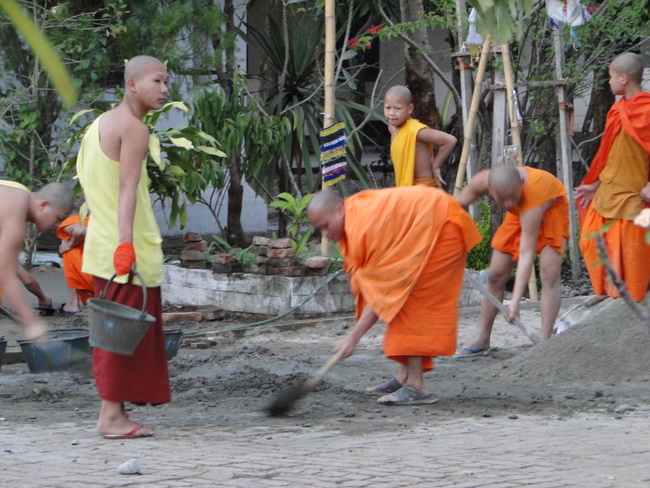
Luang Prabang: people at worknovitiates at work on temple grounds
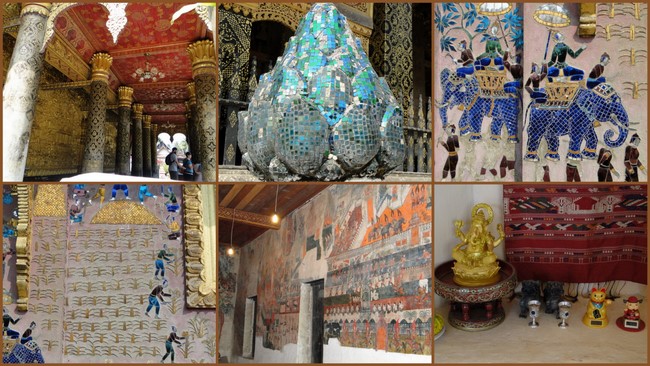
What to see? Wander into any number of the Buddhist temples and monasteries. At first sight “they all look the same,” but fix your eyes on each one’s decorations – gold leaf stencil on teak wood carvings and walls, enamel and mirrored murals depicting holy texts and everyday life, young novitiate students in saffron robes talking on cell phones while taking a break from temple chores, the beautiful sounds of temple drums and the monk’s devotional chanting several times a day.
(top left) Wat Xieng Thing, 1590, (bottom left) Wat Mai, 1788 (bottom right) Wat Ho Prabang
Discover the hundreds of Spirit houses with individualistic statements – the elephant manifestation of the god Ghanish next to Japan’s “Miss Kitty,” sticky rice, glasses of water, incense and candles in trees, on walls – all of nature is sacred. Unfortunately, the much vaunted morning ritual of offering food to the monks at dawn has devolved into a mere tourist attraction/photo op. Local people now simply bring food or make cash donations directly at the Temples. (In other areas of Southeast Asia, especially in the rural countryside, this tradition is still strong.)
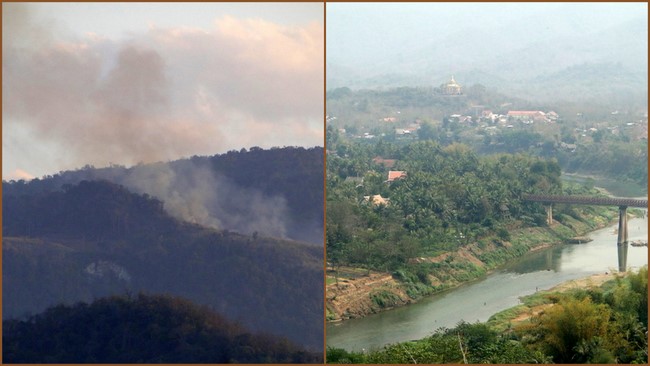
Temple details (note Miss Kitty in bottom right picture)view from Mt. Phousi: fires to clean/clear forest combines with humidity
Climb the 350+ steps up Mount Phousie in the center of the Old City passing dozens of Buddha images – the seven daily Buddhas, a magnificent Sleeping Buddha – and a rusting anti-aircraft gun emplacement left over from the Vietnam War era – to the small 1804 That Choms – one of the city’s most revered sites. If lucky, the temple fortune teller will be present. It’s the highest point in Luang Prabang with a panoramic view of the city and countryside, even if there is a humid haze in the air caused by late winter burning in the surrounding mountains (both controlled burning of underbrush in the teak forests and clearing land for Spring planting). You can purchase, for a pittance, flowers in cone shaped banana leaves, sticky rice and incense as devotional items to leave after your prayers. Women sell pairs of small live birds in bamboo baskets that you carry to the top of the hill and, after saying your prayer, release from their cage. They will take your prayer to heaven.
That Chomsi (1804) at Mt. Phousi, (bottom left) temple fortune tellerethnic set menu at TATC Museum
At the base of the Mount Phousie is the small but exquisite museum Traditional Arts and Technology Center. The artful displays detail the ethnic groups and spiritual influences that comprise Laos. The gift shop sells excellent and authentic handmade crafts and will advise as to the best shops in town. The café offers a stunning seven course set menu consisting of classic dishes from all of Lao’s ethnic groups. There were dishes I had not seen on any menu. The cost was $12.50 for 2 people – the menu doesn’t say “for 2,” the Lao’s assume no one person would stuff themselves (don’t even try to eat everything yourself).
Traditional Arts and Technology Center (TATC)
There are numerous eco-tourism companies that offer excursions into the beautiful surrounding hill countryside. The best is Tiger Trails – it seems every company slaps on the moniker “eco-tour” these days so make use of the internet and do some research. There are a host of “made for tourist” attractions in the area that are really not worth your time unless you’re in town for a few weeks – the “Whiskey Village,” the “Silk Village,” the Pac Ou Caves – and simply want a diversion. Whereas the Elephant Village – a non-profit that rescues abused elephants from the lumber industry – is a must see excursion.
scenes of the countryside surrounding Luang Prabang
Luang Prabang is a Mecca for well made high end silks, art, jewelry and furniture representing both traditional northern Lao and contemporary designs (prices are still a fraction of what they’d be in Europe or North America). The best shops are in the compact Old City, which is easy to navigate on foot. Do not purchase antiques since many “antique” stores sell fakes knowing full well it’s next to impossible to remove genuine antiques, and even contemporary fine art, without a difficult to obtain export license for each item.
Morning Market, Luang Prabang
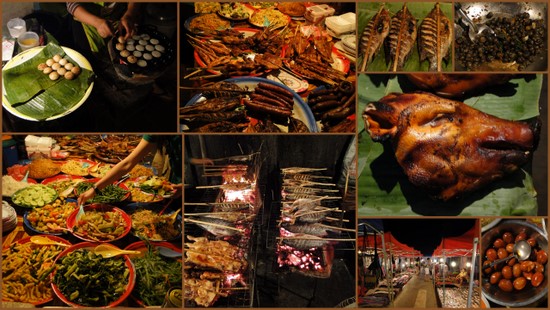
There is the MorningMarket (4:00am – Noon) that’s a serious food emporium. Discover hundreds of foods Westerners never would think could be used in the kitchen – I will detail this market in a future blog. The lively Night Market (5:00 PM – Midnight), unfortunately like so many in Thailand and Cambodia, has devolved into a tourist attraction offering the same old cheaply made clothes, crafts and souvenirs you’ll find in any tourist shop – obviously factory made and, despite labels, probably not even in the country you’re visiting. Yet for prepared street food, the Luang Prabang Night Market is fantastic! One can feast on freshly grilled meats and fish, create a salad using dozens of greens, fresh herbs and produce or add them to savory soups and stews. Along with a refreshing Beer Lao you’ll have a banquet that will cost anywhere from a couple of dollars to maybe $5.00.
Luang Prabang Night Market's prepared foodsView Pavillion Hotel
Accommodations range from $20/night guest houses (many have A/C even at that price) to boutique hotels (fortunately – cross fingers – there are no large chain hotels) surrounded by lush gardens tucked away all over the Old City that range from $55 to $155/night. Many in the $55/65 night range are just as beautiful and comfortable as those at the higher end. It’s not always easy to find these gems on the Net. I did use a good booking site – Agoda – but since hotels subscribe to booking sites it’s hardly a complete list. TripAdvisor is another good source but since it lists only ones reviewed by members, it does not have a complete list as well. My advice for anyone traveling to Southeast Asia is to book a hotel for the start of your stay in each city through a booking site and then check out what’s available. If you are pleased with the booked hotel, inquire if they’ll extend your stay at the same rate – booking sites are always discounted. If not, you can just move down the street. We stayed at The View Pavilion at over $90/night but, although it had a terrific staff, the hotel needed maintenance from its absentee owners. (Following my own advice for a change, in Chiang Mai, Thailand, at The Rimping Village Hotel they willingly extended our stay at Agoda’s discounted rate after they proved to be a mini-paradise – more on that in another blog.) Lao courtesy and concern with customer comfort is so effusive they would be insulted if you did not ask them for help making dinner reservations, advice on excursions and making the arrangements as well as securing a taxi or tuk-tuk and negotiating the fare. Take advantage – it makes them happy.
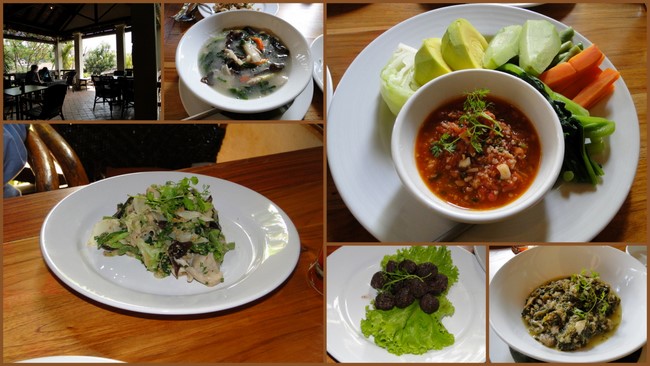
Tamnak Lao Restaurant: Fish Amok, Purple & White sticky rice, Soup with Vine Leaves, Luang Prabang Salad, Water Buffalo sausageRestaurant L'Elephant
Laotian cuisine is neither as sweet as Vietnamese nor spicy hot as Thai – although they still love their chilies. This allows the abundant use of basil, cilantro, mint, green onions, garlic, roasted vegetables and dozens of flavorful greens to shine through their masterful dishes complimented by grilled and steamed fish, pork, beef, chicken, frog, prawns and many other forms of protein. Like the rest of Southeast Asia, they use a number of vegetable/herb/meat pastes, freshly made with mortar and pestle, to add additional layers of flavor. Fermented fish sauce, which in my experience the average Westerner finds disgusting, adds subtle flavor to most dishes and was/is a salt substitute. Fish sauce – of which there are many varieties – does smell vile to the Western nose, but when added to food, that smell dissipates and actually results in a slightly sweet under taste. (I will be writing an article on a wonderful all-day cooking class offered by Tamarind restaurant.) Like most Asian dining, a number of dishes should be ordered – depending on the size of the party – with all diners sharing. We found, for our own dining comfort that for two people, three dishes – along with steamed or sticky rice – was enough. One cold salad, one fish/seafood dish and one meat/poultry dish was satisfactory. Soups are usually substantial consisting of noodles, greens and protein and can be part of a main course. It is easy for a vegetarian/vegan to eat well anywhere in Southeast Asia, but don’t expect this to be the norm among locals. Dishes will be served as they are ready not in a Western order (appetizers first followed by the main course, etc.) Two people in even the most expensive restaurants in Luang Prabang would be hard pressed to spend more than $40/couple, and it is easy for most meals to cost less than $10 – $15/couple. (Note: adding a bottle of wine will more than double to triple the cost, so don’t bother unless you can’t live without wine.)
Tamarind Restaurant: Lao appitizers, Pork/ginger/cilantro balls in lemon grass, steamed fish in banana leaf
My top picks for traditional and fusion Lao restaurants in the Old City are Tamarind and Rosella Fusion Café both on the Nam Kahn river front. The Australian/Lao owned Tamarind is probably the best in the city, and it is moderately priced serving imaginative dishes (lunch or dinner for 2 $15 – $30). Reservations are essential for dinner. The young Lao staff of Rosella Fusion Café serve much better than average traditional Lao dishes at low prices ($10 – $15/couple) while you sit at attractive teak tables surrounded by orchids at the edge of the high banks overlooking the Nam Kahn. Tamnak Lao, on Sisavangvong Road (the main street) in a classic stucco and wood Lao structure offers tasty traditional Lao dishes, also at moderate prices, while Joma coffee shop on the Mekong side river road has great French coffee and imaginative thin-crust pizzas. Ignore most hotel restaurants. Although many are in attractive surroundings, they serve food geared to the tourist palate – mediocre – at high prices (unless you really crave your Angus beef steak).
There are excellent French restaurants in this Communist nation where road signs are still written in Lao and French, bilingual schools are common and the French government funds many projects. L’ Elephant is in an elegant art-deco building offering classic French and French Indochina cuisine at prices in the very high end. Unfortunately, it’s become popular with tour groups as well. Café Ben Vat Sene (my favorite) has the feel of a French bistro in the “colonial” tropics – which it is – and too small for tour groups. Under the slowly moving ceiling fans, sitting at rustic tables with brightly colored Lao fabric napkins and placemats, eating such classic French country fare as Pommes de Terre Savoyard (au gratin potatoes with smoked ham) and freshly made Tarte au Citron(lemon tart), don’t be surprised if you conjure images of Noel Coward, Somerset Maugham and Jean d’Estray at the next table enjoying an absinthe. Orchids, the tropical evening and fine food do that to you – give in.
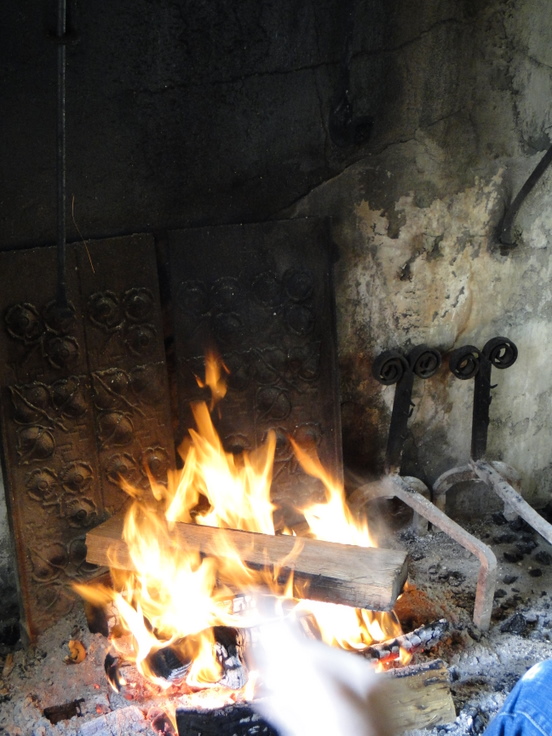
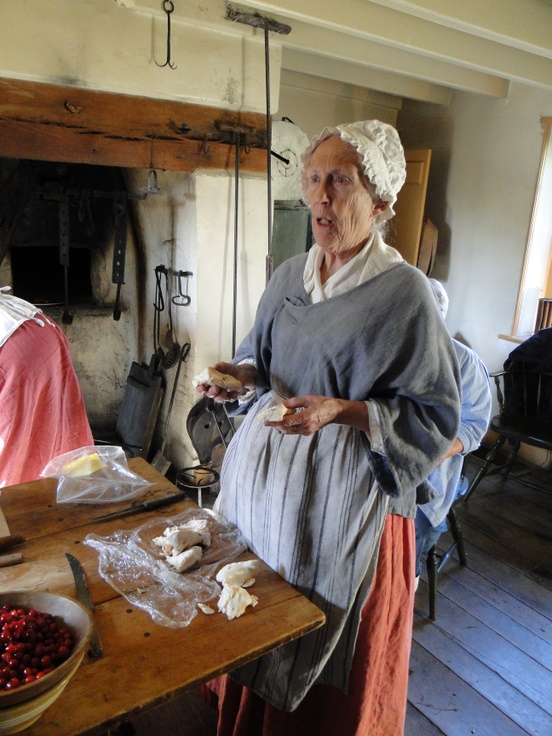
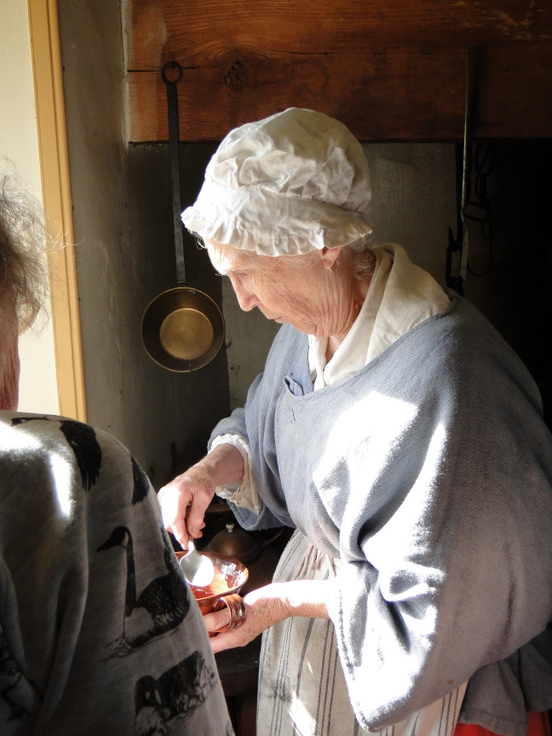
The fire’s roaring in the kitchen of the 1696 Thomas Massey House, trying to take the chill out of the beautiful autumn morning in this 17th century stone house. Eight of us are gathered around a colonial cooking icon – Clarissa Dillon, Ph.D. I’ll refrain from using the word “legend” since I heard one well known Philadelphia chef recently reject that term when applied to him saying, “I can’t be a legend; I’m not dead yet.” Neither is Dr. Dillon, an octogenarian who next year on her annual trip to the British Isles will study whiskey distilling in Scotland.
Clarissa Dillon, Ph.D.
Clarissa is one of the foremost authorities – and she’ll freely say still a “student”- of 18th century American Colonial cooking, farming, gardening and household activities. I’ll leave all the details to your exploration of her web site. Needless to say, she’s a stickler on authenticity – writing, editing and traveling extensively to get the facts and set the history books straight.
A life-long teacher, she conducts seminars, cooking and gardening classes at many 18th century historic homes that are the legacy of William Penn’s Pennsylvania colony – Pennsbury Manor, the Wyck and Morris Mansions, Pottsgrove Manor, Anselma Mills, Ephrata Cloister just to name a few.
Thomas Massey House, 1696
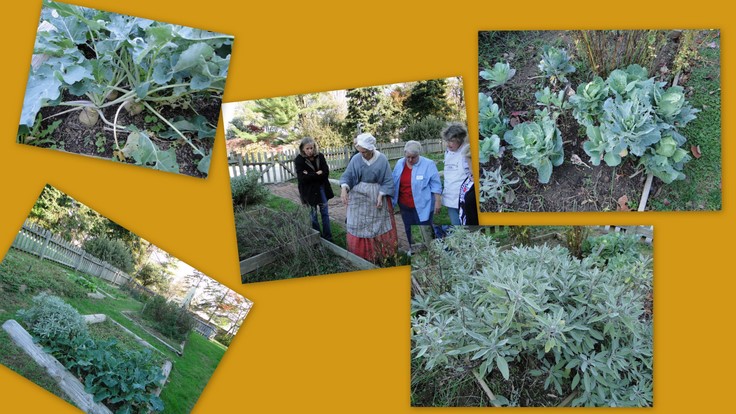
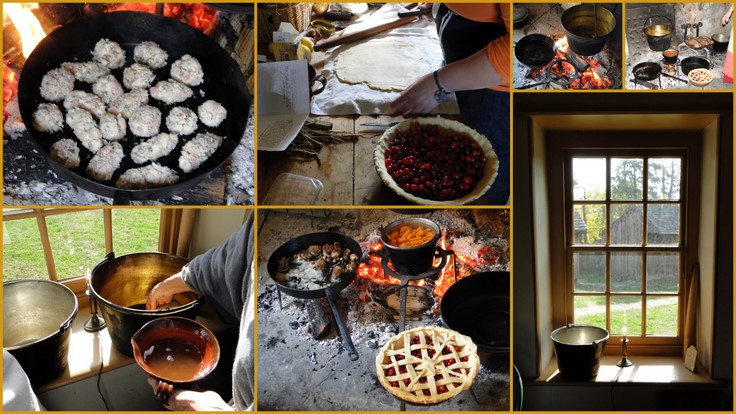
On this Saturday morning we are learning about, and preparing, an autumn dinner on an open hearth using 18th century utensils with vegetables and herbs from the Massey House garden.
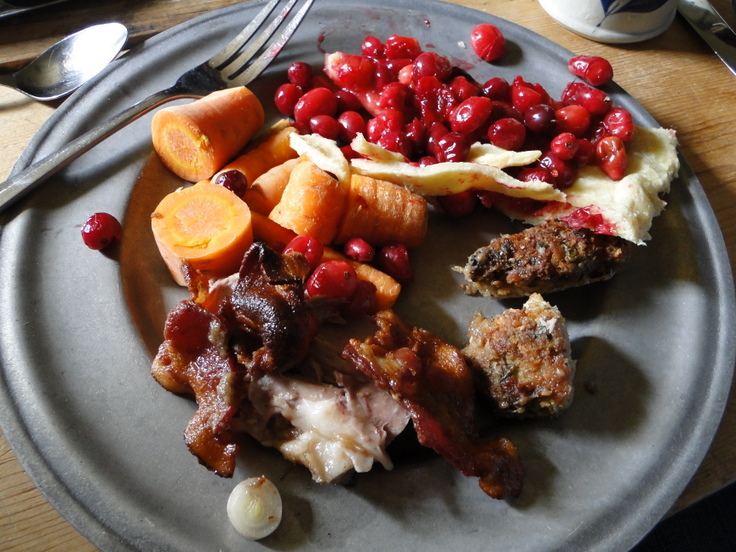
Stewed duck with bacon and veal forcemeat
Boiled Carrots
Boiled Scorzonera
Cranberry Pie
Hard cider
It’s confusing at first when I hear the word “receipt” used instead of recipe, but our modern word is, well, 20th century. For years, receipt meant cooking preparation instructions as well as accounts, and even Dr. Dillion says it’s often confusing until she sees the actual document.
Colonial American receipts were, for the most part, English, which makes perfect sense. After all, we were English colonies with very English sensibilities. Catherine Brooks, The Complete English Cook, 1762, was one of the popular sources for Colonial kitchens.
Brooks’ receipt for Stewing Ducks Whole: (all receipts are written in 18th century format)
Draw your ducks (pluck the feathers, etc.) and wash them clean, then put them into a stew-pan, with strong Broth, Anchovy, Lemon-peel, whole Pepper, and Onion, Mace and red Wine; when well stewed, put one piece of butter and some grated bread to thicken it; lay force Meatballs and crisped bacon round them and garnish with Shallots.
To translate: for 8 servings – 2 to 3 whole ducks covered with water or chicken stock. Add 5 to 6 chopped anchovy filets, peel of one lemon, 12 – 15 whole pepper corns, and one large onion chopped, 1 t. ground mace, and 1-1/2 cups red wine. Simmer until ducks register 165 degrees with a meat thermometer. Remove the ducks from the stock and keep warm. Strain the stock. Skim as much fat as possible. (If you prepare in advance, refrigerate both the ducks and the stock overnight. All the duck fat will solidify on the top and you can simply remove it.) Return to the fire, or stove, and add 1 to 2 cups of bread crumbs and ¼ pound of butter. Simmer until thickened.
Anchovy fillets, and other small salted fish, had been used since pre-Roman days as a salt substitute. Until the 19th century, salt was an expensive item commonly used for food preservation, not in a bowl on the dining table unless you were very rich!
Catharine Brooks’ Veal Force-meat Balls:
Take half a pound of suet, as much veal cut fine, and beat them in a marble Mortar or wooden bowl; have a few sweet Herbs shred fine, and a little Mace dried and beat fine, a little lemon-peel cut very fine, a small Nutmeg grated, or half a large one, a little pepper and salt, and the Yolks of two eggs; mix all these well together, then roll them into little round balls, and some in long ones; roll them in flour, and fry them brown.
To translate: for 8 servings – I’d use 3/4th pound each suet and ground veal. Buy suet from a butcher or good grocery store (DO NOT use suet for birds!!!) and chop very fine in a food processor. Add 1t. crushed dried thyme, 1 T. fresh minced parsley, 1/2 t. nutmeg, ¼ t. mace, ½ t. grated fresh lemon peel, ¼ t. each salt and pepper and the egg yolks. Roll into balls and coat with flour or bread crumbs. Fry in butter.
Bacon: Cut half a pound of sliced bacon into thirds and fry until crisp.
Presentation: Arrange the ducks on a platter, arrange the meatballs and bacon around the ducks and sprinkle with 2 sliced shallots. Serve the gravy in a separate bowl.
Stewed duck with veal force meat and bacon
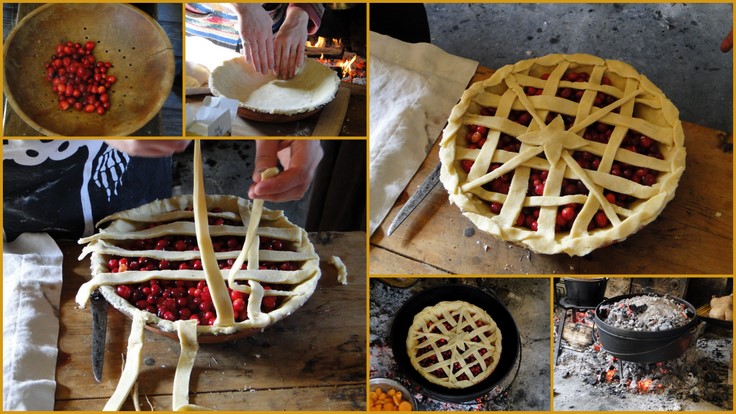
In the 18th century, pies were generally thought of as savory dishes whether made from beef and kidneys or fruit. Ann Peckham’s 18th century Cranberry Pie was meant to be served as a side dish. As a counter point to the richness of the Duck dish, the tart cranberries and flakey crust were terrific. In the 18th century, the crust was frequently so thick it was not meant to be eaten. It served as the “dish” from which the filling was spooned out.
Cranberry pie
Ann Peckham’s Cranberry Tart:
Roll a sheet of tart paste, put it into your dish, boil up some cranberries with loaf sugar; when cold put them in, and trellis them over with the puff paste, cut a border out to lie round your dish, and bake it.
To make the paste for tarts: Take a pound of flour, and half a pound of butter, rub the butter into the flour, two eggs, and a little water, and make it into a paste.
To translate: Make the filling by combining 1-½ pounds of fresh cranberries and 1 to 1-½ pounds of sugar. Place on the fire, or the stove, and bring to a boil. Simmer for 10 to 15 minutes. Drain through a colander. (Reserve the liquid, if you wish, adding ½ to 1 pound more sugar. Bring to a boil until reduced by half, and you have a cranberry syrup to use on pancakes, etc.)
For the crust: Cut the butter into the flour either with two knives, a pastry blender or in a food processor. In the bowl, using clean hands, lightly rub the flour and butter together to coat the flour with the fat, BUT don’t knead it together like bread. The heat in your hands will melt the butter and toughen the dough. Add the eggs and combine with a fork. If the mixture is not combining into a ball sprinkle in a little ice cold water just until the dough forms. Roll out 2/3’s of the dough and line a deep pie pan. After the cranberries have cooled to room temperature, pour into the crust. With the remaining 1/3 of the crust, roll out and cut into strips making a lattice design on top of the pie. Place into an oven at 375 degrees for 45 minutes until the crust is golden brown.
If baking on an open fire, place the pie pan into a cast iron Dutch oven and cover with the lid. Place on the coals of the fire, or better, on a cast iron trivet above the fire, and cover the top of the lid with coals. Rotate the Dutch oven after 20 minutes. Check the pie after 40 minutes by removing the coals from the top of the lid and checking to see the color of the crust.
Serve the pie as a side dish to the duck.
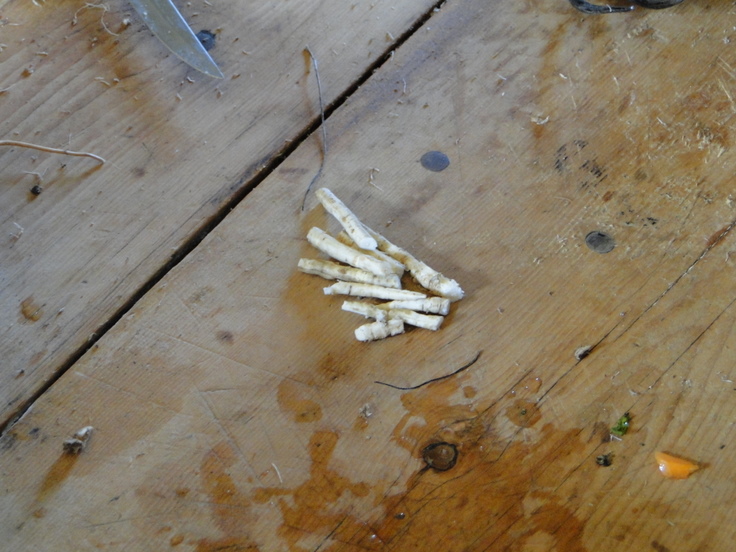
top left: whole scorzonera, top right: trimmed, bottom left: cleaned, bottom right: fresh carrotsfrom the above raw amount, this is the quantity of scorzonera ready to cook
Carrots are carrots and even in this very late October day, they were still fresh in the garden. Scorzonera though is something else and you’ll not find it in any market. You have to grow it yourself. Known in England as Viper grass, its root is the only edible part, but it’s a very thin root. After scraping the skin off, what you have are very thin pieces of a root vegetable which was fried or steamed and frequently cream and butter were added. Its flavor is akin to a mild carrot. In the 19th century it fell out of the general cooking repertoire and was replaced by parsnips. Since the amount was so small we simply added them to the carrots and simmerd both over the fire for about one hour.
Hard apple cider was the beverage of choice for the common English/Colonial person for most meals and the major reason for cultivating apple trees in the first place.
As delicious as this dinner was, more fascinating were the tidbits of knowledge I was able to absorb at this first class.
The green tops of the carrots were used as a wool dye. After boiling, the wool turns yellow.
Claret, a common wine in English receipts, is French Bordeaux.
Suet for all recipes is the thick layer of creamy white fat that cushions the kidneys.
the kitchen garden
Kitchen gardens were first created by the Dutch and not adopted in England until the 16th century, even then only the affluent had extra land around their houses for a garden. Most kitchen gardens were for medicinal purposes – sage, turnips and potatoes being among the many forms of produce used for medicine. The average person gathered wild herbs, green onions in the spring, nuts etc. for cooking until the 19th century.
American colonial cooking was not in any way influenced by the Native American diet – with the exception of common vegetables such as corn. Native Americans, considered savages, were ignored and condemned. John Bartram, the famous 18th century Philadelphia medicinal gardener grudgingly served as a go-between with the Onondaga in order to increase his knowledge.
The Colonial diet was as far from organic, vegetarian and low-fat as one can imagine. Human manure was commonly used as fertilizer. Meat was devoured especially in winter and copious amounts of fat were used in all dishes.
Cheese was a summer substitute for meat since cattle was not slaughtered until winter – they needed the summer to fatten. Cheese and butter were made in late spring and summer when the grass the cows were munching on were free from spring onions and other weeds that would taint the milk sour. Most cheeses were of the soft, fresh variety. Obviously the wealthy could afford to preserve or import high quality, and harder, English cheeses such as cheddar.
Because hearth cooking made it difficult to keep food hot while waiting for the remainder of the meal to cook, dishes were frequently eaten at room temperature which often does not detract from the flavors. All dishes would be placed on the table at once – even those deemed “sweets.”
A very wealthy household with many servants frequently served three courses with an average of 20 – 25 different dishes per course – “buffet style.” Meats, fish, seafood, vegetables, pies and puddings would all be part of each course. The first course would be “hardy” – beef, etc. Second course lighter – chicken, small birds, etc. The dessert course usually consisted of fresh and dried fruits, nuts and chocolate coated nuts.
Wine was made from everything including turnips and parsnips and brewing beer was part of every houshold and farm. “Fresh water” for drinking was an anomaly. Wherever there were towns and farms, lakes and streams were polluted with human and animal waste.
This is just the proverbial “tip of the ice berg” when it comes to my knowledge of 18th century food preparation, but it was sufficient to make me desire more!
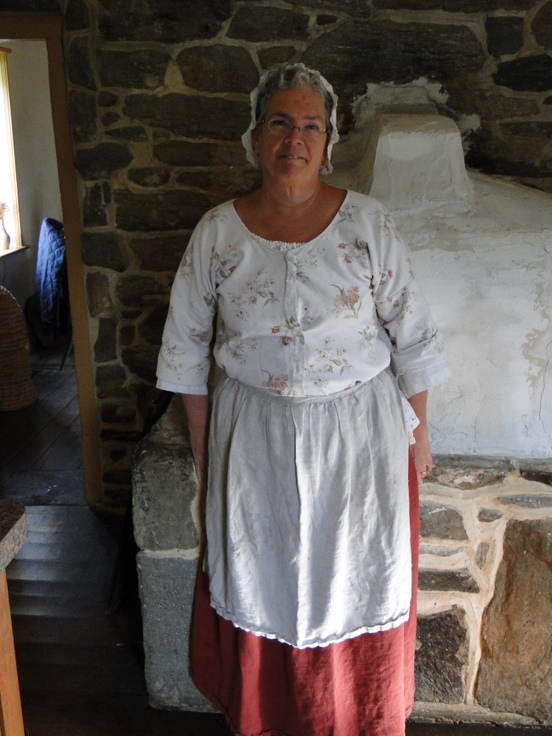
Pat Martin
The Thomas Massey House hosts authentic Colonial dinners, by candlelight, several times during the year, check their web site, and will host a Christmas house event on 11 December 2010 highlighting the food of the various ethnic groups that comprised Penn’s colony. Pat Martin is the very capable, and overly modest, chef of these dinners.
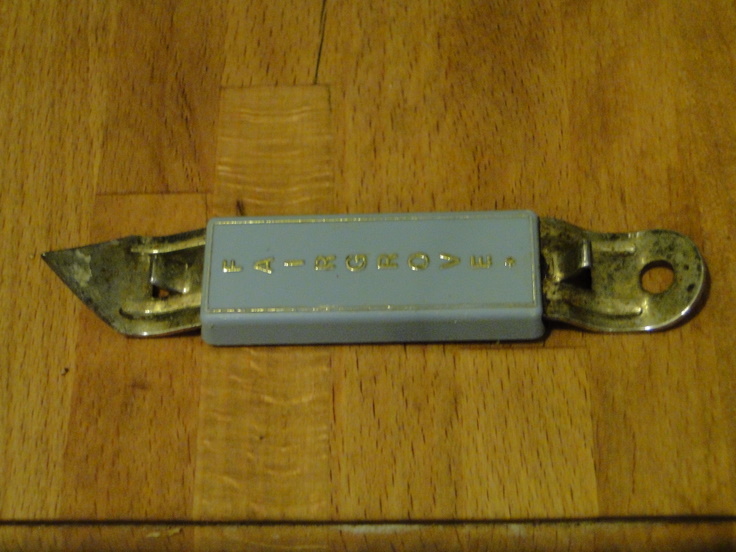
a "church key"
Oh…the church key. Clarissa said it soon will cease to be manufactured because few liquids these days are canned that necessitate the punch section of the opener. Except that in Colonial cooking, items such as canned milk are necessary. She urged that we all stock up on this simple and effective tool. Nothing, including Dr. Clarissa Dillon, ever loses its usefulness!
….especially eat some of the freshest produce, fruit, meats, fish and SEAFOOD ever but not always in restaurants.
Mecca for this abundance is the Granville Island Public Market with 50 permanent and over one hundred day vendors selling food and crafts.
It’s a vast space and on a beautiful Sunday afternoon it was packed. Not only is the variety and quality overwhelming and the prices very fair, but every ethnic “fast food” is available from Italian to Samoan – this is the Pacific Rim remember. Take your prepared foods outside to the tables and benches and you’ll also be entertained by dozens of buskers/musicians. The picture collages are best viewed if you click to enlarge (want an item identified? E-mail me through a comment. I’ll be happy to reply).
baked goods & chocolates
Although Granville Market is the largest, Downtown Vancouver has a number of smaller produce markets that you’ll run across walking through the city. So… you’re a tourist staying in a hotel with, maybe, a microwave in your room – not good for oysters? Why not book an apartment, or easier still, an apartment hotel. For six nights I had a one bedroom apartment with a complete kitchen, half a block from False Creek at the (first class) Meridian 910 Beach Avenue Apartment Hotel for $140/night including tax. When I tell you what good restaurants cost in Vancouver, as well as the $250 – $600/night at all other first class hotels, you’ll realize this is a terrific deal.
meats, cheeses and pates
I’m a seafood/fish freak – especially oysters (raw, fried, you name it). The northwest coast of the USA and Canada has survived the destructive pollution that has ravaged the eastern shore and Gulf coast beds. For $18.00 I purchased two pounds of the largest, plumpest stewing oysters I have ever experienced. They provided my wife and me with the main course for two dinners and one lunch. I’m not a big fan of deep fat frying, but pan frying is another story altogether. I created a recipe which I consider quite nice:
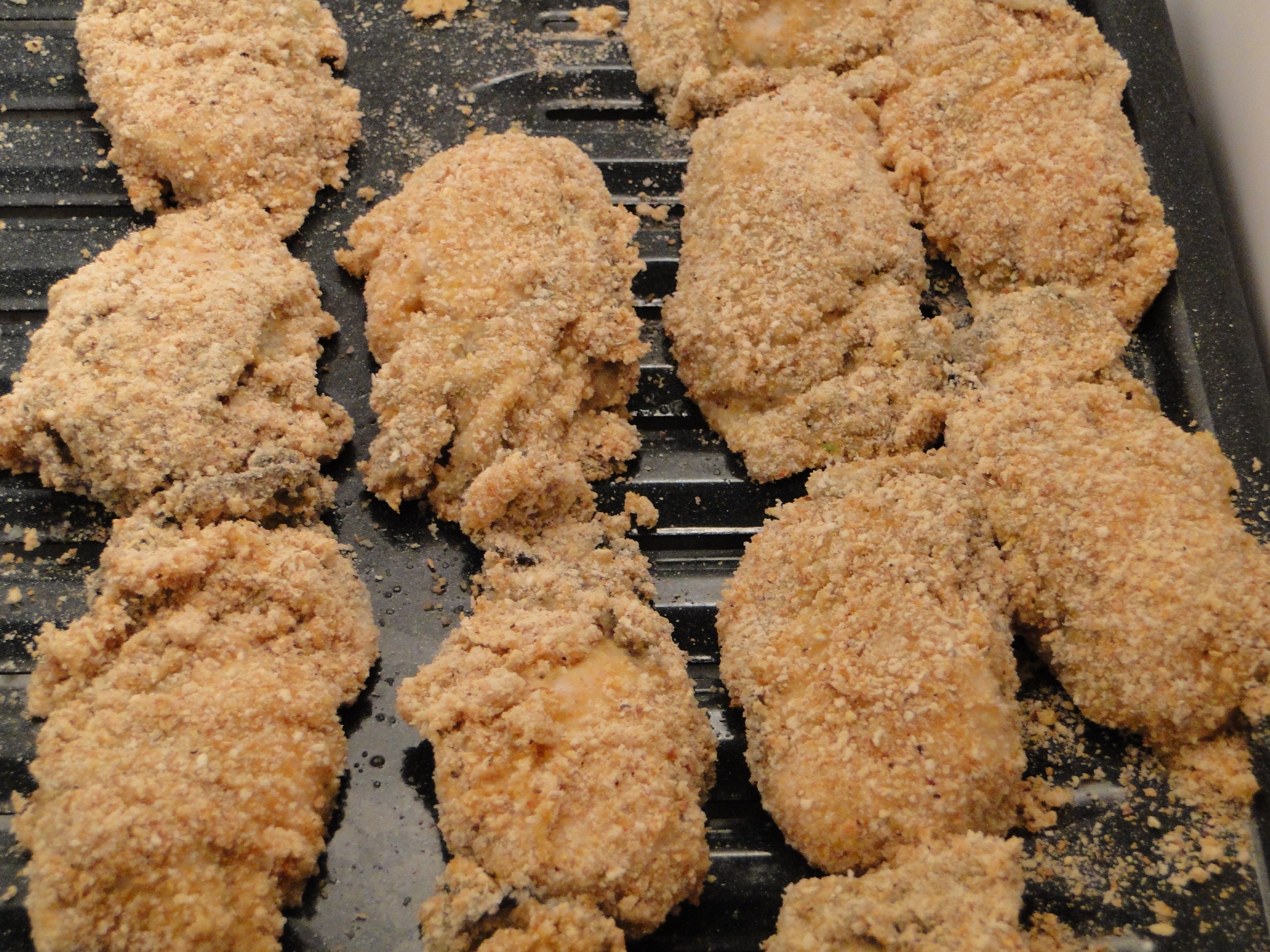
Stewing Oysters breaded and ready for frying
Pan Fried Oysters with Scotch-Green Pepper Mustard Sauce (if usingall two pounds it will serve four people)
Ingredients:
2 pounds stewing oysters
Flour
4 eggs, well beaten
DRY bread crumbs or corn meal (I like corn meal)
¼ pound butter and 4 Tablespoons olive oil (more butter if necessary between batches)
Salt and pepper to taste
1 cup (8 oz. any Scotch whiskey)
2 to 3 Tablespoons green pepper corn mustard (if you cannot find this, use 2 Tablespoons Dijon mustard and 1 Tablespoons preserved – canned – green peppercorns).
Finely chopped parsley for garnish
Procedure:
(1) place oysters in a strainer over a bowl and drain for 30 minutes
(2) reserve oyster liquor and place oysters on paper towels to dry for 15 minutes.
(3) beat eggs in a bowl
(4) in a separate bowl measure out 1 ½ cups flour
(5) in a different bowl measure out an equal amount of cornmeal or flour
(6) Follow these directions for EACH oyster: using your hands (NOT A FORK OR TONGS – you will puncture the delicate oysters – hands are made for cooking) (A) dip each oyster into the first bowl of flour and shake off the excess. (B) dip the floured oyster into the beaten egg. (C) coat the egged oyster in the additional flour or cornmeal.
(7) place each oyster on a wire rack/cookie sheet. When all oysters have been prepared, place the cookie sheet with oysters into the refrigerator for 30 minutes so that the coating will “set” – adhere to the oyster (you want to do this for anything you “bread”).
(8) in a heavy sauté/frying pan, non-stick is great, cut the 4 oz. of butter into pieces and add the olive oil. Melt the butter into the oil over moderate heat. When gently bubbling, add only enough oysters for a single layer – do not crowd! Sauté until golden brown on each side – about 2 minutes per side. Transfer to a paper towel lined platter that has been heated in a 225 degree oven and keep oysters warm until all are prepared.
(9) If the oysters have absorbed all the butter/oil, add 2 to 3 Tablespoons butter to pan and melt. Add the mustard/peppercorns and blend until smooth. Add the scotch and reserved oyster liquor and heat gently until smooth simmer for 2 minutes.
(10) Divide the sauce among the plates and top with four or five oysters. Sprinkle with some finely chopped parsley. Serve with roasted garlic whipped potatoes and steamed asparagus. (email for the roasted garlic potato recipe).
Vancouver, like most North American cities, has lost any distinctive cuisine having succumbed to the homogenized taste dictated by large food processors and TV advertising. The average restaurant serves the same burgers, fried fish, steaks and pasta dishes anyone will find in New York, Toronto or Dubuque – with the same variations on theme and price depending on whether table cloths are provided. “Fine Dining” establishments mean a couple will pay the same $150 with wine that they’ll pay anywhere for the same food and serve.
I did find one restaurant I thought was a cut above the norm in an unlikely venue since it’s in the middle of the uber-tourist/power lunch Downtown area of Canada Place/Harbor Center.
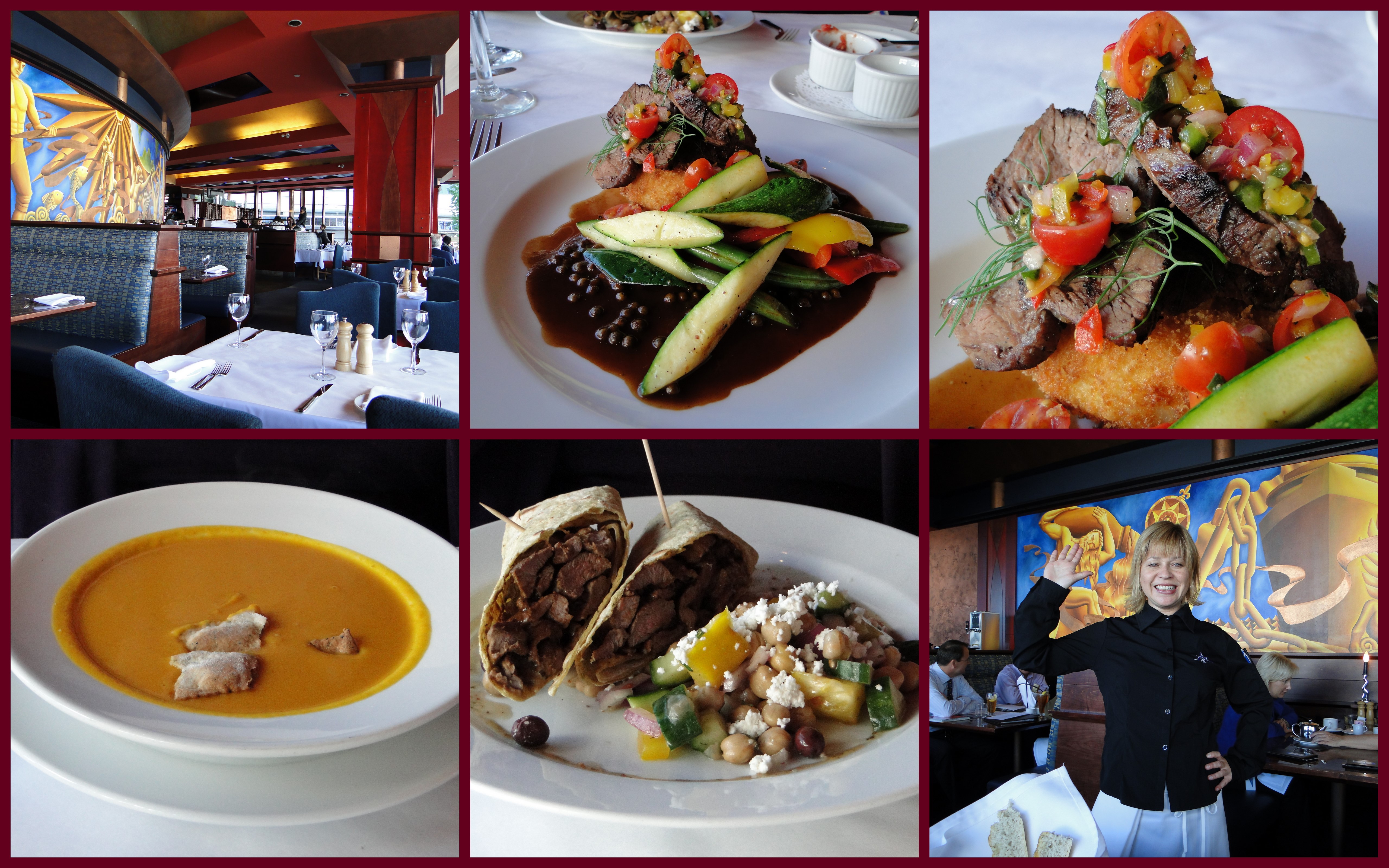
Aqua Riva and Heidi
Aqua Riva, 200 Granville Street, is a sleek, ultra-modern, glass sheathed space with spectacular views of Vancouver harbor from all tables. Recommended by friends who had dined there a few weeks before, it was an excellent choice for a first-class lunch. The same friends had told us we must have Heidi as our server, and without remembering in advance, sure enough, we were seated at a table served by Heidi – she’s waving to our friends in the collage (and was a friendly, trained, well informed professional). Aqua Riva specializes in wood grilled meats and fish. As you enter the restaurant, the grilling area is open and blazing with the aroma of good food. Wild Salmon – in every form imaginable – is available at every good restaurant along the north Pacific coast and we had had our full after nearly two weeks of travel. My wife had Cream of Sweet Potato Soup and Curry Roasted Lamb Sirloin Wrap and I had a daily special, Grilled New Zealand Lamb topping a square of fried couscous and crisp steamed vegetables on a demi-glace green peppercorn sauce. All was flavorful and well-seasoned, although I had asked for my lamb to be medium rare and it came well done – minor fault. Lunch with wine and tip was $100 for two. I would highly recommend Aqua Riva based on the ambiance, service, food and view – a couple would spend much more at lesser venues, but you will spend more for dinner.
Japadog stand, corner of Canadian Pacific RR StationVancouver Fast Food
Perusing many menus at Downtown restaurants confirmed that Vancouver’s venues were equal to most North American cities – predictable, possibly well prepared and presented but are they worth spending $100 – $250 per couple for lunch and dinner every day? What was interesting were the proliferation of spotlessly clean street vendors and office complex food courts. The occasional burger joint was around, but the majority were Asian inspired venues offering everything from made to order sushi to Japadog – “hot dogs” made from shrimp, gourmet pork and topped with such items as seaweed! With this abundance of markets and fascinating “fast food,” why spend in excess of $100 for just another tender grilled steak?
Cafe Carthedge
Yet there is a neighborhood where modest ethnic restaurants exist, from Irish Pub to North African. This is in the working class gentrifying Commercial Drive District east of Downtown. At Carthage Café we had superb Tunisian Cuisine. We shared a soup rich with the deep flavor of cumin, vegetables and lamb in a flavorful chicken broth; a stew thick with chick peas, lamb, cinnamon and couscous and large, plump Prince Edward Island mussels in a saffron, ginger and red pepper sauce. Café Carthage, it turns out, is famous for its imaginative Tunisian twists on sauces for mussels. I would return to Commercial Drive to check the many Asian and some century old Italian restaurants. Lunch for two with wine and tip was $65.
Central Branch of the Vancouver Public Library
There are a couple buildings in Downtown that stand out among the glass jungle that are worth visiting. Chief among them is the 1995 central branch of the Vancouver Public Library constructed at a cost of $100 million dollars. Moshe Safdie, a highly respected Canadian-Palestinian architect, was born in the city of Haifa in 1938 when it was the British Mandate of Palestine (he moved with his family to Montreal when he was 15). In the early 1990’s he won a rigorous competition with his radical design that mimics the Roman Coliseum. The beautiful building, full of light, plants, books and fountains is a much beloved landmark.
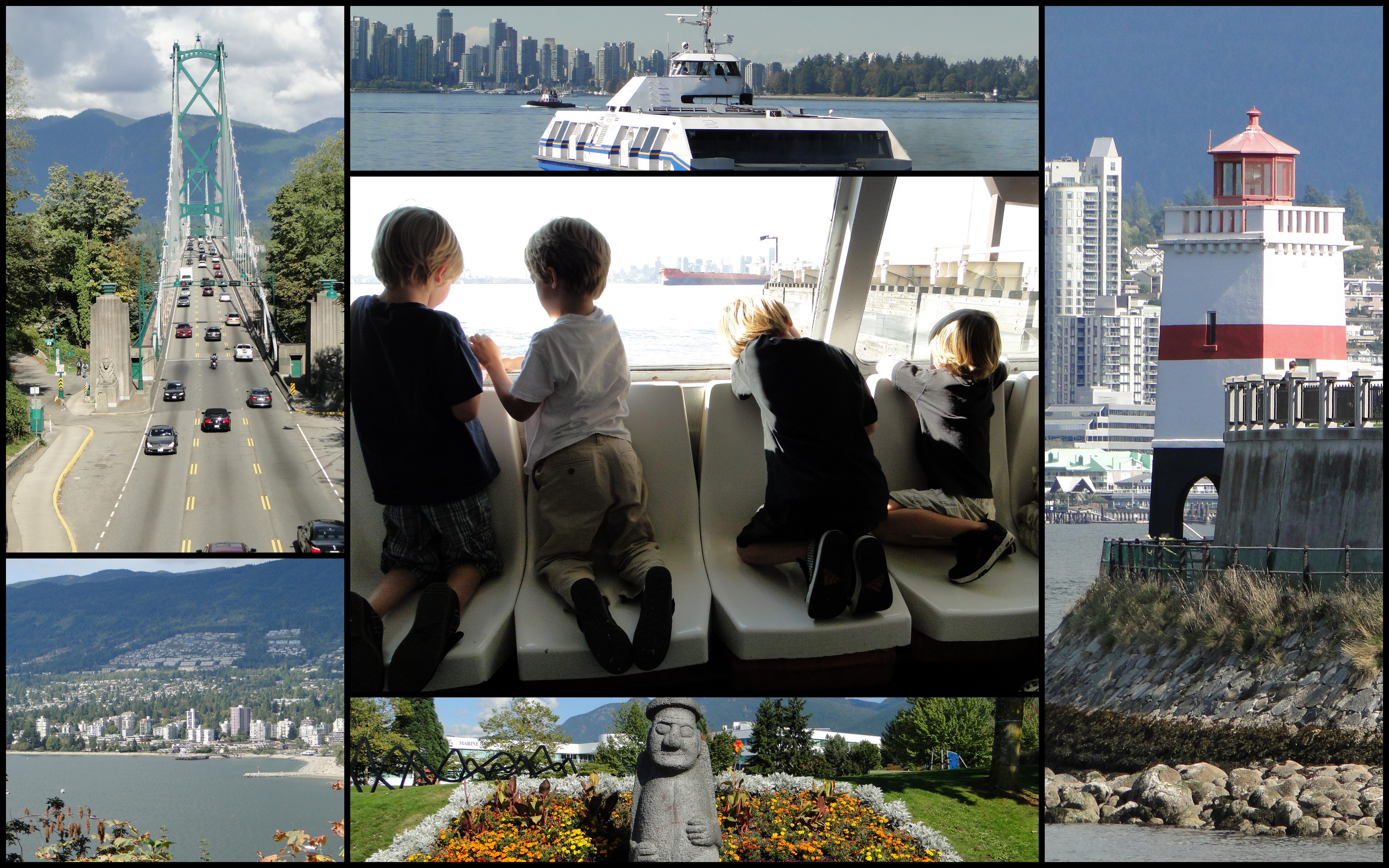
four toeheads on a day trip to North Vancouver
A pleasant short trip from the Canada Place ferry terminal in Downtown over to the city of North Vancouver, for the same $2.50/two-hour Trans Link ticket that gets you anywhere around the city, is a nice way to observe the very busy commercial port of Vancouver – fourth busiest in North America. The ferry is basically a commuter service because there isn’t really any reason to go to North Vancouver unless you are traveling to the ski resort of Whistler or other British Columbia mountain adventures. The Mall at the terminal does have a nice Market, and it is good for Americans to see how a modern, efficient ferry service actually functions. I’ve been saying repeatedly how expensive Vancouver is, but I must mention that North Vancouver is the “Beverly Hills” of the region with home prices averaging $4 million. North Vancouver has an Irish connection. In the early 20th century, the Guinness family owned nearly all the land. In the depth of the Great Depression, they constructed the suspension bridge connecting Stanley Park to North Vancouver and made an additional fortune developing the land into luxury housing and collecting the bridge tolls until the 1950’s.
Stanley Park
From food to nature, at the far end of Downtown’s West End is the beautiful retreat of Stanley Park, named after its founder in the 1880’s Canada’s Governor GeneralFrederick Arthur Stanley, 16th Earl of Darby and Lord Stanley of Preston, accomplished politician and athlete. He is most famous for establishing the sport of hockey’s Stanley Cup. A multi thousand acre preserve of both exquisite landscaped gardens, the very good Tree House Restaurant (pictured above, bottom middle) and hiking forests, Stanley Park is within walking, biking and driving distance minutes from anywhere in Downtown Vancouver. The best way to explore the park is by hiking or renting a bike. During the summer months a free shuttle tours the perimeter.
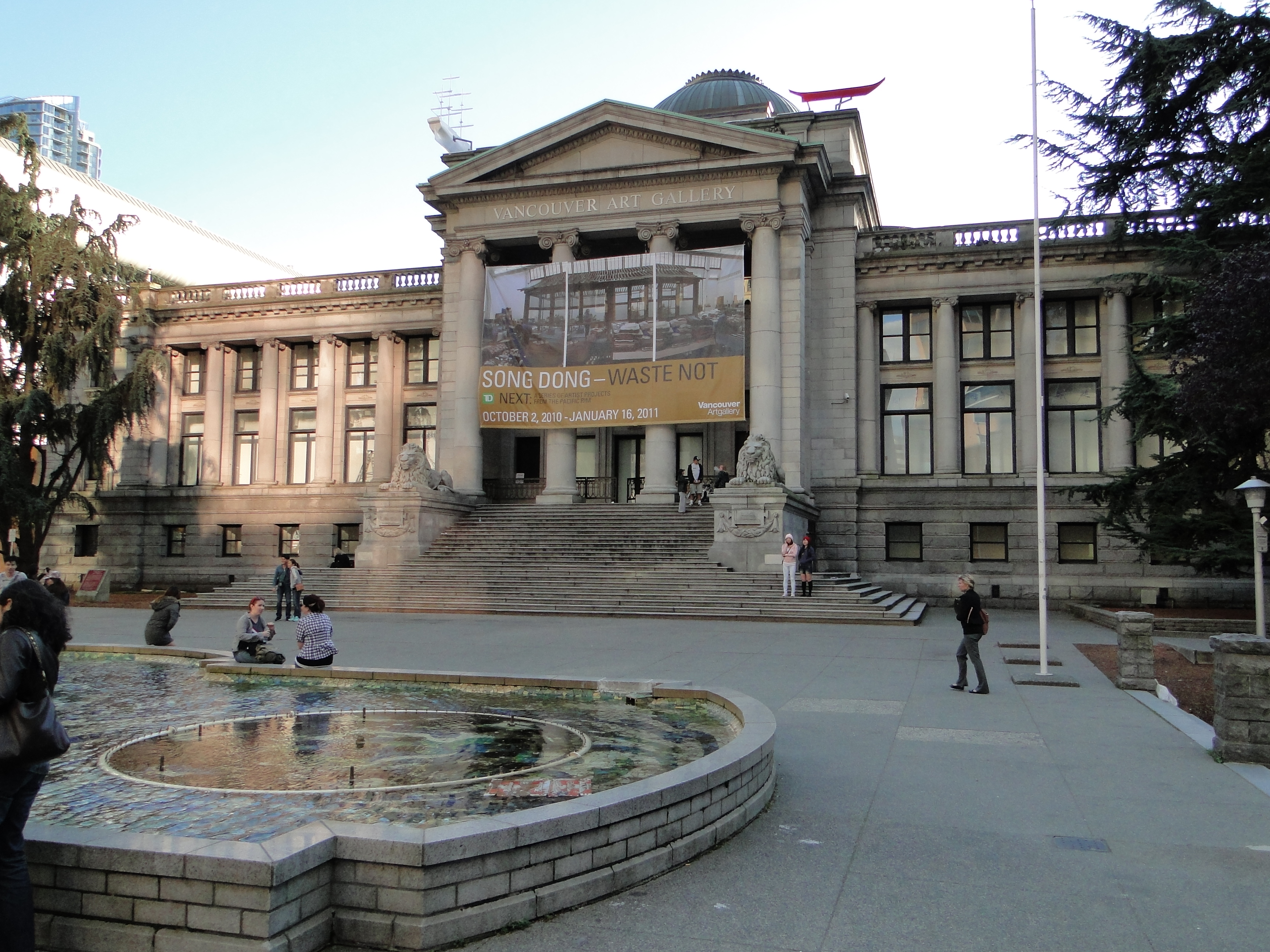
Vancouver Art Gallery - nice 1890's building but disappointing exhibits
There are three major museums in Vancouver of which only one is worth your time. If you’re on a cruise with only six hours in the city and enjoy local historical stuff, you might visit the Vancouver Museum. Many guide books praise the Vancouver Art Gallery because it owns 177 paintings by one of Canada’s most brilliant artists, Emily Carr (1871-1945), one of the famous post-impressionist “Group of 7,” but unfortunately you’ll see, if you’re lucky, maybe twelve – I have no idea where the remainder reside. Otherwise you’ll pay $19.50 to see what basically are sophomoric exhibits representing the University of British Columbia’s art school. But there is one gem that makes Vancouver a must visit. – the MOA.
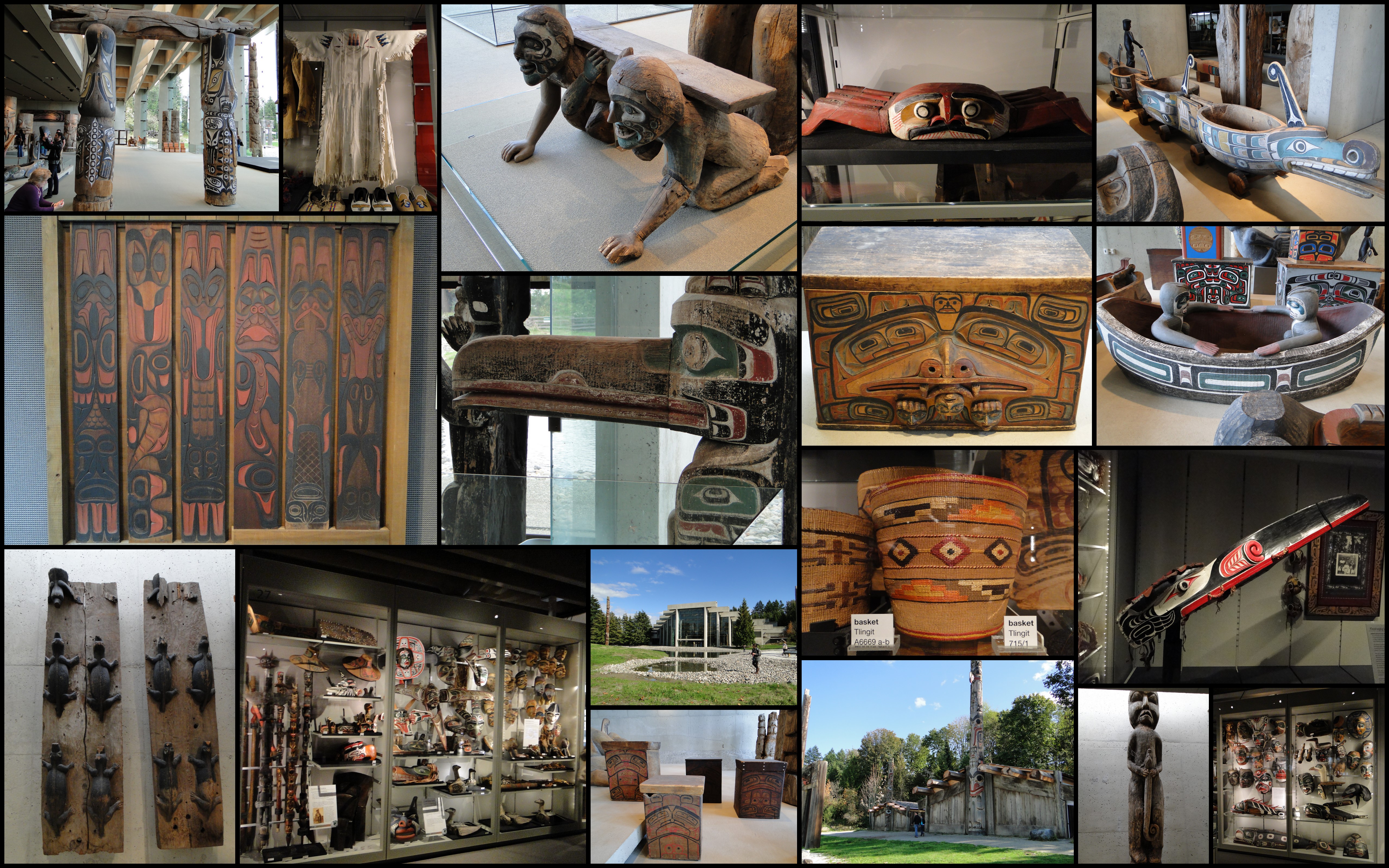
MOA’s ancient art
Arthur Erikson's Provincial Court House
If walking around Downtown and you come across a low-rise building that causes you to say “wow” – because it’s neither a boring glass structure or a wedding cake (re: The Fairmount Hotel Vancouver), it was most likely designed by Arthur Erickson, (June 14, 1924 – May 20, 2009), Vancouver native, graduate in Asian languages from the University of British Columbia, Canada’s prestigious McGill University and internationally celebrated architect. Even if you only saw the outside of the University of British Columbia’s Museum of Anthropology you would be thrilled. Yet to spend hours immersed in its collection, tens of thousands of First Nation North Pacific Coast art and all the cultures of the Pacific Rim, are priceless. Unlike most anthropology museums, the MOA does not consider these cultures dead. Not only did Canada’s First Nation cultures survive extinction – despite disease and cultural genocide for a hundred years – but the museum has a mission to revive and maintain these vibrant cultures with their outstanding art. The juxtaposition of ancient North Pacific Coast art with South Pacific cultures is illuminating. It’s obvious these cultures knew of each other’s existence – the Pacific was simply a big pond. The museum’s advocacy of the continuing revival in First Nation artistic traditions is inspiring.
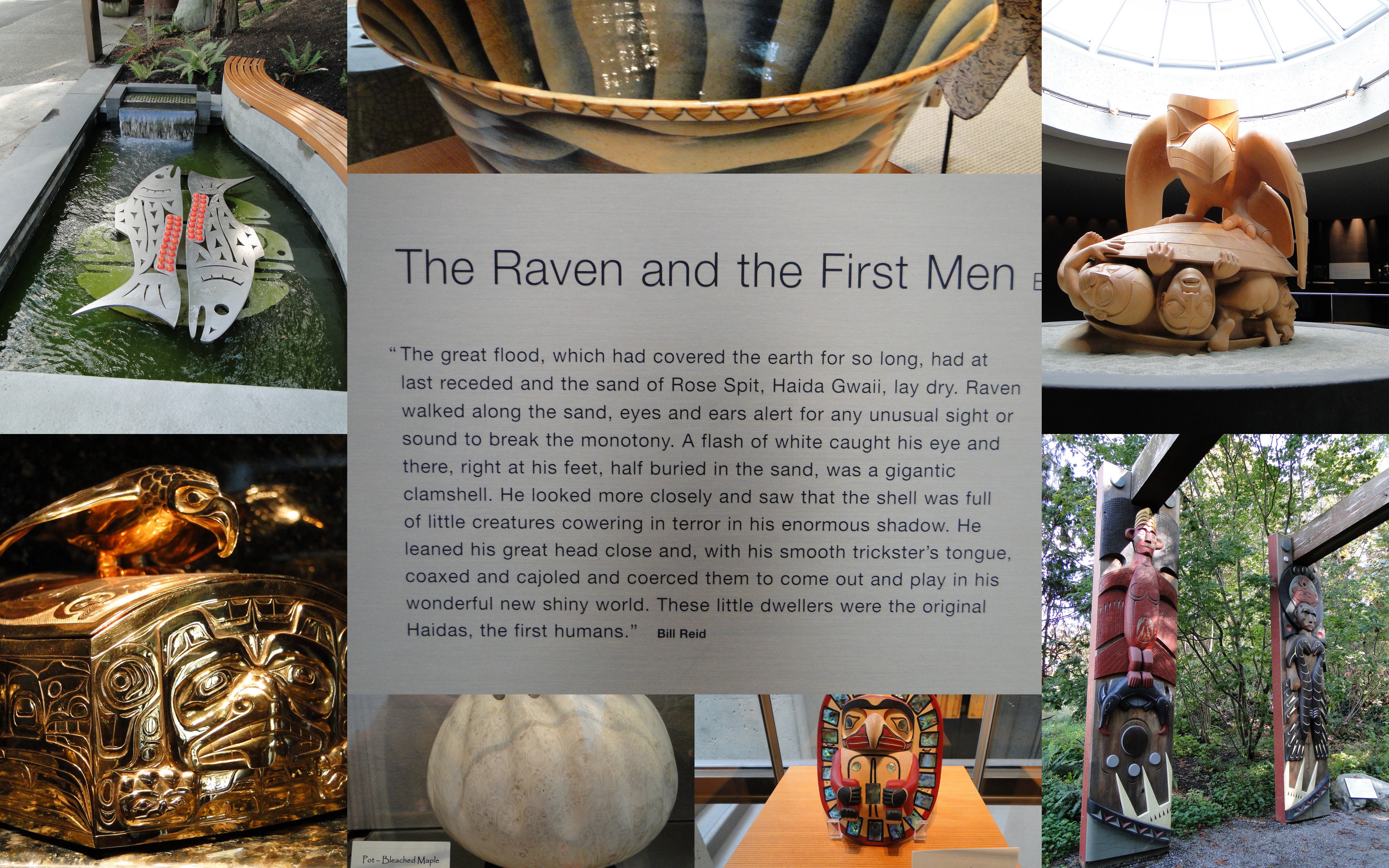
The rebirth of the worldArthur Erikson's MOA
Arthur Erickson’s 1971 design takes my breath away. Based on a North Pacific Coast Clan House, he managed to maintain his ideal of a simple concrete and glass structure that would be both distinctive and bring the outside environment inside. Set on a forested cliff, hundreds of feet above the Pacific, at the edge of the University’s South Vancouver campus, the building is more than an homage to the collection. In the 1940’s the Canadian government built two eight foot thick concrete gun emplacements as part of World War II defenses for Vancouver harbor. Rather than attempt their removal, Erikson incorporated them into the museum. One is part of an outdoor garden and the other is an inspired decision – it is incorporated into the museum as the Rotunda Gallery, dominated by, and dedicated to, First Nation artist Bill Reid’s (1920 -1998) monumental wooden sculpture “Raven and the First Man.” It’s a truly moving statement to the mythic reality that out of destruction there is rebirth.
Nestled in the Coachella Valley, 110 miles east of Los Angeles, Palm Springs has been a favorite spot for winter living for at least 500 years. Sheltered by the San Bernardino Mountains (11,500′ elevation) to the north, the Santa Rosa Mountains to the south (8,700′ elevation), the Little San Bernardino Mountains (3,700′ elevation) to the east and the San Jacinto Mountains to the West (10,800′ elevation), the Coachella Valley sits on top of, for the time being, a still sustainable aquifer. Winter daytime temperatures (October through March) average 80 (F)/25 (C).
It’s true that day time temperatures April through September average over 100 (F)/33 (C), and I know it does little to mention that the humidity is near zero. Yet, like lizards in a desert, why would anyone want to go out in the mid-day sun? There are other hours of the day – the cool of a summer evening when a dry 80 (F) does feel wonderful, or the equally pleasant morning hours, and then there are always the mountains and lakes within 30 minutes to an hour drive where temperatures average 20 to 30 (F) lower !
Life adapts and the weekly Thursday eveningVillage Fest on Palm Canyon Driveis proof that life in a summer desert can be quite enjoyable.
Bottom: caramel popcorn being preparedcenter picture: Rainier Cherries (click to enlarge)
Village Fest is any street fair anywhere – musicians, horse rides for the kids, activities such as the rock wall climb, street performers, shops open until 10:00 pm and food!! Naturally, the restaurants along Palm Canyon Drive are open, but remember this is a street fair in an agricultural region that has abundant access to farms using natural methods (organic, chemical-free). Available at stalls is a wide variety of produce, flowers, grains, fruits (fresh and dried) along with fresh-baked products, arts and crafts. Being a street fair, you’ll also find cotton candy, Philly cheese steaks (no, I didn’t have one…diet…), grilled brats and fresh caramel popcorn prepared in an improvised gas cooker made with a Hobart commercial dough mixer bowl ( resourceful). The fair stretches for blocks.
Unlike many street fairs, Village Fest is always in the evening which adds to the festive air as twilight colors the sky, the mountains darken in shadow and the lights of Palm Canyon Drive and Village Fest sparkle. Palm Springs may be the land of the Bentley (more per capita than Saudi Arabia) but it’s home to many average cars as well. All their owners seem to enjoy the timeless pleasure of a simple village fair.






































 Travel with Pen and Palate
You must be logged in to post a comment.