Category Archives: Photography

In Rediscovery: Huế, Việt Nam

(top) River park, Dragon boats for hire, (bottom) Imperial City Citadel, house boat on the Perfume River
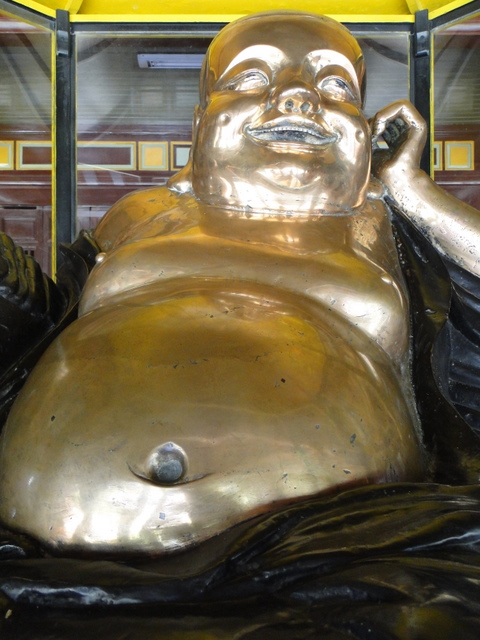
laughing Buddha at Thien Mu Pagoda

There has been a river port on the Perfume, just a few miles inland of the Pacific, at least since the early 14th century. The unpredictable river has intertwined for 650 years with Nguyen dynastic intrigue to inexorably shape the modern city. Hue exudes a less frenetic pace than Hanoi – although the cyclo and tourist boat drivers are just as “persistent.” It’s a city with an attitude: “I’ve seen it all before, several times, so let’s move on.” Besides, the river moves on regardless fertilizing the farms, and frequently cresting its banks creating destructive floods even the Imperial City cannot defend against.


Before the Vietnam War’s 1968 Battle of Hue severely damaged the city, graceful French Colonial villas blended with ancient Confucian/Buddhist architecture. Much of that is gone, replaced by functional late 20th century commercial whatever. A loss? Of course, but, of course, before the French  it was all Confucian/Buddhist, and yet there was that earlier Champa period and …
keeping one foot in each of three centuries


within the Imperial City

A four day visit is not sufficient to prove, but I have a hunch that Hue has not rediscovered its role in 21st century Vietnam – and I’m not sure they’re all that concerned. In the old commercial city on the south bank of the Perfume, Hue is still a maze of narrow streets but with few pre-1970 buildings. Many charmless new narrow 5 to 6 story hotels and condos are classically jumbled along with cafes, shoe shops, clothing stores, spas and the postcard vendor. Only a few shops noticeably cater just to tourists. Perhaps that’s because most sites for visitors are outside the city or on the north bank, such as The Imperial City.

Han Chen Temple (current temple 1885) - 5 miles north of Hue on the Perfume River - dedicated in the 8th century to Cham goddess Po Nagar
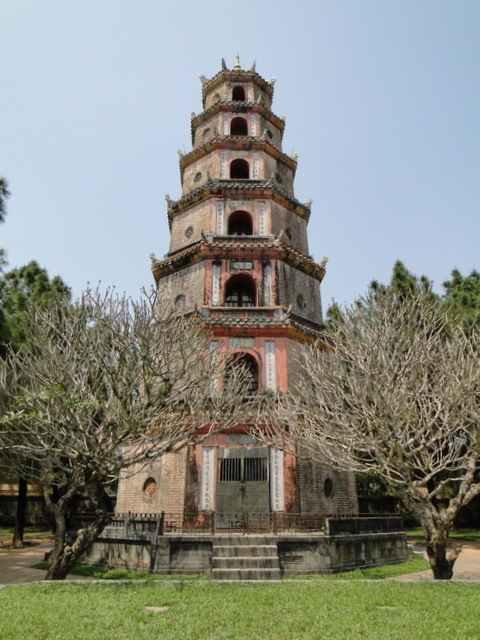
Thien Mu Pagoda

Nearly equidistance between Hanoi and Saigon, Hue has been a meeting ground of the nation’s great cultural institutions. Confucian and Chinese Buddhist Vietnam in the north blended with Khmer/Champa Buddhism from the south and both have dealt with the French legacy of Roman Catholicism. Yet even under the Confucian Court of the Nguyen emperors, and the Socialist Republic, Hue’s mascot has been the 1602 Buddhist Thien Mu Pagoda. As in all Vietnamese cities, both Confucian and Buddhist temples built through family patronage, to publicly honor ancestors, can be found tucked away on many streets.

Roman Catholic Cathedral, shrine to the Virgin Mary
fresh coconuts full of cold cocnut milk - make a hole in the peeled top, insert a straw and enjoy!!

It is convenient to walk along the landscaped river park on both banks of the Perfume River and cross either one of two bridges that connect the Imperial City with downtown. “Convenient” as long as being comfortable with the traffic, the lack of crossing lights, stop signs and constantly being asked if you want to ride a cyclo or buy something. Otherwise, metered taxis are common and inexpensive – a couple of dollars between the Imperial City and any downtown hotel. Excursions to the Imperial Tombs and boat trips on the Perfume River – both highly recommended – should be made through your hotel (more likely to get a better boat at a fair price). I prefer the freedom of not traveling with groups. A private car and driver for a four hour excursion to some of the more remote tombs was US$30. A private dragon boat for a 7 hour trip on the Perfume River stopping at tombs, monasteries and a Garden House was US$20. Rates are less if you join a group.

local "pets:" (left) water buffalo, wooden horse at Han Chen Temple, a temple dog, (bottom) shrine to honor horses, bull elephant at the Imperial City
courtyard Hotel Morin Saigon


Hue has several luxury hotels including the newly restored venerable Hotel Morin Saigon (1904) starting at $100/double. Although featuring the comforts of a 5-star hotel with an attractive pool/garden/cafe courtyard, it possess all the sterility that goes along with such venues. There are many excellent small hotels offering much better service than their 3-stars would indicate. Although at a rate that would make most Western tourists think twice, the US$35/double per night including buffet breakfast Orchid Hotel on Chu Van An Street in the Old City was not only the best hotel at that price in which I have ever been a guest, but a fine hotel by any standard.

Orchid Hotel and breakfast

Clean, modern with a staff that would never even let you push the elevator button, the Orchid’s rooms were large providing ample closets, a spacious bathroom and a desk with a high-speed desktop computer included in each room! Hue traditionally is known for its Imperial Cuisine which, unfortunately, I found in few restaurants. The Orchid only serves breakfast offering an excellent selection of  items typical of Hue – chicken balls rolled in flaked green rice, fried rolls stuffed with vegetable/meat mixtures, banana pastry with caramel sauce and an incomparable Beef Pho, the Vietnamese breakfast noodle soup. A large selection of fresh fruit – including tropical varieties such as whole passion fruit –  baguettes and Western dishes rounded out the buffet.

Am Phu Restaurant

Many decent restaurants are found in the Old City all within easy walking distance of most hotels.  Confetti Restaurant & Art Gallery and the Tropical Garden, both on Chu Van An Street, offer well prepared standard Vietnamese food in pleasant surroundings just like the majority of the area’s venues that are patronized by tourists. Yet there are lots of small places filled only with locals with menus not written in English, but, I’ll be blunt, the sanitation methods I can see frequently make me dubious. Getting a recommendation from your hotel for local restaurants is a must or else I’d never have eaten dinner at Am Phu Restaurant a bit further down Chu Van An Street.  A calamari dish with greens, peppers and cilantro and light, moist coconut batter fried shrimp were as fine as in any dining room except I was sitting on a plastic chair under fluorescent lights with a TV soap opera playing. Dinner for 2 with beer was less than US$10.

street shoe repair man


Pastry, towel art  and Swan boats on the Perfume River, shade trees and gardens, ancient tombs and palaces, markets and street merchants, mountains and house boats – they were all here 500 years ago and, despite the history Hue’s helped shaped, they’re still here today waiting to be rediscovered.
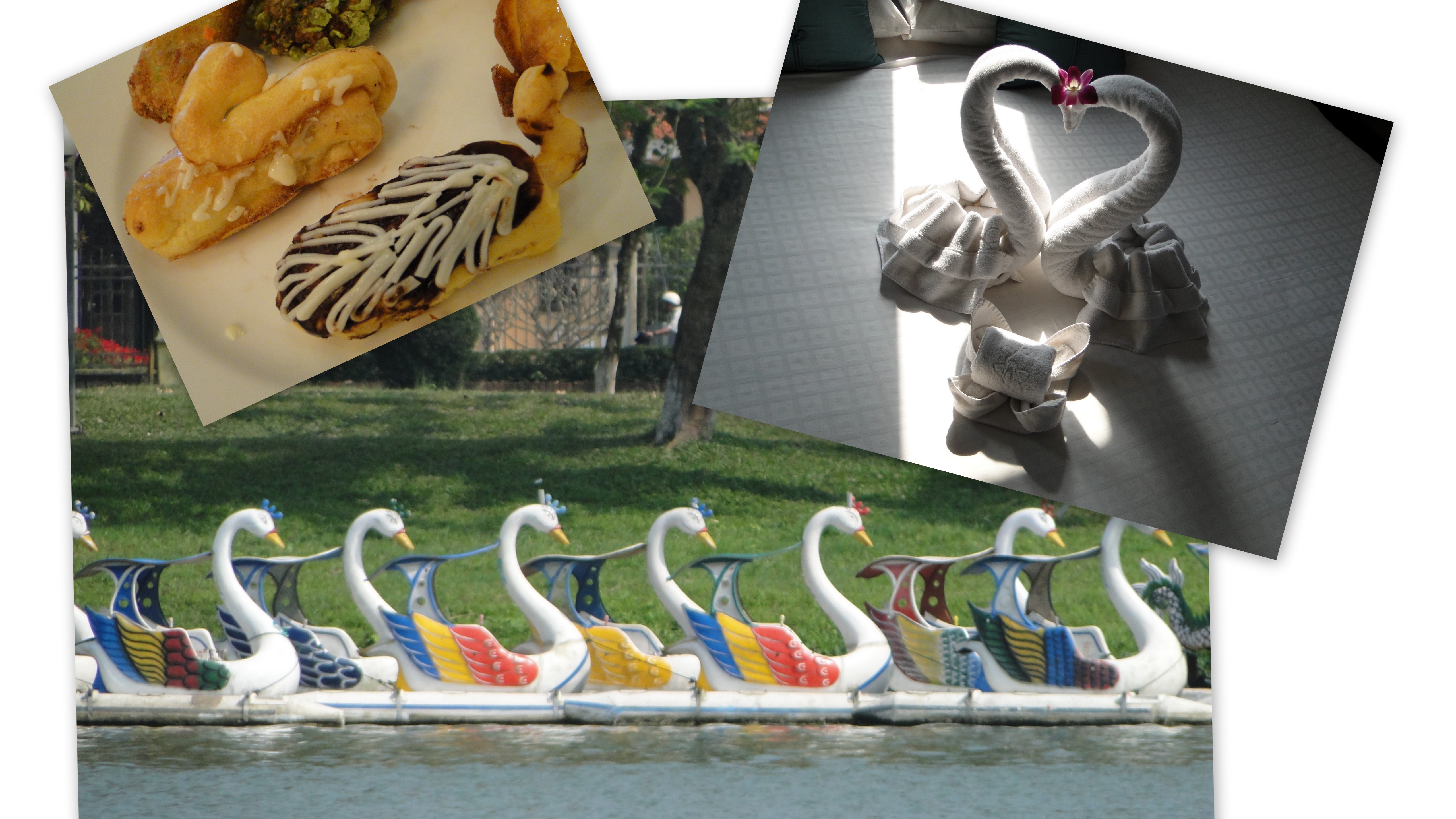
who does not like swans?

Perfume River After Life – the Nguyen Tombs

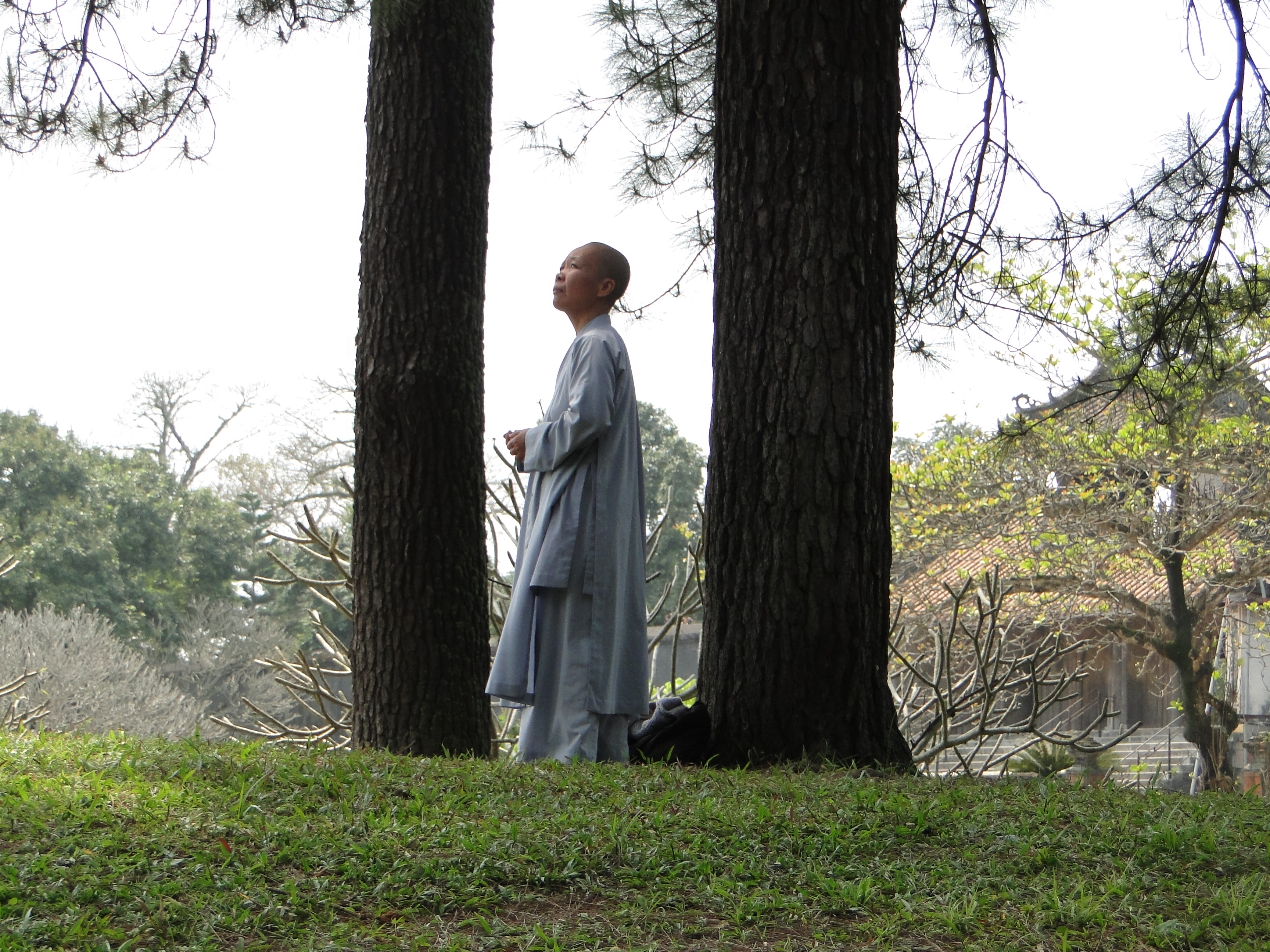
Monk in contemplation at the tomb of Emperor Tu Duc

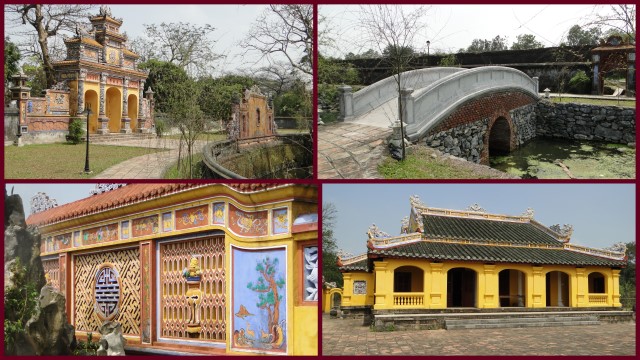
Here’s the project – and money’s no object: build a place away from work and home where you can just get away from it all, surround yourself with your friends, do what makes you happy and stay there forever. If you were a Nguyen emperor of Vietnam you did exactly that and included artificial lakes, islands, palaces, temples, gardens, courtyards, and, of course, your tomb and that of your wives. They were simply following a long tradition of emperor worship both to solidify the continuity of the dynasty and take their place as an ancestor of the nation. The Nguyen emperors certainly did it in style constructing virtual country estates to pass relaxing hours painting, eating and escaping the pressures of State both in this life and for the afterlife.

Dai Hong Mon temple at Emperor Minh Mang Tomb

Minh Mang (1791-1841) and his grandson, Tu Duc (1829-1883),  2nd and 4th Nguyen emperors, created lush forested landscapes with paths, streams and lakes. It easy to feel comfortable here for eternity.

Tomb of Emperor Minh Mang - constructed 1841 - 43


the Tomb of Emperor Tu Duc - constructed 1864-67

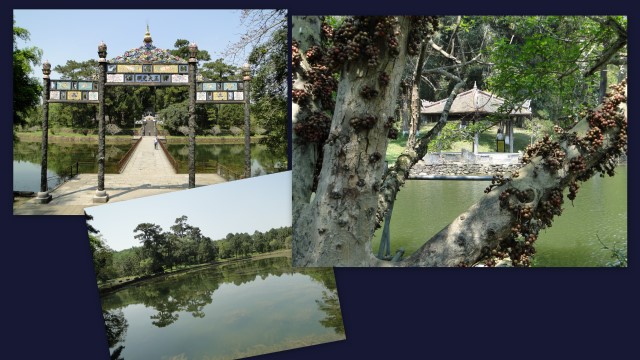
Tu Duc spent many quiet hours in the Xung Khiem Pavillion (upper right, 1865) looking out on the lake and at the boat landing to the temple (bottom left) playing music and writing poetry. He was a prolific poet. The grounds contain a lovely tomb to his first wife, Empress Le Thien Anh, and burial spaces for many of his additional 103 wives.

(upper left) incense sticks for sale, (lower left) Mandarins to serve the Emperor in the afterlife, (lower right) protective Naga on the stairs to the burial chamber at Tu Duc

Khai Dinh (1885-1925) 12th. Nguyen Emperor, was less than 5 feet tall, slightly built and unpopular because of his Francophile leanings. In the 1924 play, The Bamboo Dragonby a young revolutionary, Ho Chi Minh, Khai Dinh was ridiculed for being all pomp and no substance, but he did knew how to impress.

The Emperor Khai Dinh's burial chamber: life size statue with jade sceptre

  Rather than spread out over a park-like setting, the compact tomb complex is built on top of a forested  hill surrounded by steep hills overlooking the Perfume River. The design elements are a fusion of traditional Vietnamese features with late 19th century French baroque. The exterior has a somber countanence because the palace was constructed in concrete made with the Perfume River’s volcanic gray sand so has leached a gray/black discoloration.

ancestor altar and exterior: Tomb of Khai Dinh
Emperor Khải Định (1885 - 1925)

Yet the interior is an explosion of gold, blues, reds, fuchsia, pinks, greens – all tile and glass mosaics covering every nook and cranny of the walls and ceilings. Dragons, birds, flowers, tables, vases, trees all are depicted in excruciating and fanciful detail, many in 3-dimensional compositions. The craftsmanship is unparallel for mosaic art glass. The Emperor reigned for only 9 years but it took 12 to build his tomb – 1920-1932. Khai Dinh died as he lived, over budget. A special tax had to be levied for the tomb’s completion.

details of the 3-D glass mosaics at Khai Dinh Tomb

The opulent tomb of Khai Dinh is the last in Vietnam’s Imperial history. His son, the Emperor Bao Dai (1913-1997) abdicated the throne in 1946 and died in exile in France. Perhaps it’s karma that the last tomb should be that of an unpopular monarch since the dynasty started out on that footing.

Emperor Gia Long

The first Nguyan Emperor, Gia Long (1762-1820) was fearless, feared and unpopular. He forced Vietnam’s feuding lords to bow to his unified empire, moved the capital from Hanoi to Hue, built the Imperial City and raised taxes to pay for it all. Worse, he gave France its first foothold in Indochina, a circumstance of war he later regretted but the nation never forgave. As the founder of an empire, Gia Long knew exactly the importance symbols were for dynastic continuity represented by the worship of Imperial ancestors – the fathers of the nation. His tomb set the pattern – constructing small versions of the Imperial City for the eternal pleasure of the souls of the nation.

Tomb of Gia Long

Ironically, his tomb is the furthest south of the city and even the taxi driver had to ask several times for directions. Stopping on a dusty street outside the dilapidated walls of a small old temple, I’m told to go through a creaking wooden gate. Walking across an empty dusty yard through another gate down a path alongside a farm plot I spy the virtual ruins of the great Emperor’s final resting place. It’s overgrown with weeds and the dogs are barking from the adjoining farm. I feel a pang of melancholy as I look out on the overgrown field and feel sorry that I didn’t visit the Tomb of Ho Chi Minh in Hanoi (although cremation, not mummification, was Ho’s last wish). Gia Long struggled against major odds, seeing most of his immediate family killed as a boy, before creating an empire he ruled till his death. Not much different than Ho Chi Minh. Yet even if Gia Long’s tomb is in disrepair, his ancestors, his descendents – and now those of Ho Chi Minh – are all part of Vietnam’s collective soul.

Perfume River Life: Hue, Vietnam

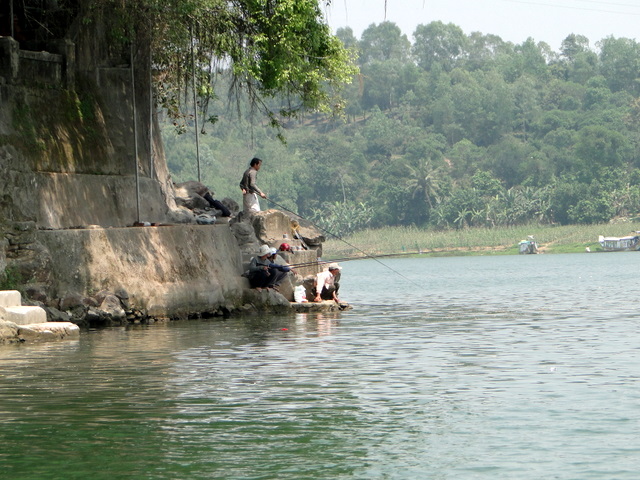
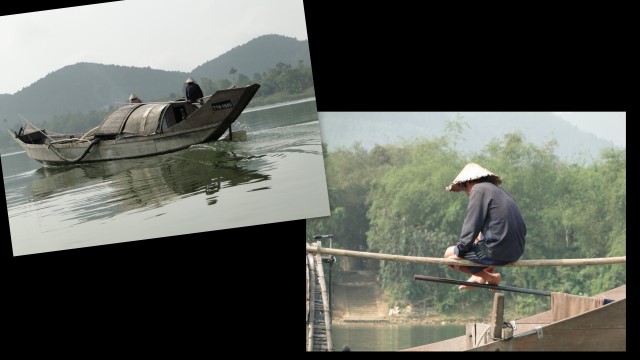
If it wasn’t for the palm trees I could imagine Huck Finn fishing the Mississippi on a lazy summer day, but this is a hazy March day on the Perfume River. Like Huck, the fishing isn’t just for fun, it’s dinner.

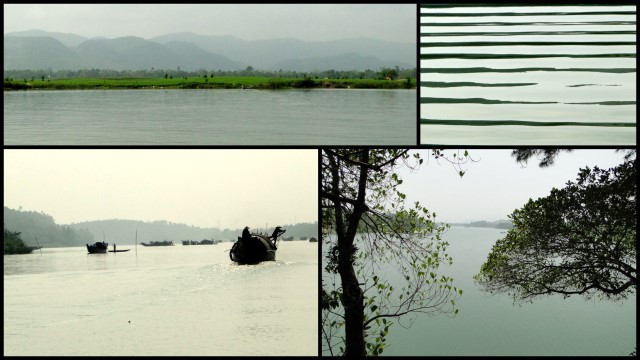
Perfume River just a few miles west of Hue

 Like so many rivers that nourish lands holding ancient cultures, the Perfume River is the artery of central Vietnam and Hue. Twisting hundreds of miles from northern mountains, she spreads wide over the low plains before joining the Pacific just east of the city. In fickle March when morning fog turns into muggy afternoon, with or without chilly showers in between, the land is as emerald green as Ireland. Lush riverside farm gardens are worked by dozens of men and women with hand tools. The plots are postcard perfect and serious work for these farmers.

farming on the banks of the Perfume River several miles west of Hue (top center & right) scarecrow & laundry to ward off birds

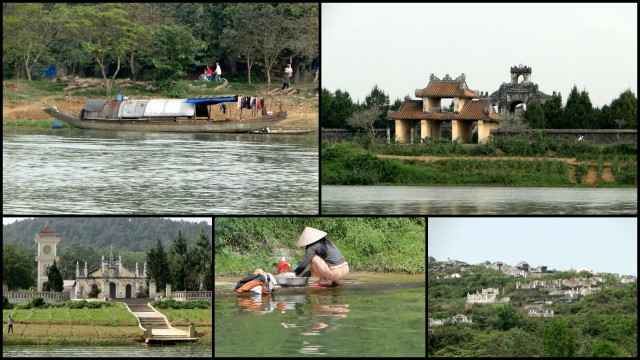
  Every late summer and autumn, like all alluvial rivers, The Perfume floods for as far as your eye can determine a tree line or the second floor of sturdy buildings. Bamboo structures visible now near the fields are seasonal and will be gone in the floods. Therefore house boats are common for many who cannot afford housing on land at a safe distance from the river.

(top) house boat, temple, (bottom) Catholic church, laundry, cemetary on a hill side

The practical resilience of river life is fascinating. Why not use it for both the wash and rinse cycles –  especially when the boat’s in motion and tourists are up front.

laundry: wash and rinse

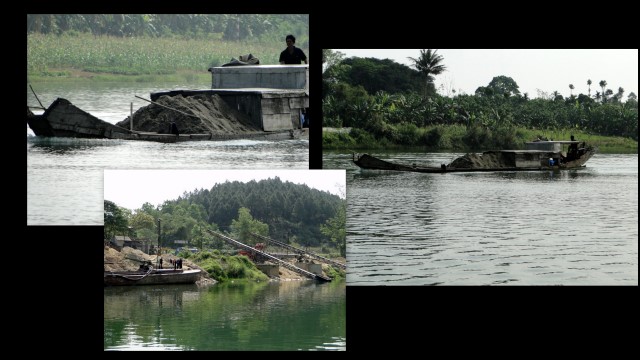
  The grittier side of commercial life on the Perfume is sand extraction. With endangered reserves of hard woods forcing Southeast Asian nations to restrict the forest industry, demand for concrete is high in this rapidly developing region. Since these rivers silt-up frequently they have been a convenient source of sand, but now demand is outstripping supply. Over dredging of the Perfume, due to the alluvial nature of the river, is a cause of worse than average floods within the past decade. These dredging operations are usually family run with simple power pumps to suck and filters to capture the dark gray sand from the river bottom – frequently mounted in their house boats. All day up and down the river are dozens of family operated sand ships. At the end of the day the owners sell their sand for a pittance to a central collector.

sand ships after a day's work, collection center

A river this tranquil, with misty mountains beyond green fields, attracted Vietnam’s wealthy and intellectual elite. Riverfront land became favored “suburban” home sites for 19th and 20th century professional families, many with connections at Court.

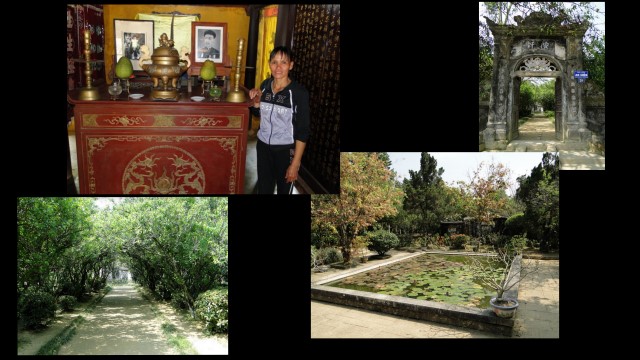
An Hein Garden House's ancestor shrine with current family owner, entrance and lily pond

Called garden houses for their proliferation of individual fruit, flowering trees and plants on their 5 + acre plots, these affluent houses were the ultimate of upper middle class life. An Hien started as the home of an Imperial Princess (of a minor wife) over 135 years ago, passing to a high Court Mandarin and to the present generation of that family. It’s not only remarkable that the antique all exotic wood house with priceless family heirlooms survived wars but the Perfume River’s floods. Although set several hundred feet from the river bank, we were shown the 4 to 6 foot water levels of the last decade of floods! The traditional tile roofed 3-bay house, supported by intricately carved ironwood pillers and beams, contained the ancestrial altar and living quarters of the family, sans the kitchen, etc. Open to the lily pond through carved screen doors, these havens of peace for their busy professional owners were based on strict Confucuan design to maximize harmony and tranquility.

not one nail or screw - 135 + year old ironwood & jackfruit wood

The gardens were prized for both their breadth of plant varieties and significance to agriculture and cooking. Jasmine, cinnamon, pomegranate, sunflowers, climbing and wild indigenous roses, exotic species of orchids, fruit trees characteristic of all of Vietnam’s regions: lychees, persimmon and pears from the north, mangosteen and durian from the south with pomelo, jackfruit and oranges plus almonds and the list goes on.

selections from An Hien garden

Is there an army of professional gardeners? No, simply the extended family members and in this case they range from California to London. Opening the house to visitors is purely voluntary and none of the Garden House owners receive compensation other than donations. In An Hien’s case the only “commercial” pitch were plant cuttings for sale. If I could only have brought some back to the States…

a pole for a seat, toes on the rudder, family in the house boat, river calm

God buys a beach house – Ocean Grove, NJ

Ocean Grove, NJ

The great organ surges with power. The behemoth American-made 1908  Robert Hope-Jones pipe organ easily fills the 100-year-old, 6,000 seat Great Auditorium with body vibrating sound waves. The National  Anthem plays and at the last chorus, the large wooden American flag over the broad stage lights up in a carnival display of patriotism. The show commences: Michael Feinstein and Linda Eder enter the stage and enthrall the audience of the sold-out concert for the next 2 1/2 hours.

The Reverend William B. Osborn may not have approved even this mainstream entertainment when he founded the Ocean Grove Camp Meeting of the United Methodist Church in 1867. The Rev. Osborn was following a well established tradition along the Jersey Shore, starting in the late 18th century, of creating havens of calm in the barrens along the ocean, far from the bustle and temptations of urban life in Camden and Philadelphia. Although Cape May, Ocean City, Vineland and many other shore towns that started as Protestant camp meetings morphed into resorts, Ocean Grove remained true to its original mission.

That mission in the 1860’s included open support for racial and women’s civil rights, education reform and prohibition. Ocean Grove is still a dry town (Asbury Park and Bradley Beach are right next door) but its relaxed fundamentalism encouraged non-camp followers to settle. Today the Rainbow Flag flies from nearly as many houses as the United Methodist Church banner.

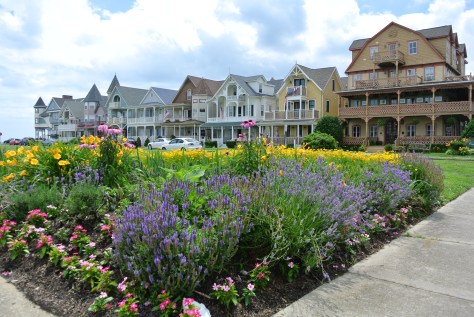
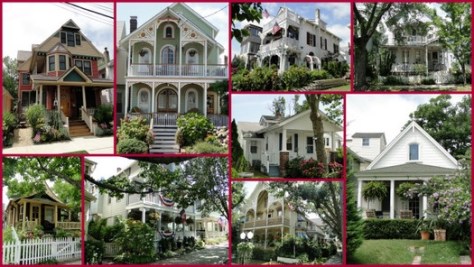
Ocean Grove: America’s largest concentration of 19th century Victorian architecture

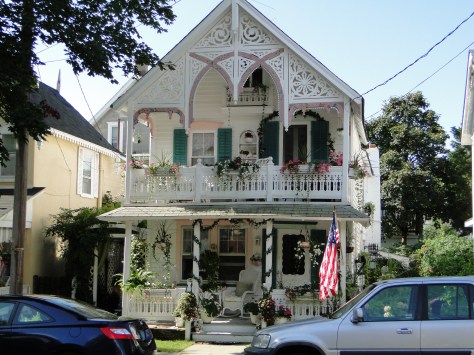
The houses of Ocean Grove are stunning. The one square mile has national historic designation with the largest concentration of original late 19th and early 20th century architecture in the country. Rarely will anyone find real estate that exemplifies the ultimate in wood craftsmanship, and this exuberance for decoration keeps many 21st century craftsmen employed by the demands of constant maintenance.

Historic Victorian architecture

Ocean Grove, a mere 90 minute drive from Philadelphia, is still a glimpse of what the Jersey Shore used to be like. The boardwalk is a walkway – no food vendors, no video arcades. Pedestrians rule and with most streets narrow, driving faster than 25 mph is difficult.

On summer weekends parking is impossible. Most people arriving Thursday or Friday for a weekend never move their cars until leaving. Ocean Grove is a perfect walking town where Main Avenue is never farther than a ten-minute walk from your B & B, and kids are safe riding bikes and skateboards.

An evening’s biggest treat is catching a concert in either the Great auditorium,  Wednesdays and Saturdays, or the boardwalk’s pavilion and always having ice cream at  Nagles or Day’s  – very partisan as to which one is the best!

The Great Auditorium, Ocean Grove, NJ

The center of Ocean Grove is the Great Auditorium with its magnificent pipe organ. This all wood, barrel-vaulted 6,000 seat structure is an engineering marvel with acclaimed acoustics making it a sought after summer concert venue by A-list performers. Besides concerts, the auditorium is the focal point for the Camp Meeting’s summer religious activities including an active youth program.  All are invited to participate in Camp Meeting activities.

Surrounding the Great Auditorium is an oddity to all new visitors. Dozens of white tented structures in close formation are what remain of the original tent city that was the camp meeting. As affluence allowed for the building of the Victorian houses, the number of tents diminished. The remaining 142 half tent/half wood cottages are on long-term lease to Camp members and frequently passed down to the generations.

Spreading majestically for at least a 1/4 mile from the Great Auditorium  to the beach is the wide, landscaped Great Lawn. Closer to the building itself, numerous antique and craft markets are held from July through October.

Camp Meeting tents
Main Street, Ocean Grove, NJ

The commercial district is small, occupying the better part of six blocks along Main Avenue and a few blocks off Main. Being northern New Jersey, Ocean Grove is not a winter ghost town. With direct train links to New York, half the population is permanent,  providing a base for shops and restaurants that are not all post cards and cotton candy.

Cheese on Main, 53 Main Avenue, offers more varieties from more countries and animals than you imagined. The Emporium At Ocean Grove, 63 Main Avenue, and Ocean Grove Trading Company, 74 Main Avenue, have imaginative, and well made, women’s fashions. Just off Main, the Beach House, 52 Pitman, is the place for souvenirs and gifts with class, and Tumblety Howell Art, 45 Pilgrim Pathway, highlights top works by area artists.
Top: Shawmont Hotel, Bath Ave B & B interior, Bottom: Bath Ave. bedroom, porch Shawmont Hotel

Dozens of bed & breakfast and hotels, all historic structures, are either on the beach or within three blocks. Some of the best, such as the Laingdon Hotel, 8 Ocean Ave, remain open year-round with a glassed-in porch. The Shawmont Hotel, 17 Ocean Ave, provides well-appointed rooms with private bath, a continental breakfast,  a beautiful porch with rocking chairs and a full view of the ocean. Bath Avenue House, 37 Bath Ave, a beautifully restored 80-year-old prior rooming house. The 30 rooms are on the small side but individually decorated, air-conditioned and with a sink. All rooms but one (on the first floor) share  bathrooms located on each of the three floors. There are so many repeat guests, that sharing a bath seems no more odd than having house guests for the weekend. A full breakfast is included, and filling. The Carriage House B & B, 18 Heck Avenue, an elegant eight room inn, provides an equally elegant breakfast making it an excellent choice for food lovers.

Ocean Grove is a dry town, but Asbury Park and Bradley Beach are within walking distance along the boardwalk. Many Ocean Grove restaurants are discretely byob, but inquire first. I would not say that the restaurants are outstanding but neither will a customer feel they have had a bad meal in any establishment. In summer, all seem to take advantage of New Jersey’s abundant summer produce.

lunch at Bia at the Majestic Hotel,

Among my recommendations are: Bia at the Majestic Hotel, 19 Main Ave., for imaginative presentations and an eating porch with an ocean view.  

BLT at Sea Grass

Sea Grass, 68 Main Ave, serves generous salads and sandwiches including a killer BLT – but this is bacon, lobster and tomato – on a large toasted soft bun with sweet potato fries.  Nagles Apothecary Cafe, 43 Main Ave, complete with soda fountain, has been an Ocean Grove institution for over a century – first as an apothecary and now a popular restaurant serving generous portions of classics for breakfast,  lunch and dinner. The outside walk-up ice cream window dishes up dozens of rich creations and along with Day’s Ice Cream, 48 Pittman Ave, have  loyal partisans who line up every day. On weekend evenings, the lines at both places can be blocks long. The Starving Artist at Day’s tries to focus on healthier ingredients and serves a good breakfast with interesting omelet fillings and pancakes.

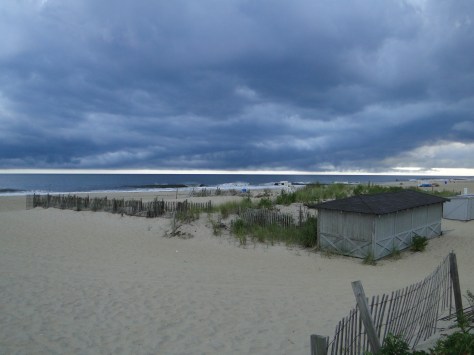
beach at Ocean Grove

The charm of Ocean Grove: a place where all you want to do is wait patiently and let  calm take over.


Peas In A Pod – A love story


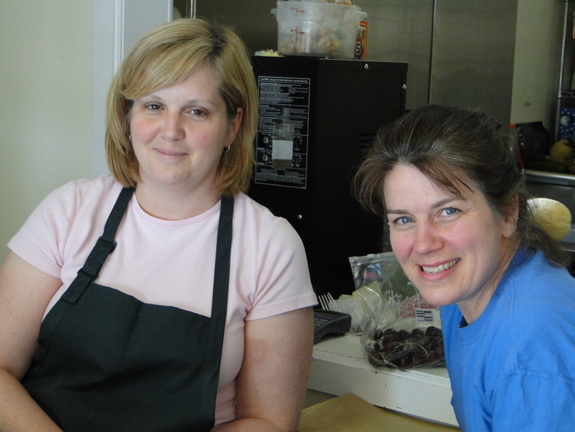
Susan and Kristen

2007 did not start well for Kristen Coyle, Susan Bailey and Karen Dooley. The three sisters faced a bitter-sweet crossroad. Their beloved parents passed away too soon to enjoy retirement and for these three daughters to share those years. Now the nest egg their parents had saved became an unexpected inheritance for the three sisters. It was the decision of the women to use the money in a way that would both benefit all three and, privately, memorialize their parents. They would open a business, a produce business. In my opinion after 30 plus years in the food industry, I’d say opening a small produce shop ranks very high on the risky scale in an industry that already is a big risk. It took brains, passion and a sense of humor to turn sorrow into Peas In A Pod.       


The sisters do not come from a food industry background. Kristen and Susan are both nurses and Karen is a teaching assistant. All were ready to try something different – but anyone can run a food business? Susan and Kristen freely admit that after three years they are still learning – a key ingredient for success. Their Dad, according to Kristen, had an adventurous spirit taking the family on roaming summer drives through the farms of south-eastern Pennsylvania – the famed Pennsylvania Dutch and Quaker farm counties: Lancaster, Chester, Berks, Montgomery and  Bucks. The object was to find, and eat,  the freshest in-season vegetables and fruits at local farms. “Eating a fresh tomato with salt…,” is a strong memory for Kristen. So is growing up in the Mount Airy section of Philadelphia surrounded by the kitchen aromas of the many Italian households in the neighborhood and  sitting down to a freshly made family dinner every night – a tradition these three busy, multi-career women still uphold.       


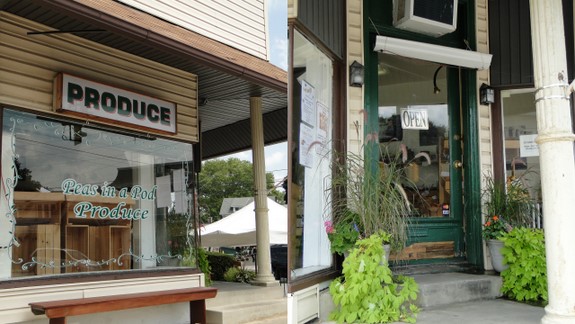
I entered the small shop at the intersection of Keswick and Glenside Avenues in Glenside, PA – a leafy, older suburb a mere 10 miles from center city Philadelphia – through a plant framed door that sticks and agitates an old-fashioned bell announcing a customer. Peas In A Pod is in a typical nondescript twin house converted into mixed commercial/apartment space. Out in front of the shop is a covered stand with produce available on the honor system. Inside, Kristen was at the counter and Susan, with helper, niece Mary Kate, were in the kitchen. (Karen had the day off). Frequent customers, of which there are many, are greeted by name; perhaps they have a quart of soup reserved. Customers, now friends by association, linger and chat.  The interior space of the shop is small, simple and functional.       


80 South Keswick Avenue was chosen the end of March 2007, and the doors to the shop opened in June – record time for a food business…until the sisters tell me the space was the very small front room – maybe 8 x 10 –  of the three rooms.  From day one the object was to sell produce from local farms that used green-earth farming techniques from southeastern Pennsylvania counties.       

 For small shops, and any small food business to succeed, it’s necessary to build personal relationships with suppliers. Susan spent days driving through  the countryside and was attracted to the corn fields ofTruck Patch Farms in Bucks County and developed the trust necessary to ensure high quality fresh vegetables, fruits and eggs. Truck Patch is their largest supplier.  Heirloom tomatoes come from Herrcastle Farms and Jesse Hale of Everhart supplies the raw honey. Patterson Farm’s  maple syrup is a personal favorite, and Four Seasons Farm in Lancaster County, as well as orchards in Loyola, PA, supply fruit, especially Pennsylvania’s wide variety of apples. What you will not find at Peas In A Pod are strawberries in January.       


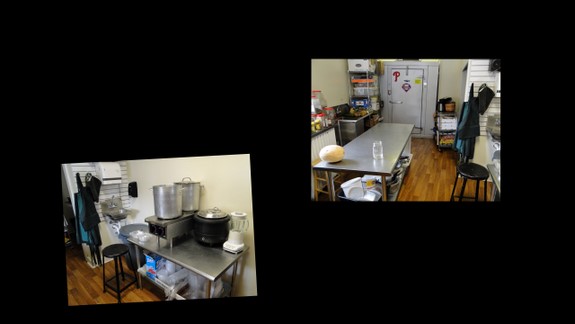
You also will not find most of their 21 soups during the months of June, July and August, but, fortunately, their incomparable Crab Bisque is available every Friday year round – otherwise there would be serious withdrawal issues. Susan’s responsible for the soup, according to Kristen. (Susan: “What were we going to sell in the winter? Soup!”) Susan wanted to bake breads, make soup and maybe expand into… (the curse of a new business – expand). Expansion is a decision often made too early. Sometimes bureaucracy is beneficial, especially considering the 2008 financial meltdown. Cheltenham Township made it clear that fire codes allowed a maximum of only two hot plates for cooking – no oven without excessive renovations –  in the compact kitchen (complete with walk in-refrigerator) that was being constructed in the second room.  A third small room became more produce and Cento brand packaged pastas and sauces. Susan had a stint, while being a nurse, at Flying Fish restaurant in Chestnut Hill and still has dreams of adding more in-house made products, but reality dictated that soups and salads were a marketable match. With the exception of crab bisque every Friday (300 quarts), the remaining 20 soups rotate with one or two  available daily – lemon chicken, bean and potato leek are all favorites. I was allowed only the briefest glance at one of their proprietary recipes, some from their Mother.  Fresh salads with in-house dressings are in a refrigerated section and range from garden to chicken to orzo. The two professional grade hot plates are doing just fine.       


Peas In A Pod celebrated a milestone anniversary this past June 2010: they’re still in business three years after opening – nearly 65% of all food businesses are bankrupt within the first three years. Not that mistakes haven’t been made – the worst was an early over reliance on expensive certified organic produce. Customers preferred the chemical-free products from many local farms that result in “same as organic” at less cost. An obvious suggestion that  future  marketing of their soups, salads and dressings may be a good idea was met with a look  in their eyes that it was already on the table.

The bell at the front door gently clanged as another customer entered the shop. Kristen said that sometimes the bell rings but no one enters. After a brief pause she adds, shyly, “We know its our parents. They would want to be here. I think they’d be proud.”                    

They certainly would.       

Peas In A Pod       

80 South Keswick Avenue
Glenside, PA 19038-4607
(215) 887-2719