Philippi would be a doorway to Asia Minor. It would serve three empires. It would be a major player in creating history.
Lydia of Philippisia became St. Paul’s first convert in 49 A.C.E. receiving baptism in the Zygaktis River – a gesture with international ramifications.
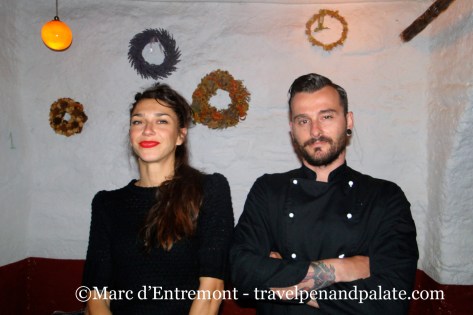
Theodora Tziamali & Chef George Katseas partners: Katogi Cafe
“We’re romantic,” says Chef George Katseas and that’s evident by both the decor and the manner in which George and partner Theodora Tziamali treat their customers like family.
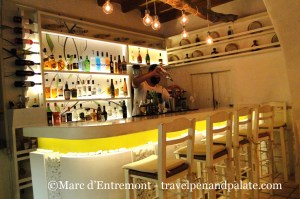
Elia
“I want to marry the modern with tradition,” says Harris Boukas the young owner of Elia.
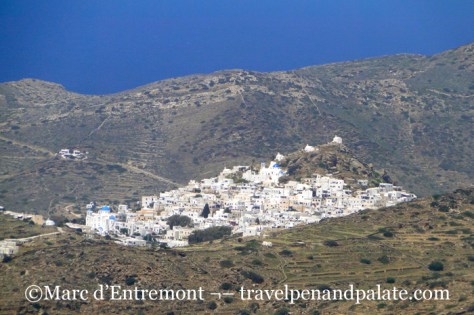
Nightlife on the Greek Island of Ios can certainly become lively during the summer season, but dining in the following seven tavernas and cafes put a smile on my face. Read more at…
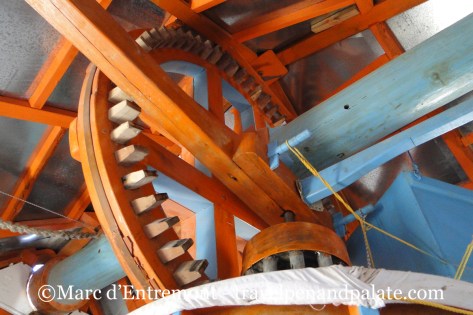
Windmills tell stories of the drive for labor saving devices even in the pre-industrial age.
Harnessing the near steady breeze of both coast and hills was a technological breakthrough akin to present day electric wind generators.
Building a windmill was no easy task.
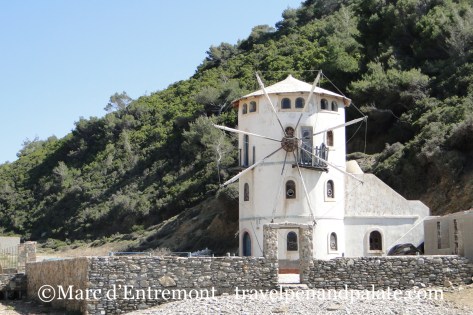
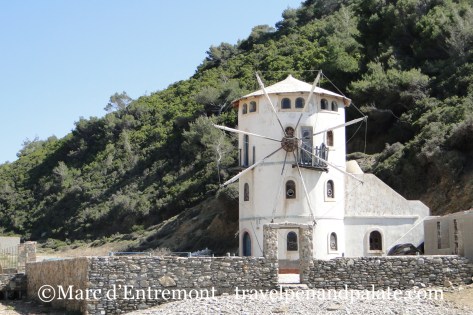
Windmill on the island of Alonissos
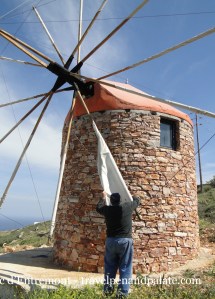
Mr. Ionnis Trinas has constructed what very well may be the first fully functioning windmill in the Greek islands for over a century. Read the rest at…
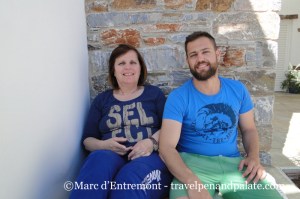
Mrs. Annezio Bouritis and her son Mixαlis Famelitis. Annezio Bakery
Mrs. Annezio Bouritis and her son Mixαlis Famelitis operate the traditional Annezio Bakery located in the port town of Merichas. Set in a typical white washed stone building with a view overlooking the harbor, the cars of customers are usually double parked on the narrow street.
cheese tarts
Greeks positively revel in sharing their food, especially with visitors. Mrs. Bouritis and Mixalis were equally enthusiastic to share recipes for cheese tarts and pastel. Read more at…
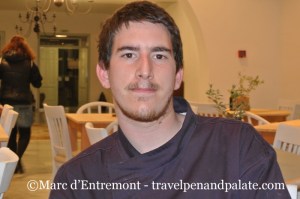
Spend time talking to the owners of the Paros Land Hotel and their promising young chef and you understand the resilience that has sustained Greece for millenniums.
It’s a creative force responsible for this enterprise and it will propel Greece beyond a temporary financial crisis.
Mrs. Tricha Stavroula, owner of Paros Land Hotel
Brothers, sisters, in-laws and grandchildren have all had a hand in the design, rebuilding and the myriad operational details required of a hotel. Their pride was palpable when they sat down each night at a long wooden table in the airy dining room for lengthy multi-course meals.
These iconic circular stone structures dot the land – both islands and mainland – and their images adorn countless postcards. Their stark beauty as ruins of a bygone agricultural age and the bird-like sails of restored mills stiff in the wind, evoke the same timelessness as the Acropolis of Athens or sacred Mt. Athos.
Wind permitting, a mill could grind up to 150 pounds of grain per hour. The mill men needed to develop skills to read the weather and gauge the strength of winds.
On the island of Sifnos, in the Cyclades group, Mr. Ionnis Trinas has constructed what very well may be the first fully functioning mill in over a century.
It’s a story worthy of Shakespeare’s Tempest – millionaires and a dark and stormy night… One can imagine the longing for peace and tranquility that celebrities seek.
Seven square miles of the Sithonia peninsula, five miles of pristine EU certified Blue Flag beaches… After all Greeks deified the very concept of hospitality. It’s unthinkable to change perfection.
In the Tudor kitchen at Hampton Court Palace, London, UK
Robert Fitch answered my question, “porridge was the staff of life” for the common person until the 18th century. No wonder working the palace was a coveted job – even for a spit turner.
The Hampton Court Palace kitchen cooked two meals for approximately 600 people daily consuming in one 16th century year 1,240 oxen, 8,200 sheep, 2,330 deer, 760 calves, 1,870 pigs and 53 wild boar.
A pudding steaming in the hearth at the Thomas Massey House (c.1696) Broomall, PA
Puddings were a major component of the English and American table during these centuries and often served as the foundation of a one dish meal in this age of cooking on an open wood fired hearth.
Clarissa Dillon, one of the foremost authorities on 16th-18th century English and colonial American cooking, tackles the often confusing interpretations of our shared culinary past.
Dr. Clarissa Dillon
I believe both Fergus and Clarissa would agree that a 17th/18th century middle class diet was healthy only if the diner was physically very active, but it’s tasty. London’s Chef Fergus Henderson and Philadelphia’s Dr. Clarissa Dillon have never met yet share a no-nonsense and unsentimental approach towards the diet of their 17th and 18th century Anglo ancestors.
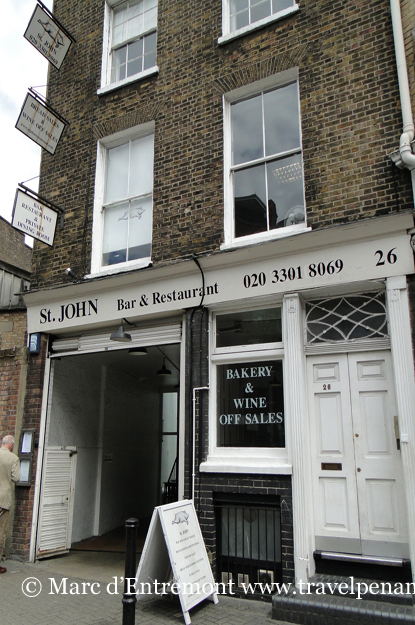
Marrow bones at St. John Bar & Restaurant, London, UK
When St. John Bar & Restaurant at 26 St. John Street, London, was a smokehouse in the 18th century, located a couple blocks from the centuries old Smithfield Market, Hampton Court Palace had a chocolate kitchen catering exclusively to the large royal household.
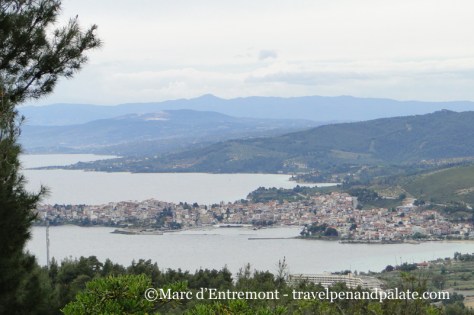
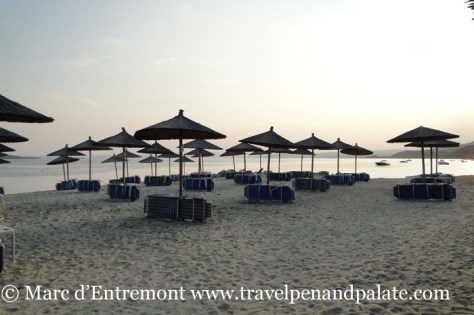
Sitting at a beach side café in Possidi on the Halkidiki peninsula of Kassandra, this North American was struck by an unfamiliar scene. People were reading.
Fingers of land jutting into the Aegean, Kassandra, Sithonia and sacred Athos have, like all of Macedonia, been at the center of turbulent times since the 4th century B.C.E. In the 21st century the only turbulence seemed to be the long lines of cars every summer weekend that bring holiday seekers from Thessaloniki and Eastern Europe.
water sports in Sithonia
Family owned since it opened in 1989, the rooms surround an opulent pool that is the focal point of the Flegra Palace Hotel including the Soleil Bar with its dramatic glass floor jutting over the water.
Fortunately mere mortals can dine at Ambrosia, the open-air dining room at the Flegra Palace Hotel in the Halkidiki seaside resort town of Pefkohori, Greece.
Banyan on the Thames restaurant, Hotel Rafayel, London
The Hotel Rafayel is part of the remarkable 21st century transformation of the Docklands, the East End and South London from post industrial wasteland into the vibrant, upscale, multi-ethnic residential and commercial city London’s east side of the Thames has become.
Lobby of the Rafayel on the Left Bank, Falcon Wharf, London, UK
Hotel Rafayel on the Left Bank has garnered praise for its attention to environmental details. From components for the actual building’s construction to its water catchment system, its eco-conscisousness only adds to its 21st century 5-Star charm.
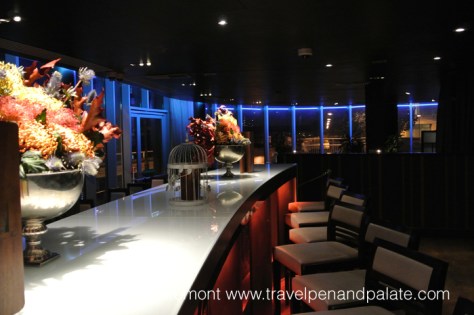
Banyan on the Thames restaurant, Hotel Rafayel, London, UK
Rapid urban change has remodeled the river scape along the Thames recreating the bustle of a modern port of international commerce. Except now the product is more than likely to be transported by computer or jet than freighter.
The ArcelorMittal Orbit, Queen Elizabeth Olympic Park Olympic Park, London, UK (scheduled to open 04/2014 )
With a city as cosmopolitan as London, there could only be more articles appearing shortly on Travel with Pen and Palate.
London from the observation deck of the ArcelorMittal Orbit, London, UK
The Tate Modern Gallery is housed in a converted art deco power plant within walking distance along the Thames River walk just up from the Globe Theater. The clean lines of the sprawling space gives justice to both the subjects and size of many great and imaginative works. A voiceless short documentary from the Tate is an urban ballet.
The clear blue water in the immense Hotel Nikopolis pool mirrors the crystal sea of Thessaloniki’s vast harbor.
Hotel Nikopolis, Thessaloniki, Greece
The strikingly modern Hotel Nikopolis, built in 1999, is reminiscent in its clean lines of the marble and limestone structures of Greek antiquity.
photo courtesy of the Hotel Nikopolis, Thessaloniki, Greece
Chef Stefanos Stamidis commands the hotel’s handsome Da Vinci dining room. Its Italian name is no conceit.
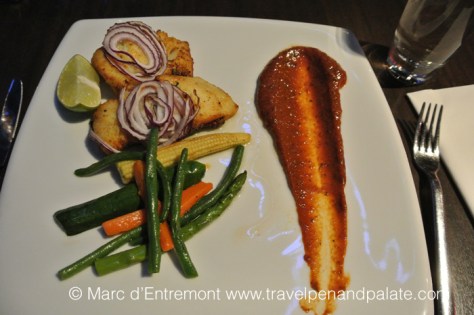
Veal ribs were glazed in deep, rich balsamic vinegar on a bed of baby carrots
Historically located at the crossroads of empires, the city has sat at the intersection of the fabled spice route connecting the ancient worlds of the Mediterranean, Near East and the Orient.
Founded in 315 B.C.E. by King Cassander of Macedon, he wisely named the city after his wife, Thessalonike, sister to Alexander the Great. Thessaloniki, as a major port city with nearly 2,500 years of history has been at the crossroads of empires starting with Alexander the Great, followed by Rome, Byzantium and the Ottomans.
For a city bulging with a young educated population – 15% are university students.
Located at the intersection of the fabled spice route between Asia and Europe has had a profound effect on both the culture and cuisine of Thessaloniki. And its young population has made it a city of cafes.
Fava with squid and raisins from Thessaloniki’s Oval café
Fava beans with squid and raisins is a favorite among Oval cafe patrons and reflects a reality that the ingredients for Greek cuisine remain easily sourced from their home provinces. Follow my step-by-step recipe with photos and recreate this delicious dish.




















 Travel with Pen and Palate
You must be logged in to post a comment.