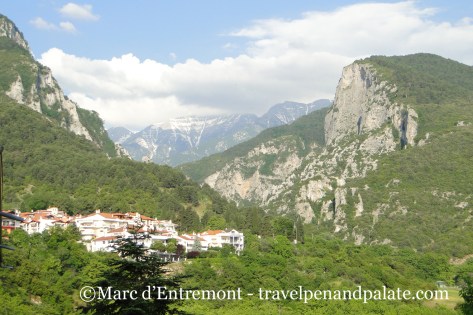
Mt. Olympus & the village of LitohoroWithin the Mt. Olympus range
Home to Zeus and his family of gods, declared the first Greek national park in 1938, a UNESCO Biosphere Reserve in 1981 and a European Union “Most Important Bird” area, the region includes 120 species of flowers, 1,700 species of plants with 23 exclusive to the Mount Olympus microclimate.
The Bath of Zeus
No wonder the gods wanted this prime real estate. At its base is Dion, the nearly three-millennium old holy city of ancient Macedonia dedicated to Olympian Zeus. Within the confines of the park is the 600-year-old Greek Orthodox Monastery of St. Dionysios of Olympus. And scattered throughout are sites steeped in legend and history.
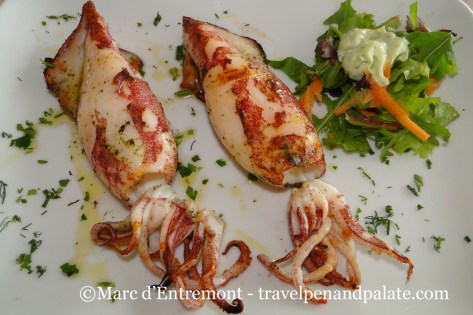
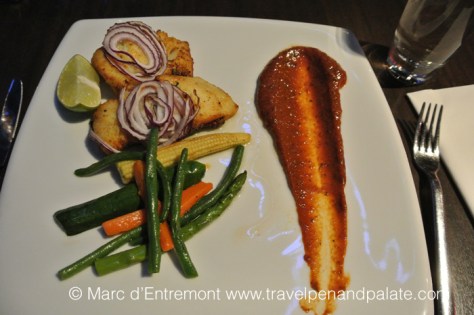
Grilled squid at AsteriasChef Kostas Tsoutsas & Yannis Laspas
The Asterias is the flagship restaurant of Yannis Laspas’ new Flegra Beach Boutique Apartments. Like the airy decor of the dining room, Chef Kostas Tsoutas has a light modern touch with traditional Greek ingredients.
Asterias Greek seafood restaurant
Flegra Beach Boutique Apartments
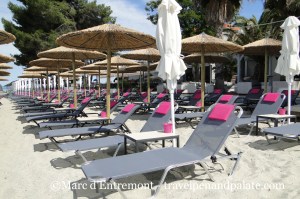
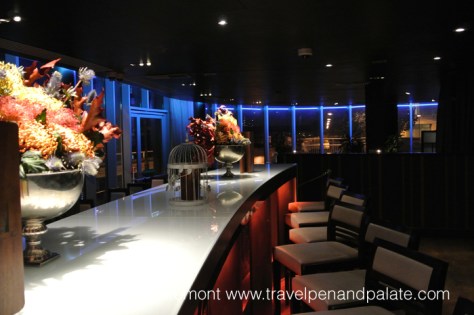
The waterfront Flegra Beach Boutique Apartments and Asterias are located in Pefkochori on the Kassandra peninsula with window walls looking onto the pine tree shaded beach and Aegean Sea.
It’s a story worthy of Shakespeare’s Tempest – millionaires and a dark and stormy night… One can imagine the longing for peace and tranquility that celebrities seek.
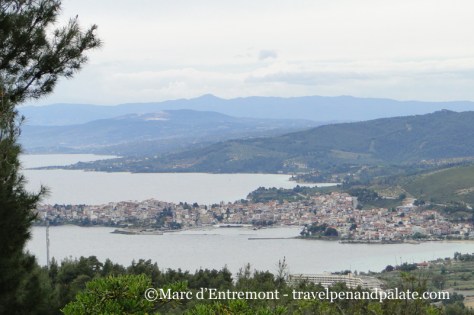
Seven square miles of the Sithonia peninsula, five miles of pristine EU certified Blue Flag beaches… After all Greeks deified the very concept of hospitality. It’s unthinkable to change perfection.
Banyan on the Thames restaurant, Hotel Rafayel, London
The Hotel Rafayel is part of the remarkable 21st century transformation of the Docklands, the East End and South London from post industrial wasteland into the vibrant, upscale, multi-ethnic residential and commercial city London’s east side of the Thames has become.
Lobby of the Rafayel on the Left Bank, Falcon Wharf, London, UK
Hotel Rafayel on the Left Bank has garnered praise for its attention to environmental details. From components for the actual building’s construction to its water catchment system, its eco-conscisousness only adds to its 21st century 5-Star charm.
Banyan on the Thames restaurant, Hotel Rafayel, London, UK
Rapid urban change has remodeled the river scape along the Thames recreating the bustle of a modern port of international commerce. Except now the product is more than likely to be transported by computer or jet than freighter.
The ArcelorMittal Orbit, Queen Elizabeth Olympic Park Olympic Park, London, UK (scheduled to open 04/2014 )
With a city as cosmopolitan as London, there could only be more articles appearing shortly on Travel with Pen and Palate.
London from the observation deck of the ArcelorMittal Orbit, London, UK
The Tate Modern Gallery is housed in a converted art deco power plant within walking distance along the Thames River walk just up from the Globe Theater. The clean lines of the sprawling space gives justice to both the subjects and size of many great and imaginative works. A voiceless short documentary from the Tate is an urban ballet.
Dinner at Sawtooth Winery, Nampa, ID – Zee Catering
The potato may still reign as Idaho’s number one production crop but in the agriculture section of the Twin Falls Sunday Times-News is a long list of local farmers selling everything from grass fed Tibetan yak to heirloom Anasazi® beans.
Salad of baby vegetables & foraged greens – Zee Catering at Sawtooth Winery
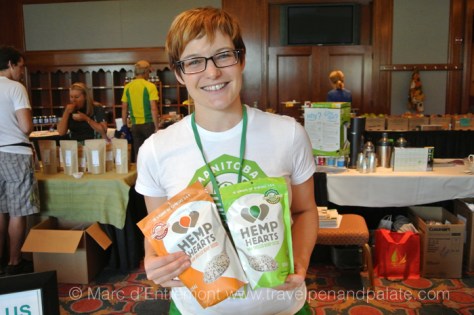
Sun Valley and adjacent Ketchum are by far Idaho’s wealthiest communities, yet that does not mean the offerings at the Sun Valley Harvest Festival are esoteric. From the many exhibitors this journalist learned that quinoa is a complete protein. Salting a sauté pan before frying vegetables prevents sticking. Hemp seeds are high in fiber, low in carbs and packed with iron.
Kelley of Manitoba Harvest’s Hemp Hearts – raw shelled hemp seeds
Out in the cooking tents a number of chefs demonstrated a range of foods. Award winning vegetarian chefs to A-list celebrities Tal Ronnen and Scot Jones of West Hollywood’s Crossroads restaurant presented a twist on traditional caponata as an entrée served on black quinoa and toasted buckwheat.
Chef Ronnen and Jones eggplant caponata over buckwheat and black quinoa
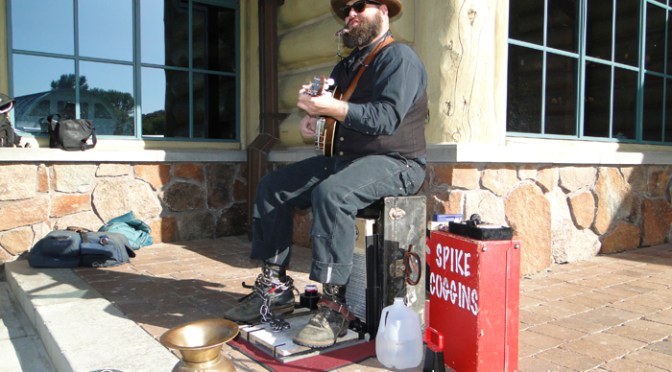
Even unique music was featured on the last day. Spike Coggins, primitive musician, enthralled guests with unique and original compositions accompanied by the banjo, harmonica and percussion instruments ranging from chains, spurs and metal cleated boots tapping out the rhythm on old railroad spikes.
At best, the European empires who vied for centuries over control of the Western Hemisphere considered Florida a convenient military outpost for protecting shipping lanes to and from the old world. Misquotes, yellow fever, swamps and wars are never good for real estate sales. European empires and American statehood did little for Florida’s economy. It took Henry Flagler – John D. Rockefeller’s partner in Standard Oil – to create an American Riviera and the state’s first golden age. His entrepreneurial expertise built the Florida East Coast Railroad, a plethora of elegant hotels, the cities of Miami and Palm Beach and revived the oldest city in North America, St. Augustine. From the late 1800’s through 1929, Florida basked in both its sunlight and the glint of a golden age in tourism.
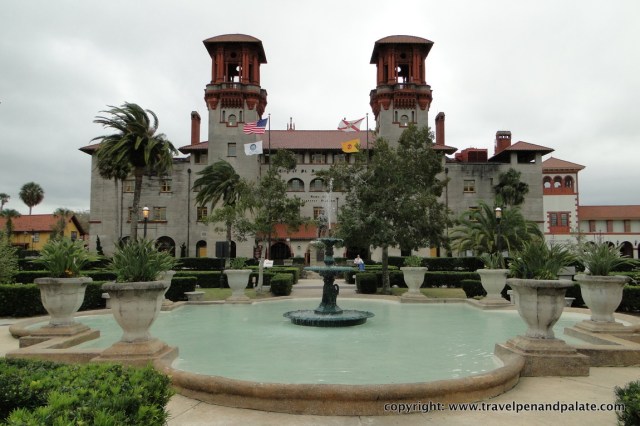
Henry Flagler’s Hotel Alcazar, 1888 (now the Lightner Museum) St. Augustine, Fl
More wars, the Great Depression and jet aircraft diverted attention and Florida’s luster suffered from the 1960’s to the end of the century. Yet the 21st century has witnessed a renaissance in interest in America’s sub-tropical real estate and it’s 20th century golden age.
The arts are flourishing with the revival of resort destinations such as the gulf coast’s St. Petersburg. The venerable Morean Arts Center (1917) has built a new facility just to feature America’s preeminent glass artist, Dale Chihuly.
Persian Sunset Wall by Dale Chihuly, Chihuly Collection, St. Petersburg, Fl
500 years ago (1513) Don Ponce de Leon fruitlessly searched for the legendary fountain of youth and discovered Florida instead. A lot of history and visitors have followed and they all needed a bed. The building that is now St. Augustine’s renowned St. Francis Inn was built while the city was still part of the Spanish empire – 1791. Yet Joe and Margaret Finnegan have never seen Lily even though they have owned St. Augustine’s historic St. Frances Inn for nearly three decades. Of course, Lily’s not a guest…
An attentive and friendly staff of 14 oversee the many details that can make a guest of the St. Francis Inn forget they’re also visiting one of America’s great historic destinations, St. Augustine, Fl.
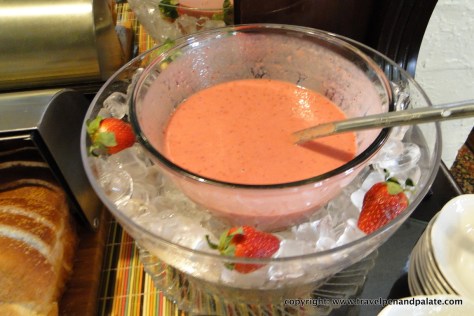
Strawberry soup, St. Francis Inn, St. Augustine, Fl
The first thing you notice when you walk into Meehan’s Irish Pub and Seafood House are the autographed Jameson whiskey bottles that line the rafters of the bar.
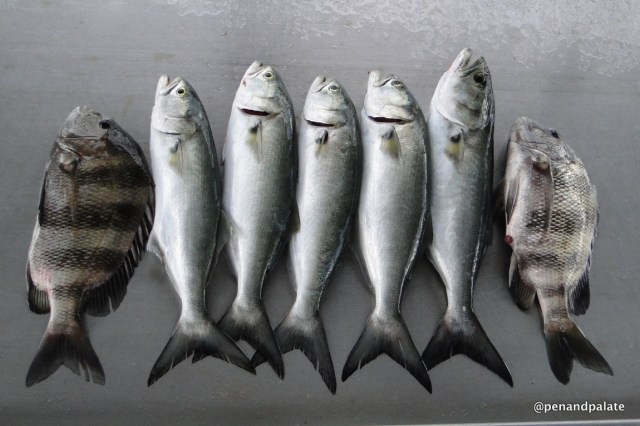
raw oysters plain & with crab, The Compleat Angler, Orange Beach, Al
“Is it hard work?” asked journalists on an IFWTWA media trip to Gulf Shores and Orange Beach, Ala. Without a pause in her stride, 85-year-old Ms. Velma Fell replied, “I love it.”
Velma Fell, 42 year employee of Bon Secour Fisheries, Bon Secour, Al
With a sly smile, chef Chris Sherrill’s response to winning Gulf Shores 5th Annual Oyster Cook-off in November was, “eat oysters, love longer.” Ten restaurants along the beautiful white sands of Gulf Shores and Orange Beach epitomize both coastal food and southern hospitality.
For me, traversing this bucolic region, l’arte del fare il vino – the art of making wine – seems more la storia d’amore di fare il vino – the love affair of making wine.
the wine shop at Cherry Valley Vineyard
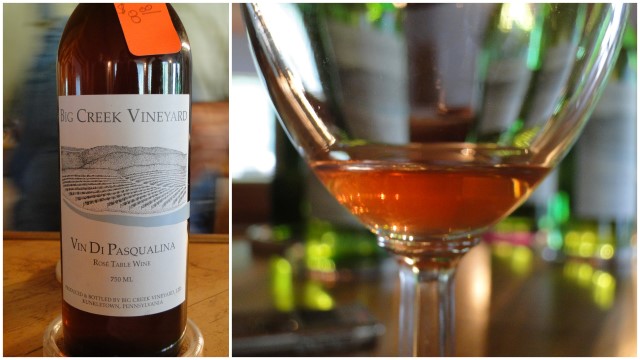
Big Creek Vineyard & Winery
Big Creek Vineyard and Winery and Sorrenti Cherry Valley Vineyard are two of the vineyards on the Lehigh Valley Wine Trail in northeast Pennsylvania that make for a pleasant weekend getaway.
named for Dr. Dominic Strohlein’s grandmother – Big Creek VineyardSorrenti Cherry Valley Vineyard
the garden for catered events at Sorrenti Cherry Valley Vineyards
“We live and eat from the land. Pachamama is our mother and we have to respect her.” Juana, spiritual healer
Iruya, Argentina
Our guide pulled the Land Rover off the road and stopped the engine. The lights were off; we were in total blackness and silence. I asked,“¿Cuál es el problema?” believing something must be wrong with the car. Opening the door, he replied, “No hay problema. Las estrellas.” As eyes adjusted, the sky was ablaze with stars. The Milky Way was a sash of white gauze. The Southern Cross stood out clearly despite competition from a few million other constellations. Satellites passed overhead. Stars sparkled white, blue and red. The dome of the planet was a Christmas display. At 10,000 feet elevation in the middle of the Andes Mountains, there were no ambient lights to dim the awe we were experiencing.
The Pachamama
No wonder for thousands of years the indigenous peoples of the Andes have worshiped the land as a living force and looked upon the Pachamama – the Earth Mother – as their benevolent protector. The mountain environment provides for the people – pack animals, meat, cloth, water from the glaciers for drinking and irrigating the parched land.
Despite Inca and Spanish conquest, both the indigenous cultures and the Pachamama remain. Jesuit missionaries were far too intelligent to attempt a wholesale, and fruitless, change of attitude. They could understand the correlation between Catholic beliefs in the Virgin Mary with that of the Pachamama and interwove their veneration. Roadside shrines can be seen today in the most remote mountain areas with statues to the Virgin Mary with traditional offerings to the Pachamama of food, jewelry, figurines, coca leaves and hundreds of burning candles.
The Quebrada de Humahuaca
Argentina’s Andean Northwest is home to cultures that have called it home for 9,000 years. Irrigation canals constructed 3,000 years ago still water fields. 3,500 year old villages are alive with people in traditional clothing except it’s not a fashion statement. Hornos, outdoor clay ovens, are the center of the kitchen; adobe houses are constructed as a community effort without power tools.
The ancient village of Tilcara, 1,100 miles northwest of Buenos Aires, is an excellent base to explore the UNESCO World Heritage Site of the Quebrada de Humahuaca. The mountain enclave of Iruya is reached only after a surreal six hour journey. At 13,000 feet, the Salinas Grande Salt Flats seem like a different planet, and not too far north, near the Bolivian border, the legendary Ruta 40 begins its 5,000 mile journey to Tierra del Fuego.
Brown is the color of Tilcara, but don’t let that deter you from staying. Its brown adobe buildings, tan stone streets and dusty countryside provide a beige backdrop for the stunning multi-colored reds, greens and pinks of the surrounding mountains. The brown of Tilcara is also a foil for the bright colors of indigenous handicrafts – multi colored garments made from soft alpaca and llama wool along with many forms of pottery based on ancient designs. The senses are entertained by the aromas from food stalls selling humitas – a creamy corn and cheese mixture wrapped in corn husks – empanadas – an Andalucian savory pastry first made by the Moors of North Africa – fresh grilled tortillas and the incomparable Andean goat’s milk cheese Queso de Cabra.
Angels and Folk Heros
Angeles Arcabuceros
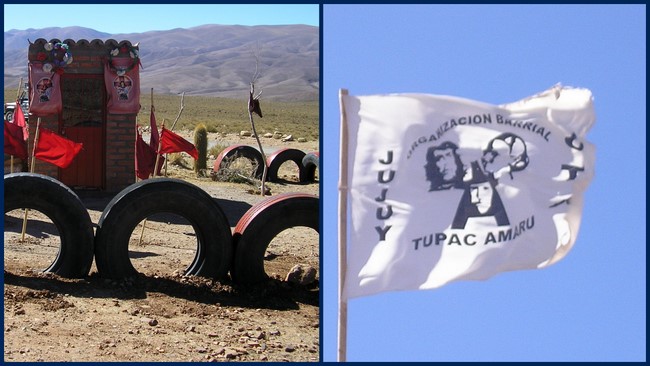
To explore the rugged countryside of the Quebrada requires a four-wheel drive vehicle. Many of the roads are unpaved, twisty and narrow. The journey to Iruya explored a surreal mountain landscape – barren and rocky, nearly unpopulated, at elevations exceeding 9,000 feet – punctuated by tiny villages and steep valleys shrouded in clouds. In Uquia’s 17th century Iglesia de San Francisco de Paula is a priceless collection of the Angeles Arcabuceros(Angels with Guns). The paintings depict winged angels fully dressed as conquistadors bearing guns and swords – not too subtle Spanish Colonial propaganda. Several miles further I spied a road side shrine to folk hero Gauchito Gill. Throughout Argentina, shines to this 19th century gaucho Robin Hood are visible on rural road sides identifiably draped with red banners. He is especially revered in the north where he led a peasant rebellion against landowners, was captured and executed. Numerous miracles have been attributed to Gauchito Gil, and he has a large cult-like following. Red banners and depictions of Gil’s heroism are frequently superimposed on the cross and may be flanked by the unlikely triumvirate of Evita Peron, Che Guevara and the last ruling Inca, Tupac Amaru.
shrine to Gauchito Gill
Our guide had prepared a picnic lunch. Before eating he poured a portion of our drinking water onto the soil. It was the offering to the Pachamama. This was not a gesture to fascinate tourists – this was for real.
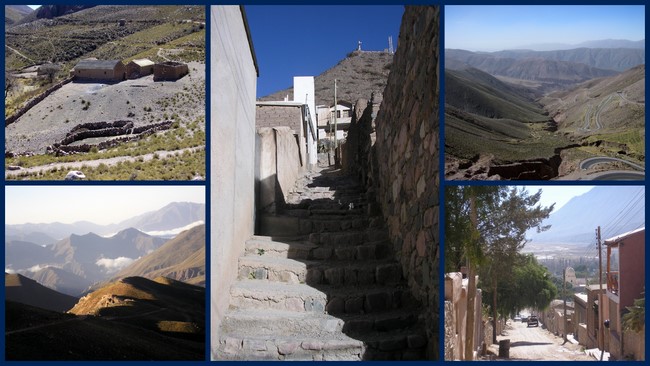
(upper left) a farm at 8,000 feet, (center) staircase street in Iruya, (lower right) Tilcara
Iruya
Iruya, with a population of 4,300 at an altitude of 9,120 feet is perched on the mountainside high above the Rio Iruya. Its white buildings, dominated by its much photographed Igelsia de Nuestra Senora del Rosario y San Roque, gleam in the sun as they rise in a jumble up the green-brown hills. Many of its streets are literally stone staircases and negotiating this labyrinth can be bewildering at first when the street dead ends at the door of a house.
Salinas Grande Salt Flats
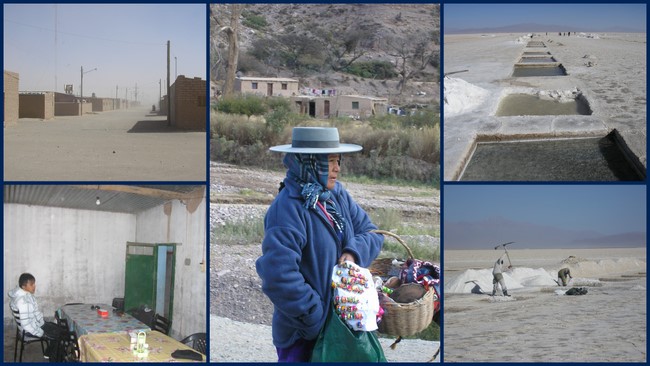
The following day our excursion to the Salinas Grande Salt Flatstraversed numerous switchbacks as we climbed through the spectacle of the Cuesta de Lipan offering panoramas of snow covered peaks and barren steppe. A road side marker indicated the highest point for this route, 13,344 feet. As we descended, the gleaming salt flats came into view. Amid the treeless, brown countryside of the altiplano, the vast Salinas Grande Salt Flats reflected the sun like an immense solar collector. These are among the world’s largest and highest naturally renewing salt flats in existence covering an area of 3,200 square miles. Salt extraction has gone on for decades using unchanged hand methods. Walking on the flats is nothing less than other-worldly. In the thin winter air at 12,000 feet the strong wind was biting yet the experience exhilarating. Sunglasses are necessary – the glare off the salt is blinding without them. The flats resemble cracked concrete except there’s a crunch under your feet.
Comunidad Aborigen Tres Pozas
meat drying in the sun
Comunidad Aborigen Tres Pozas is eight miles west of the flats, and the only human settlement for many miles in any direction. It’s the home for most of the workers and consists of a few dozen simple adobe buildings as brown as the surrounding desert. The winter winds were creating a sand storm. Sand whipped by high winds can find its way through closed car windows and doors lodging everywhere inside your clothing, your mouth, nose and ears. The café, Comedor Las Guapas Salineras, is not an establishment any guide book would recommend for dining, but I’d highly recommend if you want to actualize that overused phrase “an authentic experience.” The education is startling and humbling. For an absurdly small price, coupled with genuine kindness and effort, you dine on simple food in conditions few of us would ever accept.
(right) Comunidad Aborigen Tres Pozas (left) Salinas Grande Salt Flats
For a tourist town, Hoi An has a surprising number of decent restaurants at some of the lowest prices outside the major cities. My first dinner in this city of 200 + year-old-buildings was at a hip new boutique hotel and café, River Lounge (35 Nguyen Phu Chu). The simple, modern white interior provides a nice foil for imaginative interpretations of traditional Vietnamese cuisine.
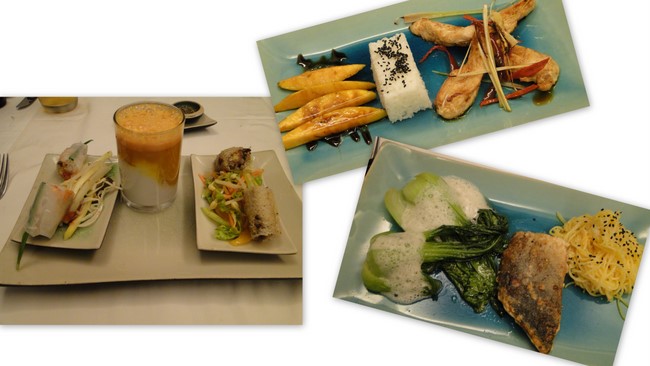
Take simple cream of pumpkin soup, found on so many menus, River Lounge serves a cream foam topped with the seasoned pumpkin puree in a swirl on top in a tall clear glass. The textures of hot puree mixing with cooler cream, as well as the visual, is a nice touch. The rest of the meal was equally satisfying.
An assortment of spring rolls, an entrée of grilled river fish with steamed morning glory greens and lime foam and fresh noodles and one of boneless chicken in a sesame/soy/ginger reduction accompanied by a block of rice and grilled mango. Dessert was a perfectly executed creme caramel topped with a crunchy ginger sugar glaze.
Cafe Can
Cafe Can(74 Bach Dang St.) is one of many Hoi An river front restaurants that all basically offer the same menu. Cafe Can caught my eye for both its pleasing outdoor dining and its large wood charcoal grill off to the side with fresh fish and seafood for dinner. In simple large pots of aerated water are freshly caught giant prawns, crabs and clams.
Sold by weight, they are best grilled napped with a variety of herb/garlic/ginger/soy sauces. The meal was accompanied by a large platter of steamed vegetables and mushrooms, with a large local beer.
A variety of other preparations, from fish baked in banana leaves to fried as well as non-fish dishes are available. Being open to the street directly across from the river, don’t be surprised when more than one street vendor wander in selling bracelets, the English language Vietnam Times, dried fruit and homemade candies. It’s all part of Vietnam.
(top left) Cafe Can, (top right & bottom) Dem Hoi Bar & Restaurant
Dem Hoi Bar & Restaurant, just down the block from Cafe Can, has the advantage of a beautiful French colonial building with a large open second floor that offers stunning views of the river and Hoi An harbor. The menu is decent – nothing surprising but well prepared.
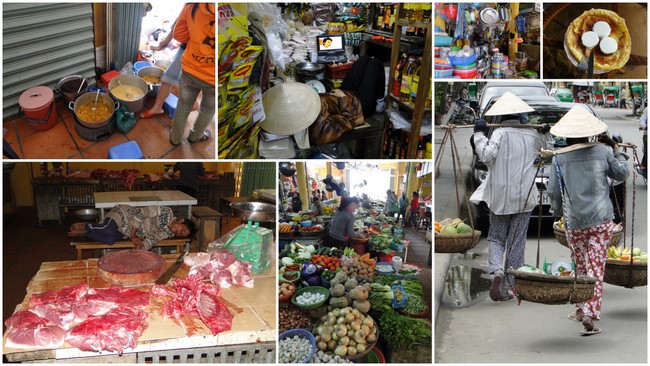
Hoi An Market – sleeping on the job… or next in line?
Over on the French Quarter are several cafes that serve, if lucky and they are available at the market, Vietnamese delicacies such as pig’s brain and eel. The brain was unavailable but the eel was nicely fried in a light batter – tasted a lot like trout (see, not chicken!) The Hoi An Market is classic offering everything from hot soup to wonderful French crepes topped with coconut ice cream (top right).
Windbell Homestay Hotel
When it comes to hotels there is a large selection of accommodations with many moderately priced first class venues. The newest choices are on the expanding residential island of Cam Nan, a 10 minute walk across the bridge from the Old City. Cam Nan Island is quiet with a pleasant mixture of old wooden houses with vegetable plots to the larger homes of new middle class residents.
Windbell Homestay Villa has an established reputation for comfort, service and a good restaurant. Set around a central garden and beautiful blue tiled swimming pool, this family run hotel offers spacious rooms with lots of windows that open onto nice private vistas letting in the sea breeze. Including a full breakfast, strong Wi-Fi, double rooms average in the low US$100s.
Windbell Homestay Hotel Restaurant
Serving all meals, the Windbell Homestay is one of the rare small hotels with a full service restaurant with everything freshly made to order. A Hoi An specialty, White Rose, (bottom left) is a delicate dumpling filled with savory mixtures which the Windbell does particularly nice as well as spicy shrimp, Beef Pho (upper left) and a great herb calamari sauté on mint and watercress (upper right). Add a bottle of white or red from Vietnam’s largest winery, Vang Dalat and you’ll enjoy a pleasant meal overlooking the lit gardens and pool. (Vang Dalat will not win any awards soon).
Hoi An Folk Art Museum (center) Ba Trao singers, (top right) tea garden, bottom right) Unicorn Dance
The Hoi An Folk Art Museum is well worth a visit. It has a fine display of traditional tools, everyday life items, artistic and musical traditions, the important silk weaving industry and some contemporary art. The large 18th century structure is a treasure in itself.
Hoi An is one of those rare villages tourism has revived that, as of yet, has not been destroyed by its success. Perhaps it’s the strong merchant background of old Hoi An – sails and a port still equals sales. It doesn’t hurt having a strong preservation ethic among the town leaders. New construction in the Old City was following strict building codes using the same materials and methods of construction as 200 years ago. That commitment bodes well that even though it will remain a tourist town, Hoi An’s real, still going about its business and beautiful.































 Travel with Pen and Palate
You must be logged in to post a comment.