Category Archives: UNESCO World Heritage Sites

Beach Anyone? An Undiscovered Vietnam

the beach at Lang Co, 40 miles (65 km) south of Hue

Vietnam:  jungles, mountains, green and 1,956 miles (3260 km) of  coastline (not counting islands)  much of it pristine, undiscovered, wide, white sand beach. “Undiscovered” by a beach-hungry Western tourist world but for how long?

The 65 mile (110 km) trip from Hue to Hoi An is a beautiful coastal drive past fishing villages, wet lands and rice paddies with the road winding through the hills of the Truong Son Mountains. The postcard fishing village of Lang Co is situated between the Pacific and a perfect crescent lagoon dotted with boats. Tourism investment money is starting to develop the beach towns, but it will, hopefully, be some time before they’re condo canyons.

We were on our way from Hue to the UNESCO Heritage village of Hoi An, some 10 miles south of Da Nang. From Hue the passenger train line from Hanoi to Ho Chi Minh City (Saigon) hugs the same coast as the coastal highway, a 4 hour trip to Da Nang. From Da Nang you catch a taxi to make the 30-45 minute drive to Hoi An (cost $28 – $45/double train and taxi). As beautiful as the rail trip would be, I chose to arrange for a car and driver to make the trip to Hoi An with the option of stops on the way. For US$60/double this was a terrific day trip as well as transportation to our next destination.  

Lang Co lagoon

I would have enjoyed wandering around the village of Lang Co, but on this day it was primarily a lunch stop. The Thanh Tam Seaside Resort is nicely designed. The main reception building contained a spacious restaurant decked over a sloping hill and opening onto a sweeping view of the Pacific at palm tree-top level. The palm trees create a large shaded sitting area at beach level. The rooms for the hotel were in separate beach front buildings. I did not see the rooms but TripAdvisor reviews are not kind. Of course there was a large store selling jewelry and clothing. There was no competition on either side of the resort for the peace of an enormous stretch of sand with beautiful views of the mountains.

even monks need a little R & R: Thanh Tam Seaside Resort

 For a tourist resort, the restaurant was surprisingly good. Specializing in seafood, there was a fine selection of grilled clams and oysters topped with a variety of savory sauces. Spring rolls were delicate and lightly fried. Prices were at the high end for Vietnam meaning that lunch or dinner for two will average US$25/30. (Our light lunch with espresso was $18/two). 

Thanh Tam Seaside Resort

  The Hai Van Pass is the reason for making the overland trip by car – or if intrepid, by bicycle. The train dramatically hugs the coast around this finger of the Truong Son Mountains that literally juts into the Pacific Ocean creating a 1500 foot (497 m) barrier geographically dividing the country north and south. By car Highway 1 switchbacks up lush mountainsides, brushing clouds, opening vistas of the blue ocean set against the intense green of farm fields. This mountain barrier creates the moist microclimate that makes Hue and the Perfume River delta a unique ecosystem.
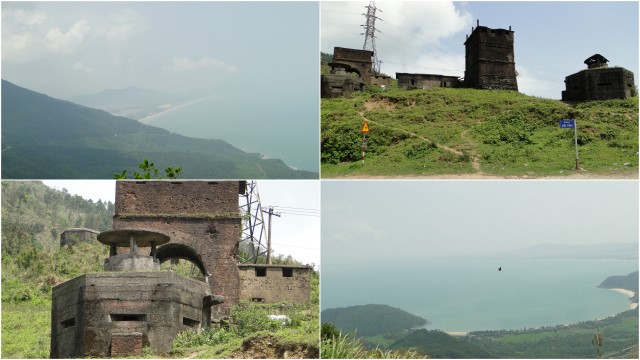
Hai Van Pass with 200 years of military installations (top right) Lang Co lagoon (bottom right) Da Nang Bay

 For over 1,000 years, Hai Van Pass (Pass of the Ocean Clouds) was the boundary between the Kingdoms of Vietnam and Champa. Even after the final conquest of Champa by Vietnam’s Nguyen dynasty in the early 19th century, the Pass was deemed a strategic position through the Vietnam War. Pill boxes are next to a 19th century watch tower. Today the site’s a rather windy, shabby remnant of a violent past. One side of the road is lined with the ubiquitous tourist stalls selling the same trinkets, water, soda, cigarettes, scarves, postcards etc that you’ve seen so many times already. Your car literally will be surrounded by well meaning and persistent sales women. I admire their persistence, even while regretting that I do not need what’s for sale, because it’s certainly a peaceful pursuit after this site’s violent past millennium.
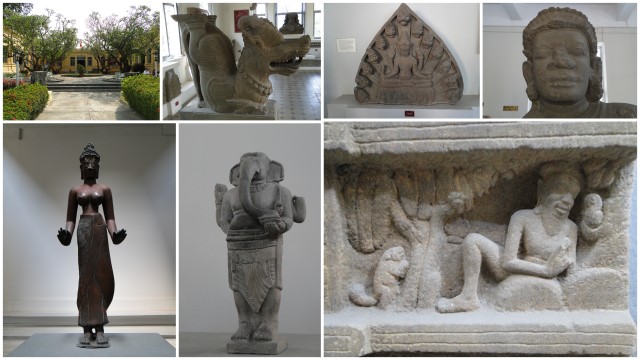
Museum of Champa Art Da Nang

  Having traveled to both Cambodia and northern Vietnam, I could see and understand the distinct break in artistic traditions between the Chinese Confucian influenced north Vietnam and the Hindu/Buddhist/Khmer Champa Kingdom of the south – there is a cultural divide. Da Nang’s Bao Tang Dieu Khac Champa Da Nang (Museum of Champa Art) is both a gem and the world’s largest repository of the exquisite sculpture of this civilization.

Da Nang Sports Complex

The rapidly sprawling rather charmless city of Da Nang looks like a new settlement. If there was a historic core or a building prior to 1975 it’s well hidden. Being both a major port and air base during the Vietnam War did make it a prime target for severe damage. With modern Vietnam’s penchant for getting on with the future there’s little to no evidence of that past war. Yet Da Nang’s future fame will result in the development of its miles of stunning beaches. Australian money has already begun to pour in starting major golf/hotel/condo resorts. Iconic China Beach is highly desirable real estate. Da Nang’s airport is undergoing major expansion. I know it would be politically correct to decry this future loss of pristine nature, but also patronizing. This is an ancient land. It changes.

In Rediscovery: Huế, Việt Nam

(top) River park, Dragon boats for hire, (bottom) Imperial City Citadel, house boat on the Perfume River
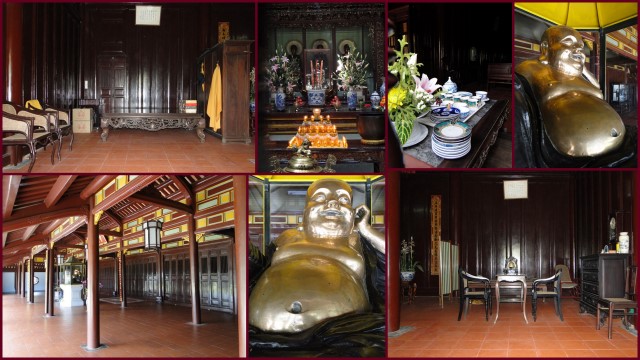
laughing Buddha at Thien Mu Pagoda

There has been a river port on the Perfume, just a few miles inland of the Pacific, at least since the early 14th century. The unpredictable river has intertwined for 650 years with Nguyen dynastic intrigue to inexorably shape the modern city. Hue exudes a less frenetic pace than Hanoi – although the cyclo and tourist boat drivers are just as “persistent.” It’s a city with an attitude: “I’ve seen it all before, several times, so let’s move on.” Besides, the river moves on regardless fertilizing the farms, and frequently cresting its banks creating destructive floods even the Imperial City cannot defend against.


Before the Vietnam War’s 1968 Battle of Hue severely damaged the city, graceful French Colonial villas blended with ancient Confucian/Buddhist architecture. Much of that is gone, replaced by functional late 20th century commercial whatever. A loss? Of course, but, of course, before the French  it was all Confucian/Buddhist, and yet there was that earlier Champa period and …
keeping one foot in each of three centuries


within the Imperial City

A four day visit is not sufficient to prove, but I have a hunch that Hue has not rediscovered its role in 21st century Vietnam – and I’m not sure they’re all that concerned. In the old commercial city on the south bank of the Perfume, Hue is still a maze of narrow streets but with few pre-1970 buildings. Many charmless new narrow 5 to 6 story hotels and condos are classically jumbled along with cafes, shoe shops, clothing stores, spas and the postcard vendor. Only a few shops noticeably cater just to tourists. Perhaps that’s because most sites for visitors are outside the city or on the north bank, such as The Imperial City.

Han Chen Temple (current temple 1885) - 5 miles north of Hue on the Perfume River - dedicated in the 8th century to Cham goddess Po Nagar
Thien Mu Pagoda

Nearly equidistance between Hanoi and Saigon, Hue has been a meeting ground of the nation’s great cultural institutions. Confucian and Chinese Buddhist Vietnam in the north blended with Khmer/Champa Buddhism from the south and both have dealt with the French legacy of Roman Catholicism. Yet even under the Confucian Court of the Nguyen emperors, and the Socialist Republic, Hue’s mascot has been the 1602 Buddhist Thien Mu Pagoda. As in all Vietnamese cities, both Confucian and Buddhist temples built through family patronage, to publicly honor ancestors, can be found tucked away on many streets.

Roman Catholic Cathedral, shrine to the Virgin Mary
fresh coconuts full of cold cocnut milk - make a hole in the peeled top, insert a straw and enjoy!!

It is convenient to walk along the landscaped river park on both banks of the Perfume River and cross either one of two bridges that connect the Imperial City with downtown. “Convenient” as long as being comfortable with the traffic, the lack of crossing lights, stop signs and constantly being asked if you want to ride a cyclo or buy something. Otherwise, metered taxis are common and inexpensive – a couple of dollars between the Imperial City and any downtown hotel. Excursions to the Imperial Tombs and boat trips on the Perfume River – both highly recommended – should be made through your hotel (more likely to get a better boat at a fair price). I prefer the freedom of not traveling with groups. A private car and driver for a four hour excursion to some of the more remote tombs was US$30. A private dragon boat for a 7 hour trip on the Perfume River stopping at tombs, monasteries and a Garden House was US$20. Rates are less if you join a group.

local "pets:" (left) water buffalo, wooden horse at Han Chen Temple, a temple dog, (bottom) shrine to honor horses, bull elephant at the Imperial City
courtyard Hotel Morin Saigon


Hue has several luxury hotels including the newly restored venerable Hotel Morin Saigon (1904) starting at $100/double. Although featuring the comforts of a 5-star hotel with an attractive pool/garden/cafe courtyard, it possess all the sterility that goes along with such venues. There are many excellent small hotels offering much better service than their 3-stars would indicate. Although at a rate that would make most Western tourists think twice, the US$35/double per night including buffet breakfast Orchid Hotel on Chu Van An Street in the Old City was not only the best hotel at that price in which I have ever been a guest, but a fine hotel by any standard.

Orchid Hotel and breakfast

Clean, modern with a staff that would never even let you push the elevator button, the Orchid’s rooms were large providing ample closets, a spacious bathroom and a desk with a high-speed desktop computer included in each room! Hue traditionally is known for its Imperial Cuisine which, unfortunately, I found in few restaurants. The Orchid only serves breakfast offering an excellent selection of  items typical of Hue – chicken balls rolled in flaked green rice, fried rolls stuffed with vegetable/meat mixtures, banana pastry with caramel sauce and an incomparable Beef Pho, the Vietnamese breakfast noodle soup. A large selection of fresh fruit – including tropical varieties such as whole passion fruit –  baguettes and Western dishes rounded out the buffet.

Am Phu Restaurant

Many decent restaurants are found in the Old City all within easy walking distance of most hotels.  Confetti Restaurant & Art Gallery and the Tropical Garden, both on Chu Van An Street, offer well prepared standard Vietnamese food in pleasant surroundings just like the majority of the area’s venues that are patronized by tourists. Yet there are lots of small places filled only with locals with menus not written in English, but, I’ll be blunt, the sanitation methods I can see frequently make me dubious. Getting a recommendation from your hotel for local restaurants is a must or else I’d never have eaten dinner at Am Phu Restaurant a bit further down Chu Van An Street.  A calamari dish with greens, peppers and cilantro and light, moist coconut batter fried shrimp were as fine as in any dining room except I was sitting on a plastic chair under fluorescent lights with a TV soap opera playing. Dinner for 2 with beer was less than US$10.

street shoe repair man


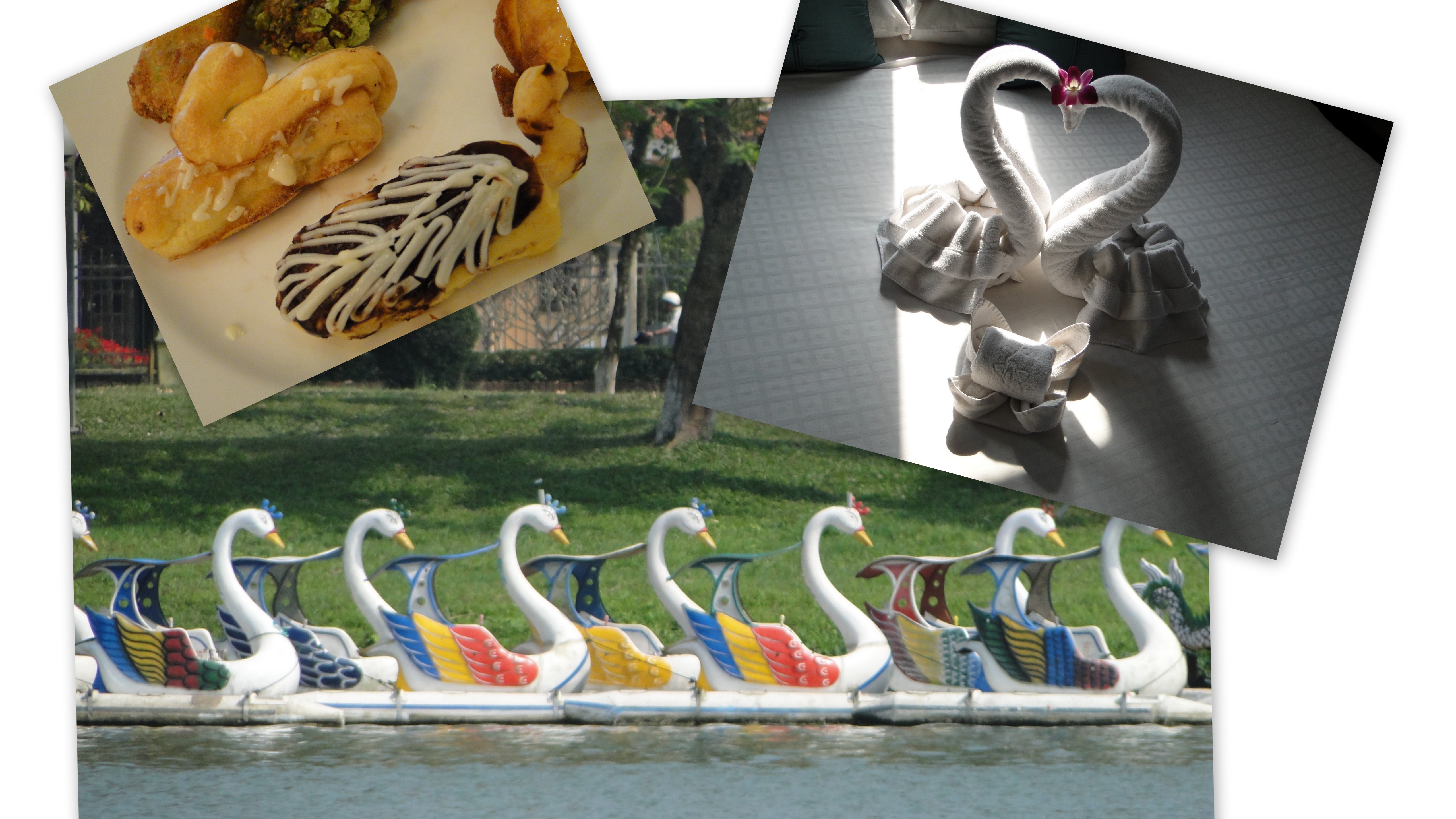
Pastry, towel art  and Swan boats on the Perfume River, shade trees and gardens, ancient tombs and palaces, markets and street merchants, mountains and house boats – they were all here 500 years ago and, despite the history Hue’s helped shaped, they’re still here today waiting to be rediscovered.

who does not like swans?

Serenity, Violence and the Heavenly Lady: Hue, Vietnam


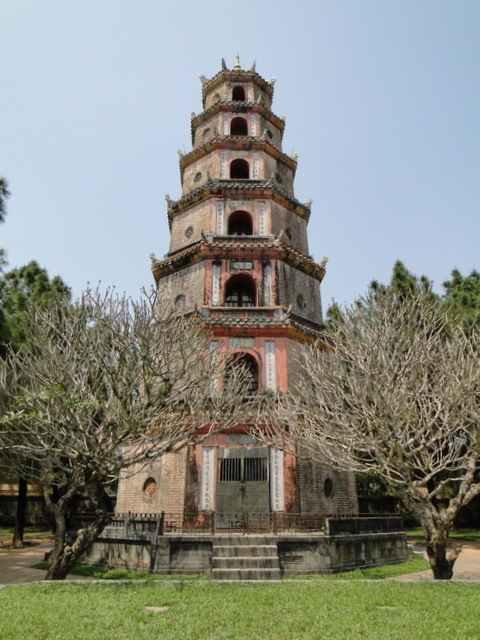
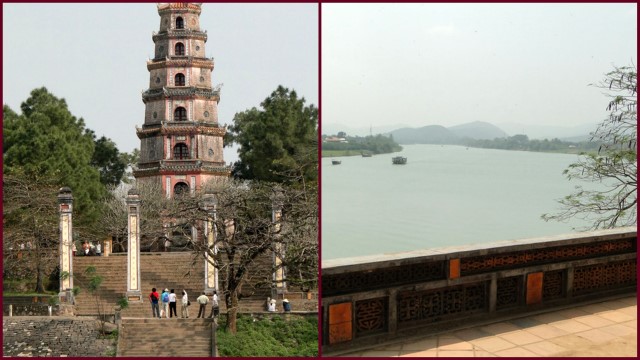
Phuoc Dien Tower & the Perfume River
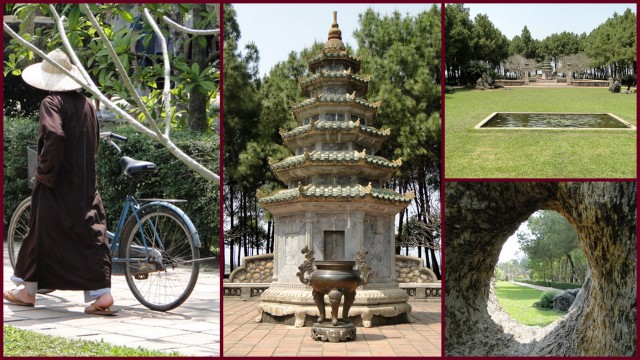
the bonsai garden at Thien Mu Pagoda

The boat’s noisy motor is in sharp contrast to the serenity of the Perfume River as we glide toward the landing dock of Hue’s most important tourist attraction. Fortunately on this afternoon in March, there are no large crowds to mar the tranquility of arguably Vietnam’s most beautiful Buddhist temple complex. Construction commenced on Thien Mu Pagoda (“Heavenly Lady Pagoda”) in 1601 on Ha Khe hill, on the north bank of the Perfume River, the site selection being determined by a holy lady’s spiritual visions. She couldn’t have chosen a more serene site. High above the river, surrounded by a graceful pine forest, the Pagoda complex of temples set within green gardens captures the river breeze cooling Hue’s otherwise muggy afternoon.

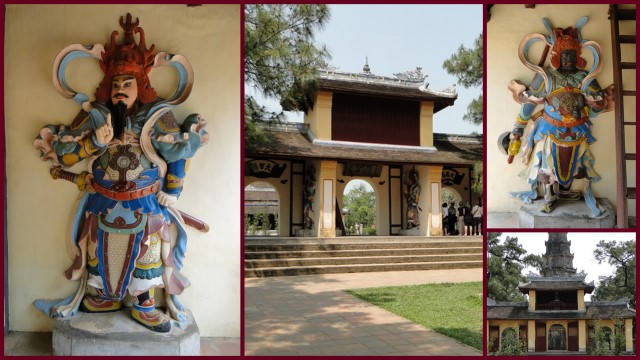
2 of the 6 guardian warriors at the gates of Phuoc Dien Tower

The number “seven,” as in Seven Stages of Enlightenment, plays a significant role in the temple’s design concept. From the river the complex is constructed on seven slightly rising tiers. The dominant octagonal Phuoc Dien Tower (1864) in the front of the complex rises in seven levels with seven statues each a different representation of the Buddha. It is guarded by six warriors on either side of the three entrance gates – ok, that breaks the pattern, but…

Dai Hung shrine, Stela (1715) on marble turtles recounting Buddhist history and thought

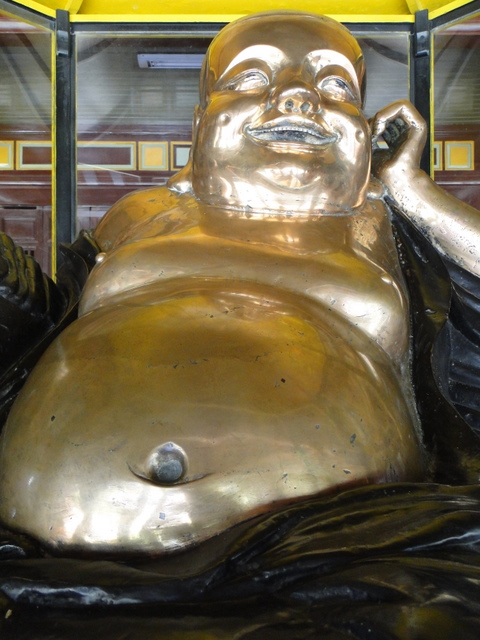
On the next level is the elegant Dai Hung shrine with a rotund brass laughing Buddha brilliantly set off by the dark wood and deep reds of the building. Through side windows I had an unprecedented view of monk’s quarters within a temple.

Dai Hung shrine with laughing Buddha

Thien Mu Pagoda is Vietnam’s oldest monastery, and a visitor should be mindful that they are enjoying the grounds where dozens of monks and novitiates are in work, study or prayer.

A small open building on one side of the complex always has a crowd of people. It contains a sacred relic from Vietnam Buddhism’s more recent past – a circa 1950’s Austin motorcar. It was the car driven by Thích Quảng Đức to the Saigon intersection where, in June 1963, he set himself on fire in protest to the anti-Buddhist dictatorial regime in South Vietnam hastening its downfall. Thích Quảng Đức was originally a monk from Thein Mu Pagoda and, partly due to the fact that his heart didn’t burn, he is venerated today as a bodhisattva.

the Austin of the Venerable Thích Quảng Đức

Violence and serenity – an unholy glue – well known in a land several millenniums old. Next to the Venerable Thích Quảng Đức’s rusting Austin the path to the Pagoda exit is through an exquisite simple Peace Garden.

Perfume River After Life – the Nguyen Tombs

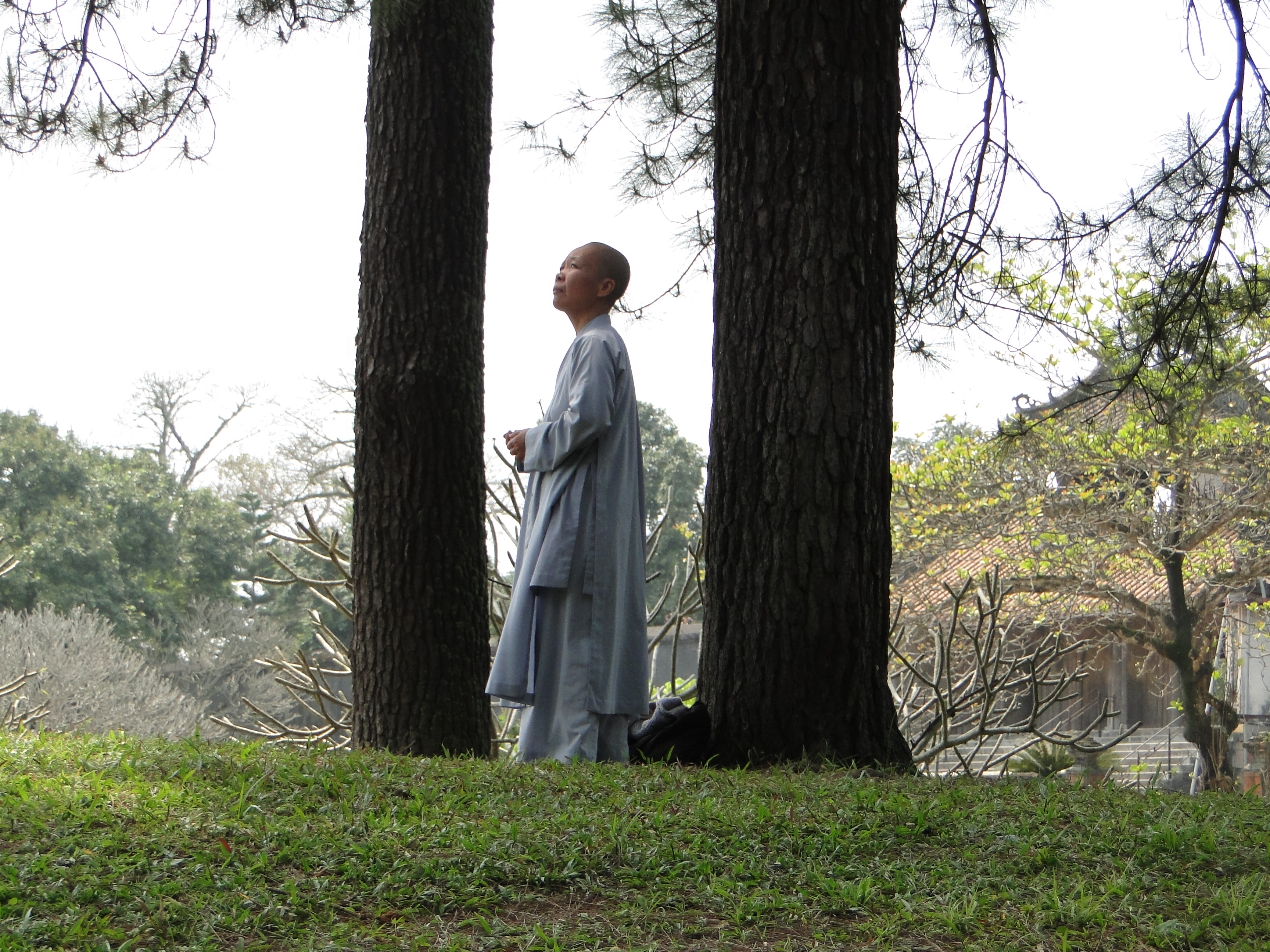
Monk in contemplation at the tomb of Emperor Tu Duc

Here’s the project – and money’s no object: build a place away from work and home where you can just get away from it all, surround yourself with your friends, do what makes you happy and stay there forever. If you were a Nguyen emperor of Vietnam you did exactly that and included artificial lakes, islands, palaces, temples, gardens, courtyards, and, of course, your tomb and that of your wives. They were simply following a long tradition of emperor worship both to solidify the continuity of the dynasty and take their place as an ancestor of the nation. The Nguyen emperors certainly did it in style constructing virtual country estates to pass relaxing hours painting, eating and escaping the pressures of State both in this life and for the afterlife.

Dai Hong Mon temple at Emperor Minh Mang Tomb

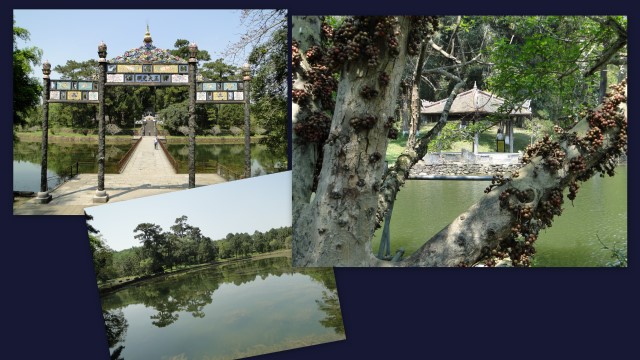
Minh Mang (1791-1841) and his grandson, Tu Duc (1829-1883),  2nd and 4th Nguyen emperors, created lush forested landscapes with paths, streams and lakes. It easy to feel comfortable here for eternity.

Tomb of Emperor Minh Mang - constructed 1841 - 43


the Tomb of Emperor Tu Duc - constructed 1864-67

Tu Duc spent many quiet hours in the Xung Khiem Pavillion (upper right, 1865) looking out on the lake and at the boat landing to the temple (bottom left) playing music and writing poetry. He was a prolific poet. The grounds contain a lovely tomb to his first wife, Empress Le Thien Anh, and burial spaces for many of his additional 103 wives.

(upper left) incense sticks for sale, (lower left) Mandarins to serve the Emperor in the afterlife, (lower right) protective Naga on the stairs to the burial chamber at Tu Duc

Khai Dinh (1885-1925) 12th. Nguyen Emperor, was less than 5 feet tall, slightly built and unpopular because of his Francophile leanings. In the 1924 play, The Bamboo Dragonby a young revolutionary, Ho Chi Minh, Khai Dinh was ridiculed for being all pomp and no substance, but he did knew how to impress.

The Emperor Khai Dinh's burial chamber: life size statue with jade sceptre

  Rather than spread out over a park-like setting, the compact tomb complex is built on top of a forested  hill surrounded by steep hills overlooking the Perfume River. The design elements are a fusion of traditional Vietnamese features with late 19th century French baroque. The exterior has a somber countanence because the palace was constructed in concrete made with the Perfume River’s volcanic gray sand so has leached a gray/black discoloration.

ancestor altar and exterior: Tomb of Khai Dinh
Emperor Khải Định (1885 - 1925)

Yet the interior is an explosion of gold, blues, reds, fuchsia, pinks, greens – all tile and glass mosaics covering every nook and cranny of the walls and ceilings. Dragons, birds, flowers, tables, vases, trees all are depicted in excruciating and fanciful detail, many in 3-dimensional compositions. The craftsmanship is unparallel for mosaic art glass. The Emperor reigned for only 9 years but it took 12 to build his tomb – 1920-1932. Khai Dinh died as he lived, over budget. A special tax had to be levied for the tomb’s completion.

details of the 3-D glass mosaics at Khai Dinh Tomb

The opulent tomb of Khai Dinh is the last in Vietnam’s Imperial history. His son, the Emperor Bao Dai (1913-1997) abdicated the throne in 1946 and died in exile in France. Perhaps it’s karma that the last tomb should be that of an unpopular monarch since the dynasty started out on that footing.

Emperor Gia Long

The first Nguyan Emperor, Gia Long (1762-1820) was fearless, feared and unpopular. He forced Vietnam’s feuding lords to bow to his unified empire, moved the capital from Hanoi to Hue, built the Imperial City and raised taxes to pay for it all. Worse, he gave France its first foothold in Indochina, a circumstance of war he later regretted but the nation never forgave. As the founder of an empire, Gia Long knew exactly the importance symbols were for dynastic continuity represented by the worship of Imperial ancestors – the fathers of the nation. His tomb set the pattern – constructing small versions of the Imperial City for the eternal pleasure of the souls of the nation.

Tomb of Gia Long

Ironically, his tomb is the furthest south of the city and even the taxi driver had to ask several times for directions. Stopping on a dusty street outside the dilapidated walls of a small old temple, I’m told to go through a creaking wooden gate. Walking across an empty dusty yard through another gate down a path alongside a farm plot I spy the virtual ruins of the great Emperor’s final resting place. It’s overgrown with weeds and the dogs are barking from the adjoining farm. I feel a pang of melancholy as I look out on the overgrown field and feel sorry that I didn’t visit the Tomb of Ho Chi Minh in Hanoi (although cremation, not mummification, was Ho’s last wish). Gia Long struggled against major odds, seeing most of his immediate family killed as a boy, before creating an empire he ruled till his death. Not much different than Ho Chi Minh. Yet even if Gia Long’s tomb is in disrepair, his ancestors, his descendents – and now those of Ho Chi Minh – are all part of Vietnam’s collective soul.

The Imperial and Forbidden Purple City of Hue – Vietnam

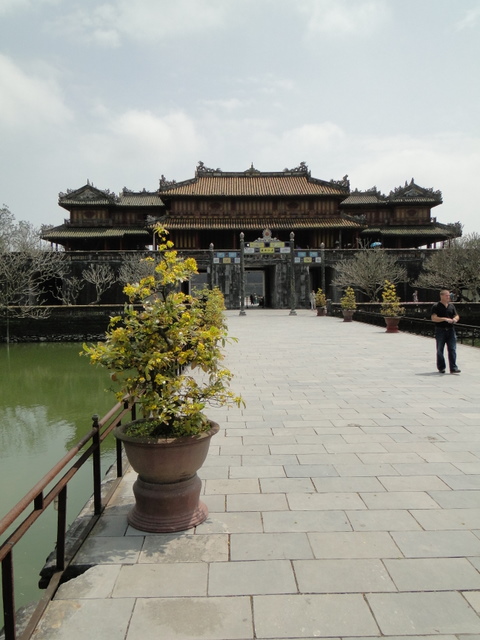
Ngo-Mon (Royal Gate) from Golden Water Bridge, Imperial City Hue (fortified citadel is beyond)

All respectable Vietnamese buildings based on Confucian design principles have an entrance gate  opening onto a small space backed by a freestanding wall – the Spirit Wall. To enter the courtyard one simply walked a short distance to the right or left around the wall. Easy for humans but not evil spirits who cannot sail through so effortlessly.  This would be especially useful for an imperial capital. The moat enclosed fortified walls of the 2-1/2 square mile Hue Imperial City was home to hundreds of buildings – palaces, temples, administrative offices and housing – lakes, gardens fountains and the Forbidden Purple City – home to the Imperial family. This vast complex was “Versailles” for the Nguyen Dynasty (1802-1946). After years of war wresting control from feudal lords, Gia Long, first Nguyen emperor, established the modern boundaries of Vietnam – fatefully, with a little help from the French.  Yet even double gates and fortified walls could not prevent floods, nor could meticulous planning under Confucian principles protect from bombs and artillery. Tempered by this reality, what remains of the vast UNESCO World Heritage Site with its ongoing restoration is beautiful, serene and haunting.

Wandering freely, after paying the admission of US$2.50 at the inner Ngo-Mon Gate, through palaces, gardens, ruins under restoration, past breathtaking decorated gates and crumbling walls, what struck me was the modern Vietnamese attitude toward the Imperial City. No matter that not all Nguyen family members were fondly remembered – to say the least – this was still the shrine to 144 years of national ancestors and therefore sacred ground. Even the 1933 tennis court of the last Emperor, playboy Bao Dai is being restored.  The descriptions – written in French, English and Vietnamese – for the extensively restored Dien Tho Palace complex is nearly reverential.

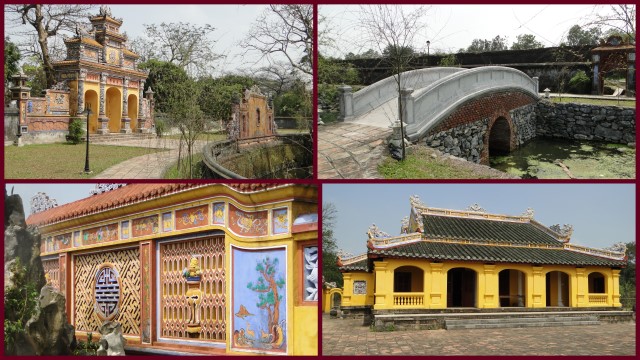
Dien Tho Palace (upper) gate with spirit wall, garden bridge, (bottom) detail of a garden wall, one of several palaces within the complex

Sadly there isn’t an army of restoration workers on site. Despite UNESCO designation, the projects are vast, requiring research, meticulous craftsmanship and lots of money. Germany and Japan are actively contributing to several current projects. Maintenance alone is a daunting task – this is 2-1/2 square miles of monuments.

restoration projects


The 1968 Tet Offensive during the Vietnam War (locally known as the American War) inflicted severe damage on the Imperial City, yet there are no vitriolic nationalist slogans, just a sober plaque describing the skeletal remains of a palace building within the Forbidden Purple City (bottom left).

1968 Imperial City war damage and open land where structures once stood

Yet there are always the reminders that this is Vietnam where the practical tasks of everyday life are as important in Confucian thought as the lofty actions of State. Laundry drying on the Imperial City’s walled moat? As long as it’s feng shui…

not airing the Imperial family laundry

Shui-mo painting alive: Halong Bay, Vietnam

(left) Halong Bay, (right) watercolor in the Shui-mo style

Have you ever wished you could live in a postcard? You can if you cruise the UNESCO World Heritage Site of Halong Bay. Situated on Vietnam’s north east coast, it has been an important player in the nation’s history and economy for over a millennium. It doesn’t hurt being one of the most beautiful sites on the planet.

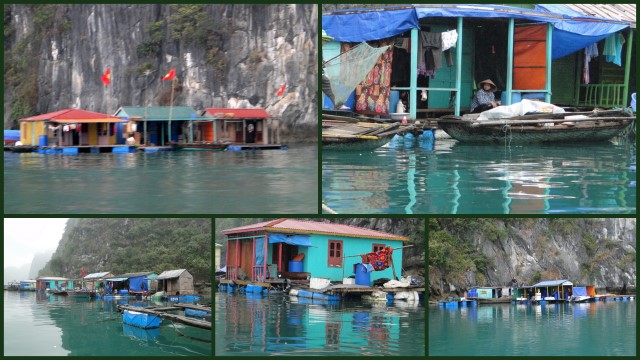
Hundreds of limestone island mountains have been sculpted by centuries of erosion. The bay itself opens to the Gulf of Tonkin, the port of Ha Phong and the vast Pacific. It has been an artery of wealth for Hanoi and north Vietnam, as well as the cultured pearl capital of the country. The bay, like so many expanses of water in Southeast Asia, contains floating villages. Unlike floating villages on lakes, Halong Bay’s are not as polluted or dangerous for residents, although the average family wage is less than US$800/year – owning your own floating house can run 20X that amount.

floating village of Halong Bay

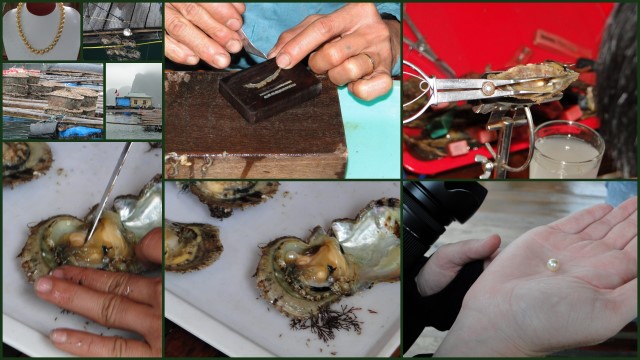
The main occupation is cultured pearl farming and it’s an extraordinary art. A thin slice of the oyster’s skin is dissected under microscopic glasses and transformed into “seeds” that are surgically inserted into the live oyster. Several seeds may be implanted in one oyster, but, after 3 to 7 years gestation – depending on the type and color – less than 20% will ever produce gem quality pearls. Packed in baskets suspended from bamboo floats, this important crop waits for the luxury world beyond.

(left) $US1,000 gold cultured pearl necklace, village oyster baskets and farming docks, seed pearls, inserting seed pearl, (bottom) extracting pearl

Prior to the Indochina wars that ravaged Vietnam during the 20th century, Halong Bay’s limestone islands provided shelter for villages and isolated Confucian and Buddhist retreats. During the war they served as protection from air raids and today they are fascinating caves for everyone to explore. Several caves have been transformed into “tourist-friendly” sites complete with guides and dramatic multi-color theater lighting illuminating an otherworldly scene that takes on the look of an “otherworldly tourist attraction” – shapes of hanging feet, a large erection.. etc. (I keep on saying – the truth – that Southeast Asians are playful and NOT dour.) It’s fun to walk through the caves.
(top left) Chinese charactors for “the world outside”, (bottom left)  the giant penis of Halong Bay’s Hang Hanh cave.
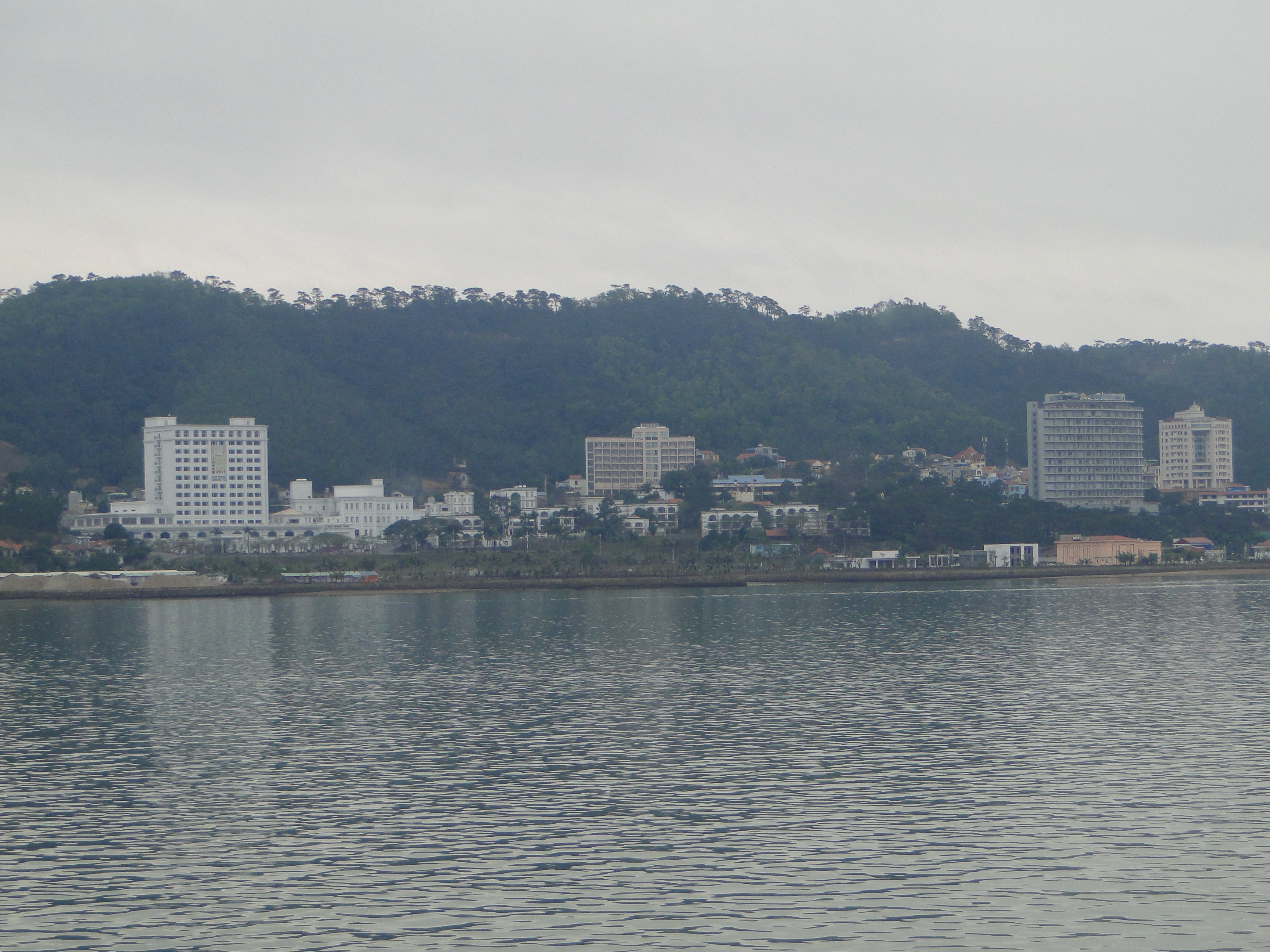
Halong City

Halong Bay’s a year round destination but summer is its high season. March was still chilly and damp but added a mystical mist to the entire scene. There are islands that have summer beaches and there are a variety of ways to visit the bay. The most popular is by taking an overnight cruise on a small Chinese Junk-style ship carrying between 10 – 35 passengers. From the port of Halong City, the ships sail into the center of the bay – about one hour – and anchor. From there passengers are ferried to the floating villages, pearl farms, caves, kayaking through caves and to beaches. There are over 400 ships that ply the bay ranging from small day-trip boats to “luxury” cruise junks. I place the word “luxury” in quotes because it’s difficult to determine beforehand which ships fit that description. Our ship, the Hanoi Opera, booked through the highly recommended Explorer Tours, was a fine ship carrying 20+ passengers but whose beds were designed for ascetic monks – the futon mattress was perhaps 1.5 inches thick to be generous. Paying $US420/couple for 2 nights to sleep on a wooden pallet was very uncomfortable. We discovered that there were many other ships that offered a higher level of comfort at less cost. Having researched the options for a month before booking the cruise, and after extensive conversations with fellow travelers, I would not recommend booking ahead. With so many ships available for tours, the best options are: (1) stay overnight in Halong City and take a day excursion on the bay, or (2) stay overnight in Halong City and check out the overnight ships to see which ones offer real beds. A one-night cruise is sufficient and should run around US$150 – $165/couple, including meals.

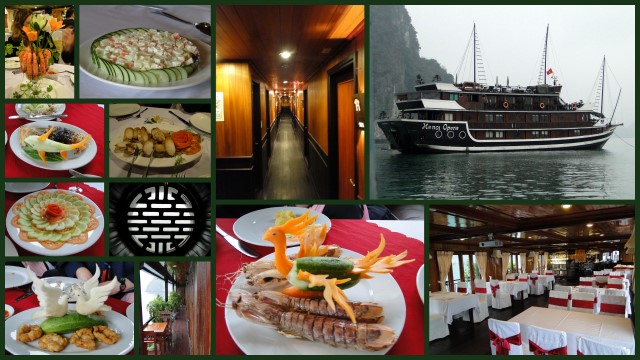
Hanoi Opera Ship: the dining room takes pride in garde manger

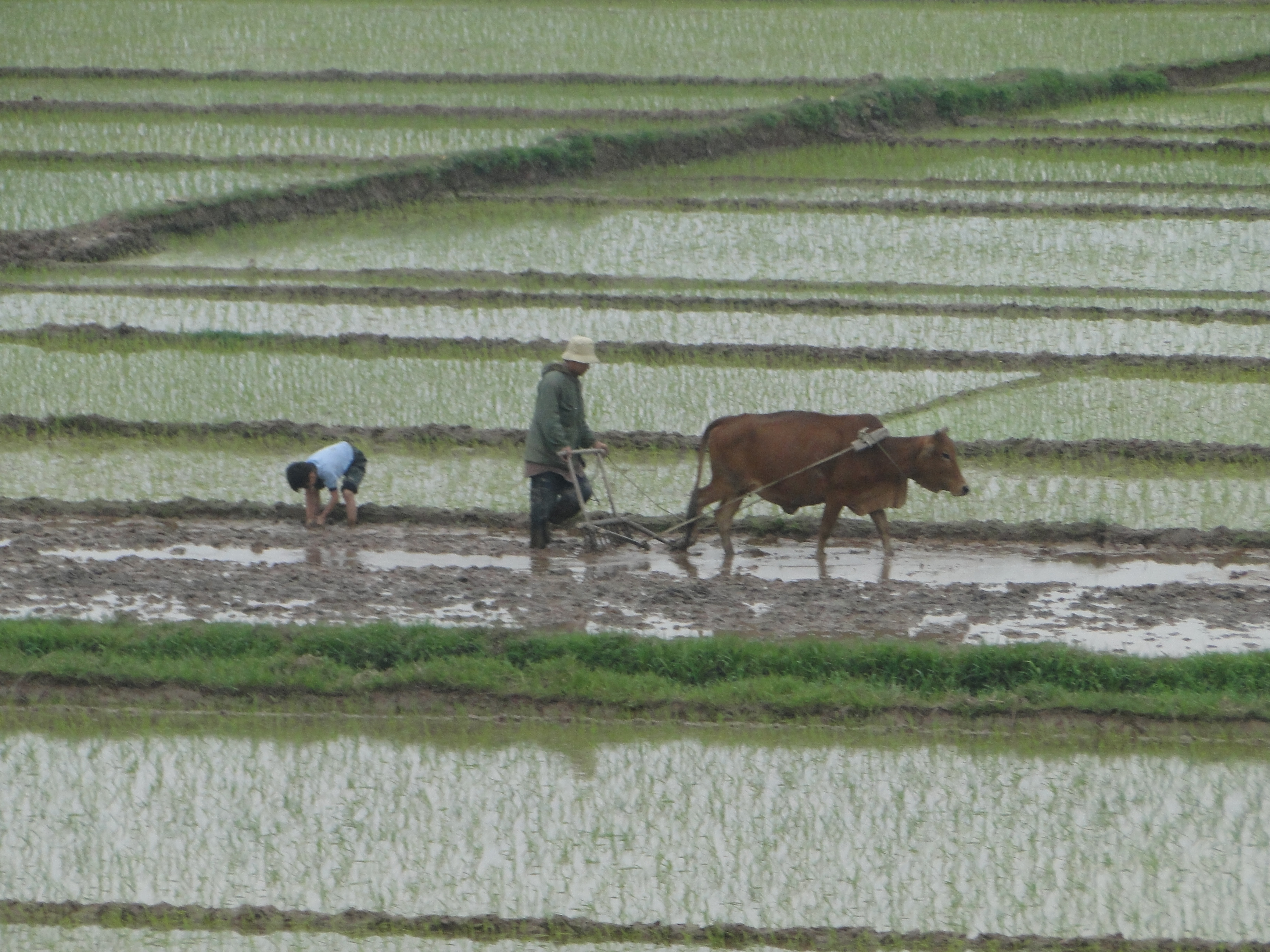
The three hour bus trip from Hanoi to the Bay – included in the cruise fare – was equally interesting. Although not comfortable given the condition of Vietnamese roads, passing through rural countryside and old villages undergoing rapid middle-class changes was enlightening. Rice paddies with Water Buffalo pulling wooden plows are next to French/Vietnamese style “McMansions” of  affluent Vietnamese. Anyone owning a house more than 9 feet wide is affluent since ancient real estate tax laws dictate high levies on any structure wider – although depth and height are excluded. Catholic churches towered over Confucian and Buddhist temples. Trash, dust and too much traffic for the narrow roads was typical. Nineteenth century farming and building techniques were side-by-side with 21st century office buildings, truck dealers and technical schools.

9′ wide house, vegetable plots &  rice paddies, bamboo canes for beans, cemetaries in rice paddies, a Catholic church, a Vietnamese mansion

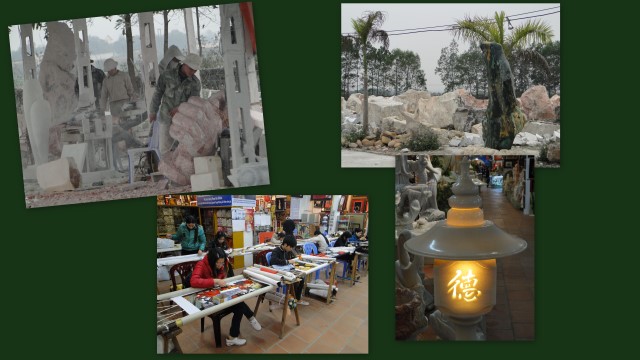
Of course, the bus does make a shopping stop at a stone carving studio. Vietnam has an abundance of both limestone and marble. Hand-made marble carvings, especially garden fountains and statues, in sizes that are quite large, are available and shipping can be arranged – don’t look for bargains, these are top-of-the-line. Silk embroidery – some of it quite fine – is an art that frequently employs the disabled and is widely available, as well as jewelry and women’s ready-to-wear clothing – as long as you’re a size 8 or less.

The Ta Prohm Strangler

copyright: www.travelpenandpalate.com

The ceiling fan stirs the languid air as mosquitoes flirt in the shadows of verdant ferns and orchids. Roosters compete with motor bikes to break the dawn. The gray/pink haze illuminates the dust laden street with its fading blue and red tin roofed houses. A young man in his 20’s, shirtless, in red shorts, barefoot, opens a creaking gate to drag the motor bike out of the night-time safety of his house. He pauses, takes in the day – a day just like yesterday – the sun will break through and life will steam.

I sit on the rattan chair at the small dining table, close to the window away from the fluorescent ceiling lights and their harsh pools of blue/white light. The coffee is black, thick and sweetened with condensed milk, just as everyone in this ancient kingdom likes it – except me.

Other guests filter down the wide wooden staircase during the morning. Given the heat, humidity and sugar high from the coffee, I easily imagine a veritable cornucopia of characters from any number of 20th century expat-in-the-tropics novels. The fit German couple in the corner table – early 50’s but have that trekkers’ older look – bussed it overnight from the capital, 12 hours, no air-conditioning. I’ve been warned the overnight busses are not wise – theft, bandits, drivers falling asleep, other accidents. Relaxed they were with their pineapple juice, coffee and toast; they’ve faced worst dangers (?). There’s the eager well-scrubbed English 20-something travel companions planning their one-day schedule to see 14 temples, naive to the toll the jungle will take by temple # 3. The sullen early middle-aged North American couple, skin already too red from the sun,  start the day badly due to the eggs (they were oddly undercooked in some sort of fat and sprinkled with ground cinnamon). Yet even though $20/night is nothing to spend on a hotel – ok, weak a/c, weaker WiFi and it’s the third world – it should include… Perhaps he needs to ask the Ta Prohm Strangler what life in the jungle should include.

Royal Residence of the King of Cambodia in Siem Reap

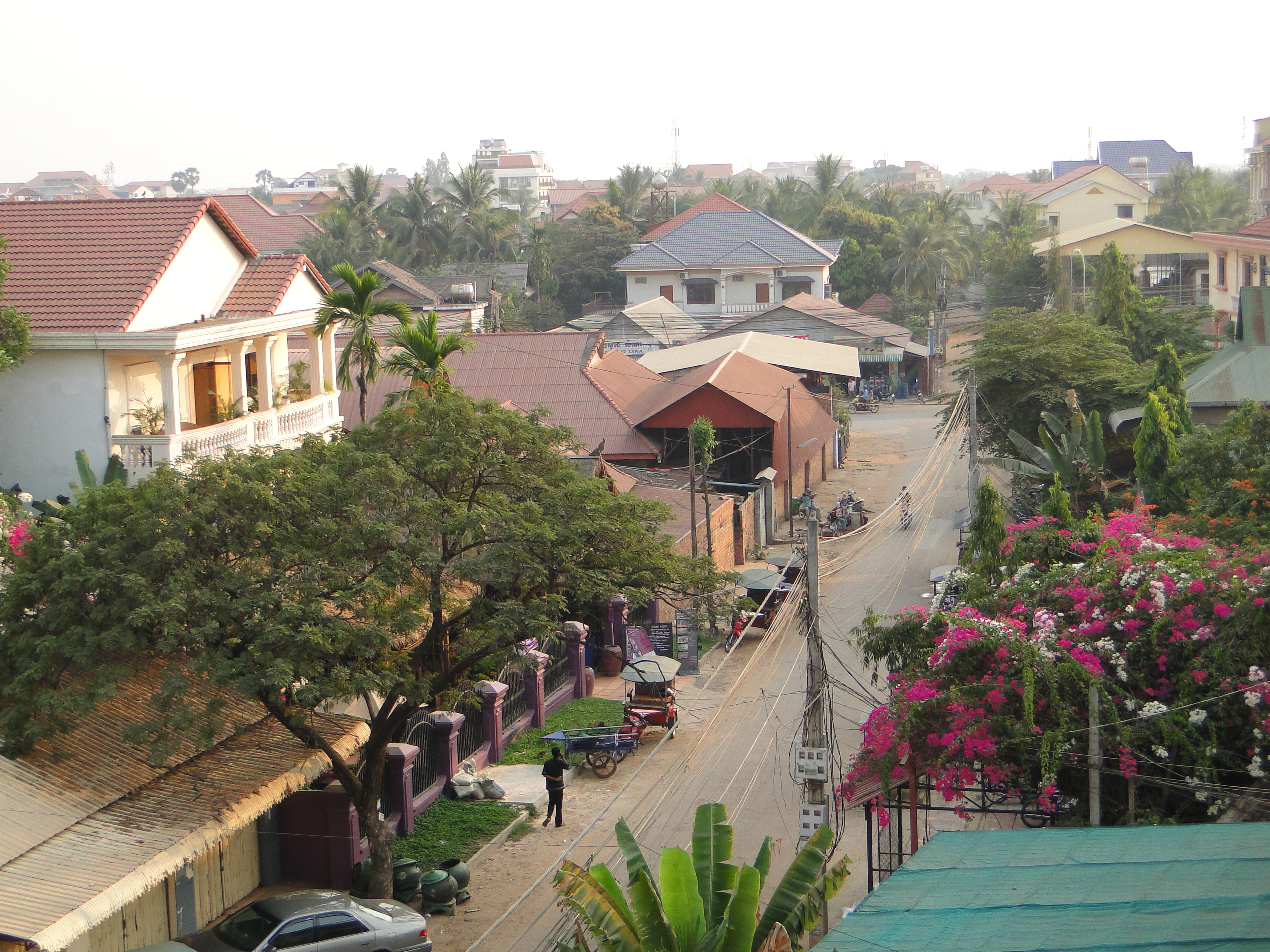
Siem Reap, Cambodia, is not far from the 19th century. Just outside the town are dusty small villages still in that time warp.   French annexation of the Angkor Wat region over a century ago assured its discovery as one of Earth’s great man-made sites, and Siem Reap developed a modest tourist industry. A few elegant hotels, such as the 1929 Grand Hotel d’Ankor, guest houses and a very modest Royal Residence were sprinkled on tree-lined streets in what was just a large village.

Grand Hotel d’Ankor (1929)

The survival of Angkor, and Siem Reap, through World War II, the French Indochina War, the Vietnam War, Pol Pot and the civil war (total war years: 1939 -1989) is miraculous although like all urban areas, the town and its population suffered greatly. Yet what is Siem Reap without Angkor, what is Angkor without the Khmer Empire, and what is empire without war?

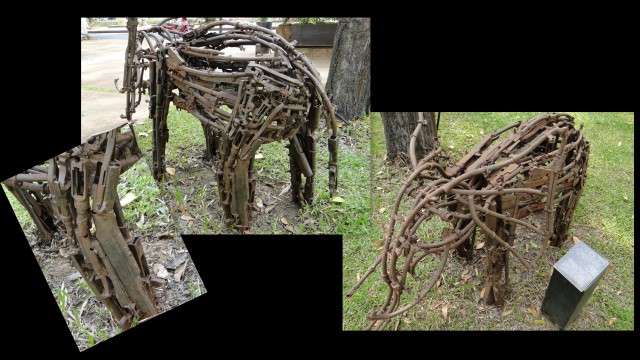
Mother Elephant, sculpture, the Peace Art Project, made from decommissioned weapons

The meters of bas-relief carved on many walls of the over 200 temple complexes at Angkor Thom tell the story that this was the center of an empire – political, military, economic and religious – as well as the home to thousands of people for hundreds of years. Since 1989, stability under the restored monarchy has made tourism safe again at Angkor. Still, visiting the UNESCO site at night is neither allowed nor advisable. Driving, or even being driven, at night for any long distance in rural areas outside Siem Reap is not a good idea. Bus travel to the Lao border a couple hundred miles north can take a full day. It has been this way for hundreds of years, ever since the Khmer Empire moved its capital south and the Ta Prohm Strangler moved in.

the Bayon (early 13th century)

The expansionist Thais of Siam put an end to the westward growth of the Khmers in the 15th century by sacking and eventually occupying most of the Empire’s capital at Angkor Thom. Then the French took it from the Thais (1907) and gave it back to the new Khmer kingdom of Cambodia (under their “protection”). Except there’s still this issue over the 11th century Preah Vihear temple right on the border created after the French annexed the land so…

Monk did get cigarette lite

Siem Reap exploded during the last decade developing from a modest town into a chaotic jumble of village/tacky/new high-end without sufficient infrastructure. A new strip of luxury resort hotels, lining the road from the airport to town, seriously serving bus tours, seem incongruous interspersed with rice paddies and no beach. The old French Quarter’s charm is hidden behind questionable electrical lines and examples of exuberant marketing.

Dusty unpaved roads with small houses and even smaller tailor shops, fruit stands and tall narrow guest houses intersect with a boulevard and the ATM across the street. The night-time scene is classic: locals hawking cheap wares while children watch TV on someone’s laptop, “tuk-tuk? where are you going?” the smells of grilled meat and humid air, music thumping from dozens of open bar/restaurants, “2 dollars foot message?”  lights of all shapes and colors illuminating a kaleidoscope of swirling Australians, French and Japanese  dodging the motor bikes and tuk-tuks. The gods and demons of ancient  Angkor would prefer if Siem Reap was grander, but I’m confident they’d approve the activity – after all, it is once again Cambodia’s cash cow. Could the Strangler be failing?

reviving traditional crafts, training the disadvantaged: the non-profit Artisans d’Angkor

Creating a sustainable economy is difficult in a region both exhausted by strife and whose fame is based on ruins. Artisans d’Angkor operates both training facilities and retail outlets for high-end traditional Khmer silk, wood and stone arts and crafts. Training those with special physical needs is part of their mission as well. Touring both the craft shops and the silk farm is instructive and a pleasant break from tracking down the Ta Prohm Strangler.

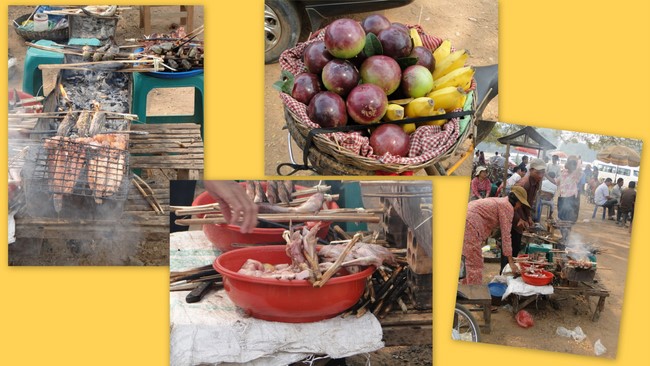
(top left) palm fruit, (center) boiling palm fruit juice, (bottom left) palm brown and white sugar, (top right) Palm Juice Drink: sweetened palm syrup & water in bamboo cups

Southeast Asians eat all the time – a grilled banana, nibble fresh pineapple, sip some cane juice, a fresh baked fish in salt, a coke, a few dried strawberries. There’s always food, and no one’s fat. Yet KFC’s here and Australian beef burgers but so are frog’s legs and sautéed freshly picked morning glory greens from the river bank.

(Left) grilling fish and poultry on aromatic wood holders within Angkor UNESCO World Heritage Site
Siem Reap River: cafe, hand-made silk fashions and Temples (click to enlarge picture)

There’s a quiet side, the banks of the Siem Reap River. The town’s best restaurant and small hotel, Bopha, is located at 512 Acharsva Street facing the east bank. It’s a haven of calm with rooms and the restaurant surrounding and within several lush tropical garden courtyards. A private pool adds to the relaxation of spending less than $US60/double and US$20/couple for haute Khmer cuisine (US$10-20/wine).

Bopha: (top from left) baked fish, green papaya and chicken salad (bottom from left) steamed rice and grilled pork with crispy noodles

The lure is still the past – the Royal City of Angkor Thom, the vast complex of 243 temple cities once populated with over one million people ruling an empire covering much of present day Southeast Asia. Started by Khmer kings and Hindu priests in the 9th century, reaching its zenith in the 13th as the capital of a Buddhist empire, sacked by the Thais in the 15th century, it has been sustained and ultimately saved by monks from the strangulation of neglect, changing politics, wars and the jungle.

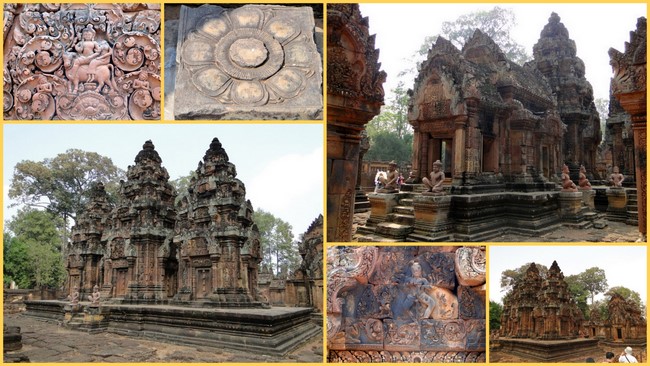
Banteay Srei, 12th century “women’s temple” built several miles from the Royal City of Angkor Thom

The Strangler Fig (strangler vine to the locals) sends dozens of roots deep into the ground around rocks and buildings for hundreds of feet. It encases and crushes whatever it encounters. To kill the vine, all roots must be severed. To restore a temple, the vines must be killed.

A metaphor for the restored Khmer Kingdom of Cambodia? Can all the destructive roots of the past 500 years be severed and the orderly, yet bloody, grandeur of nationhood be reborn? Or will Siem Reap be a new Khmer model: play it day-by-day, see what happens, hope, sweat and keep the Ta Prohm Strangler at bay.

Strangler Fig (Vine) at Wat Ta Prohm

Palace, Temple, Farmer’s House: Chiang Mai


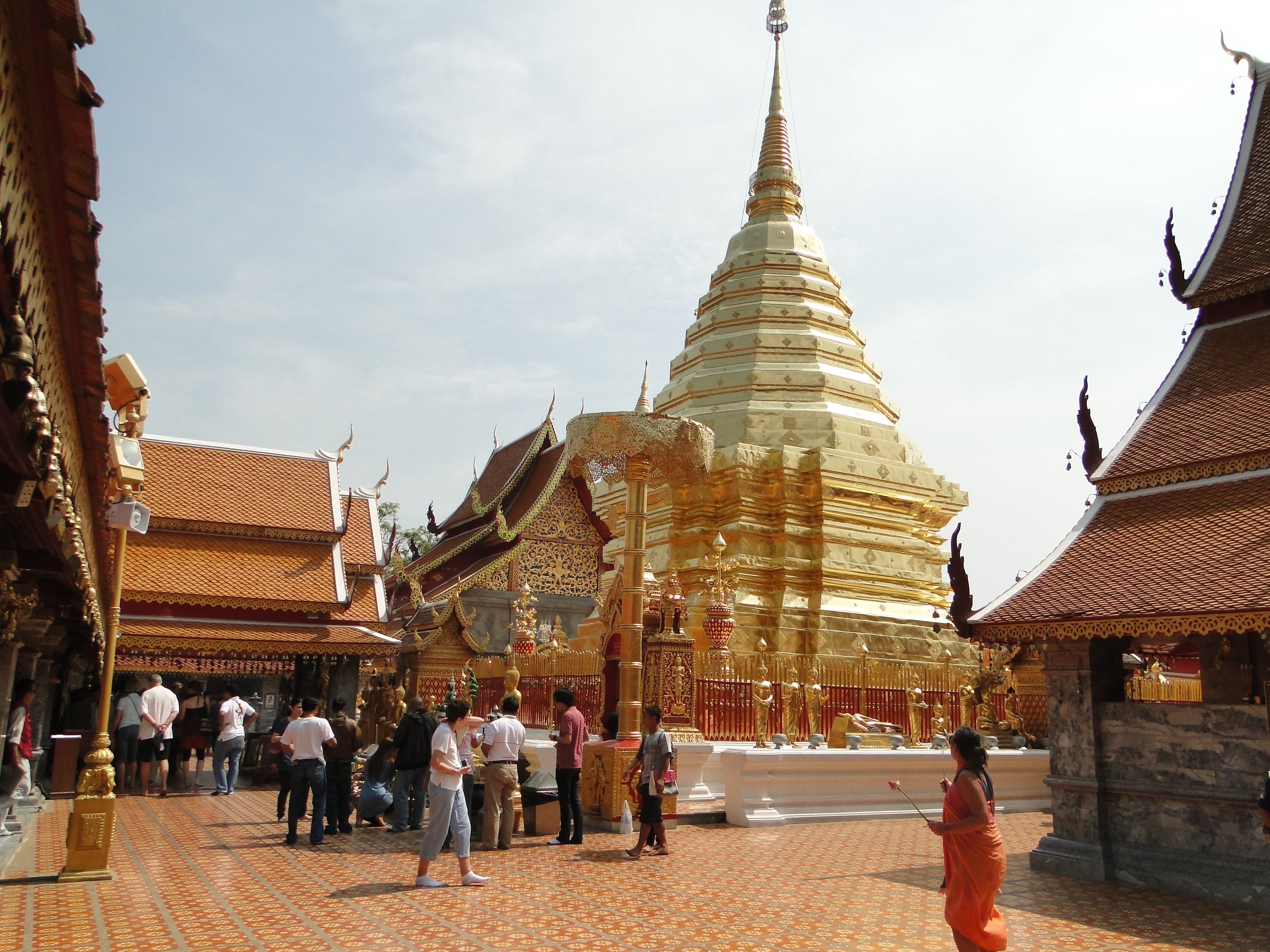
Chiang Mai from Doi Inthanon National Park (right) Symbol of the Nation: PHRATHAT DOI SUTHEP

Chiang Mai in a muggy late February haze: the ancient, once fortified, city still sits surrounded by a watery moat and the highest mountains in Thailand.  The hills provided vantage points warning of potential invasions from its arch-enemy, the Burmese (and their Thai cousins from Ayutthaya in the south). Yet the Ping River  that nourishes the valley’s abundant agriculture inexorably continues its cycle of – all too frequent for some – annual floods.

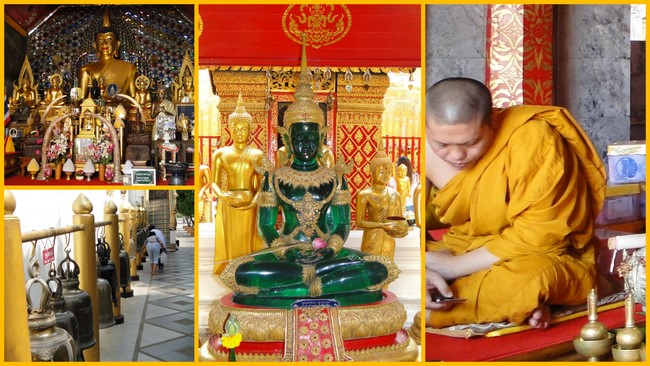
prayer, cash offerings,, gongs and frescos
Wat Phrathat Doi Suthep

It’s no wonder that one of Thailand’s most sacred Buddhist temples (site selected by a White Elephant and whose golden chedi emblazons the Royal Standard) should top one of these mountains.  Wat Phrathat Doi Suthep’s founding dates from the late 14th century. Inside the temple grounds, visitors must remove their shoes (like all temples the interior is immaculate) and must be appropriately dressed – no shorts, short skirts, sleeveless blouse or shirt. Within the site are pagodas, statues, bells and shrines displaying the eclectic mix of Hindu/Buddhist craftsmanship common in Thailand. Tourism and worship, even texting, blends seemlessly within the atmosphere of common respect temples generate.

Wat Phrathat Doi Suthep: replica of Bangkok's Emerald Buddha

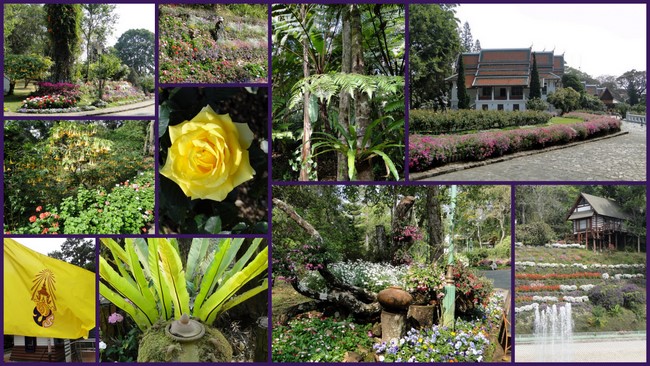
Bhubing Palace is only a few miles from the Wat. Both are less than an hour’s drive up scenic Mount Doi Suthep through Doi Inthanon National Park (offering great outdoor activity potential). The extensive Palace gardens run the gamut from common perennials to roses, orchids and a tropical rain forest yet all are seemlessly blended within the natural landscape by a small army of professional gardeners. The gardens are open to the public whenever members of the Royal Family are not in residence (information is available through your hotel or the tourist offices in the city). The Palace itself is rather modest reflecting its role as a home to get away from it all. Bhubing Palace is a popular site for foreign and Thai tourists, and with Chiang Mai’s position next to ethnic hill tribes, there’s often a colorful mix of clothing.

Bhubing Palace and gardens, (bottom left) the Royal Standard

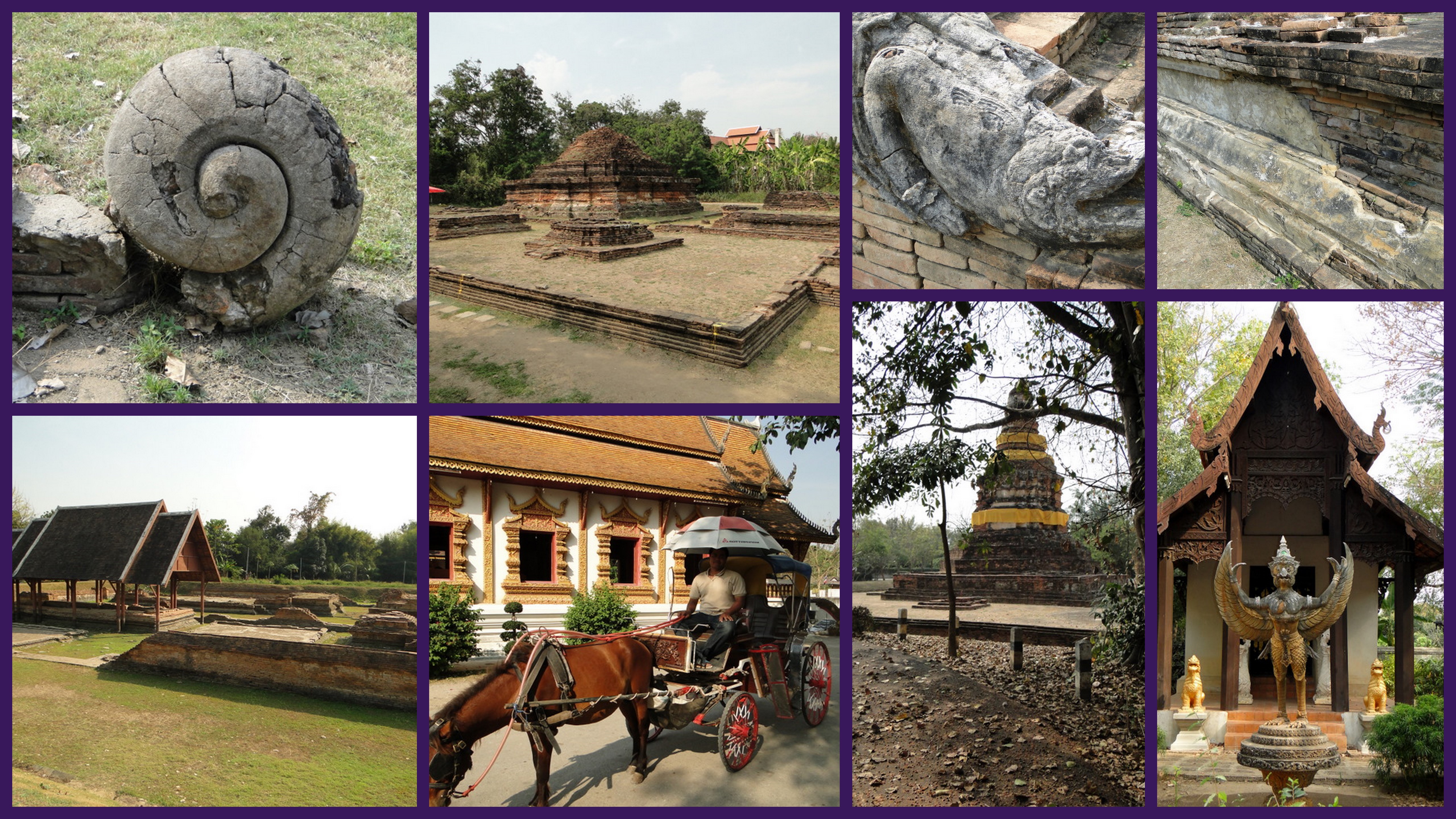
Wiang Kum Kam had been a Buddhist settlement long before the late 13t century when it was chosen as the first capital for King Mangrai’s Lanna Kingdom (Kingdom of Million Rice Fields: 13th – 18th centuries).  Yet frequent flooding caused even the King to move – Chiang Mai. With its rural complex of 20 temples and chedi, Wiang Kum Kam remained important throughout the Lanna period, but repeated assaults by the course-changing Ping River forced most of the temples to be abandoned during the 15th century.

examples of the temple complex at Wiang Kum Kam: (bottom center: horse cart with driver/guide at Wat Chedi Liam, the Chedi of Wat E-Kang, Wat Chang Kum - one of 2 operating temple sites - with the god Garuda.

With assistance from UNESCO, archeological excavations started in the 1980’s removing on average 3 – 4 feet (1 – 1.3 meters) of mud and silt deposited over the past 500 years. With on-going restoration and preservation, Wiang Kum Kam is an historical park. Surrounded by village houses and deep green rice paddies, you understand the allure of the rural countryside when crickets, birds, locust and the sound of  horse’s hooves are louder in the hot humid air than any man made noise. 

Wat Chedi Liam

The ideal method for touring Wiang Kum Kam is by horse carriage. For less than US$5-7.00(inc. a tip) with driver/guide, a couple to 3 can tour the lost city in a style that adds to its sense of time-warp, despite its location only 5 miles south of Chiang Mai.  Many of the sites are mere ruins yet a closer look reveals stories in the fragments – decorative carvings of sea snails as stair rails, sea monsters or evidence of mortar covering thick, wide brick construction.  The Wat Chedi Liam is the starting/ending point for the carriages. Remarkably, this Wat survived the destructive floods over the centuries and has remained a living temple.
19th/early 20th century properous farmer's elevated house and barn

Moved and restored, the 19th/early 20th century farmers elevated house and barn is a fine example of life for many people in Wieng Kum Kam over the past 1500 years. Constructed almost entirely of light but flexible bamboo, including flooring, these elevated structures prevented both unwanted animals and moderate flooding from doing major damage to the home. Rice and grains were stored in the upper floor of the barn along with light tools, while larger tools remained on the open ground floor.

at the Winter Palace gardens

The Hmong, Yao, Lahu, Akha and Karen (otherwise known as the long neck people) are collectively the ancient hill tribes speaking pre-Lanna/Thai languages. Comprising nearly 15% of the Chiang Mai area’s population and known for their craft skills, they’ve become somewhat a tourist attraction. Standard tours to villages frequently are nothing more than staged shopping trips. Check around for alternative tours or best option is to arrange through your hotel a private car/driver/tour guide. This allows for custom designed touring avoiding what’s obviously staged and explotative. Cost for a 7 – 8 hour day average US$40/60 depending on itinerary. It’s the most comfortable way to travel as well.
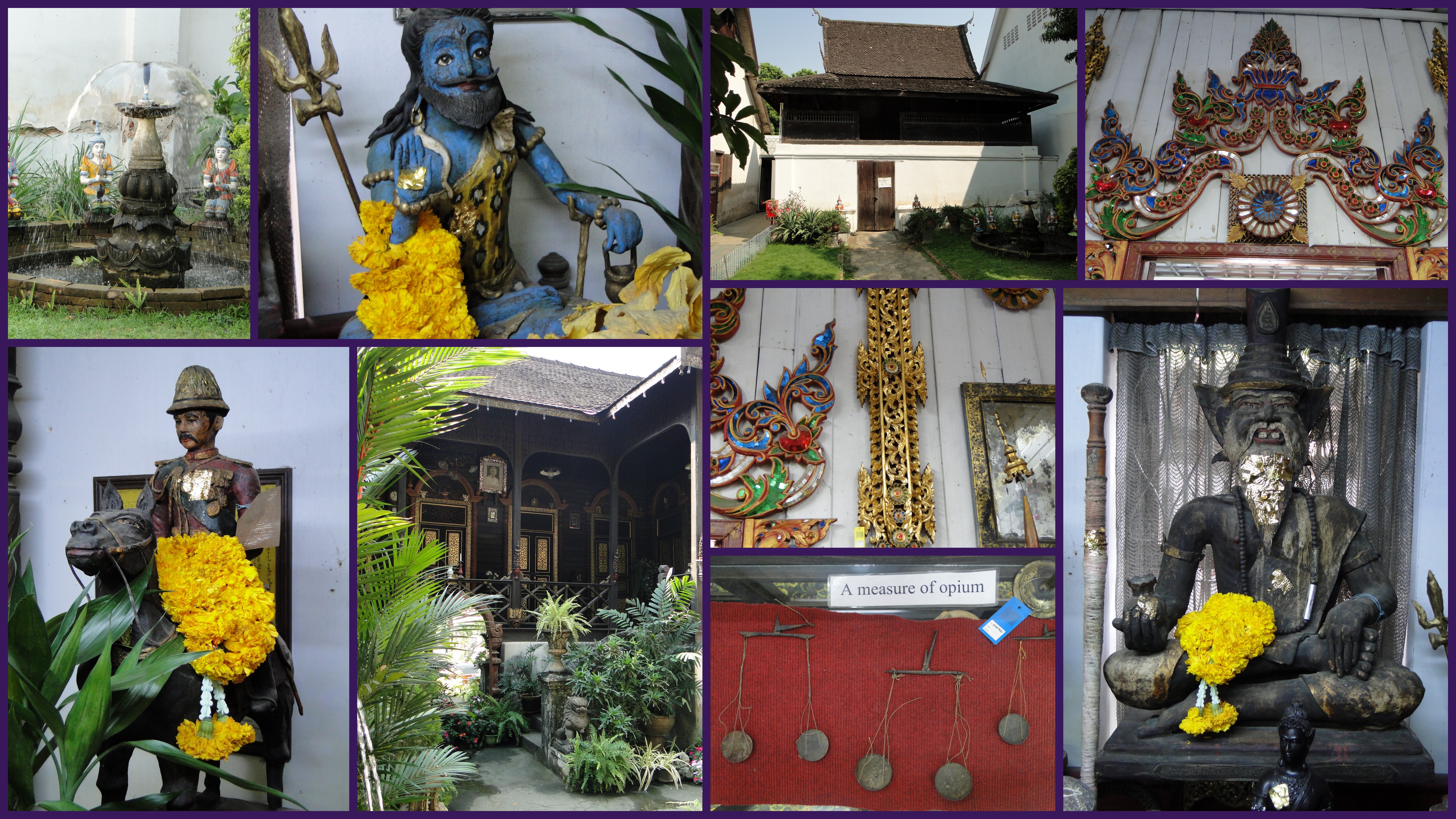
(Top from left) fountain w/children in prayer, Shiva - late 19th c., the Buddhist Scripture Hall/library - 1878 - built and funded by generations of local Chinese-Thai families, (center & top right) decorative temple elements of multi-colored mirrors, mother-of-perals inlay, (bottom from left) statue of a 19th c. officier on horseback, entrance to Wat Gate Ket Karem Museum - late 18th century monks residences, measures for opium, Narod the Hermit (19th c. in wood) the Hindu father of witchcraft
Prince Damrong Rajanpub

On the ethnically diverse east bank of the Ping River is the venerable temple, monastery and school complex of Wat Gate Ket Karem and its museum. Established within the past decade in a renovated 19th century wooden building on the temple grounds, the museum is the gift of “Uncle Jack” Jarin Bain, an octogenarian who can still be seen offering his services as a docent. Many of the artifacts and collectables were acquired by an early 20th century German expat business man. A major source of knowledge on the artifacts come from the extensive writings of Prince Damrong Rajanpub (1862-1943) regarded as the father of Thai archaeology and history. In 1962 this 57th son of King Rama IV (1804-1868) was selected by UNESCO for its World’s Most Important Person’s List.

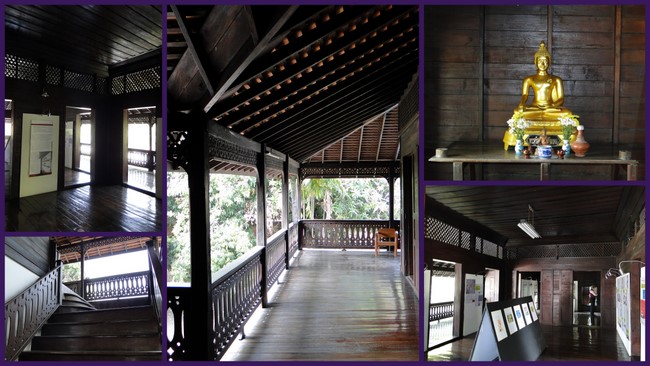
The Lanna Architectural Center’s  Khum Chai Burirat house (1893/early 20th century renovations) is not only a fitting site for a museum of pre-20th century Thai architecture, but an excellent example of  “ruen kalae” or mansion style. An extension of Lanna University’s  architecture department, the house-museum is free and open most days. Sitting in a walled park just blocks from the Old City, Khum Chai Burirat house was donated to the University. The smooth highly polished teak hardwood, Buddhist chapel, curved main staircase, wide covered 2nd floor wraparound porch and wood lace decorative touches tell of a time when buildings compensated for the hot climate rather than attempted control. That rarely works; just ask the Ping River.

Lanna Architecture Center, Ratchadamnoen Road, at the junction with Phra Pok Klao Road

Chicken Feet to iPods: The Markets of Chiang Mai

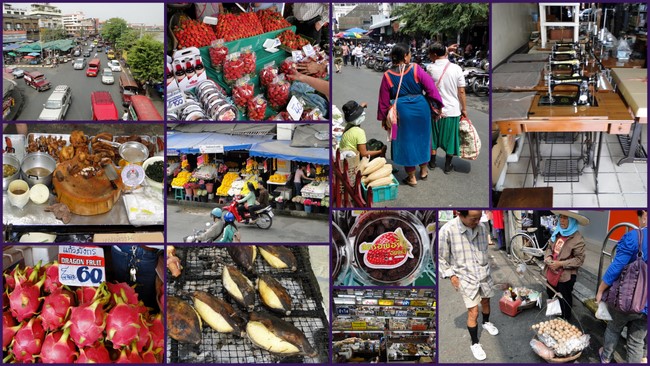
Chinatown Market in Chiang Mai

A quintessential Chinatown – winding narrow streets packed with people, motor vehicles and wooden carts, the ornate red and gilt gate, the smells of grilled meat and steaming soups, the sellers of dragon fruit, dried strawberries and grilled bananas, whole plucked chickens and spotted eggs, smoked ducks and dried fish, sunglasses, Apple iPods, Nike logo T-Shirts, apartment size refrigerators. Expect this isn’t part of San Francisco or New York; this is in Chiang Mai, the Kingdom of Thailand’s second largest city.

Confucian temple in Chinatown market

The Chinese have been investing in Southeast Asia long before its current economic boom. Since the 13th century they have been a major presence in the city on both sides of the Ping River. The market on the west bank is jammed with hundreds of vendors both in large indoor markets and nearly every square inch of the sidewalks selling literally, just about everything.

Chiang Mai, like many Southeast Asian cities, offer an abundance of shops offering custom-made clothing and shoes. Often high quality clothing can be made within 24 to 36 hours. Shops offering “2-hour” service  make me question the quality of the product. The best shops offer a sizable selection of high quality materials and well designed clothing displayed on many mannequins giving you that essential “gut” feeling of confidence. The process of cloth selection, design choices, measurement and a minimum of two fittings, as well as good craftmanship, takes time (and if the store’s good they’re also busy). I was not aware that most of the sewing is accomplished using treadle machines – real hand/foot-made. It makes sense in a region of the world where power outages can be common and demand for the products are high. High quality custom hand-made clothing can frequently range 60 – 75% less than comparable ready-to-wear clothing in North America or Europe.

new Penguin treadle sewing machines for sale

No Southeast Asian city has only one market and that is certainly true of Chiang Mai. Starting at the Thapae Gate and running the length of cobble stoned  Ratchadamnoen Road through the heart of the Old City, Chiang Mai’s Sunday Night Market is a major attraction for both locals and visitors alike. The street is closed to traffic its entire length from 5:00 PM to midnight, but that does not mean a lack of congestion, except this time its only people.

The Sunday Night Market

  Although touted as a venue to find quality handmade crafts I did not find this true. Most of the “crafts” were the same low quality souvenir trinkets found in abundance everywhere albeit with some imaginative displays such as the heart made of rice with inexpensive earrings on top. The market is more important as a citywide social gathering  mixing expats, tourist and all age groups of locals. There’s  traditional street food foods grilling and simmering and deserts rarely found on North American Thai menus. Try creamy sweetened steamed rice blended with banana, melon or pumpkin wrapped in a banana leaf cone (bottom center) or (bottom right) Kaw Tom Mud – sticky rice with sweetened coconut milk and banana or soy bean paste wrapped in a banana leaf package. Both are delicious. Most restaurants on this major Old City road are open late and become part of the market scene considering that with warm/hot evenings outside seating is common. Some of the oldest Buddhist Temples are open and beautiful to see at night.

Lights, live music and lots of sounds, aromas, colors, children scurrying about, yet there are  poignant reminders of wars that past generations endured. A group of elderly musicians, playing traditional music. were raising funds for victims of land mines. The soft music and chants were in sharp contrast to the riot of noise in the market, but the real impact was the reality that the musicians were all land mine victim survivors. The yin and yang of reality, it’s all in the Sunday Night Market.

Night Market

The Night Market is 7 days a week 5:00 PM – Midnight (not trafffic free) and is the real center of northern Thailand’s handmade crafts. Occupying a permanent space on the west bank of the Ping River just a couple blocks south of the Iron Bridge (great night-time views walking over the Ping River – there are sidewalks on the bridge), the market space has permanent shops, stalls, open air restaurants and live music on a central stage. Fine quality silks and decently made cotton and linen clothing are in abundance (I bought a pair of well made linen pants and a linen shirt – $10US total). Wood carvings, marionette puppets (a beloved craft), cut leather art works, some imaginative jewelry, an eclectic selection of old and new decorative art, lots of bright lamps, more smoked ducks – a lot of goods available. Of course there’s the food, and at the Night Market, fish and seafood are a specialty.

Night Market seafood: choose the item you want the restaurant to prepare

Giant prawns – as large as lobster tails –  sea snails, calamari, oysters, a variety of fresh fish – many still swimming – Pacific lobsters and crabs are all available. A customer chooses exactly the specimen and quantity they want and pay by weight. The cost? Less than a third what it would be in North America or Europe. The preparation? Grilled with garlic and fresh herbs, steamed and added to an entrée salad with cucumbers, tomatoes and fresh herbs, stir-fried with fresh vegetables and/or a variety of mushrooms, deep-fat fried tempura style – you can decide, you can create. Add an ice-cold local beer and enjoy the warm night.

After dinner perhaps you’ll want a massage – outdoors (I didn’t so I can’t comment on their quality). A foot massage  may cost $2.00US (30 – 60 minutes) whereas a Thai massage – more like an hour on the rack without death – does limber your muscles and may cost as much as $7.00US/hour. Gentler Swedish or Shiatsu methods are available if you don’t want to plunge too soon into a Thai massage. Or how about tiny little fish nibbling on your feet and legs? I didn’t try it – return trip – but devotees swear that it not only feels terrific, it’s more effective than a pumice stone – and I guess fun…

Night Market massages

(Next: Chiang Mai Part 3 – attractions in the countryside)

PS: (1) spicy chicken feet are akin to chicken wings and summer b-b-q season’s soon.

(2) take normal precaution eating raw foods in a hot, humid climate.

Buddha and Other Expats in the Royal City of Chiang Mai

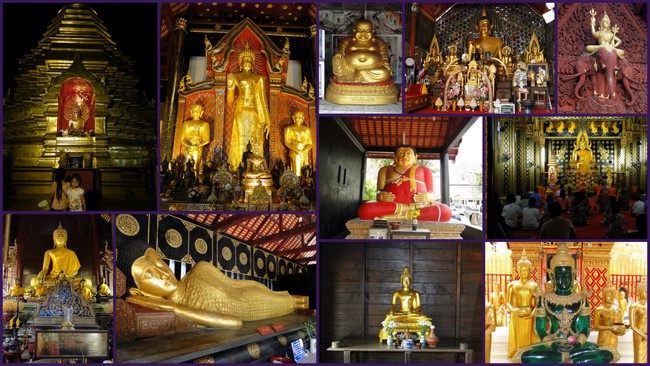
the many faces of Siddhārtha Gautama, the Lord Buddha

Actually the Buddha never visited Chiang Mai no less move there, but legions of his devotees have over the centuries from around the world – India, Laos, Vietnam, China, Australia, France, England, Canada, America. Not all of these expats are Buddhist.  Hinduism from India arrived first, a few thousand years ago, followed by Buddhism somewhere around 500 AD, and all had no real issue with local Animist practices, Confucianism brought by Chinese merchants and Christianity when Europeans arrived after 1500 AD. After all, what we know today as Chiang Mai has been an important city since its turbulent days as the capital of the Lanna Kingdom, wars with its arch-enemy Burma, Japanese occupation during World War II, its rise as the cultural heart of ancient northern Thailand and even the onslaught of overfed Western expats looking for a low cost of living and cheap facelifts.

the Western Buddha??

As flexible as Buddhism is, modern Thai’s have few issues with Starbucks, cell phones or even fat expats, but the shorts for sale in the upper right picture are strictly for foreign women (unless you want to be a Thai woman with a tarnished reputation) and no Thai guy would go shirtless unless at the beach – which is no where close to Chaing Mai. That said, Chiang Mai is not an attractive city. Many of its old teakwood structures are found scrunched tightly among mold stained concrete buildings of more recent vintage. Like most Southeast Asian cities, sidewalks crumble under persistent floods of the Ping River during rainy season, their primary use as motor bike parking lots and spontaneous “stores” for sellers of everything from sunglasses to spicy hot chicken feet.

attractive old and modern architecture (why take pics of majority ugly buildings)

Like most of regions of the world with hot sunny weather, walking would seem to be the obvious choice to see the city, but this is Southeast Asia. Although many people do walk – certainly far more than any American city – “pedestrian friendly” is a concept that’s not part of Asian consciousness. With few walkable sidewalks, one shares the often narrow streets with cars, trucks, motor bikes and other forms of public transportation  in a devil-may-care free-for-all. Chiang Mai has few traffic lights, except in some places on the  modern expressways in the new outer parts of the city, and fewer police to calm the constant rushing traffic. To cross the street a pedestrian simply crosses the street into the traffic which frequently comes from all directions. Although daunting at first, this is exactly what the on-coming traffic expects as it, usually, avoids both pedestrians and other vehicles with deft agility. The worst action a pedestrian can take is to get spooked and hesitate halfway across several lanes of traffic – that’s when the cars and motor bikes get spooked and “problems” occur.

Transportation: (top) trying to cross the street, Songthaews (bottom) Saamlors and Tuk-Tuks

Most Thai’s without their own transportation ride the Songthaews – converted small trucks that carry up to a dozen people at a fixed rate along fixed routes like buses. They’re cheap at about $.35 – $.70 US a ride. The Saamlors and Tuk-Tuks are for short distances especially within the Old City and its immediate surroundings. There is no problem getting a Saamlor or Tuk-Tuk because their drivers “believe” that no one wants to see the city by walking. They are everywhere, and you’ll be asked by nearly every one during your walk if you “want a ride?” “where are you going?” and “one hour to see the city?” The trouble is that there are no set rates and no meters and the “one hour tour” is to any number of shops selling items you do not want but for which the driver gets a cut. To say there is a “sliding scale” on the rate is an understatement. Locals know the game quite well and the distance. What will be quoted to a local frequently is 50% – 75% less than to an obvious foreign visitor. If one does not haggle over the fare before the ride expect to pay as much as the driver believes you’re gullable, or guilty enough, to pay and be asked about “a tour” or “a good shop…” (Actually you’ll be asked this even if you do settle on a price but just be firm because the shops are rarely ones you would visit on your own.) Never expect to pay the same rate for any two rides to or from the same place. Yet in 95 degree (F) heat at 3:00 PM you might not care about the fare. On the other hand, any fare over 100 BHT ($3.00 US) to just about anywhere within center city is too much. Taxis with meters exist but your hotel must call them. They’re rarely available to flag down.

(top left) gathering morning glory greens on the banks of the Ping River, (top right) grases for anomal feed, (bottom left) broom seller, (bottom center) threshing rice - photos by Boonserm Satrebhaya (Chiang Mai Then and Now, 2010)
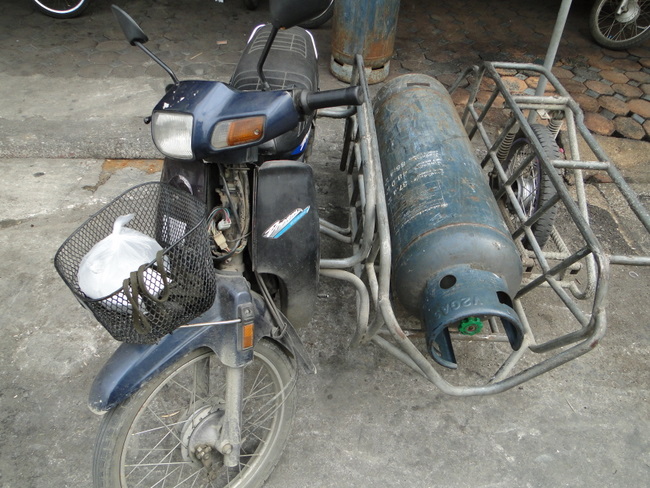
motor bike outfitted to transport propane gas tanks

So why visit such a chaotic city? The people for one thing. The average Thai is friendly and gracious even if they’re scamming you or you’re not buying something. They’re so industrious – and I’ll add the Laotians, Cambodians and Vietnamese – they make the average workaholic American seem lazy. Nearly every building is a store with family living quarters in the back or above. Motor bikes and bicycles are movable stores or “freight” haulers. Where there isn’t a motor bike parked on the sidewalk there’s most likely someone who has set up a “café,” or selling jewelry and T-shirts, or water and soda, or even making fresh dumpling pot stickers. Whether the nation’s a monarchy or a “socialist” republic, Southeast Asians can’t count on a pension (unless they’re the favored few that work for large corporations) and “social security” is an unknown concept. The extended family is one’s social security and the ability to be creative with work.

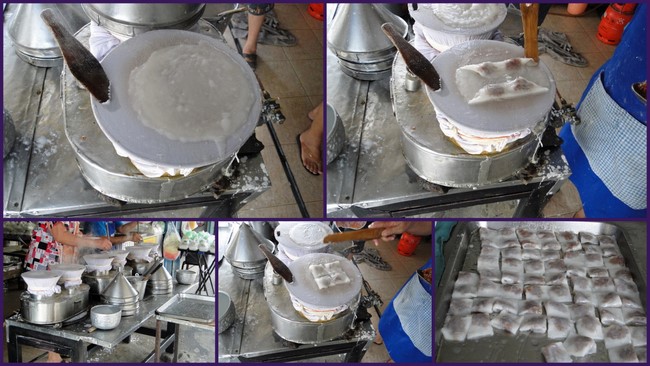
Dumpling Pot Sticker street stand: rice flour mixture is steamed on cheese cloth, minced pork mixture added, 8 dumplings are packaged with fresh greens and cilantro: $.65 US

 There are the 300 Buddhist temples in Chiang Mai and the surrounding countryside that are oasis of calm in a busy city as well as repositories for a millennium of stunning art, architecture and knowledge. Nearly all are open to the public most hours of the day.

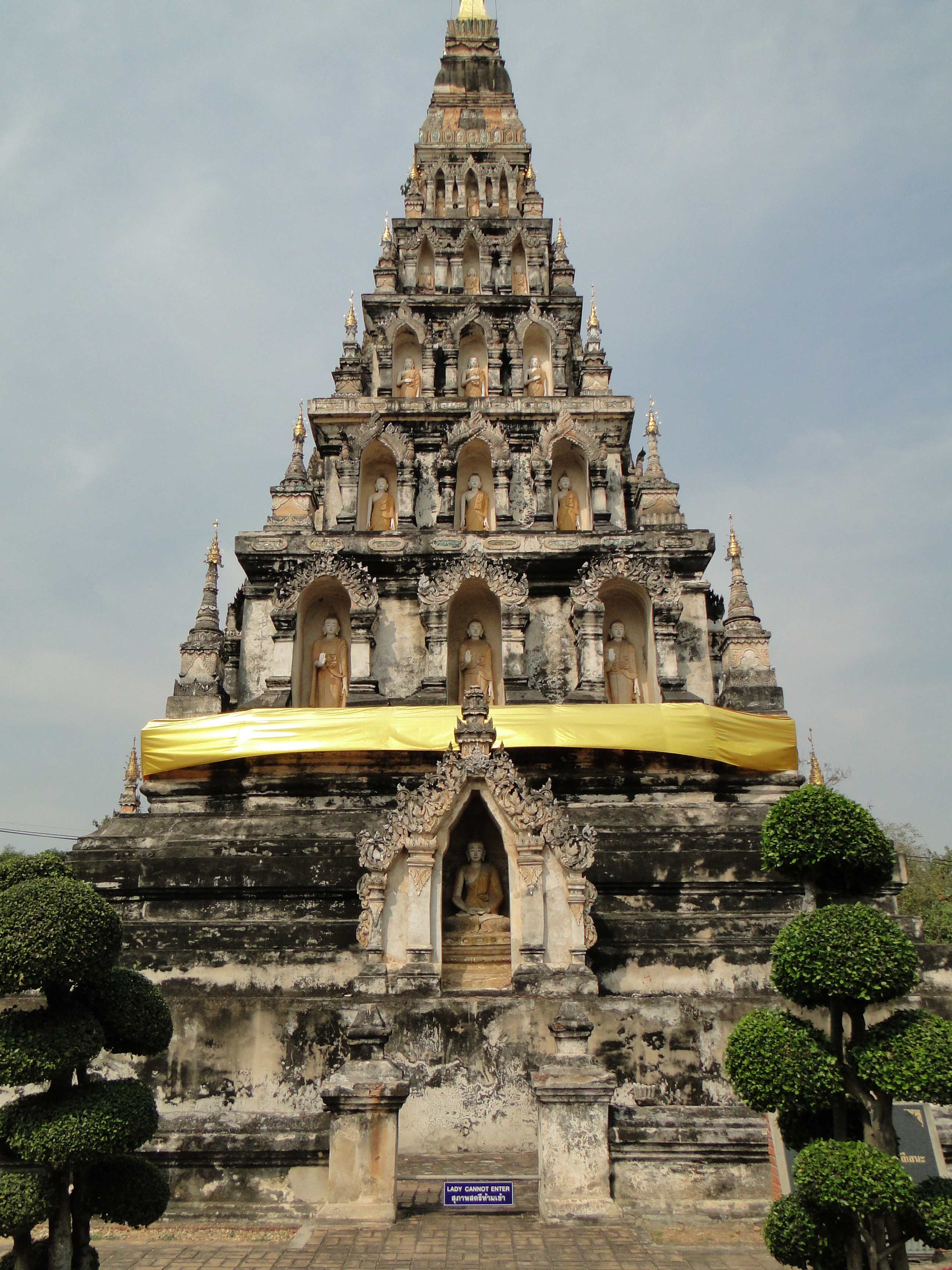
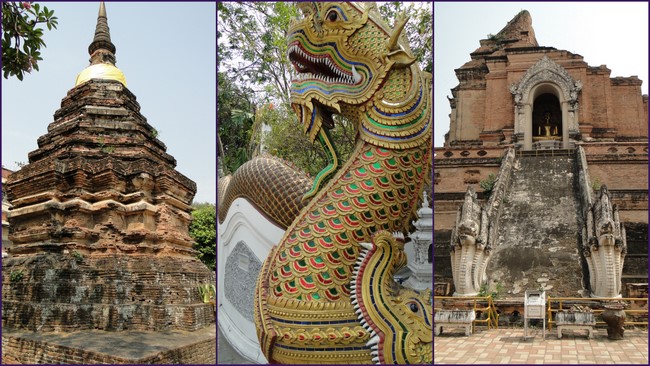
(left) Wat Cheitta, 15th century, (center) protective Naga snake, (right) 14th century Phra Dhautu Chedi Luang

 There is the beautiful green countryside with villages, farms, mountains, waterfalls – and tourist traps (oh well…). It’s not surprising that as a national medical center (and for an American inexpensive care), slightly lower temperatures than steamy Bangkok, especially November through February, along with a cost of living less than half that of North America and Europe, Chiang Mai attracts one million tourist a year, over 10,000 permanent expats and numerous seasonal residents. Like everything in Southeast Asia, Chiang Mai’s an experience worth a return visit.

(Part II – attractions, markets and Thai cuisine)