Tag Archives: antiques

Beach Anyone? An Undiscovered Vietnam

the beach at Lang Co, 40 miles (65 km) south of Hue

Vietnam:  jungles, mountains, green and 1,956 miles (3260 km) of  coastline (not counting islands)  much of it pristine, undiscovered, wide, white sand beach. “Undiscovered” by a beach-hungry Western tourist world but for how long?

The 65 mile (110 km) trip from Hue to Hoi An is a beautiful coastal drive past fishing villages, wet lands and rice paddies with the road winding through the hills of the Truong Son Mountains. The postcard fishing village of Lang Co is situated between the Pacific and a perfect crescent lagoon dotted with boats. Tourism investment money is starting to develop the beach towns, but it will, hopefully, be some time before they’re condo canyons.

We were on our way from Hue to the UNESCO Heritage village of Hoi An, some 10 miles south of Da Nang. From Hue the passenger train line from Hanoi to Ho Chi Minh City (Saigon) hugs the same coast as the coastal highway, a 4 hour trip to Da Nang. From Da Nang you catch a taxi to make the 30-45 minute drive to Hoi An (cost $28 – $45/double train and taxi). As beautiful as the rail trip would be, I chose to arrange for a car and driver to make the trip to Hoi An with the option of stops on the way. For US$60/double this was a terrific day trip as well as transportation to our next destination.  

Lang Co lagoon

I would have enjoyed wandering around the village of Lang Co, but on this day it was primarily a lunch stop. The Thanh Tam Seaside Resort is nicely designed. The main reception building contained a spacious restaurant decked over a sloping hill and opening onto a sweeping view of the Pacific at palm tree-top level. The palm trees create a large shaded sitting area at beach level. The rooms for the hotel were in separate beach front buildings. I did not see the rooms but TripAdvisor reviews are not kind. Of course there was a large store selling jewelry and clothing. There was no competition on either side of the resort for the peace of an enormous stretch of sand with beautiful views of the mountains.

even monks need a little R & R: Thanh Tam Seaside Resort

 For a tourist resort, the restaurant was surprisingly good. Specializing in seafood, there was a fine selection of grilled clams and oysters topped with a variety of savory sauces. Spring rolls were delicate and lightly fried. Prices were at the high end for Vietnam meaning that lunch or dinner for two will average US$25/30. (Our light lunch with espresso was $18/two). 

Thanh Tam Seaside Resort

  The Hai Van Pass is the reason for making the overland trip by car – or if intrepid, by bicycle. The train dramatically hugs the coast around this finger of the Truong Son Mountains that literally juts into the Pacific Ocean creating a 1500 foot (497 m) barrier geographically dividing the country north and south. By car Highway 1 switchbacks up lush mountainsides, brushing clouds, opening vistas of the blue ocean set against the intense green of farm fields. This mountain barrier creates the moist microclimate that makes Hue and the Perfume River delta a unique ecosystem.
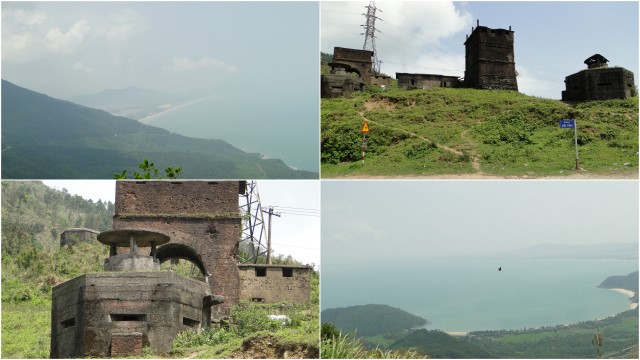
Hai Van Pass with 200 years of military installations (top right) Lang Co lagoon (bottom right) Da Nang Bay

 For over 1,000 years, Hai Van Pass (Pass of the Ocean Clouds) was the boundary between the Kingdoms of Vietnam and Champa. Even after the final conquest of Champa by Vietnam’s Nguyen dynasty in the early 19th century, the Pass was deemed a strategic position through the Vietnam War. Pill boxes are next to a 19th century watch tower. Today the site’s a rather windy, shabby remnant of a violent past. One side of the road is lined with the ubiquitous tourist stalls selling the same trinkets, water, soda, cigarettes, scarves, postcards etc that you’ve seen so many times already. Your car literally will be surrounded by well meaning and persistent sales women. I admire their persistence, even while regretting that I do not need what’s for sale, because it’s certainly a peaceful pursuit after this site’s violent past millennium.
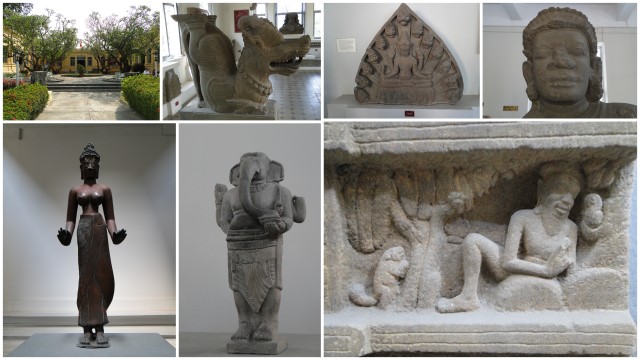
Museum of Champa Art Da Nang

  Having traveled to both Cambodia and northern Vietnam, I could see and understand the distinct break in artistic traditions between the Chinese Confucian influenced north Vietnam and the Hindu/Buddhist/Khmer Champa Kingdom of the south – there is a cultural divide. Da Nang’s Bao Tang Dieu Khac Champa Da Nang (Museum of Champa Art) is both a gem and the world’s largest repository of the exquisite sculpture of this civilization.

Da Nang Sports Complex

The rapidly sprawling rather charmless city of Da Nang looks like a new settlement. If there was a historic core or a building prior to 1975 it’s well hidden. Being both a major port and air base during the Vietnam War did make it a prime target for severe damage. With modern Vietnam’s penchant for getting on with the future there’s little to no evidence of that past war. Yet Da Nang’s future fame will result in the development of its miles of stunning beaches. Australian money has already begun to pour in starting major golf/hotel/condo resorts. Iconic China Beach is highly desirable real estate. Da Nang’s airport is undergoing major expansion. I know it would be politically correct to decry this future loss of pristine nature, but also patronizing. This is an ancient land. It changes.

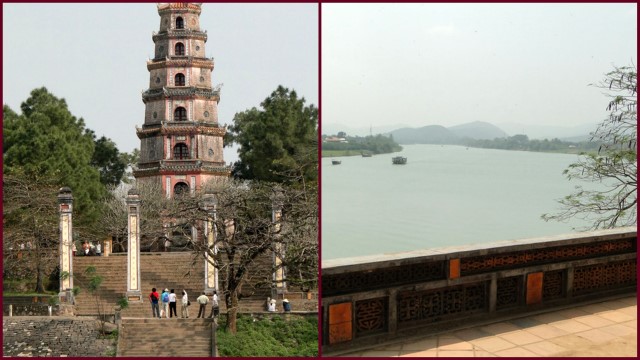
Serenity, Violence and the Heavenly Lady: Hue, Vietnam


Phuoc Dien Tower & the Perfume River
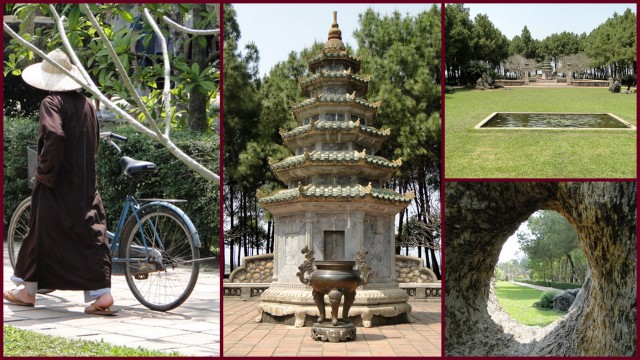
the bonsai garden at Thien Mu Pagoda

The boat’s noisy motor is in sharp contrast to the serenity of the Perfume River as we glide toward the landing dock of Hue’s most important tourist attraction. Fortunately on this afternoon in March, there are no large crowds to mar the tranquility of arguably Vietnam’s most beautiful Buddhist temple complex. Construction commenced on Thien Mu Pagoda (“Heavenly Lady Pagoda”) in 1601 on Ha Khe hill, on the north bank of the Perfume River, the site selection being determined by a holy lady’s spiritual visions. She couldn’t have chosen a more serene site. High above the river, surrounded by a graceful pine forest, the Pagoda complex of temples set within green gardens captures the river breeze cooling Hue’s otherwise muggy afternoon.

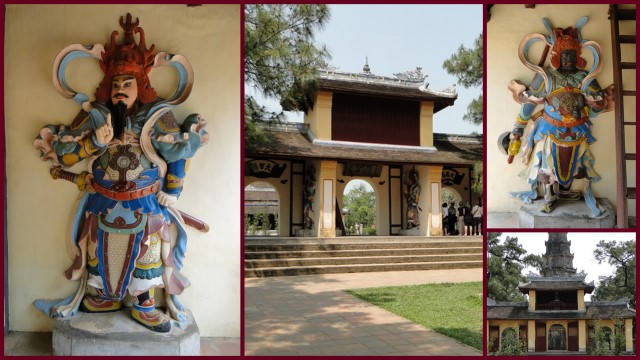
2 of the 6 guardian warriors at the gates of Phuoc Dien Tower

The number “seven,” as in Seven Stages of Enlightenment, plays a significant role in the temple’s design concept. From the river the complex is constructed on seven slightly rising tiers. The dominant octagonal Phuoc Dien Tower (1864) in the front of the complex rises in seven levels with seven statues each a different representation of the Buddha. It is guarded by six warriors on either side of the three entrance gates – ok, that breaks the pattern, but…

Dai Hung shrine, Stela (1715) on marble turtles recounting Buddhist history and thought

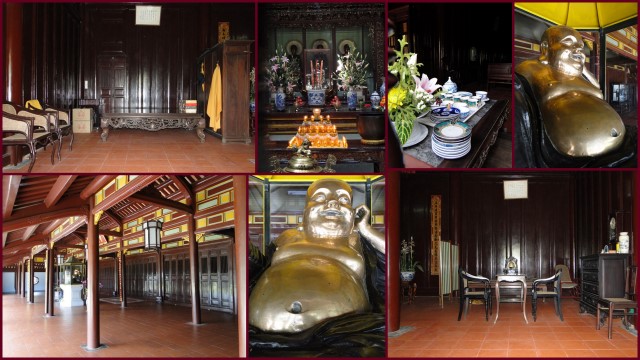
On the next level is the elegant Dai Hung shrine with a rotund brass laughing Buddha brilliantly set off by the dark wood and deep reds of the building. Through side windows I had an unprecedented view of monk’s quarters within a temple.

Dai Hung shrine with laughing Buddha

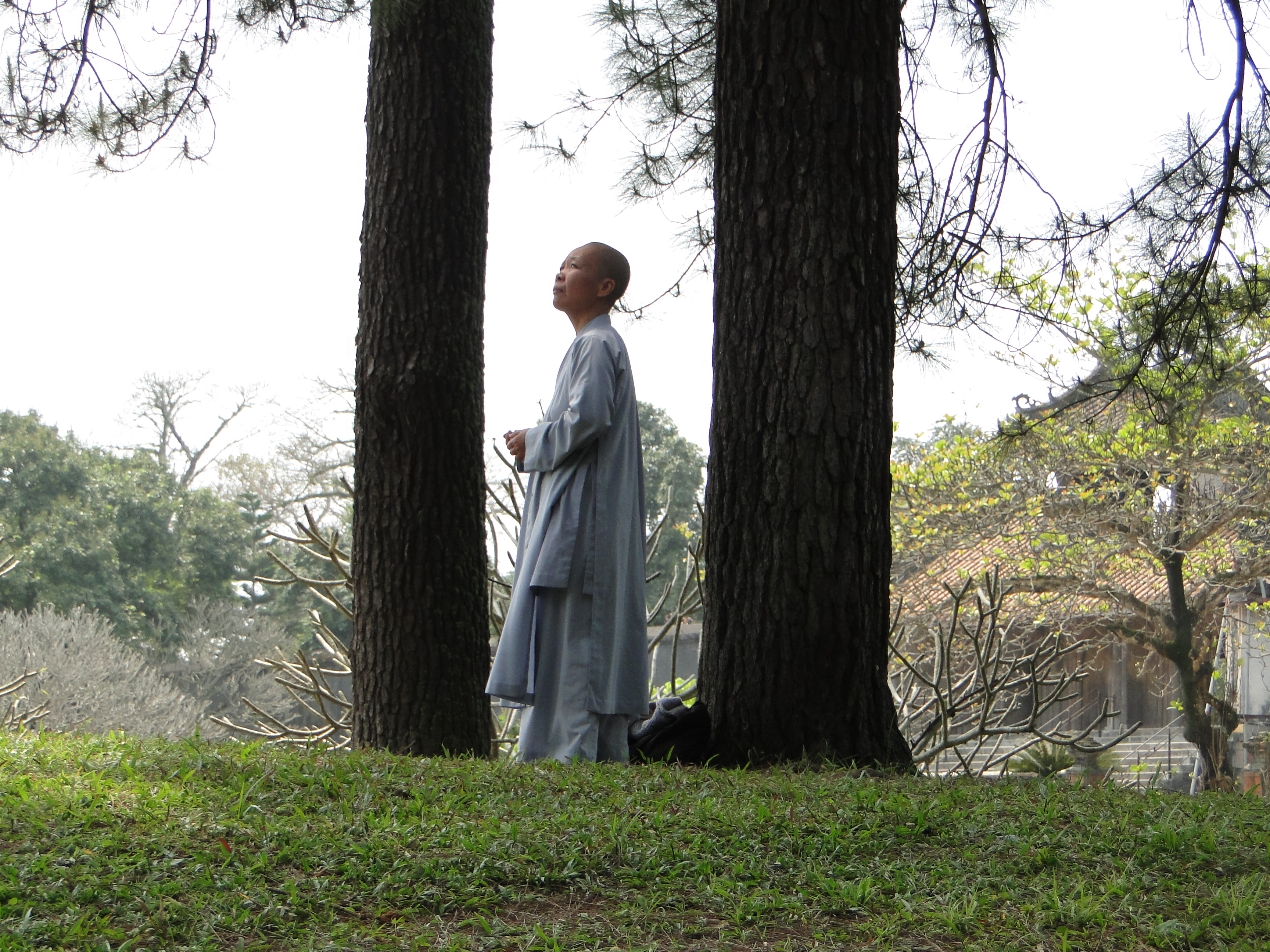
Thien Mu Pagoda is Vietnam’s oldest monastery, and a visitor should be mindful that they are enjoying the grounds where dozens of monks and novitiates are in work, study or prayer.

A small open building on one side of the complex always has a crowd of people. It contains a sacred relic from Vietnam Buddhism’s more recent past – a circa 1950’s Austin motorcar. It was the car driven by Thích Quảng Đức to the Saigon intersection where, in June 1963, he set himself on fire in protest to the anti-Buddhist dictatorial regime in South Vietnam hastening its downfall. Thích Quảng Đức was originally a monk from Thein Mu Pagoda and, partly due to the fact that his heart didn’t burn, he is venerated today as a bodhisattva.

the Austin of the Venerable Thích Quảng Đức

Violence and serenity – an unholy glue – well known in a land several millenniums old. Next to the Venerable Thích Quảng Đức’s rusting Austin the path to the Pagoda exit is through an exquisite simple Peace Garden.

Perfume River After Life – the Nguyen Tombs

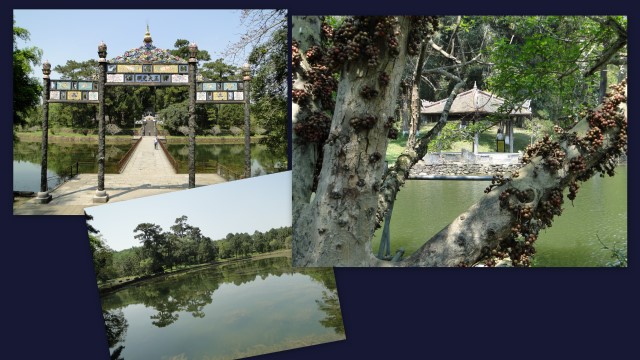
Monk in contemplation at the tomb of Emperor Tu Duc

Here’s the project – and money’s no object: build a place away from work and home where you can just get away from it all, surround yourself with your friends, do what makes you happy and stay there forever. If you were a Nguyen emperor of Vietnam you did exactly that and included artificial lakes, islands, palaces, temples, gardens, courtyards, and, of course, your tomb and that of your wives. They were simply following a long tradition of emperor worship both to solidify the continuity of the dynasty and take their place as an ancestor of the nation. The Nguyen emperors certainly did it in style constructing virtual country estates to pass relaxing hours painting, eating and escaping the pressures of State both in this life and for the afterlife.

Dai Hong Mon temple at Emperor Minh Mang Tomb

Minh Mang (1791-1841) and his grandson, Tu Duc (1829-1883),  2nd and 4th Nguyen emperors, created lush forested landscapes with paths, streams and lakes. It easy to feel comfortable here for eternity.

Tomb of Emperor Minh Mang - constructed 1841 - 43


the Tomb of Emperor Tu Duc - constructed 1864-67

Tu Duc spent many quiet hours in the Xung Khiem Pavillion (upper right, 1865) looking out on the lake and at the boat landing to the temple (bottom left) playing music and writing poetry. He was a prolific poet. The grounds contain a lovely tomb to his first wife, Empress Le Thien Anh, and burial spaces for many of his additional 103 wives.

(upper left) incense sticks for sale, (lower left) Mandarins to serve the Emperor in the afterlife, (lower right) protective Naga on the stairs to the burial chamber at Tu Duc

Khai Dinh (1885-1925) 12th. Nguyen Emperor, was less than 5 feet tall, slightly built and unpopular because of his Francophile leanings. In the 1924 play, The Bamboo Dragonby a young revolutionary, Ho Chi Minh, Khai Dinh was ridiculed for being all pomp and no substance, but he did knew how to impress.

The Emperor Khai Dinh's burial chamber: life size statue with jade sceptre

  Rather than spread out over a park-like setting, the compact tomb complex is built on top of a forested  hill surrounded by steep hills overlooking the Perfume River. The design elements are a fusion of traditional Vietnamese features with late 19th century French baroque. The exterior has a somber countanence because the palace was constructed in concrete made with the Perfume River’s volcanic gray sand so has leached a gray/black discoloration.

ancestor altar and exterior: Tomb of Khai Dinh
Emperor Khải Định (1885 - 1925)

Yet the interior is an explosion of gold, blues, reds, fuchsia, pinks, greens – all tile and glass mosaics covering every nook and cranny of the walls and ceilings. Dragons, birds, flowers, tables, vases, trees all are depicted in excruciating and fanciful detail, many in 3-dimensional compositions. The craftsmanship is unparallel for mosaic art glass. The Emperor reigned for only 9 years but it took 12 to build his tomb – 1920-1932. Khai Dinh died as he lived, over budget. A special tax had to be levied for the tomb’s completion.

details of the 3-D glass mosaics at Khai Dinh Tomb

The opulent tomb of Khai Dinh is the last in Vietnam’s Imperial history. His son, the Emperor Bao Dai (1913-1997) abdicated the throne in 1946 and died in exile in France. Perhaps it’s karma that the last tomb should be that of an unpopular monarch since the dynasty started out on that footing.

Emperor Gia Long

The first Nguyan Emperor, Gia Long (1762-1820) was fearless, feared and unpopular. He forced Vietnam’s feuding lords to bow to his unified empire, moved the capital from Hanoi to Hue, built the Imperial City and raised taxes to pay for it all. Worse, he gave France its first foothold in Indochina, a circumstance of war he later regretted but the nation never forgave. As the founder of an empire, Gia Long knew exactly the importance symbols were for dynastic continuity represented by the worship of Imperial ancestors – the fathers of the nation. His tomb set the pattern – constructing small versions of the Imperial City for the eternal pleasure of the souls of the nation.

Tomb of Gia Long

Ironically, his tomb is the furthest south of the city and even the taxi driver had to ask several times for directions. Stopping on a dusty street outside the dilapidated walls of a small old temple, I’m told to go through a creaking wooden gate. Walking across an empty dusty yard through another gate down a path alongside a farm plot I spy the virtual ruins of the great Emperor’s final resting place. It’s overgrown with weeds and the dogs are barking from the adjoining farm. I feel a pang of melancholy as I look out on the overgrown field and feel sorry that I didn’t visit the Tomb of Ho Chi Minh in Hanoi (although cremation, not mummification, was Ho’s last wish). Gia Long struggled against major odds, seeing most of his immediate family killed as a boy, before creating an empire he ruled till his death. Not much different than Ho Chi Minh. Yet even if Gia Long’s tomb is in disrepair, his ancestors, his descendents – and now those of Ho Chi Minh – are all part of Vietnam’s collective soul.

The Imperial and Forbidden Purple City of Hue – Vietnam

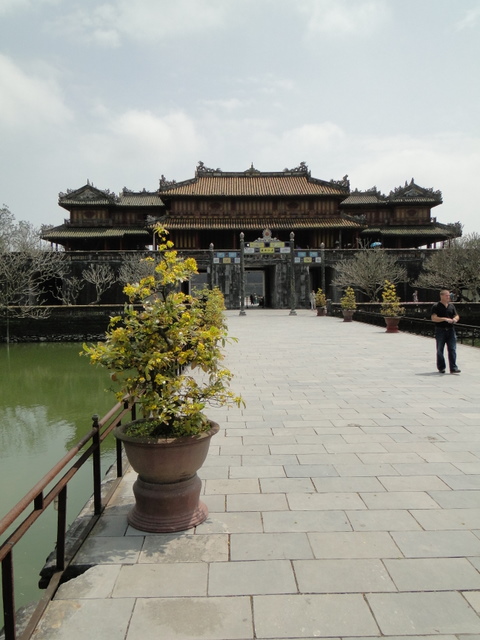
Ngo-Mon (Royal Gate) from Golden Water Bridge, Imperial City Hue (fortified citadel is beyond)

All respectable Vietnamese buildings based on Confucian design principles have an entrance gate  opening onto a small space backed by a freestanding wall – the Spirit Wall. To enter the courtyard one simply walked a short distance to the right or left around the wall. Easy for humans but not evil spirits who cannot sail through so effortlessly.  This would be especially useful for an imperial capital. The moat enclosed fortified walls of the 2-1/2 square mile Hue Imperial City was home to hundreds of buildings – palaces, temples, administrative offices and housing – lakes, gardens fountains and the Forbidden Purple City – home to the Imperial family. This vast complex was “Versailles” for the Nguyen Dynasty (1802-1946). After years of war wresting control from feudal lords, Gia Long, first Nguyen emperor, established the modern boundaries of Vietnam – fatefully, with a little help from the French.  Yet even double gates and fortified walls could not prevent floods, nor could meticulous planning under Confucian principles protect from bombs and artillery. Tempered by this reality, what remains of the vast UNESCO World Heritage Site with its ongoing restoration is beautiful, serene and haunting.

Wandering freely, after paying the admission of US$2.50 at the inner Ngo-Mon Gate, through palaces, gardens, ruins under restoration, past breathtaking decorated gates and crumbling walls, what struck me was the modern Vietnamese attitude toward the Imperial City. No matter that not all Nguyen family members were fondly remembered – to say the least – this was still the shrine to 144 years of national ancestors and therefore sacred ground. Even the 1933 tennis court of the last Emperor, playboy Bao Dai is being restored.  The descriptions – written in French, English and Vietnamese – for the extensively restored Dien Tho Palace complex is nearly reverential.

Dien Tho Palace (upper) gate with spirit wall, garden bridge, (bottom) detail of a garden wall, one of several palaces within the complex

Sadly there isn’t an army of restoration workers on site. Despite UNESCO designation, the projects are vast, requiring research, meticulous craftsmanship and lots of money. Germany and Japan are actively contributing to several current projects. Maintenance alone is a daunting task – this is 2-1/2 square miles of monuments.

restoration projects


The 1968 Tet Offensive during the Vietnam War (locally known as the American War) inflicted severe damage on the Imperial City, yet there are no vitriolic nationalist slogans, just a sober plaque describing the skeletal remains of a palace building within the Forbidden Purple City (bottom left).

1968 Imperial City war damage and open land where structures once stood

Yet there are always the reminders that this is Vietnam where the practical tasks of everyday life are as important in Confucian thought as the lofty actions of State. Laundry drying on the Imperial City’s walled moat? As long as it’s feng shui…

not airing the Imperial family laundry

Hanoi at 1,001

Past error is no excuse for its own perpetuation.”  Senator Robert F. Kennedy, 1968

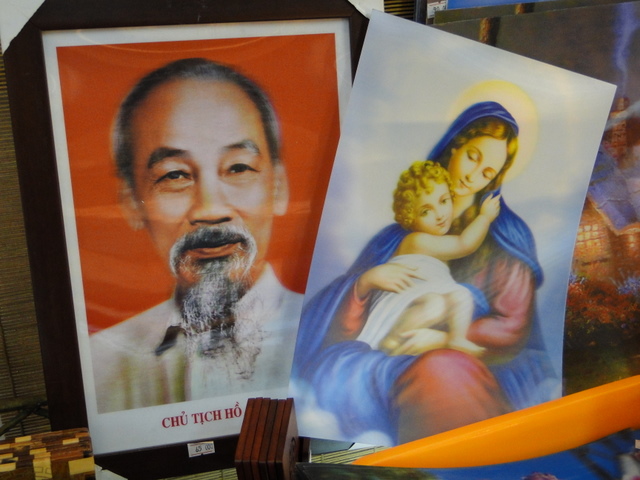
DISCLAIMER: I did not group these myself. They were in the gift shop of the Temple of Learning

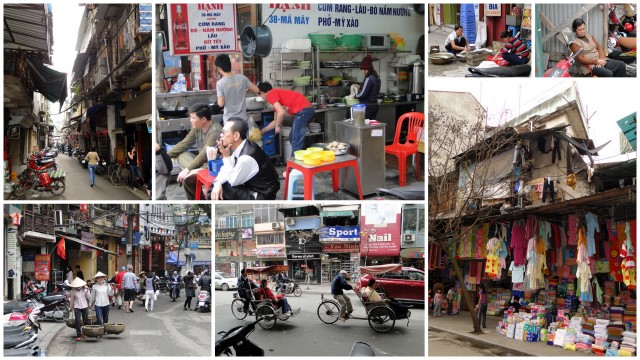
There’s little visible evidence of Hanoi circa 1010 – the city was established by Chinese expanding southward on settlements along the Red River that had been there already for 2,000 years. Actually, there’s little evidence of Hanoi pre 1870’s. Confucian culture preserves the spirits of the ancestors, not their buildings. Even if decades of war and millions of tons of dropped bombs had not significantly damaged the city, ingrained capitalism would have dictated their presence superfluous. The drive from Hanoi’s dreary Noi Bai International Airport – 28 miles (45 km) from the city’s downtown – passes extensive rice paddies boardering high-rise office complexes, narrow mold-streaked French colonial-style town houses next to another BMW dealership before winding snake-like into the heart of Old Hanoi with it’s 21st century sensory overload.

“old” 19th century buildings, chic cafe and typical traffic

“Charming” is a term to apply to Hanoi only if you believe Manhattan deserves the moniker as well. Frenetic is my description. The motor bike horns begin by 4:00 AM, followed by the publically broadcast music from the computer/TV store across the street starting at 8:00 AM, then the TV in the hotel’s breakfast room entertaining the owner’s young son with the Cartoon Network dubbed in Vietnamese. Outside is pandemonium if not prepared.

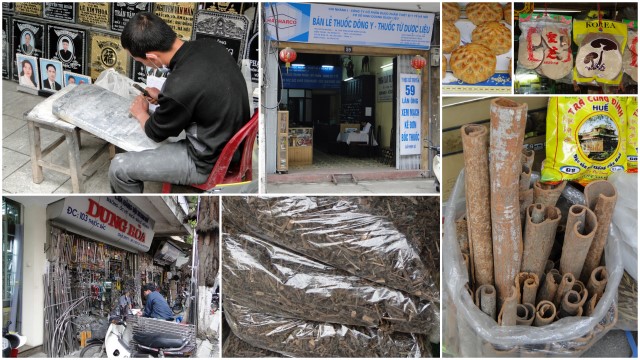
(top from left) monument maker, traditional medicine clinic, pastery and mushrooms, (bottom from left) plumbing supply store, ginsing, cinnamon sticks over a foot long.

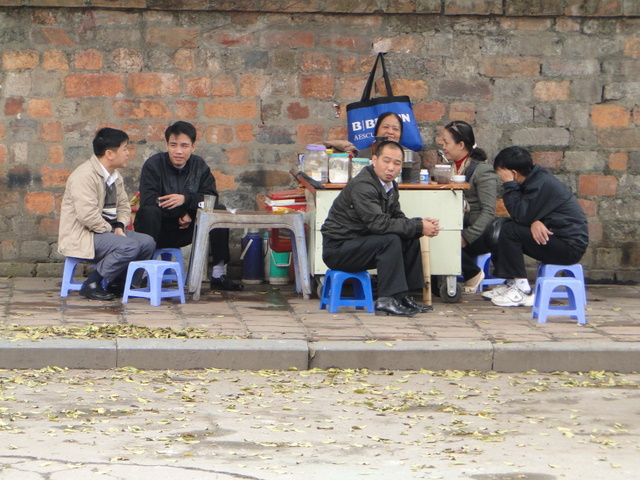
Hanoi is a city that would make Donald Trump proud. Everyone is an entrepreneur and quite aggressive in their selling methods whether it be a cyclo driver following you down the street because you really don’t want to walk (?), or stepping over and around another sidewalk café while saying “no” to the hundredth deep fried donut, peeling the hand of the seller off your arm because you really do not need another map of the city all the while being aware that you’re walking in the middle of the street, because there’s no sidewalk space, along with cars, motorbikes and bicycles. Everything is for sale and streets, not just in the Old City, are frequently dedicated to a product – silversmith, watches… The Hotel Ho Guom was located on the edge of the Old City and the French Quarter and most of the surrounding shops were computer and TV stores.

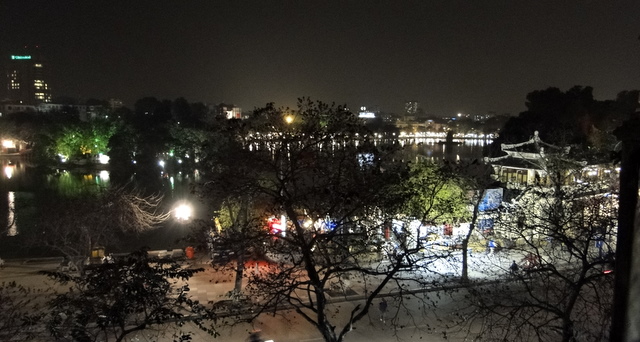
Street life is not attractive compared to Thailand and Laos. The city is dirty. In Thailand and Laos both the cities and countryside were virtually trash free and yet there was not an overabundance of trash cans. Residents and shop owners simply picked up after themselves. Not so in Hanoi. There is an air of freewheeling rampant capitalism with a “me-me” attitude. It is nearly impossible to simply stop on the side of the street when walking to take a photo without having to dodge a vehicle, a person, a pile of discarded greasy food or a hawker. Yet Hanoi is a rich city. It is Southeast Asia’s most expensive real estate, everyone is either working or eating (or both), Bentley, BMW and Mercedes cars share the streets with motor bikes, high rise buildings are going up and the lakes are beautiful – even if they’re still not havens of quiet.

Hoan Kiem Lake
Emperor Lý Thái Tổ

It is not a tourist city, it’s for business. Evidence of the horrific wars that tore the country apart are nowhere to be seen except in the museums – none of which are worth seeing unless you’re really into war and politics. The most prominent statue to a political figure is the huge monument to Emperor Lý Thái T (974-1028) who ended Chinese domination over Vietnam. One of the city’s largest structures is the Roman Catholic Cathedral of St. Joseph (1886). Over 15% of Vietnamese are Catholic and Saturday night Mass was packed.

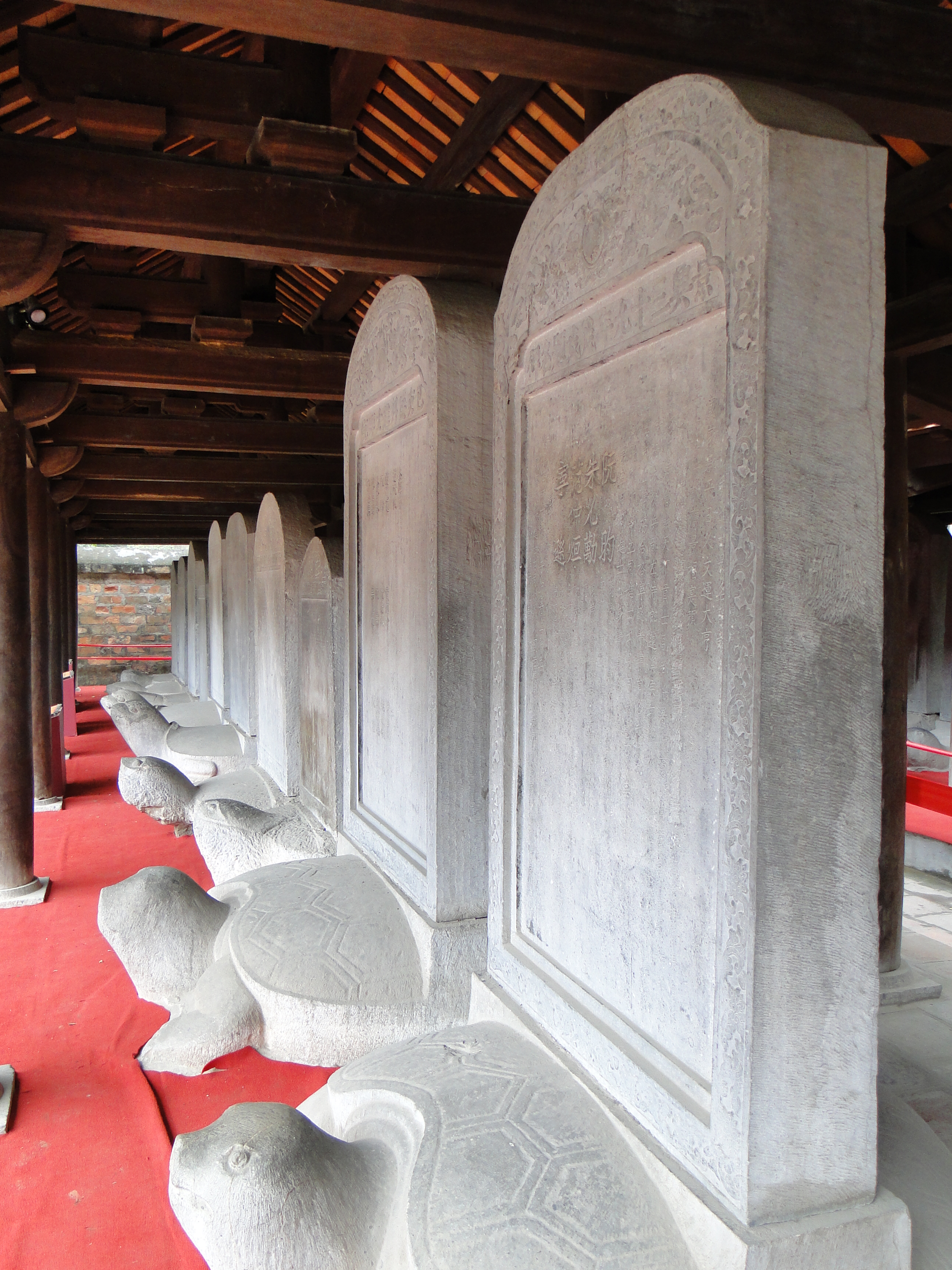
The Temple of Learning, built in 1070, dedicated to Confucius, functioned for more than 700 years as Vietnam’s Imperial University educating the country’s nobles, royalty, mandarins and other elite. If after years of study and a month-long series of exams, a student graduated as a Mandarin their name was engraved on stone stele that sits on large stone turtles in the temple. Annually about 8 out of every 3,000 exam takers ever reached that loftiest of degrees. The temple consists of a series of five landscaped courtyards. The first two are primarily gardens including fanciful designs and topiary. The third one has a lotus pond and the stellae. The final courtyard holds the shrine to Confucius. The northern half of Vietnam has been Confucian for centuries. More a social and political philosophy based on ethics and behavior, and quite compatible with capitalism and central government, Confucian thought – although complex – does guide Vietnam today. Ancestor worship and offerings to the animistic spirits of nature by burning incense and leaving food and drink on alters, in trees and at monuments is as common in Vietnam as anywhere else in Southeast Asia.

the many Confucian ways of prayer

Within the Old City are several privately owned houses many within the same family dating back several centuries and are open to the public. They give a glimpse of middle class merchant life that, in reality, still exists today. The front of the house was always the store, and directly above were the 2nd floor store rooms reached by a staircase. Behind the store is the residence dominated in front by the alter to the ancestors. At least two courtyards open the houses to outdoor light and rain water. Chinese architectural influence is paramount in these pre-19th century structures.

87 Ma May Street

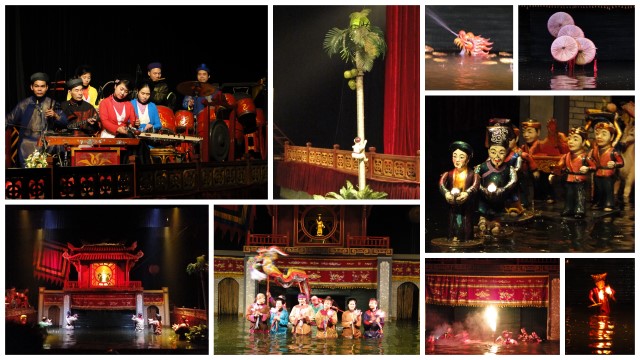
Most “tourist attractions” signal to me to “stay away,” but Hanoi’s Water Puppet Theater is unique and well worth the US$3.00 admission (for a front row seat). Started during ancient rice harvest festivals, the flooded rice paddies were transformed into magical puppet theaters. Puppets are a beloved form of entertainment throughout Asia, but these puppet masters control their elaborate characters from behind screens and actually under the water. Fire breathing dragons compete with dainty court dancers and palm tree climbing coconut collectors. A live orchestra in traditional dress playing on traditional instruments completes the experience as one of the best cultural venues in the city!

The Water Puppet Theater

Cuisine is not Hanoi’s forte. There are a lot of places to eat and, as usual on this Earth, they’re mediocre. The finest restaurant in Hanoi is also the most fascinating. Koto, next to the Temple of Learning, is in an elegant, 3 story French art nouveau town house. Opening at 11:30 AM it is full within the hour. Founded 20 years ago by concerned Australians and Vietnamese, it is a culinary training school and refuge for disadvantaged/abused/orphaned young adults. If I had not known this in advance, I would have assumed it’s simply a superbly well trained staff serving creative dishes at moderate prices. It was the best meal I had in Hanoi. Cost for two was less than US$18.00

Koto
the incomperable Vietnamese Pho: soup, frequently eaten for breakfast, with noodles and beef

Unfortunately, many restaurants in Hanoi listed in guidebooks or on user reviewed travel sites were geared to tourists with Western taste (Australian beef burgers) and overpriced for the country. One important note of traveling in Vietnam is that it’s the least expensive of the Southeast Asian nations. A metered taxi (don’t travel any other way) is a couple of bucks anywhere within downtown, dinner for two with beer is under US$20, a first class hotel is overpriced if it’s rates are more than US$55-75, admission to any museum is a couple of bucks. I did have a very interesting, but not consistently well prepared, dinner at the top rated Highway 4, on a dark and dreary street north of the Water Puppet Theater. Deep fried crickets were fascinating – like eating feathery nuts, but beef flamed in foil was tough and other unexciting dishes were under seasoned. Although they advertise such exotic foods as Water Buffalo penis and fried scorpians, none of these were available. The Hotel Ho Guom, $55/double, was centrally located with an energetic and helpful staff – although the web site pics are better than reality. The room was comfortable and the breakfast provided a nice choice of traditional and Western foods.


deep fried crickets, beef flamed in foil: Highway 4 Restaurant


 Hanoi is not a comfortable city, and I’d suggest no more than a two day stay. Yet, for someone of my American generation it was an important visit. Barely avoiding the draft in the late 1960’s, brought up on  ideas of “communist domination,” it was valuable to learn that it truly was all lies. If Vietnam is a “socialist” state, Wall Street’s full of socialist. The war was a nationalist independence movement to throw off Western domination so that they could resume the rampant capitalism Vietnam always enjoyed before the French imposed their colonial regime. Vietnam succeeded, and if, along with their Chinese cousins, they eventually dominate Southeast Asia it will be through capitalist investment not ideology.


Buddha and Other Expats in the Royal City of Chiang Mai

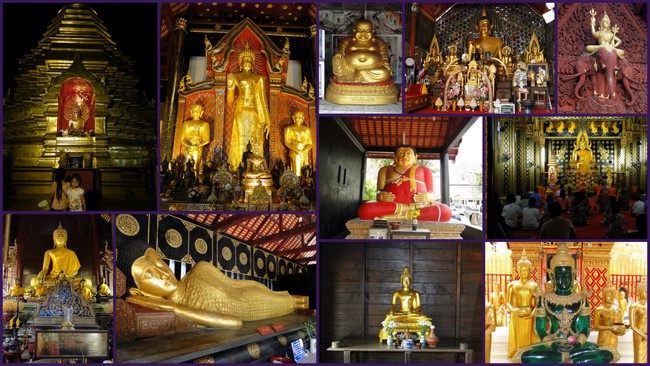
the many faces of Siddhārtha Gautama, the Lord Buddha

Actually the Buddha never visited Chiang Mai no less move there, but legions of his devotees have over the centuries from around the world – India, Laos, Vietnam, China, Australia, France, England, Canada, America. Not all of these expats are Buddhist.  Hinduism from India arrived first, a few thousand years ago, followed by Buddhism somewhere around 500 AD, and all had no real issue with local Animist practices, Confucianism brought by Chinese merchants and Christianity when Europeans arrived after 1500 AD. After all, what we know today as Chiang Mai has been an important city since its turbulent days as the capital of the Lanna Kingdom, wars with its arch-enemy Burma, Japanese occupation during World War II, its rise as the cultural heart of ancient northern Thailand and even the onslaught of overfed Western expats looking for a low cost of living and cheap facelifts.

the Western Buddha??

As flexible as Buddhism is, modern Thai’s have few issues with Starbucks, cell phones or even fat expats, but the shorts for sale in the upper right picture are strictly for foreign women (unless you want to be a Thai woman with a tarnished reputation) and no Thai guy would go shirtless unless at the beach – which is no where close to Chaing Mai. That said, Chiang Mai is not an attractive city. Many of its old teakwood structures are found scrunched tightly among mold stained concrete buildings of more recent vintage. Like most Southeast Asian cities, sidewalks crumble under persistent floods of the Ping River during rainy season, their primary use as motor bike parking lots and spontaneous “stores” for sellers of everything from sunglasses to spicy hot chicken feet.

attractive old and modern architecture (why take pics of majority ugly buildings)

Like most of regions of the world with hot sunny weather, walking would seem to be the obvious choice to see the city, but this is Southeast Asia. Although many people do walk – certainly far more than any American city – “pedestrian friendly” is a concept that’s not part of Asian consciousness. With few walkable sidewalks, one shares the often narrow streets with cars, trucks, motor bikes and other forms of public transportation  in a devil-may-care free-for-all. Chiang Mai has few traffic lights, except in some places on the  modern expressways in the new outer parts of the city, and fewer police to calm the constant rushing traffic. To cross the street a pedestrian simply crosses the street into the traffic which frequently comes from all directions. Although daunting at first, this is exactly what the on-coming traffic expects as it, usually, avoids both pedestrians and other vehicles with deft agility. The worst action a pedestrian can take is to get spooked and hesitate halfway across several lanes of traffic – that’s when the cars and motor bikes get spooked and “problems” occur.

Transportation: (top) trying to cross the street, Songthaews (bottom) Saamlors and Tuk-Tuks

Most Thai’s without their own transportation ride the Songthaews – converted small trucks that carry up to a dozen people at a fixed rate along fixed routes like buses. They’re cheap at about $.35 – $.70 US a ride. The Saamlors and Tuk-Tuks are for short distances especially within the Old City and its immediate surroundings. There is no problem getting a Saamlor or Tuk-Tuk because their drivers “believe” that no one wants to see the city by walking. They are everywhere, and you’ll be asked by nearly every one during your walk if you “want a ride?” “where are you going?” and “one hour to see the city?” The trouble is that there are no set rates and no meters and the “one hour tour” is to any number of shops selling items you do not want but for which the driver gets a cut. To say there is a “sliding scale” on the rate is an understatement. Locals know the game quite well and the distance. What will be quoted to a local frequently is 50% – 75% less than to an obvious foreign visitor. If one does not haggle over the fare before the ride expect to pay as much as the driver believes you’re gullable, or guilty enough, to pay and be asked about “a tour” or “a good shop…” (Actually you’ll be asked this even if you do settle on a price but just be firm because the shops are rarely ones you would visit on your own.) Never expect to pay the same rate for any two rides to or from the same place. Yet in 95 degree (F) heat at 3:00 PM you might not care about the fare. On the other hand, any fare over 100 BHT ($3.00 US) to just about anywhere within center city is too much. Taxis with meters exist but your hotel must call them. They’re rarely available to flag down.

(top left) gathering morning glory greens on the banks of the Ping River, (top right) grases for anomal feed, (bottom left) broom seller, (bottom center) threshing rice - photos by Boonserm Satrebhaya (Chiang Mai Then and Now, 2010)
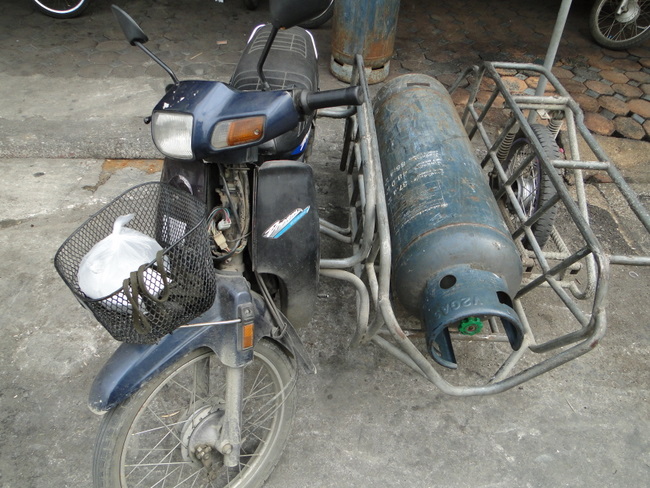
motor bike outfitted to transport propane gas tanks

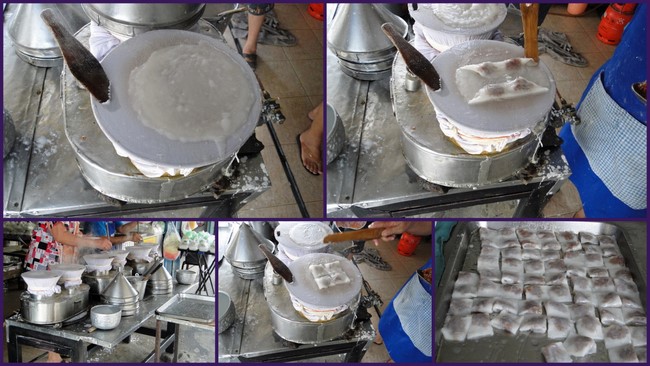
So why visit such a chaotic city? The people for one thing. The average Thai is friendly and gracious even if they’re scamming you or you’re not buying something. They’re so industrious – and I’ll add the Laotians, Cambodians and Vietnamese – they make the average workaholic American seem lazy. Nearly every building is a store with family living quarters in the back or above. Motor bikes and bicycles are movable stores or “freight” haulers. Where there isn’t a motor bike parked on the sidewalk there’s most likely someone who has set up a “café,” or selling jewelry and T-shirts, or water and soda, or even making fresh dumpling pot stickers. Whether the nation’s a monarchy or a “socialist” republic, Southeast Asians can’t count on a pension (unless they’re the favored few that work for large corporations) and “social security” is an unknown concept. The extended family is one’s social security and the ability to be creative with work.

Dumpling Pot Sticker street stand: rice flour mixture is steamed on cheese cloth, minced pork mixture added, 8 dumplings are packaged with fresh greens and cilantro: $.65 US

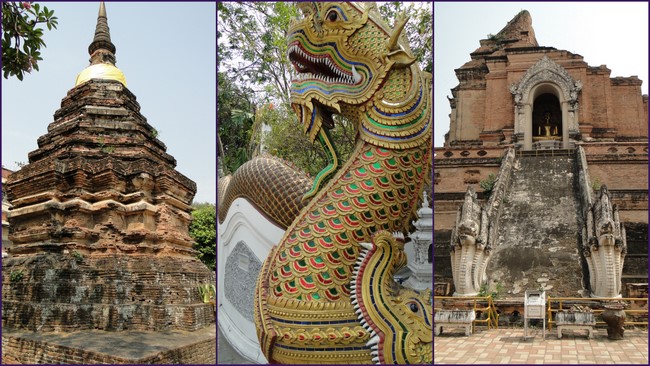
 There are the 300 Buddhist temples in Chiang Mai and the surrounding countryside that are oasis of calm in a busy city as well as repositories for a millennium of stunning art, architecture and knowledge. Nearly all are open to the public most hours of the day.

(left) Wat Cheitta, 15th century, (center) protective Naga snake, (right) 14th century Phra Dhautu Chedi Luang

 There is the beautiful green countryside with villages, farms, mountains, waterfalls – and tourist traps (oh well…). It’s not surprising that as a national medical center (and for an American inexpensive care), slightly lower temperatures than steamy Bangkok, especially November through February, along with a cost of living less than half that of North America and Europe, Chiang Mai attracts one million tourist a year, over 10,000 permanent expats and numerous seasonal residents. Like everything in Southeast Asia, Chiang Mai’s an experience worth a return visit.

(Part II – attractions, markets and Thai cuisine)

Who Knew? Wyncote Historic District

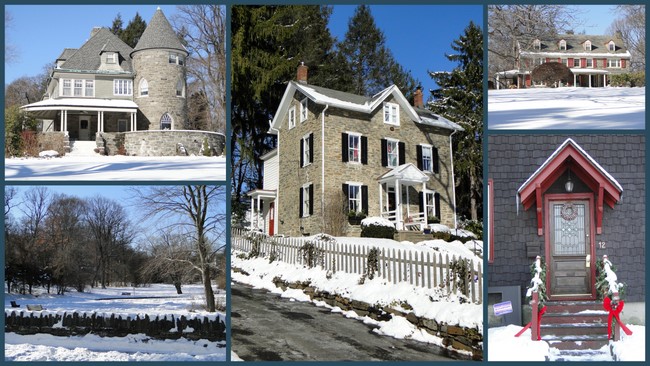
Wyncote Historic District

 I travel to far away places to visit UNESCO World Heritage Sites and in the United States to experience regions of historic significance with little regard to the reality that National Historic Districts are, literally, in my back yard. Twenty-nine, to be exact, are within Montgomery County, Pennsylvania alone. The most recent addition, in 1986, is a 10 minute walk from my house.

The Wyncote Historic District does not honor any battles. It hasn’t particularly lived through any traumatic events – unless one counts the entire 20th century. It didn’t start as a community of hardship that developed into a national inspiration. Wyncote was a late 19th century Philadelphia suburban (semi) planned community for the wealthy. The Wyncote Historic District is a 108 acre area within Montgomery County’s Cheltenham Township ten miles north of downtown Philadelphia. Of the nearly 200 residential structures all but a handful were built between 1865 and 1934 – the golden age of Philadelphia’s industrial might – and designed by some of the leading names in architecture.

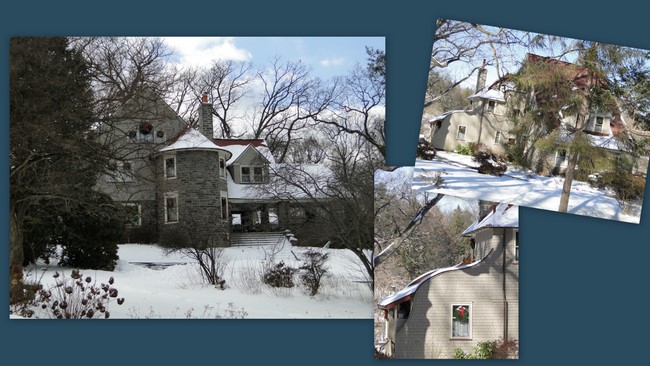
Angus Wade designs, 1890's

Prior to the 1850’s Cheltenham Township was a prosperous farming region consisting of land grants handed down by the Penn family in the 17th and 18th centuries. Even in colonial days, the area was a favored retreat from the city’s sweltering summers. Wealthy Philadelphians maintained country farm estates in this admittedly bucolic countryside or rented rooms and houses for the summer.  The construction of the railroad linking Philadelphia with the coal-producing regions of northern Pennsylvania induced newly wealthy entrepeneurs, such as the Widener, Elkins, Tyler families to purchase large tracts of land for the dual purpose of constructing country homes for themselves and selling subdivisions to their friends and others of their class.

Horace Trumbauer design, 1890's
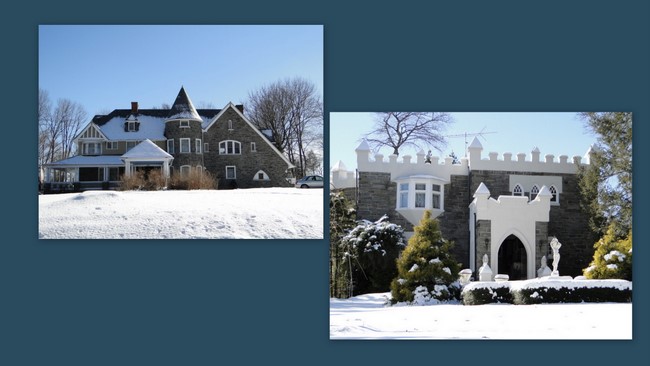
Horace Trumbauer designs

By the 1890’s the Wyncote Improvement Association was formed to ensure building codes, minimum house costs and lot sizes.

All Hallow's Church, 1898, Frank Furness design
Jenkintown/Wyncote Station, Horace Trumbauer design

Frank Furness, nationally acclaimed architect (Reading Terminal, Pennsylvania Academy of the Fine Arts) designed an exquisite little gem in 1898, All Hallows Episcopal Church. The then young Horace Trumbauer established his reputation with a number of  houses in the district, and the Jenkintown/Wyncote Reading Railroad Train Station (still a busy commuter depot). Later in his career, Trumbauer would design some of the regions most stunning mansions, public buildings and commercial spaces.  

Curtis Hall and Arboretum

By 1915  most development ended and Wyncote had the reputation as an exclusive community of wealthy residents. People from the managerial and professional elite of Philadelphia as well as indusrty heads lived in Wyncote –  the Proctor family (Proctor-Silex Electrical Company), Cyrus H.K. Curtis (Curtis Publishing, Saturday Evening Post, Ladies’ Home Journal) and the Lippincott family (book publishing). Mary Louise Curtis Bok, daughter of Cyrus, an accomplished musician and founder of the Curtis Institute of Music, constructed a private concert hall and arboretum on their Wyncote estate. The 45-acre arboretum’s landscape was designed by Frederick Law Olmstead (New York’s Central Park). Curtis Hall and the arboretum were acquired by Cheltenham Township as a park in 1974.

The architecture of Wyncote illustrates the new and increasing role of university-trained architects in the design of turn-of-the century, upper-income houses in suburban America. The majority of architects working in Wyncote received their professional training in the new School of Architecture at the University of Pennsylvania.  Queen Anne, Colonial Revival, Tudor, Craftsmen, Victorian and even medieval castles were all part of the eclectic mix coupled with rolling hills and large landscaped lots.

The 1986 designation as a Historic District was a major boost in preventing the decline and decay that take over so many older neighborhoods consisting of large houses that, let’s face it, require large maintenance costs. Pride in ownership is evident in the pristine condition of the district, despite high real estate taxes. This 1891 Craftsmen house with over 3,000 square feet, 5 bedrooms, etc, is currently on the market for $435,000 with annual real estate taxes over $10,000/year.

for sale: $435,000 (taxes $10,000+/year)

Wyncote has always been a nice area for walks and many a dog, including mine, use Curtis Arboretum daily. Yet how often does anyone think, “this might be significant?” Your own back yard – a heritage site? Who would have “thunk” it. Thanks National Register of Historic Places.

New York, New Year

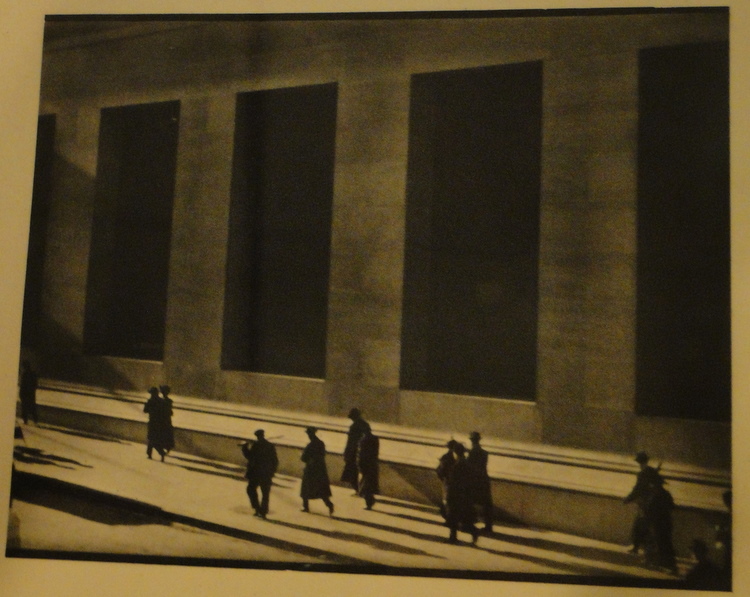
Wall Street (1916) photo by Paul Strand (1890-1976) Metropolitan Museum of Art, New York

Commerce has been the purpose of New York since its founding a mere 400 years ago. Because of its vast wealth, the world has settled within the city. In some cases pieces of the world have been purchased to reside in New York – from Egyptian temples to Chicago staircases. The Metropolitan Museum of Art and the Tenement Museum bookcase the spectrum of forces that shape this world metropolis.

The MET - "Grand Central Station" of the art world

The MET was co-founded in 1870 by four men whose backgrounds were as varied as the city. John Taylor Johnston, from a prominent New York family, made a fortune in railroads, was an avid art collector and fulfilled a life-long dream in creating the MET. Eastman Johnston was an acclaimed artist from well-connected New England stock. George Palmer Putnam, founder of G. P. Putnam’s Sons, was a leading publisher of art books. All three men were intellectually curious and well-traveled.

from the Luigi Palma di Cesnola collection of ancient art

Yet I personally find it fascinating that an Italian military officer, immigrant, American Civil War hero and diplomat, General Luigi Palma di Cesnola, served as the Museum’s first director (1879-1904). Not only had General di Cesnola a noted military career both in Europe and America, but as a “gentleman archeologist” – the only type in the 19th century – he had amassed a stunning collection of ancient Mediterranean art and artifacts. His collection became the genesis of the Met, and during his 25 year tenure the MET achieved  international patronage and stature. Like all great art institutions, the Metropolitan Museum of Art is meant to be absorbed in stages through many visits as its collection span the ages.
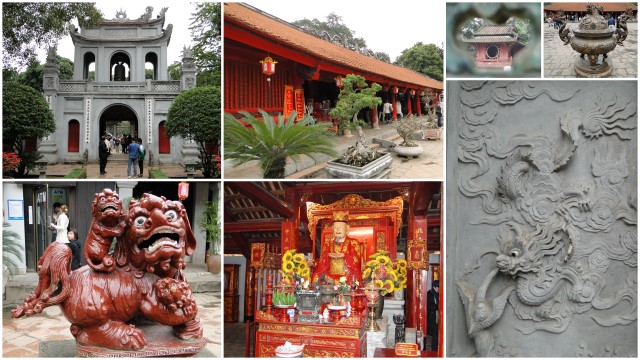
New York City Tenement Museum

A shorter, but no less significant,  spectrum of  life is represented in the unique New York City Tenement Museum on Orchard Street on the Lower East Side. Without the influx of hundreds of thousands of immigrants between 1870 and the 1930’s, the American economic engine would have been severely hampered. Yet these seekers of a better life lived, worked and loved in small, dark rooms in row upon row of brick walk-ups built on narrow streets and created the 20th century.

Well-trained, professional tour guides immerse the visitor in the everyday life of actual tenants who lived in the buildings on Orchard Street that comprise the museum. You’re in their cramped quarters. You see, or rather don’t see, how these families from Eastern Europe, and elsewhere, could accomplish their piece-work in the dim light of a gray winter afternoon, no less work 18 hours a day. From the memories of family members, we understand that many of the dreams of these immigrants were realized by future generations.

Perhaps some in the current post-immigrant generation are now exercising in that health club off Orchard Street above the Duane Reade drug store and living in renovated $1,400/month 3 room “tenement” apartments now renting on the Lower East Side!

The ancestors certainly didn’t have lunch at Giant (stay tuned).


Staircase from Chicago Stock Exchange Building, 1893, Louis Sullivan, architect (now part of the MET)

Pennsylvania Christmas: 2 Eras

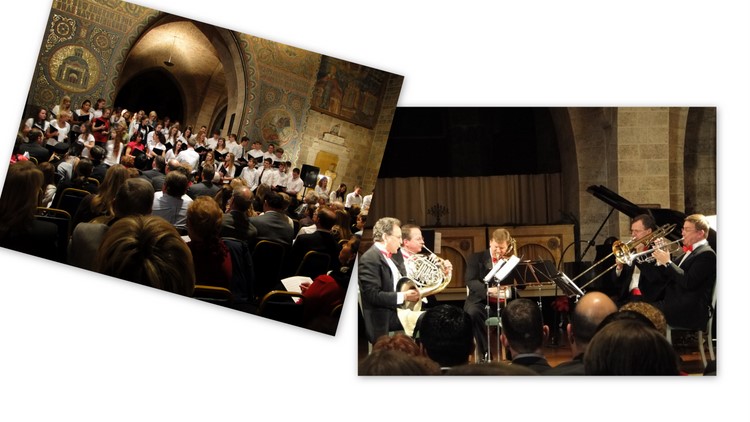
In 1937, while occupying the almost finished mansion, Raymond and Mildred opened Glencairn to the community for the first annual Christmas concert. Enlisting friends from the Philadelphia Orchestra, the Academy and Cathedral choirs, the Glencairn Sing continues to this day. Set in the Great Hall, which  seats 300, there are few venues more impressive in which to hear a concert. Leopold Stokowski, who played many concerts at Glencairn, praised the acoustics of the Great Hall. The Glencairn collection of nativity crèche is on display during the Christmas season and spans the centuries from early Medieval to the 20th century.

Glencairn
Glencairn “Castle”

Driving on Huntingdon Pike, just north of Philadelphia in Montgomery County, only the most jaded driver would not be impressed when Glencairn comes into view. The family home (1930s-1980s) of Raymond and Mildred Pitcairn, their nine children and 50 servants, Glencairn was intended to be more than just an ostentatious display of limitless wealth. Designed by Raymond Pitcairn in the Romanesque style of an early European medieval castle, Glencairn was to incorporate, display and bridge the historical continuum in art and design from the ancient world through the Renaissance.

Cairnwood

John Pitcairn, Raymond’s father and founder of PPG Industries,  started the  acquisition of a vast collection of ancient art in the late 19th century as part of his philanthropic support for the Academy of the New Church. John had constructed his own mansion, Cairnwood, in the early 1890’s, but of greater significance was his funding of the Bryn Athyn Cathedral.

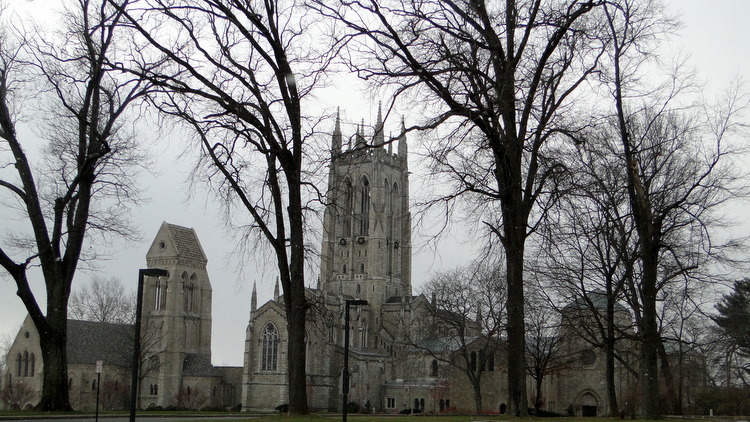
Bryn Athyn Cathedral

Everything in Bryn Athyn is more than it seems. John Pitcairn and other devoted believers in the teachings of Emanuel Swedenborg  purchased the land that would become the Borough of Bryn Athyn  in the Philadelphia’s suburban Montgomery County as  an enclave for The New Church. With John Pitcairn’s vast wealth the Academy of the New Church (kindergarten through college) was established and in 1913 a unique building project was undertaken.

John’s eldest son, Raymond Pictairn , had not only become fascinated with Byzantine and early medieval art but in the medieval way of life, especially the interaction between the patron of a great project and the artisans that built and crafted the structure. Collaborating with his father and the architects, Raymond oversaw not only the construction of the Cathedral from 1913 to 1928, but the creation of an entire medieval artisan village on the grounds of the estate.

Hundreds of European and American crafts people worked and lived in the village from 1913 until 1939. Craft shops were constructed for making authentic tools necessary to create every item. Everything from stone cutting to stained glass was done on site.  From a design concept, the Cathedral structure has evolved from Romanesque through early Gothic.

the Great Hall at Glencairn

1928 marks the dedication of the Cathedral – although work continues in perpetuity according to the Pitcairn trust – and the beginning of construction on Glencairn. The story goes that Raymond was unhappy that the cathedral project was concluding so he decided to continue the process, and the life of the artisan village, by constructing his own castle. Glencairn would rise nine stories, and the 42,000 square foot palace would incorporate within its interior some of the greatest treasures of the ancient and medieval world while reviving such crafts as exquisite Byzantine mosaics. It would take eleven years to complete – 1928-1939.

the Glencairn Sing: Christmas 2010 – Choir of the Academy of the New Church, brass horn quintet

Glencairn, Cairnwood, and the vast art collection, were bequeathed by Mildred Pitcairn to the New Church in the early 1980’s. Glencairn today is a stunning house museum professionally administered. Among its collection are rare Southwest Native art and artifacts. Cairnwood hosts special events, but the Cathedral and the beautiful park grounds are both accessible to the public.

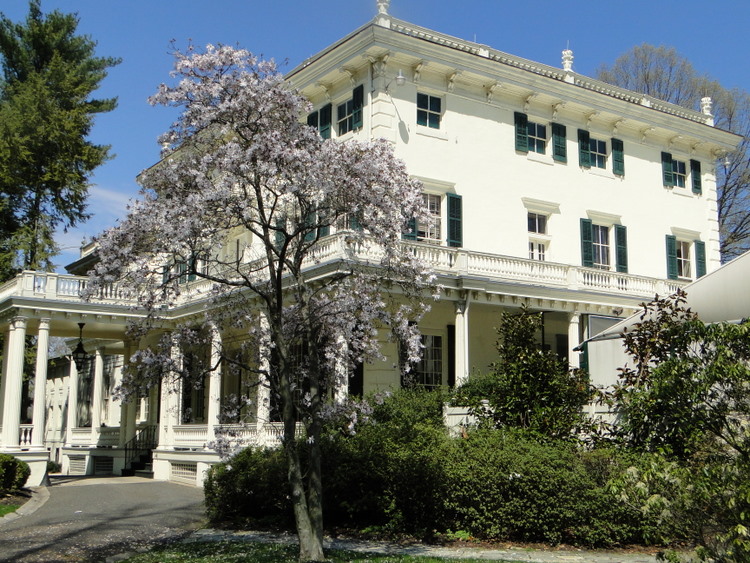
Glen Foerd (on the Delaware River in Torresdale, Philadelphia, Pennsylvania)
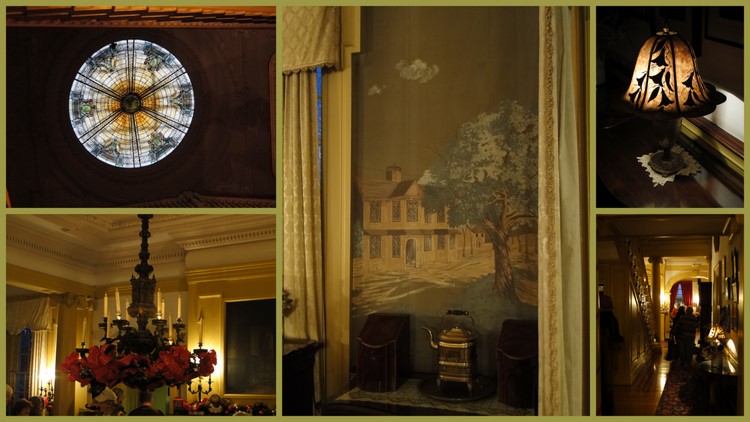
interior details of Glen Foerd

If the Pitcairn’s represent the ultimate in what great wealth can devise, the gracious Delaware River mansion of Glen Foerd tells the story of Philadelphia’s 19th century Victorian merchant families. Built when the Torresdale area of Philadelphia was a bucolic enclave along the Delaware River, Glen Foerd was home to three merchant and manufacturing families.
Charles Macalester, son of a wealthy Scots merchant, built the mansion in 1850. Charles, a staunch Presbyterian and philanthropist, founded the acclaimed Macalester College in Minnesota and Presbyterian Hospital in Philadelphia, now Penn Presbyterian Medical Center. Since 1975, Glen Foerd  has been owned by a non-profit conservation corporation. The Delaware River mansions were the ultimate Philadelphia status symbol from the late 18th through the late 19th centuries. Often weekend and summer homes, they afforded a refuge from the hot, humid and disease ridden summers of Philadelphia streets. It was not uncommon for residents to travel by boat to each others’ estates.

Christmas decorations at Glen Foerd

Christmas transcends history which makes viewing, and discovering, the holiday through the “eyes” of Philadelphia’s historic houses all the more interesting.

Save

Save

Save

Christmas in Penn’s Colony

A Christmas menu 1685

 “A Bill of Fare for Christmas Day, and how to set the Meat in Order.: Oysters. 1. A collar of brawn. 2. Stewed Broth of Mutton marrow bones. 3. A grand Sallet. 4. A pottage of caponets. 5. A breast of veal in stoffado. 6. A boil’d partridge. 7. A chine of beef, or surloin roast. 8. Minced pies. 9. A Jegote of mutton with anchove sauce. 10. A made dish of sweet-bread. 11. A swan roast. 12. A pasty of venison. 13. A kid with a pudding in his belly. 14. A steak pie. 15. A hanch of venison roasted. 16. A turkey roast and stuck with cloves. 17. A made dish of chickens in puff paste. 18. Two bran geese roasted, one larded. 19. Two large capons, one larded. 20. A Custard.

The second course for the same Mess. Oranges and Lemons. 1. A Young lamb or kid. 2. Two couple of rabbits, two larded. 3. A pig souc’t with tongues. 4. Three ducks, one larded. 5. Three pheasants, 1 larded. 6. A Swan Pye. 7. Three brace of partridge, three larded. 8. Made dish in puff paste. 9. Bolonia sausages, and anChoves, mushrooms, and Cavieate, and pickled oysters in a dish. 10. Six teels, three larded. 11. A Gammon of Westphalia Bacon. 12. Ten plovers, five larded. 13. A quince Pye, or warden pye. 14. Six woodcocks, 3 larded. 15. A standing Tart in puff-paste, preserved fruits, Pippins &c. 16. A dish of Larks. 17. Six dried neats tongues. 18. Sturgeon. 19. Powdered Geese. Jellies.”
The Accomplisht Cook, Robert May, facsimile 1685 edition [Prospect Books:Devon] 2000 (pages unnumbered)

In the later 1700’s George Washington would have finished his dinner at Mount Vernon with his own recipe for eggnog:

  1 quart of cream, 1 quart of milk, 12 eggs, some sugar,  2 cups brandy, 1 cup rye whiskey, 1/2 cup rum, 1/2 cup  sherry.

And we thought all our founding fathers were Puritans?  


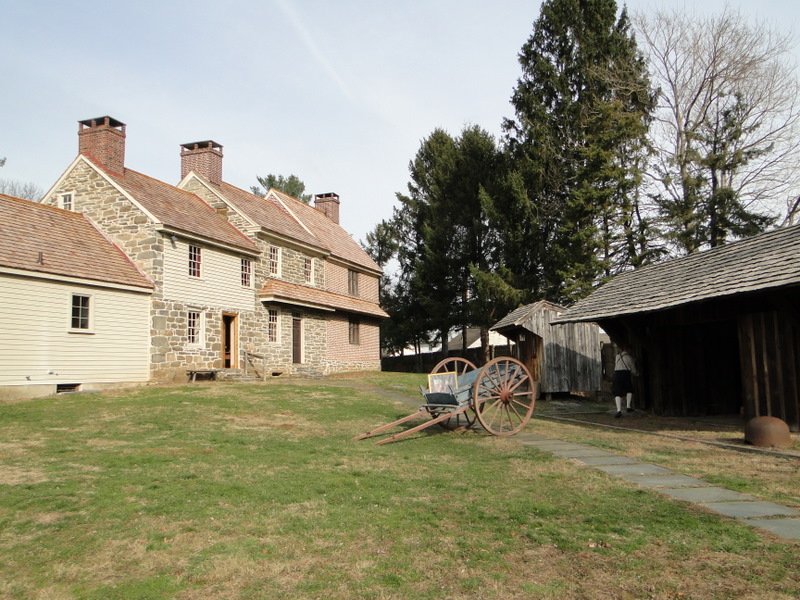
Thomas Massey House (1696 brick section)

Anglican and Catholic Southerners did celebrate Christmas with considerable feasting, unlike the Puritan, Congregationalist, Quaker, and Mennonite Northern colonists but both traditions blended in the keystone colony of Pennsylvania. The prior history of the Delaware Valley and William Penn’s inclusive policies created an ethnic and religious mix not found in the other twelve colonies. Swedes, Germans, French Huguenots, Welsh among others settled and celebrated their traditions next to their simple Quaker neighbors. The prosperity of Pennsylvania led even  Quaker families to decorate their homes with greens and dine on the bounty of the colonies. Thirty and forty course dinners in wealthy Philadelphia homes were not uncommon by the 1770’s. 

Massey House interior - (Top) view of stable & blacksmith shop, 17th century floor boards, chaise lounge, (Bottom) faux painted moulding on stair case, 18th century Swedish wick trimmer

Thomas Massey, a prosperous self-made Quaker farmer with over 300 acres,would have celebrated Christmas in a restrained manner in these early years (17th century) of the colony. At the recent (11 December 2010) Christmas reception at the Thomas Massey House – a Pennsylvania Historic Site –   the variety of holiday traditions in colonial Pennsylvania was celebrated – minus the thirty course dinner. 


.
original 1696 sitting room

 Quaker simplicity is evident in the sparsely furnished and decorated sitting room. Dried fruits and gingerbread were both seasonal luxuries and celebratory foods.

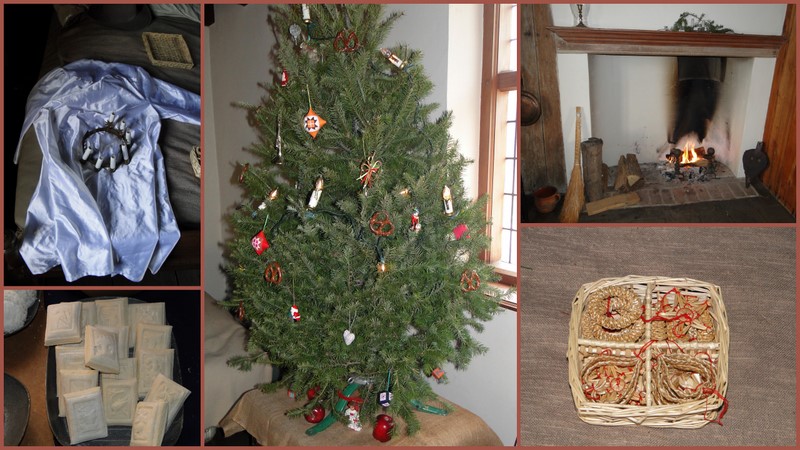
Swedish settlement in the Delaware Valley preceded William Penn, and they remained an important part of the colony.  They brought over their pre-Christmas festival of St. Lucia (above left) its saffron bun (Lussekatter) and simple woven decorations (lower right). Although there is no evidence that the Christmas tree was used by Germans in the colonial period, they did decorate with boughs of greens, made pretzels (praying hands – see center picture) and a number of cookies that have become American traditions – Lebkuchen, PfeffernusseAnisplatzchen. 

18th century reflective hearth rotisserie with pork roast
Massey House blacksmith making a 4" iron nail
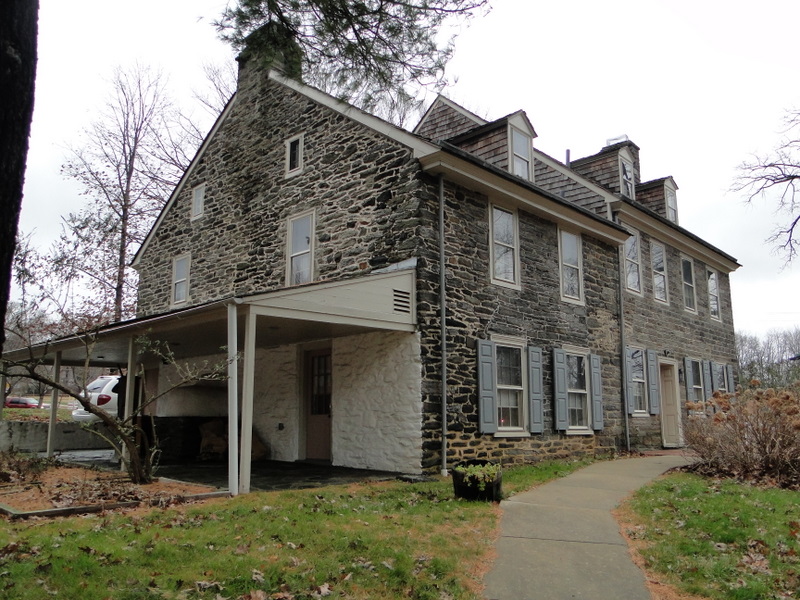
Wall House, 1682

On an original William Penn land grant, Richard Wall began construction on his house in 1682. Like all surviving houses from this era, additions were numerous. Even though both the Wall and Massey houses remained private residences for over 250 years, major structural renovations seem to have ceased  by the early 19th century. As a house museum, the Cheltenham Historical Society interprets the interior of the Wall House to reflect the changing taste in furnishings and fashion during 250 years as a home and the events that shaped the lives of the residence.

The parlor is Victorian with early crocheted decorations (center). A room devoted to World War II memories displays a field hospital “tree” decorated with blue and white ribbon, paper and painted tongue depressors (left). The entrance tree is aglow with 19th and early 20th century German glass ornaments (right).

(top) water pump, hearth, 2-storey spring house, (bottom) mid-19th century soup tureen, late 19th century bread mixer

The Wall House kitchen contains an extraordinary collection of 18th and 19th century tools and well as a well restored hearth. In honor of the season, the table was set for Christmas dinner in true 18th century fashion – all the dishes on the table at once.

An 18th century Quaker Christmas dinner at Wall House

Having served as a Quaker Meeting House in its very early years,  a stop on the Underground Railroad, and the home center of the Shoemaker-Bosler Mill complex until the 1920’s,  the Wall House reflects the human stories that are history and displays with great care the objects of everyday life.

(left) one of many 19th century "eggbeater" drills, (center/top right) late 18th century tree trunk sewer pipe, (bottom right) early 19th century shovels made by the nearby Rowland Shovel Factory

Today, toys are always Christmas, although not in Colonial times. Among the many everyday treasures at the Wall House is a stunning 5 foot tall, 9 room doll house. Constructed in 1915, furnishings were painstakingly assembled over the next forty years.

the Cynthia Langsdorf Wilkinson doll house

 Nearly everything within the house was hand-made or adapted. Miniature electrified chandeliers glow, a sub-miniature electric train operates and even an attic is appropriately cluttered including a discarded toilet. It’s awesome whimsy – just the spirit Christmas is supposed to generate. The Wall and Massey Houses prove that in Pennsylvania we have been enjoying that spirit for centuries.